Friday, November 17, 2006

It's Only Talk (2005)


It's Only Talk (Ryuichi Hiroki, 2005)
Japanese Title: Yawarakai seikatsu

A pervading and depressing sense of temporariness envelopes the psyche of the main character of Ryuichi Hiroki's It's Only Talk. Played with heartbreaking sincerity by Shinobu Terajima (who displayed an engrossing vulnerability in her debut film as the writer in director Hiroki's breakthrough film Vibrator (2003) --- although Hiroki has been making soft core pornographic films before), Yuko is a 35 year old manic-depressive. She keeps a website where she posts pictures of choice places and events she has visited --- one of the places we see is a playground made of rubber tires; the playground's centerpiece is a tall and handsome replica of Godzilla made entirely of truck tires. Her first interaction in the film is with K (Tomorowo Taguchi), a pervert she supposedly met in the net. He takes her to Kamada (he explains that he prefers taking his mistresses to out-of-town excursions); She loves the place and decides to stay there, living off the insurance money she has gathered from her parents' death.

In Kamada, she re-unites with a former classmate Honma (Shinsuke Matsuoka), now an active politician. Honma suffers from erectile dysfunction; he claims that an antidote to his embarrassing situation is to bed a girl he's in love with --- it turns out that manic-depressive Yuko isn't the panacea to his woes, also to her dissatisfaction. Through her website, she eye-balls with fellow manic-depressive Noboru (Satoshi Tsumabuki), a young yakuza, married and with child. She shows him the rubber tire playground; we learn that Noboru harbors a childhood fondness of the elusive site and repays Yuko with friendship for re-uniting him with his past. The fourth man in Yuko's life (or at least as shown in the film) is her cousin Shoichi (Etsushi Toyokawa). Shoichi moves to Kamada to be with his mistress, after separating from his wife and child. The mistress dumps him and he is forced to move into Yuko's apartment.

There's an engrossing dynamism to Hiroki's film. Midway through the feature, Yuko suddenly wakes up, switching from her jolly nature to the depressive one as her psychological disease promises. Instead of leaving the point of view to the near immobile Yuko, Hiroki shifts interests to Shoichi, giving us a grasp as to the psyche of the men affected by Yuko and a maintained cinematic tempo. It seems (and Hiroki, in the Q&A after the film screening confirms; Hiroki wanted a happy ending to his film, injecting a memorable sound bit to the penultimate scene in the bath house) that the cinematic goal is optimistic (with bright colors and movement), probably to lessen the impact of the fact that the film is ultimately a downer.

Yuko is used to the temporary nature of her life. She's manic one day, and wakes up morose the next. Her life is a series of depressing events --- her parents died (she claims from a famous earthquake), her boyfriend perished (from the subway gas attacks), a dear friend died (from the 9/11 terrorist attack), during the pendency of the film, another important figure in her life would meet the same fate. The same way, the men of her life carry the same fate. Their lives are as volatile as their temporary encounters with Yuko. K's life, like his name, is blanketed with anonymity; most probably to protect his non-pervert facade and his family. Honma has yet to meet the woman to cure him. Noboru's profession keeps his life a mercurial matter. Shoichi's fickle-mindedness in relationships force him back to Yuko whom he previously had an intimate relationship with.

Like the effects of her bipolar nature, like the men whom she can never be with, like the interesting places that dot the Kamada neighborhood, it seems to be the fate of poor Yuko that her life be denied of comforting permanence. Her only escape is to take photographs (of the places she has visited, among other things) with her digital camera, to provide a semblance of permanence in life's grueling surprises.

Thursday, November 16, 2006

Heremias (2006)


Heremias (Lav Diaz, 2006)

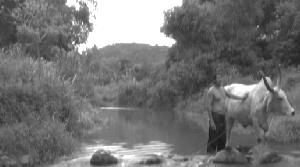
Ox-driven carts full of native crafts line up at a concrete road. We painfully await each and every one of the caravans to finish their diagonal descent and disappear from Lav Diaz's immobile frame. Ten minutes has passed by, then another fifteen of the same scene of nomadic crafts merchants travelling from one end of the screen to another. The amount of time forces you to observe the surroundings of the traveling group: You delight at the clouds who also move slowly from right to left, the wild grass swaying in relaxed abandon, the majestic view from atop the hill. Before you know it, you share with these crafts merchants the pristine value of time: since you have so much of it. At night, you listen to their songs over a bonfire, their tales of girlfriends throwing away their vows of love to leave with a Japanese man, their worries that their little ones might catch a fever. Diaz pleads you to take a few hours to immerse yourself with their lifestyle; it's not exactly a harsh request as Diaz rewards you with beautiful scenery --- the still scenes may be likened to black and white post cards of rural life in the Philippines.

Titular character Heremias (Ronnie Lazaro) suddenly wants to separate from the group. He actually has no reasons why; the fact that a super typhoon is hitting the country within a few days makes the decision more brash, irrational and dangerous. Alone, he wanders about aimlessly. At one junction. he again makes an irrational decision of opting for the dirt road rather than the safe and predictable cement road. His ox seems wary of Heremias' choice of road, and needs to be pulled to the dirt road instead of driven comfortably. The typhoon arrives --- we actually feel its power (the non-stop downpour of rain, the frequent thunders, the deafening wail of the wind). Heremias and his ox take shelter at an abandoned building by the dirt road. The next morning, he finds his cart and his ox gone.

Lav Diaz's nine-hour masterpiece Heremias is only the first part of two films. If anything, it's one lengthy prelude to the main narrative. The main character is mostly an aimless character. It's quite difficult to grasp anything from the character as his interactions are mostly bare and pointless. Midway the film, we learn more about the film's geographic setting than the character. We learn that Barrio Hapon (the area wherein Heremias loses his ox and cart) was named so because it became a haven for Japanese stragglers after the Pacific War. Heremias' night companions detail how a certain Oshima was executed by military officials for being a vicious soldier during the Japanese occupation; the other companion debate on whether Oshima was really kindhearted or evil. On a bus stopover, the bus driver details to Heremias how a town called Prinsesa Bayawak (Princess Lizard) got its name; that a couple's daughter was taken away and was never to be found again, and in her stead, a lizard who can tell whether a visitor is of good or bad nature arrives.

When Heremias re-unites with his merchant companions and tell them how his wares got stolen, and how inutile and corrupt the local policeman was, one of his companions begin to tell another tale of how a woman was able to catch her husband's murderer by returning to the crime scene. Thus, Heremias again separates from his group to return to the abandoned house, hiding himself efficiently in the forests to begin a lengthy observation of passers-by. The observation culminates when a gang of teenagers arrive and start popping drugs, drinking, vandalizing, and throwing profanities. When the effects of the alcohol, the drugs, and the hype have died, they start plotting to rape a girl. All this, Heremias has witnessed, and like the biblical prophet of the same name, started to go about town telling first, the police, then the priest, of what is about to happen. His warnings are unheeded mostly because the supposed perpetrators are relatives of a high-ranking and dangerous government official. His last resort was God, and pleads to save the girl in return for his sacrifice to walk and fast for forty days.

It's quite hard to empathize with Heremias' situation. Diaz's visuals doesn't allow for close-ups, Ronnie Lazaro can only do much with bodily gestures and moans of supposed anguish. Yet with all the stylized distance Diaz reserves for his beloved character, there is this one point in the film that an unadulterated emotion aches with so much power, that it surpasses almost everything. Right after being driven away for merely wanting to save the girl, right after being punished physically and psychologically for his new-found knowledge, he struggles painfully within the darkly-lit and rain-drenched forest. Diaz makes you suffer with him; the same way he allowed you to feel how it is to die painfully in Ebolusyon ng Isang Pamilyang Pilipino (Evolution of a Filipino Family, 2004). Amidst the blanketing greys (this is most probably a technical effect, rather than an artistic one --- Diaz never makes use of artificial lighting), we hear Heremias pleas to God (who is mostly absent from the film save for a few acknowledgments, mostly gathered from the Philippines being a traditional Catholic nation) and an occasional glance at his desperate face gathering bits of light making it distinguishable to the careful eye. At that moment in the film, Heremias finally bares his soul to us --- the effect is powerful and tremendous; it's almost akin to Faust dealing with the devil, but in this case, it's the exact opposite, Heremias transforms into a selfless individual and makes a contract with God.

A question arises: Is Heremias' sacrifice a useless one? Is there a God who would make true his end of the bargain? Diaz never really answers the question, or if he will, we'd have to wait another year (Diaz is currently shooting the second part of the film), and a few more hours of his meditative filmmaking, to know. In my opinion, despite the obvious absence of a God in the film, there is indeed a predestined design to have Heremias land in that particular situation. Heremias' sudden anxiety and discomfort with his life's transient nature, his decision against all notions of logic to separate from his group, the strong typhoons, those shared tales that discuss the distinguishable and the indistinguishable natures of goodness and evil, the tale of the woman who discovers her husband's murderer, Heremias' role as the world's solitary observer: all these were carefully placed to land the reactionary character in that moment wherein he would have to bet his life to ease that fate-driven burden of guilt knowing that a girl is about to be raped and killed. By a mile, this is probably this year's best film.

Sunday, November 12, 2006

Pat Garrett and Billy the Kid (1973)


Pat Garrett and Billy the Kid (Sam Peckinpah, 1973)

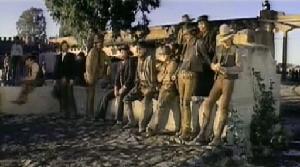
Bob Dylan's music accompanies the first killing in Pat Garrett and Billy the Kid. Pat Garrett (James Coburn) rides across New Mexico with some of his comrades. He is complaining with his weathered baritone about how one of his comrades is grazing sheep in his land. That comrade replies that the lease agreement they had involves his land and not Pat's. Pat scoffs at the law, the same law that he acknowledged when he was elected Sheriff of the land. A few moments after Pat's indignant scoffing, Pat Garrett is shot to death. Director Sam Peckinpah freeze frames the violence, and cross cuts the assassination with a flashback to a few decades ago wherein Billy the Kid (Kris Kristofferson) and his band are shooting chicken's heads. Pat Garrett and Billy the Kid is bookended with two deaths. Peckinpah is keen on reminding us that his film is an ode to a death, of Pat Garrett, of his pal-turned-nemesis Billy the Kid, and finally, of the Old West.

A younger Pat Garrett disrupts Billy the Kid's fun and invites him inside the saloon. After a few glasses of whiskey, Pat tells Billy to leave the area in five days, or he will be forced to chase him out. Pat and Billy were former friends. However, Pat has accepted the post of sheriff and with it the mission to end Billy's outlaw career. Now, they are formidable enemies, with Pat and his assured confidence and with Billy and his youthful wit and clever designs and trickery. Peckinpah lets his audience wade through the duo's mastery: gunfights after gunfights leave several casualties with the two standing alive and surviving.

Amidst the numerous bloody deaths, there is a distinct lyricism to Peckinpah's storytelling which is fascinatingly undaunted by the somewhat flawed narrative flow. It helps that Dylan lends his musicality to the film (he is also casted as the mysterious "Alias," one of Billy the Kid's erstwhile companions) which flavors the rustic scenery of New Mexico with a gorgeously apt romanticism. It also helps that Kristofferson (who is far older than the real Billy the Kid who died at 21) possesses a cool charm which is comparable to Coburn's sun-drenched and slightly exhausted macho offerings. Peckinpah's two anti-heroes are so iconic that his shifts from one storyline to another gets muddled and confusing. Peckinpah adds a host of other characters to keep Pat's hunt more interesting and the deaths and tortures numerous.

Pat Garrett and Billy the Kid is Peckinpah's personal ode to the death of the Old West, as encapsulated by the outlaw Billy the Kid. It seems that the sheriff Pat Garrett ultimately belongs to that era of free spirits unherded by commercialism-established laws and regulations, that when Pat Garrett was ultimately forced to shoot Billy the Kid, an appropriate response was to shoot his reflection in the mirror too: it's a mighty metaphor of Pat Garrett's death as compared to the uneventful portrayal of his assassination during the beginning and the end of the film. When Billy the Kid died and the rule of law reigned triumphant in the Frontier, personalities such as the Kid, Garrett, and their ragtag band of outlaws and rabid law enforcers have been stripped of their myths and accompanying lyricism. Death is no longer a legacy, but a mere expression of crime and punishment.

*****
This post is my contribution to This Savage Art: Sam Peckinpah Blog-A-Thon.

Saturday, November 11, 2006

Manoro (2006)


Manoro (Brillante Mendoza, 2006)
English Title: The Teacher

Against the stylized eroticism of Masahista (The Masseur, 2005), and the glossy artfulness of Kaleldo (Summer Heat, 2006), Brillante Mendoza's third feature Manoro (The Teacher) feels out of place. Shot in cinema verite style, opening with the confused madness of an elementary school graduation where mothers try to silence their crying babies as little children march towards the principal to get their diplomas, Manoro looks and feels definitively all over the place. The paradox of both cinematic restraint and excesses that dominated Mendoza's last two features is absent from this delightfully heartfelt piece, something I hardly expected from a director who pushes artistic style over human emotions.

The opening titles summarize the premise of the plot: The mountain-dwelling Aetas have been forced to settle in the lowlands by the sudden eruption of Mt. Pinatubo. With their settlements being closer to the government-funded schools of the Kapampangan townships, the Aeta children now have the opportunity to study. Jonalyn, one of the elementary school graduates of the ceremony depicted in the confused introduction and an Aeta, seeks to teach her elders to read and write a day before the National Elections. With Jonalyn's effort, the Aetas, for the very first time, have participated in the democratic process that has existed in the Philippines since the early part of the 20th century.

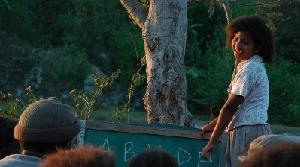
From the graduation, Jonalyn proceeds to the Aeta settlement to begin her mission of literacy. She brings sample ballots to aid her task. However, upon reaching the settlement, she notices that her grandfather is missing. Along with her father, she treks towards the forest to look for her grandfather. Half of the film details the father and the daughter's hike up the mountain. It gives Mendoza an opportunity to visualize the untouched natural vistas of the Aeta settlement. Up the mountain, Jonalyn begins to review some of the elders how to write the names of the presidential candidates (GMA - FPJ - Lacson) by showing the older Aetas the geometric designs of the alphabet rather than actually educating her tribes members the rigors of reading and writing. Jonalyn's efforts are certainly skin-deep; her purpose is only to train the Aetas for the election day tomorrow, rather than the long term benefits of actual literacy. Nevertheless, the story is indeed heroic, something that, if handled by a more opportunistic director, might turn out to be a tearjerking tale of exaggerated realism. In Mendoza's hand, with the help of Ralston Jover's appropriately detached screenplay, the heroic tale transforms into an examination of the minority group's psyche and their sad but accepted place in national politics.

The fact that most of the film concentrates on Jonalyn and her father's hike, and on Jonalyn's persistent plea to the Aetas to vote the next day (only a few got to vote as most of the Aetas weren't registered voters; and probably only a few of those who actually voted have made valid ballots --- one of the Aeta grandmothers voted GMA-FPJ for president not knowing that GMA and FPJ are two different candidates; the consequences of Jonalyn's shallow re-educating of the Aetas), and the side plot of Jonalyn's missing grandfather, instead of the more conventional tale of the struggle of education against the Aeta's insistent rejection convinces me that Mendoza merely took the real story as a backdrop for his more ambitious designs. It certainly works. There's a feel of ancient tradition whenever the father-daughter tandem walks past the beautiful landscapes of the Pampanga wilderness. At certain points, Mendoza allows us to listen to the Aeta songs which are absolutely delightful; both in their melodic simplicity and the fact that the lyrics depict a sense of centuries-old aching and religion. More painful is when the father relies on his daughter's literacy to obtain a job from a passing Korean (he practices writing his name when his daughter sleeps during the night); Mendoza and Jover seems to acknowledge that the traditions of wilderness survival, of ancient paganist religion, and of all those songs equating the Aetas with the rest of humanity (the Aetas have been discriminated against as being the less civilized Filipinos) aren't enough to keep the minority group from surviving against the 21st century reliance on Western-imposed literacy; that the election the next day is an acknowledged step for the Aetas to pass to modernity.

Probably the most touching moment of the film is when Jonalyn waits for her grandfather outside the polling station. Her grandfather arrives carrying his traditional bows and arrows and a dead wild boar atop his strong shoulders. The grandfather doesn't vote but merely fetches Jonalyn, her eyes tell us a sense of failure on her part. The grandfather and Jonalyn return to their settlement to celebrate the day. The tribe feasts on the wild boar and starts to dance. One of the Aetas asks the grandfather why he didn't vote. He replies with the same pride that has gotten him standing strong against decades of discrimination and minority treatment, "that doesn't make me less of a man."

Marie Antoinette (2006)


Marie Antoinette (Sofia Coppola, 2006)

Sofia Coppola's anachronistic portrait of one of history's most notorious queens, for me, feels like a repeat of the themes the director has explored in Lost in Translation (2003). The film begins with Marie Antoinette (Kirsten Dunst) removed from her native Austria to be wed to the prince, and later the king, Louis XIV of France (Jason Schwartzmann). A bored soon-to-be queen is put into focus; inside her carriage carried amidst the vast countryside of Austria only to be stopped in the French-Austrian border where a ceremony awaits her. She weeps as she forgoes her Austrian maids, Austrian dresses, and her Austrian dog --- it's an immature gesture at first, but as minutes pass by and we see Marie Antoinette breeze through a forced home she can't quite claim as her own, we distinguish that the comedic farewell to her Austrian roots boasts a deeper emotional depth rather than pangs of mere premature removal.

Like Bill Murray's character in Lost in Translation who breaks foreign culture-imposed boredom by spending a romantic interlude with another expatriate, Marie Antoinette struggles through the strange customs of the French monarchy. The repetitive cycle of daily procedures and the seeming lack of real human warmth from the denizens of the Versailles palace forces the foreign queen to refashion the uptight customs; she claps after a beautiful opera performance in which the rest of the audience follow. Against the coldness of her royal husband, she finds a passing romantic relationship with a dashing soldier --- yet in the end, remains loyal to her once impotent beau.

Coppola, for certain, isn't interested in history. Other than the richness of the Versailles setting, and the grandiosity of the costumes and sets, the film feels less attached to its narrative than most biopics or historical dramas. Instead of dwelling in events, Coppola turns a sympathetic eye to the notorious queen; spending more time in portraying her youth and humanity rather than historical accuracy. Much has been said of the infamous soundtrack of this period piece; I didn't think much of the soundtrack as modern music never felt out of place in the story of a queen whom Coppola figured to be a modern-day soul garbed in corsettes and gowns. There's a bit overdrowning of the anachronisms as when the young queen delights in modern-day shopping and having a restyling of the hairdo put into action by an annoying "I Want Candy" song. Coppola's experiment seems to turn against her when the threat of the French Revolution starts to figure in the plot. It seems that when Coppola is faced with historical facts, her cinematic re-characterization of the historical figure fails.

Coppola is more ambitious here than in Lost in Translation. Coppola here creates a historical fantasy as against the more intimate modern-day romance of her last feature. She doesn't seek to revise what history has already told us. She actually ends the film abruptly; disallowing her audience to know the young queen's fate. It feels like Coppola has fell in love with her reinvented queen that the real historical figure's tragic end cannot properly fit into the filmmaker's vision. The colors, the cakes and pastries, the shoes and dresses, are for certain, trite and shallow --- but what else is there to evoke from a queen who has nothing else to do but to parade, be pretty and be young? In Coppola's mind, the queen is nothing more than a victim of circumstance; the same way Louis XIV has been forced to bloom faster than the rest when his father dies (he prays to God since he's too young to reign, his king-ship forces him to finally sleep with the young queen to provide an heir). In Marie Antoinette, Coppola removes the personalities from the stories and the history that turned them into the figures that are revered or detested today. Although the feature might not entirely be successful, Marie Antoinette sheds a humanity and an accompanying psychology (no matter how shallow and infantile) to the last queen of France by familiarizing (even to the extreme of bluntly entertaining) modern audiences to the unattractive annals of history.

Thursday, November 09, 2006

Flags of Our Fathers (2006)


Flags of Our Fathers (Clint Eastwood, 2006)

Joe Rosenthal's photograph of six soldiers struggling to raise an American flag atop the highest peak of Iwo Jima has become an indelible image of American heroism. The photograph has adorned stamps, paintings, sculptures, and has become the point of exploration for Clint Eastwood in his latest feature Flags of Our Fathers. Adapted from the non-fiction book written by James Bradley (son of one of the trio heroes of Iwo Jima), Flags of Our Fathers is an engaging examination of heroism within and without the battlefields of the Pacific War. As with almost all Eastwood films, the treatment feels heavy-handed and the result, somewhat depressing. Yet, the magnitude of Eastwood's vision, his astounding tinkering with 21st century war filmmaking (complete with CGI vistas of oceans populated with ships and tanks) keeps the pic from drowning in its unsavory sentimentalism.

Eastwood's film is boggled by a non-straightforward narrative. He juggles a narrative that opens with a present-day interview handled by James Bradley (played by Tom McCarthy), which gives way to the happenings during the Iwo Jima heroes' campaigning for war bonds. Flashbacks of the actual battles intersect sequences. The result is somewhat confusing, especially during the opening sequences wherein Eastwood barrages his audience's senses with a number of characters typical to the war genre. It picks up midway when Eastwood has started to drape the pic with his typical melodrama and histrionics; somewhat washed tastefully by a healthy dose of Saving Private Ryan-type of war pic realism.

Flags of Our Fathers is probably Eastwood's visually richest film. Tom Stern, who was also director of photography of Eastwood's last two films, washes out the color from Eastwood's canvas. At times, the film looks black and white --- which is helpful since it mutes the violent moments of the film; giving a richness or depth to the warfare rather than a mere romp at excessive morbidity. The desaturated photography also aids Eastwood's period scenes.

I do have problems with the film, some very serious ones. The pic is grounded on Doc Bradley (Ryan Philippe), who when compared to his companions, is a bit of a downer. Philippe doesn't help much; his baby-face features do not add interest on the character whose temperate and goody-goody nature blurs Eastwood's discussions on heroism and adds questionability to the plausibility of the feature. More interesting are Bradley's companions. Rene Gagnon (Jesse Bradford) is the lime-light hogging pretender; his exact opposite is Native American Ira Hayes (Adam Beach) who rejects the call of sensationalism as he sees himself unfit for heroic status. Eastwood overhandles Hayes' histrionics, and turns Gagnon and his girlfriend propaganda caricatures; Bradley remains to be the uninteresting middle ground who, when not fighting it out or rescuing injured soldiers, is quite a bore.

The film becomes preachy as it reaches its finale. Screenwriters Paul Haggis and William Broyles, Jr. take center stage with a wordy and rather unflattering conclusion to Eastwood's effort (especially the brilliantly staged warfare scenes). The ending basically encapsulates the entire Iwo Jima experience, the rabid propaganda-gathering, Hayes' subsequent downfall with alcoholism, Gagnon's fading away to obscurity, into a Hallmark card-type sugary concoction. Eastwood further adds schmaltz with his minimalist musical score.

Tuesday, November 07, 2006

Numbalikdiwa (2006)


Numbalikdiwa (Bobi Bonifacio, 2006)

Bobi Bonifacio's Numbalikdiwa starts promisingly. A young man goes home with a bag of skewered meat for his dinner, and proceeds to call his mother while munching on his food. Moments later, the door knob to his house alarms him of a possible visitor, who turns out to be a his friend who is inviting him to watch a basketball match. Right after scolding his friend for not knowing how to knock properly and sending him off, a darkened monstrous hand grabs him by the neck.

The narrative proper starts after the introductory sequence. We are introduced to Anton (Ping Medina) who is bothered by his ailing grandmother (Estrella Kuenzller) of a certain ritual ceremony called numbalikdiwa which Anton is supposed to continue practicing. Evidently, Anton seems to be bothered by his grandmother's persistence. The next morning, Anton brings Karissa (Meryll Soriano), his adopted sister and love interest, to their barbecue store where they daily roast skewered meat for their customers, including wealthy couple Carlos (Albert Martinez) and Portia (Maricel Soriano). Karissa is secretly in love with affluent Carlos but is aware that she will be unable to match the beauty, grace, and intelligence of Portia. That night, after a car accident involving Karissa, Anton is forced to perform the numbalikdiwa.

The ritual of numbalikdiwa, according to the film's website is "An ancient, macabre ritual where the dead assumes the body of a living person. Like cannibalism, it involves the ingestion of the deceased’s ground meat and bones as part of the ritual. With the help of the Sasigloho, an ancient tribal deity,the dead assumes the identity of the living and continues to live his/her life accordingly, granting near immortality to the one who practices it." I am unaware of the veracity of such ritual, but it seems the ritual is a product of Bonifacio's very rich imagination. Cannibalism and the assumption of the traits of the eaten is not entirely a unique concept --- Recently, Fruit Chan's Dumplings (2004) makes use of shredded fetus to maintain youthfulness; Hollywood made use of hoodoo rituals to ensure immortality by transferring souls from one body to another in The Skeleton Key (Iain Softley, 2005).

Bonifacio, instead of burdening his first feature with the need to become a commentary or a philosophy or morality lesson, opts to simplify matters by structuring his film as a horror film or a gory episode from Twilight Zone. The film is not as deep as I would have wanted. Bonifacio seems to have trouble furthering his characters above their basic descriptions. For example, Anton's love for Karissa seems to be more of an afterthought, a plot device. Bonifacio opts to pronounce the relationship in little details and gestures, mostly from the point of view of Anton making Karissa's sudden turnaround as the film's point of view in the latter half a bit emotionally muddled and implausible, more like an unexplained and jarring shift in mode rather than a smooth transition from Anton's unrequited love to Karissa's confusion in romantic attraction. The same can be said with regards to Karissa's hidden longing for Carlos. I am quite unsure whether Karissa is in love with Carlos or merely envious of Portia's traits. The vagueness of the relationships may have worked, but in this feature wherein the strength of one's attraction should equal the moral sacrifices of the ritual, I would have opted for black and white relationships that are more fleshed out.

It's understandable that Bonifacio will stumble in his first feature. He is very young and probably very excited that he decides to pump up the horror factor rather than enriching the characters. What amazes me is how technically exceptional the film is considering its meager budget. It is quite a boon that Bonifacio has gathered formidable performances from Maricel Soriano, Albert Martinez, Ping Medina and Meryl Soriano. Bonifacio uses the digital medium with so much ease. He frames his scenes with purpose, edits his scenes judiciously, that the typical criticisms against digital video seems to be absent from this feature. While Bonifacio may have problems giving weight to his characters and their relationships, he is absolutely brilliant in staging horror scenes. The sound editing, the music, prosthetics, the cinematography; everything meshes wonderfully giving an ominous, almost Lynchian flavor to the narrative.

The Notorious Bettie Page (2005)


The Notorious Bettie Page (Mary Harron, 2005)

During Bettie Page's career peak, she has been described as the pin-up queen of the universe. Yet despite the rather crass title she has obtained by posing in several nudist and fetish magazines, the real Bettie Page has remained a virtuous girl; maintaining the upright religiosity of her Southern roots. It's not surprising that a biopic about her would be made. Martin Scorsese originally wanted to make something out of Page's life with Liv Tyler as the famous pin-up model, but that was shelved due to the production of Howard Hughes biopic The Aviator (Martin Scorsese, 2004). Mary Harron subsequently finishes this biopic which I thought was a dull and uninteresting effort, considering that the life of Page is undeniably colorful.

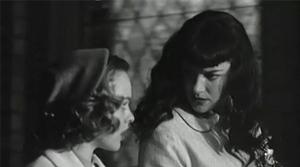
Partly to blame is Harron's aesthetic decision to film majority of the film in black and white with some sequences (mostly those shot in Miami) in color. The flip-flopping from black and white to color is mostly a jarring experience especially when the black and white photography is so beautiful. The initial sequences were shot like a Classic Hollywood pic most probably to emphasize Page's place in pop culture history. Page's career end ushered in the proliferation of smut --- pornography a million times more lewd than Page's reenacted bondage photographs. There's a sense of classiness to the black and white photography, but almost immediately jumbled when Harron decides to film some portions of the film in color. She probably has a reason behind the infrequent switches, but the reason gets lost in style.

Then there's the blunt moral center of the film. Although Bettie Page is assumed to be a devout Christian, Harron seems to be banking on such too much. The film never gets past that angle and is consumed by its own moralistic preaching. It seems that Harron is more interested in the fact that Bettie Page is an uncharacteristic icon because of her differences in profession and belief, rather than the fact that the model is human. The dilemma brewing inside Bettie Page can only be seen in various glimpses --- these glimpses are supplied by Harron whenever she's not busy moralizing and preaching and diving for icons and symbolisms within the story of the model's life.

The Notorious Bettie Page is not entirely a dull experience. Gretchen Mol brings a watchable vitality to Harron's horridly underwritten Bettie Page. Mol's charismatic performance infuses the character the bare humanity it needs to carry on the narrative. As mentioned above, the cinematography is top-notch. The glossy black and white photography supplies the pic with a distinct setting that sufficiently supplants this present era wherein Bettie Page's poses are considered tame. It's actually a nice idea for Harron to use the real footage of one of Bettie Page's films (the film shows a scantily clad Page dancing and wiggling her bottom) as visual aide for the end credits. It's funny how that same film was part of the reason for the model's notoriety and her repeated mentions in the United States senate proceedings against pornography, but is now a part of this film --- a film that fosters a moralistic tone and appropriately ends with Bettie Page preaching verses from the Bible.

Thursday, November 02, 2006

Bona (1980)


Bona (Lino Brocka, 1980)

The titular character (Nora Aunor) of Lino Brocka's film Bona has an irrational devotion for a bit player in action movies, Gardo (Philip Salvador). Brocka and screenwriter Cenen Ramones do not bother to give us details as to how Bona has suddenly worshiped Gardo, except in one instance wherein Bona returns late and her father scolds her. The father tells Bona that she was just given an autographed photograph of the bit player, and she that caused the uncontrollable obsession over him. This lack of background is an arguable point for critique as it turns the character into a masochistic woman whose servitude is obtained for free and is even repayed with cruelty and Gardo's unintentional sadism.

After spending a night tending to an injured Gardo, Bona goes home and incurs her father's wrath. She decides to leave her family for good and live with Gardo, exchanging the comforts of her middle-class household with the slums of Tondo where Gardo resides. Yet the slums is actually paradise compared to the interiors of Gardo's house where Bona is treated literally like a dog. He beds with numerous women expecting the adoring Bona to merely accept that fact. He actually considers Bona's staying with him as the latter's debt of gratitude, despite the unconditional loyalty and service she has given to the immature bit player. Outside, Bona's middle-class roots is appreciated. She tutors her neighbors' children, gets food and provisions under generous credit, and her conditions are benevolently guarded over by a kindhearted Nilo (Nanding Josef).

The plot is merely a series of vignettes of Bona's sacrifices intertwined with scenes of slum-living. When the plot does move forward, Brocka is uncharacteristically controlled and rejects typical melodrama tropes to justify narrative motion. Aunor handles her character with much pathos giving the mysteriously devoted fanatic a believable human face. Salvador is tall and brooding compared to the short-framed Aunor. The couple actually looks quite odd when together. Salvador mestizo looks overshadows Aunor's more Filipino facial features. The male bit player towers over the female fan. The actors' physical differences emphasize the politics that happens within Gardo's shanty. Bona can't do anything but be obedient in absolute awe and respect to Gardo. It's can probably be seen as symbolic of the involuntary aftereffect of the Philippines' experience with colonial rule.

The film is masterfully made. Brocka exhibits bravura editing skills. He relishes in the long moments just capturing the day-to-day experiences of slum-dwelling, the same way he relishes in capturing the day-to-day sacrifices that Bona has to make culminating in an ending that can easily be described as timeless. Conrado Baltazar's cinematography is, as always, exquisite. His camera captures impoverished Tondo with acute tenderness as compared to the usually dark and dilapidated interiors of Gardo's shanty. Max Jocson's music lends an incongruent rhythm to the lives of the slum dwellers.

The question remains: Why did middle-class Bona reject her comfortable life to become a mere servant to a bit-player? It's an irrational impulse that creates a huge implausible hole in the titular character. There is really no answer to that question and one just has to impress upon oneself that the character is indeed irrational, and at the same time completely human.

We first see Bona among the crowds that follow the procession of the Black Nazarene in the courtyard of the Quiapo Church. The procession is a yearly event that claims the lives of those who are trampled by the stampede caused by the thousands of religious devouts who violently scramble towards the image of the Black Nazarene to get blessed. Just outside the imposing church are billboards of the latest films that are showing in the local cinemas. We see Bona is sandwiched between the church procession and the cinemas with its rousing billboards. Brocka seems to be connecting the irrational loyalty and obedience of the Filipino people to the irrational traditions of a Spanish-imposed Catholicism and with fanaticism. In the opening shot, we see thousands of people scrambling around the carriage carrying the image of the Black Nazarene: each and every one of these people, not including the several millions more around the Philippines who are similarly situated, are like Bona, ready to subject themselves to inhumanity to be graced by a scrape of divinity.

Wednesday, November 01, 2006

Kaleldo (2006)


Kaleldo (Brillante Mendoza, 2006)
English Title: Summer Heat

The opening titles of Brillante Mendoza's sophomore effort Kaleldo (Summer Heat) gives the backdrop of the film. Rudy Manansala (Johnny Delgado) is the widowed father of three daughters whose woodcarving business has suffered a downfall due to the eruption (and the resulting lahar flooding) of Mt. Pinatubo. He strives to bring back his woodcarving business. Through the three summers succeeding the marriage of one of her daughters, Mendoza tries to paint a portrait of a family striving to maintain its balance ten years after the life-altering eruption of the volcano.

The film formally opens with the wedding ceremony of Grace (Juliana Palermo) and Conrad (Lauren Novero). Imperfections and mistakes haunt the wedding --- a guest's car malfunctions just outside the church, the barong tagalog of Rudy is torn from the backside, the church's sound system is not working properly, among several others. Despite the facade of happiness that the celebration brings, it seems that something else is brewing within the mindsets of the guests. Grace has just married to a richer family (the mother brought her son a separate dish since she doesn't approve of the food prepared by Grace's family) who seem to disapprove of the provincial lifestyle of the Manansalas as compared to their more affluent traditions.

Mendoza divides the events that ensue after Grace's wedding into three portions; each portion is entitled to an element appropriate to the general emotions rampaging the subject daughter. The first episode is entitled "Wind" and takes Grace's experiences as the wife of a maternally doted Conrad. It seems that Grace's experiences within the Manansala family (being the least favored and the youngest; she was enrolled in a provincial computer school when her other sisters were enrolled in private schools) has been carried on within the family of Conrad wherein despite being the wife of the only son, she is treated lower and like a necessary nuisance to the in-laws' family. The second episode is entitled "Fire" and examines the failing marriage of Lourdes (Angel Aquino) with her husband Andy (Allan Paule). Lourdes' need to help the father's livelihood leads to her infidelity, which culminates in a fiery encounter that forever wounds the marriage. The last episode is entitled "Water" and focuses on Jesusa (Cherry Pie Picache) and her relationship with Weng (Criselda Volks) which also coincides with the death of the Manansala patriarch.

Kaleldo can be primarily described as overly indulgent. Masahista (The Masseur, 2005), Mendoza' first feature which was shot in digital video, is a tale of masseur-hustlers in the outskirts of Pampanga. Mendoza has approached the topic with a clinical (nearly anti-septic) approach that burdens the minuscule story with much style and technique and less of humanity. Mendoza seems to acknowledge such clinical direction (I'd like to call his style as cinematic distillation --- the inappropriate removal of spots and imperfections in favor of technical fervor, which somehow distills humanity and pathos from the story) as the proper direction for his early career and appropriates it to this tale of muted emotions within the striving family. For me, its quite problematic. With all its visual splendor (the film is really beautiful and turns the sandy plains of Pampanga into a colorful and lively setting) and proficient acting, Kaleldo appears to me as a mere folly rather than a gorgeous drama of erupting emotions and grandiose encounters.

The narrative is turned blunt by Mendoza's need to make a gorgeous film. He consistently places images of vegetation being swayed by the wind, fires and crimson blood spreading in water, and the downpour of rain (of course, appropriated in the episodes) in the middle of scenes, which further complicates the film's erratic pacing. Furthermore, there seems to be a desperate need for Mendoza to make an "art" film which doesn't really suit the thickly layered story he is trying to tell. He places images of wonderful colors, pretty framings, and curiously injected scenes of culture and tradition (the Catholic self-flogging makes an appearance, along with the santa cruzan, and other distinctly Filipino events) within the narrative framework, which simply does not jive or give further depth to the film. Simply put, Kaleldo is indeed lovely and joyous to look at, but in the end, there's really not much there. Mendoza is only successful in draping the deserts of Pampanga with art film gloss, and nothing more.