Showing posts with label 1935 Films. Show all posts

Wednesday, September 10, 2008

The Good Fairy (1935)


The Good Fairy (William Wyler, 1935)

William Wyler's The Good Fairy, adapted from Ferenc Molnár's play by legendary screenwriter and director Preston Sturges, is basically about Luisa Ginglebusher (Margaret Sullavan), an orphan girl who is picked by a theater owner (Alan Hale) to be his theater's usherette. Luisa, fresh from the orphanage and thus naive in the ways of men, skirts from the insistent prodding of the men (the most humorously insistent of which is played by Cesar Romero) waiting outside for the usherettes to get out by pretending to be the wife of theater patron and hotel waiter Detlaff (Reginald Owen), who then invites Luisa to a posh party hosted in the hotel he works for.

In the party, Luisa gets acquainted with Konrad (Frank Morgan), a wealthy meat trader. When Konrad loses control of himself and starts promising Luisa luxurious things, Luisa, in order to again skirt men's advances, tells Konrad that she is married. Konrad thinks of a way to resolve the deadlock and proposes that he makes Luisa's husband rich so the husband can shower her with expensive things. Luisa randomly chooses a name from the phonebook: Dr. Max Sporum (Herbert Marshall), an impoverished lawyer whose only dream is to purchase a state-of-the-art pencil sharpener. Luisa, in turn, becomes the good fairy (of the story she often tells the other orphans in the asylum) to Sporum, who, because of her fabricated representations to Konrad, becomes appointed the very well-salaried general counsel for Konrad's meat company.

The Good Fairy is a film that shines because of sheer charm. Margaret Sullavan, from the first time we see her relating the story of the good fairy to the other orphans to her weepy apologies when her innocent ruse has been discovered, possesses undeniable charisma that carries the picture from beginning to end. She literally transforms from tomboyish waif to lovelorn maiden in a matter of an hour and a half, and loses none of the appeal she started with. Later in the film, Luisa tries on one of the "genuine foxines" that are on sale in the department store while waiting for Sporum to finish his shave. She looks at herself in the mirror, beautiful and sophisticated and aware of it (the shot is framed in such a way that we see Luisa reflected in endless layers of mirror reflections, dancing as if she had an entire troupe behind her). It's a gorgeously shot scene, one that aptly visualizes Luisa' transition from innocent orphan to a damsel in love for the first time, with Sporum absent his unsightly beard.

The film's innate charm carries over to the supporting cast. Morgan's Konrad, who is initially seen as lecherous predator, sheds that particular image and becomes one of the picture's more lovable characters: bumbling, generous, loony, lonely, and at times aloof. Marshall's Sporum also transforms, from pathetic loser, a victim and recipient of life's circumstances and dumb luck, to a dashing leading man, infusing the picture with delirious romance although belatedly.

Wyler's direction is competent, with a few moments wherein he complements Sturges' screenplay with clever touches, like in the flashy scene with the mirrors in the department store or Luisa experiencing her first movie (a melodrama of some sort where it seems like a woman is begging her man to forgive her, with the latter unaffectionately throwing the line "Go!" over and over again), drowning in the emotions of the unintelligible sequence that happens in the silver screen. Sturges' screenplay makes most of the material. The film is essentially light, a breeze to watch from start to finish, enjoyably sprinkled with gregarious conversations that are sure to enchant.

Wednesday, August 09, 2006

Captain Blood (1935)


Captain Blood (Michael Curtiz, 1935)

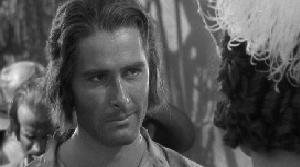
Michael Curtiz's Captain Blood marks the first starring role for Aussie-born actor Errol Flynn, which got the part of the brash yet chivalrous doctor-turned-slave-turned-pirate Peter Blood, after the role got turned down by two previous actors. It also marks Flynn's first collaboration with the prolific Hollywood director, and his co-star Olivia de Havilland. Much like many firsts, the film's got to be very good to inspire continuations, and Captain Blood is exactly that: a vastly entertaining, although conventionally romantic swashbuckling film.

The story is set within the political turmoil of 17th century England where tyrant King James has been executing rebels with heartless ease. Dr. Blood is caught while tending to a wounded rebel, and is punished alongside them and is supposedly to be hanged for treason, when it is suggested that they just be shipped to Port Royal in Jamaica as slaves. Arabella Bishop (de Havilland), niece of the plantation-owning Col. Bishop (Lionel Atwill) buys off the misjudged doctor, eliciting reluctant sparks of romance between the two. Blood and his crew escape by capturing a Spanish privateer and lives a life of piracy, as they are enemies to their own country, and outcasts in other nations.

Flynn is a fortunate discovery here. His sharp facial features, his noble yet confident swagger, his expressive eyes, are perfect for the Hollywoodized adventurer. He is ripe for romance, danger, and swordfights. His scenes with Basil Rathbone (who plays a French pirate captain whom Captain Blood is unfortunate enough to team up with) swells with stiff competition, and their swordfight becomes the highlight for this swashbuckling film. De Havilland is a gorgeous and much-needed presence in this testosterone-filled adventure romp. Though homosexual undertones may be gathered with Captain Blood's uncomfortable friendship with navigator Jeremy Pitt (Ross Alexander), they're merely undertones and half-baked guesses as the film is essentially about swordfights, ship battles, and brave young men stealing the hearts of dainty females with merely an act of chivalry and an ounce of bravery.

Curtiz's direction is precise, though it is often uneven when the film invariably changes mood. There are attempts at comedy, but most of them are outdated or the comic timing not as perfectly constructed into the film. The cinematography is also uneven but oddly beautiful. England is shown as lifeless and unexciting with its interiors unattractive and bare. The Caribbean, on the other hand, is full of life and the rumbles and the ship gun battles, are fiery with visionary energy. Much of the gun battles are lifted from the silent film The Sea Hawk, directed by Frank Lloyd, but to point out such recycling for criticism is nitpicking. Erich Wolfgang Korngold's musical arrangements add much to the cinematic excitement the Curtiz, his cast, and his crew has cooked up, and much of today's musical directors could learn a thing or two from Korngold's apt use of musical rhythm and melody in evoking a sense of adventure and romanticism that is very natural to the film.

Friday, August 04, 2006

The Bride of Frankenstein (1935)


The Bride of Frankenstein (James Whale, 1935)

James Whale's Frankenstein (1931) left me at awe. Men trying to be gods, creating monsters. Monsters of moral ambiguity, dramatically trying to catch the light. Monsters as mere children, misshapen, misunderstood and later on, prosecuted. It' is an experience that will leave any viewer horrified, and suspicious of the possible answers to the many questions left unanswered. James Whale, who originally didn't want to revisit the tale, ups the stakes and cooks up a sequel that further examines the humanity of the monster, the insatiability of all humanity, and all that existential, religio-social conceptions of morality. The sequel, The Bride of Frankenstein, although impossible, is a vast improvement over its predecessor.

The Bride of Frankenstein opens on a stormy night, inside a beautiful mansion where two men are discussing poetry and literature as a lady is doing some stitching in her dainty chair. We learn that the lady is no ordinary woman, but is actually Mary Shelley (Elsa Lanchester), the creator of the story of Frankenstein and his monster. She then proceeds in telling what happened after the fiery conclusion of the first film. The monster (Boris Karloff) has survived and in an effort to save himself, kills townspeople who are trying to harm him. Dr. Henry Frankenstein (Colin Clive) is recuperating from his injuries when a mysterious visitor Dr. Pretorius (Ernest Thesiger) pays him a visit, and offers him a team-up to create another monster, a female monster who would serve as the monster's mate, and from there create a world of "gods and monsters."

The monster is stalking the woods and the nearby houses where he is continuouosly chased by angry mobs. Although injured and afraid, he becomes attracted to the beautiful music from a nearby hut. The owner is a blind man who befriends the monsters and teaches him basic words. The scene is quite moving, despite the overt religiosity that surrounds it. The background music features church tunes, the old blind man prays and thanks God for giving him a friend in his times of loneliness, and the monster, for the first time, sheds a tear. It could've ended there where a well-deserved bliss is finally granted to the misunderstood creature. However, the joyous and playful exchanges of smiles and elementary words are aborted when two huntsmen disrupt their momentary glee and attack the monster, chasing him again into the woods. The monster flees but is now armed with a learned sense of good and evil.

The monster hides in a crypt and longs for friendship from a beautiful corpse. There, he chances upon Dr. Pretorius, who has been stealing corpses for his experiments. They make a pact. Dr. Pretorius is a prime character in the film. He is the very personality of evil and Whale doesn't put upon him any question of moral ambiguity. His experiments are unlike that of Dr. Frankenstein's. He actually creates life from his very own sources: black magic, as Dr. Frankenstein calls it.

The results are misshapen, unholy creatures. Miniature versions of royalty, clergy, a pitiful mermaid, a ballerina, and finally a demon, who Pretorius admits he has a bit of resemblance with. He comes in the film, always with an offer to the human characters that they can either accept or desist, a literary trait of the devil who delights in obligations and contracts as read from the stories of Faust and Daniel Webster. Here, the devil, as Dr. Pretorius, makes two contracts: one with Dr. Frankenstein and one with Frankenstein's monster. The objects of the contracts are similar: for the doctor, the safety of her bride; and for the monster, companionship.

The film climaxes in the creation of the monster's mate. Much has been said about the homosexual undertones of Dr. Frankenstein and Dr. Pretorius' team-up: Frankenstein as the overworked father, and Pretorius as the mother who makes sure everything is alright. It holds ground here as its quite evident in Whale's direction. However, much more than that, the climax here is very technically well-staged. It literally has you grabbing your seat, waiting to see what happens to the experiment, and if successful, if the experiment will go as planned. The conclusion is both humorous and fitting. The monster's mate is dressed in a white flowing dress, with her eyes wide with curiosity or fear, and her head constantly bobbing up and down. The monster descends waiting to see his bride. The music reminds you of a bizarre wedding song. The two finally exchange glances. Like any other human being in the village, the female creation shrieks in horror. The bride thereafter settles and sits down. The monster proceeds to sit beside her and attempts holds her hand. The female monster again shrieks at the sight of the monster, and the monster gives up.

Brilliantly staged, masterfully directed, superbly acted by both Karloff and Elsa Lanchester, the scene is a culmination, or a fitting conclusion to all of the spice and the excitement held over the supposed marriage between the two monsters. The film ends in a bittersweet note. Dr. Frankenstein and his wife escape through the help of the monster who makes a final decision: that he, who is a created out of evil, despite learning goodness and evil through the inherent kindness of the blind man, and with his supposed mate, and the conniving devil-incarnate Dr. Pretorius, should perish, leaving a world that is bereft of evil, although tainted.