Be With Me (Eric Khoo, 2005)
Eric Khoo has matured as a filmmaker ever since his feature film debut Mee Pok Man (1995). Be With Me, Khoo's third feature is a near-silent film whose narrative experimentations doesn't feel contrived as it could be, but instead, is rather tender, sensitive and utterly beautiful. Khoo's visuals are pretty. Singapore's urbane locales are bathed with cool, metallic colors. It's more human tenements are rustic and painted with comfortable browns. It feels very different from the Singapore Khoo painted in Mee Pok Man. That Singapore was ugly, filthy and cruel. Be With Me's Singapore is a land of opportunity and emotional depth, despite being covered by a ton of steel, glass, and financial and technological success.
Be With Me is basically three stories intertwined by fateful connections. The base of the three stories is real life character Theresa Chan, a sixty one year old woman who was blinded at fourteen, and became deaf at twelve. In the film, her autobiography is being translated by Brian (Jason Tan), who hasn't visited his father as regularly as possible. Brian's father is an eternally depressed person after his wife has died. It's a beautiful gesture to the strength of a lifelong marriage that Khoo decided to materialize Brian's dad's nostalgia with the wife physically being seen and felt by the sorrowful father.
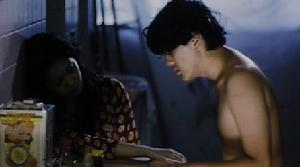
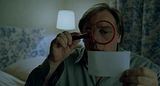
The two other stories revolve around tales of unrequited love. Fatty (Seet Keng Yew), a security guard, is secretly in love with beautiful yuppie Ann (Lynn Poh). It's a tragic romance which can never blossom because of the differences between the two, and the fact that Fatty is not that intelligent. Fatty struggles to write a love letter to the lovely Ann, whom he secretly stalks every night. Finally, there is the erstwhile lesbian romance between Sam (Samantha Tan) and Jackie (Ezann Lee). In what seems to be a result of the tired notion of love at first sight, the two fall helplessly in love until one gets tired and tries to find love the heterosexual way.
The film is carefully paced. While the set-up is slow, it's never boring. Spoken words are never used, except in certain instances mostly by Theresa who dictates English in strong and proud aural tones. Communication in Be With Me is limited to internet chatting, cellular phone texting, or in Fatty's case, a love letter. Khoo has a clear message as to how love has suffered in the midst of easy communication. The lesbian romance ends in a sour note. Khoo details how messages of resonating impact are easily deleted in the click of a button, and how a reply has become an easy decision instead of the tactful way of reacting to a emotional question. As opposed to Fatty's tale wherein communication is so difficult that the possibility of love is squandered because of illiteracy or the impossible expectations of a modern society.
The two tragic tales could've been melodramatic misfires if it weren't for the sturdy and well-observed way Khoo connects it to Theresa Chan's portion. Theresa and Brian's father meet in the end, with the father finally letting go of his wife and erupting in a mournful embrace to the source of inspiration for his emotional recovery. Theresa's blindness and deafness (which weren't there when she was born, therefore she has an idea how it feels like to have all his facilities working) is a powerful symbol of letting go, as connected with the father's incapability to let go of a beautiful past, or Fatty's incapability to let go of what could be a beautiful future, or Jackie's incapability to let go of a beautiful present relationship with Sam.