Showing posts with label John Carpenter. Show all posts

Friday, May 25, 2007

They Live (1988)


They Live (John Carpenter, 1988)

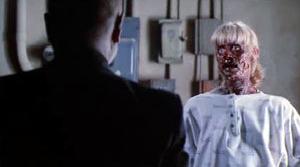
The world in John Carpenter's They Live is very similar to ours --- multi-racial with class structures divided by earning and spending capacity. The only difference is that in Carpenter's warped world, a huge conspiracy has successfully hidden the awful truth from humanity. Aliens whose heads are shaped like skinless skulls sporting insect-like eyeballs has transformed humanity into greedy, money-starved creatures by means of propaganda. Through television, these aliens have hypnotized humanity into thinking that the aliens look like one of us, and their un-creative and almost fascist statements are gorgeous ads and literature.

A wanderer (pro-wrestler Roddy Piper) walks into Detroit looking for a job. After searching in vain, he ends up working in a construction site and living in a tent city beside a mysterious church. He ends up discovering sunglasses that allow him to see the world for what it really is --- a society that mindlessly follows the uni-directional orders of those aliens walking, dining, and socializing among us.

Carpenter's motives are crystal clear: that consumerism is bad; avarice is evil; and that the true divide of humanity is between the controlling elite (the film's ugly extra-terrestials) and the suppressed working class. From the film's first few frames, you can tell Carpenter's disgust with society --- that the city of high rise buildings and expensive consumer products can live side by side with unemployment and poverty. The elite is overprotective of its powerful place in society, utilizing schemes and even the government to secure its place. The working class, however, is boiling to its limits, just waiting for that right time and that right opportunity to unravel to the world the elite's grand conspiracy.

At the center of the working class' battle is the newcomer, who with his determination and curiosity lands a more worthwhile job in ridding the world of its unwelcomed guests. Piper is most certainly not an actor --- he's all muscle, all steroids, all androgen without a granule of wit or cunning, which makes him perfect for that central role of the angry representative of the abused humanity. He is stoic in a way that rocks and stones are stoic; his emotionality doesn't pass through the thickness of his manly hide; which is why he can't have his way with Holly Thompson (Meg Foster) nor seduce her to his cause.

In the middle of Carpenter's modern-day fable on humanity's addiction with greed and consumerism is a prolonged fight between Piper and Keith David (who plays the wanderer's doubting sidekick Frank). There's an almost deadpan humorous quality to the dubious and indulgent exercise; there's that clinging feeling that the sequence simply doesn't belong to the pic but strangely, it fits right in and even deepens Carpenter's social commentary. Instead of merely being a critique on the elite's stronghold on society through its devious machinations, the film also tackles the working class' innate inability to unite. There's absolutely no question as to why the world has become such a feasible place for the aliens' enterprise --- it's because we are too willing or too involved with our individual concerns to pay true attention to what is happening elsewhere.

In the end, the aliens have become so ingrained in human society that it probably won't matter whether they look like walking skeletons. We've come to drink with them, have sex with them, eat dinners with them, transact businesses with them --- it's quite possible that we've become them. What good will that little revelation do but shock us momentarily. Will it shock us to leave the pleasures of avarice behind? I think not.

Wednesday, April 11, 2007

Assault on Precinct 13 (1976)


Assault on Precinct 13 (John Carpenter, 1976)

The first thing that a viewer who stumbles upon John Carpenter's Assault on Precinct 13 would experience is its electronica score. A repetitive melody-scarce score plays over the film's lengthy opening credits. The droning gets quite grating; and the culprit for the synthesizer score (as we'll get to see) is director John Carpenter himself. Carpenter, who wrote the screenplay, also edits the film (under pseudonym John T. Chance --- as a tribute to the protagonist in Howard Hawk's Rio Bravo (1959), the clear inspiration for this film). Shot over the span of twenty days, Assault on Precinct 13 is nothing short of an achievement in low budget filmmaking. As bad as the pun may seem, Carpenter isn't just the carpenter, he's also the architect, the engineer, the painter, and the interior designer.

The score isn't actually bad. Once Carpenter sinks you in slowly but surely into the film, the score mixes perfectly with everything else. The once-grating repetitive melody becomes akin to a heart beating profusely. You actually quite follow it --- you dread the score that dictates tension, and you treasure when it levitates to something easing. It's quite an effective score --- nothing fancy, nothing extravagant, just purely supportive of whatever else Carpenter is cooking up onscreen.

It's the score that made the film's singlemost horrific sequence so memorable. A little girl asks his father for spare change to purchase ice cream from an ice cream truck. In the background, a black car carrying four gangmembers out for a random kill is roving. In a sequence that is made more tense by the pulsating electronica in the background, the ice cream vendor is mauled then murdered, and the little girl is unflinchingly shot point blank. This sets the father into a vengeful rampage, killing one of the gangmembers with a pistol. The father is then chased by the gang to the soon-to-be-vacated precinct in the middle of town.

The precinct is headed by Bishop (Austin Stoker) for the night. Alone with a couple of cops, a few precint employees (including sexy Leigh, played by Laurie Zimmer), and some prisoners (Wells, played by Tony Burton and ambiguous Wilson, played by Darwin Joston) in transit to a neighboring jail, Bishop would have to defend the precinct from the murderous gangmembers who are out to kill. It's a genius concept (although borrowed from Hawks), which despite its incredible turn of events, foreshadows a social ill --- of that time bomb of the youth of an impoverished community, mixed with years and decades of racial respite, of exposure to media, and of numbing indications of their role in society, that will soon explode in a bloodbath of exact confrontation between the "us" and the "them." It's a classic film conflict, only emphasized by Carpenter with his precise film language.

The film begins with a few gangmembers sneaking in a darkened alley. Moments later, they are shot violently by police officers using high powered firearms. We hear from the radio news that what happened the night before was a shoot-out (which is a fallacy since a shoot-out consists of both parties shooting at each other); we also learn that the gang is a strange mixture of different races when their leaders perform a bloodletting ritual. Carpenter opts to snatch human faces from the gangmembers --- they have no personalities (although a hint of savagery, of amoral depravity is painted to the child-murderer), they move as hordes, and they die like soulless beings (for which they do the same, as each body count for them is nothing more than a path for their vendetta's completion.

Despite Carpenter's portrayal of the gang as nobodies, as mere foot soldiers whose death we delight upon, there's still a sense that they could be victims turned victimizers --- especially with that opening sequence of defenseless rub-out, of Carpenter's decision to leave these gangmembers' past a secret and their humanity concealed. They live by a complex code of action, something more ancient than the rules of American civility, and that accounts for their overt rebellion to social standards and against the protector of such standards, the police. In a sense, we cannot really regard the gang as downright savage and uncivilized but merely as the "other," marginalized for years by America and have logically opted to form their own cultural norms and moral codes --- an eye for an eye, a tooth for a tooth, no matter how many eyes and teeth are obliterated along the way.

******
This post is my contribution to Lazy Eye Theater: John Carpenter Blog-A-Thon.

Sunday, August 27, 2006

Prince of Darkness (1987)


Prince of Darkness (John Carpenter, 1987)

To describe John Carpenter's Prince of Darkness as merely a fine piece of horror cinema is to give this film a huge disservice. Prince of Darkness is more than horror, it's actually a very interesting piece of science fiction, that dabbles in occultism and the age-old mysticism that have always surrounded organized religion. Although the film contains zombies, demons, roaches, worms, beheading, blood, and a lot of screaming, the main thrust, the oomph that makes Prince of Darkness special is the way Carpenter attacked the tired and almost cliche theme of the devil boss himself taking over the Earth.

Instead of doing the film in the conventional horror way: witches, Satanists or other demoniacs who urge for their master to make his apocalyptic entrance in our world, Carpenter cooks up this whole theory wherein Satan is actually a creature from another dimension, or planet, and the Catholic Church has kept hidden inside a glass structure (which looks like a cheaply made bright green lava lamp) the Prince of Darkness, which awakens just in that moment where a supernova just exploded and some light particles, or quarks, or whatever, lands in Earth to urge the ooze to turn into an actual living creature, which infects everything it touches like a mind-controlling parasite. Carpenter's theory is complex, he uses scientific banter to raise the film's standing much higher. There's talk of telepathy, visual signals from the future, quantum physics, Catholic history that Carpenter struggles to jive and mix into a coherent whole. Surprisingly, it works and despite the kookiness of it all, is actually very entertaining.

Carpenter starts it off wonderfully. A priest mysteriously dies leaving a key to a darkened chamber in a closed-down church. A man, Brian (Jameson Parker) stalks a beautiful girl Catherine (Lisa Blount)who turns out to be his classmate in a philosophy-physics class under Professor Birack (Victor Wong). The key left behind by the dead priest is used by another priest (Donald Pleasance), who troubled by what he discovered, contacts Professor Birack, who in return, instructs his students who are experts in physics and other scientists to spend a weekend in the abandoned church to measure the happenings in scientific terms, and find out what can be done.

The premise is fantastic and Carpenter's filmmaking is quite admirable. His script (using pseudonym Martin Quatermass) maybe heavy handed but Carpenter's filmmaking makes up for such, using deadpan humor, or expert scare and shock tactics to allow the viewer to swallow the implausibility of everything. It's fine horror, with tinges of Romero zombie-fest (with the homeless schizophrenics surrounding the church in hordes), Italian schlock (there's an abundance of worms, and other creepy crawlers), and American exorcism scares (the near-latter part reminded me a bit of William Friedkin's The Exorcist). The sci-fi angle is more for thrills and chills rather than serious thinking, but Carpenter's insistence on the far-fetched theory may give the film some sudden pauses to its near-perfect pacing, but everything is forgiven when Carpenter turns the last twenty minutes into a hair-raising, mind boggling, exhilarating ride to a conclusion that will leave you scratching your head by how Carpenter came up with an unexpected stroke of genius.

******
This post is my contribution to Lazy Eye Theater: John Carpenter Blog-A-Thon.