Showing posts with label Martin Scorsese. Show all posts

Saturday, April 24, 2010

Shutter Island (2010)


Shutter Island (Martin Scorsese, 2010)

Which would be worst, to live as a monster or to die as a good man?” asked Teddy Daniels (Leonardo di Caprio) to Chuck (Mark Ruffalo), before leaving his partner befuddled by his rhetorical remark, the understated wisdom of which seems to betray the belief that would lead to Teddy’s undisclosed but obvious fate. These last words that Teddy imparted to Chuck, when read alongside the various conversations, dialogues, and revelations that happened prior, implores for a discourse on Martin Scorsese’s film adaptation of Dennis Lehane’s Shutter Island that goes beyond both the director’s utilization of his undisputed mastery over the film language or the narrative twists and conceits that have been employed.

It is inescapable in this post-Sixth Sense film-going culture that Shutter Island would be met with assessments based primarily on how the reveal has been successfully or unsuccessfully pulled off. Admittedly, there’s some sort of pleasure to be derived in participating in a cinematic mind game that has been carefully laid out to leave you guessing until the end. However, to situate Shutter Island in the same level as all those films that primarily rely on their twists for novelty is to oversimplify the seductive complexities of Scorsese’s film.

Indeed, Shutter Island is a seductive film. Robert Richardson’s cinematography here --- the sun-drenched exteriors of the Ashecliff, the dimly-lit interiors of its Civil War fort-turned-mental facility, the surreal hues of Teddy’s recurring dreams and hallucinations --- is simply exquisite. While no original music was composed for the film, Robbie Robertson makes use of existing music --- anything from Gustav Mahler to John Cage --- to weirdly apt consequences, creating feelings of fear or forthcoming angst out of the beautiful images that Richardson has conjured for Scorsese. Editor Thelma Schoonmaker creates magic by weaving together these scenes to result in a strangely grandiose and operatic explicitly genre effort, and by cutting sequences, from something as unnoticeable as that scene where Chuck gives one of the patients being interviewed a glass of water cutting quickly to POV shot of the patient drinking from an invisible glass and then cutting back to the medium shot as if nothing suspicious has happened, to compound the cinematic sleight-of hand.

Simply put, Shutter Island is one glorious picture. As orchestrated by Scorsese and his immense understanding of film and film history, Shutter Island transcends the limitations of its narrative and its genre, rightfully earning its place in that prestigious line-up of films also known as Scorsese’s filmography

However, Scorsese does not only make technically proficient films. From Mean Streets (1973) to The Departed (2006), Scorsese, notwithstanding the drastically increasing budgets and their appurtenant studio interference, has never failed to imbibe his films with at least a modicum of discourse on the relationship of violence or sexuality (but mostly, violence) with humanity. Scorsese never inhibited himself in portraying violence as it should be. Unlike the multitude of directors who have made a niche in equating violence with entertainment, Scorsese does more with violence than utilize it as the end-all of his filmmaking. What I believe he does in his films is to impart a reality that our very existence as human beings has provided for us a need for violence. Violence is what situates us with nature; on the other hand, it is our capacity to control, convert or countenance violence is what differentiates us from nature. Scorsese, through his films, has explored the rudiments of man’s affair with violence, situating it within societal norms, moral codes, religious tenets, historical perspectives and cultural situations, and in turn. His films tend to push forward a calculated discourse on the functions of these man-made concepts in the midst of an uncontrollably natural urge for bloodshed.

Shutter Island, unlike Scorsese’s earlier films where the violent man is hindered by the requirements and expectations of society to the point of extinguishing it completely or rationalizing it, has violence up front and center. From the film’s opening, where booming horns accompany Teddy, first seen suffering from seasickness in the ferry’s lavatory, as he and Chuck make their way to Shutter Island, Scorsese already raises expectations of things to come, with the main character on the verge of exploding, especially with the host of events (uncooperative employees of the mental institute; the storm whether its gravity is merely an outward realization of Teddy’s internal turmoil or real; his recurring dreams and hallucinations) that only foretell fate’s invitation to react wantonly.

Thus, most of the film seems to be an awkward affair for Teddy as he becomes more and more alienated, only to be left guarded from turning uncontrollably violent by the badge and duty he possesses and the guilt he bears. Preventing Teddy from turning into a monster are the defenses he has concocted. Absent them, he is naked to his history and its repercussions, making him volatile to his humanity’s primal capabilities to destroy and fully acknowledging, comprehending and allowing them, and worse, to eliminate guilt, the element that functions as a reminder of permanent moral codes, altogether.

In a film that exploits humanity devoid of sanity and rationality, Teddy’s last statement is a refreshing moment of clear reason. It also situates the unbridled manifestations of man’s capacity for violence within the context of a revived but broken morality. Knowing fully well the extent of our capacity to be monsters, it seems that these emotions and memories which would eventually fuel our innate violent selves are nothing more than disposable components in humanity’s quixotic quest to live a life free of pain and guilt. As it seems, sanity is as much a curse as insanity has equated itself to innocence.

Wednesday, October 04, 2006

The Departed (2006)


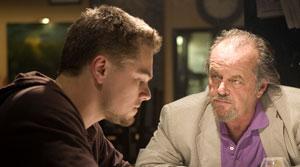
The Departed (Martin Scorsese, 2006)

Finally, something good has come out of the recent Hollywood fetish of Americanizing popular Asian films. Just this year, two Americanized Asian films left me in regretful boredom (Alejandro Agresti's The Lake House and Jim Sonzero's Pulse). Martin Scorsese's reworking of Infernal Affairs (Andy Lau & Alan Mak, 2002), the first of a trilogy touted as Hong Kong's answer to Francis Ford Coppola's The Godfather Trilogy, is an amazingly exhilarating feature from its first minute to last. William Monahan keeps the story of Infernal Affairs intact, updating it with some interesting details and additional characters and finally, uprooting the plot from the seedy underbellies of Triad-run Hong Kong to within the hugely Irish-run organized crime scene of Boston.

The title also gets a face lift. The Hong Kong films address relations that compares to a torturous afterlife. the American remake merely describes its set of characters as departed, or in less stylized language, dead. The title is apt. Almost all deaths in the film are caused by gunshots to the head (I can think of three deaths wherein the characters die in a different manner, two of which are still caused by gunshots, and none of which ends with survival), where there is no assurance of survival, no uncomfortable middle ground wherein one is given an opportunity to address his life decisions and the results of such in his afterlife. It seems that Scorsese instantly wants his audience to know that the characters in his mob film are dead men walking. He twists and turns them in situations wherein the only way out is death. In an uncomfortable twist of logic and Scorsese's dry humor, he appropriates the dictum that "dead men don't talk," especially dead men who weren't given a chance to talk at all. In the film where the value of life is equated to the revelations that could be spewed, the theme of death is all too palpable.

The story is simple. There are two sides: the police and the Irish mob. The Irish mob is headed by Frank Costello (Jack Nicholson), a hedonistic and very hands-on mob leader. He dotes and lets Colin Sullivan (Matt Damon) into the police as his rat, who gives his benefactor early warnings as to the police's operations and other very pertinent information. The police, under a very fatherly Oliver Queenan (Martin Sheen) and his mercurial assistant Dignam (Mark Wahlberg), puts Billy Costigan (Leonardo di Caprio) into the Irish mobster's inner ring by delegating years to make his transformation from cop to criminal believable. Two rats in both opposing sides, racing to discover each other.

But the film is a lot more than the plot whisked away from the Hong Kong original. Monahan successfully made the effective storyline into a purely American tale, a tale that Scorsese would be able to handle with his trademark talents. The plot is rooted in an American scenario of racial conflict: Irish against Blacks; Irish against zealot Catholics; American paranoia against the fastly developing Communist China. Then Monahan also intricately details the American police bureaucracy into the picture: making two department heads (head of Special Investigations Department played by a testosterone-laden Alec Baldwin), instead of the original one; adds the FBI into the picture complicating red tape and bureaucracy further. Monahan, with the help of a very macho-thinking director like Scorsese heats up the sexual politics and the romance, with the entry of a more believable, more humanly erring psychiatrist girlfriend (Vera Farmiga) of both opposing rats, as compared to the beautiful yet largely useless poster girl of the original film. Farmiga's psychiatrist adds a feminine dizziness into this machismo-driven picture. It's an altogether grittier picture, and with the careful eye for these little details, makes the outrageous plot a bit more plausible, and churns out a complexity that is both enticing and exciting.

Scorsese has been accused of being an Oscar-whore ever since he made two big budgeted epics that came too close to finally giving him the award. What Scorsese can't be accused of is being a lousy filmmaker. Scorsese doesn't waste any time in brewing up with useless details, instead he opens the film with Costello quoting, and like an evil pedophile, recruiting an Irish kid from an ice cream parlor with candies, milk, and a comic book. Costello storms up each scene he's in. His unpredictable nature, quick-tempered yet nobly fair (he pays up a huge sum of money after breaking Billy Costigan's hand numerous times) demeanor, makes his character into such a memorable personality, an improvement to Eric Tsang's triad leader, which I thought was a brilliantly played stereotype. Nicholson plays up the role with a deranged confidence that is both curiously comedic and scary at the same time.

Monahan juices up the mobster lord's role to the detriment of Queenan. One of the emotional thrusts of Infernal Affairs is the relationship that developed between the cop boss and his secret agent. It's a quiet paternal relationship that achieves full emotional power in one of the film's important plot movements. In Scorsese's remake, the relationship is kept to a minimum, or is at least shown subtly. There are little instances wherein I sense a bit of the fatherly relationship of Queenan and the undercover cop rise, and when it does show up, it makes the inevitable end to the relationship, more poignant. Juxtapose their relationship to Costello and his rat's, wherein the code alludes to such relationship, but in the end, results in something remarkably ironic.

The hugest difference I saw between Scorsese's The Departed and Infernal Affairs is the fact that the latter contained a religious thrust, a Buddhist implication that seemed to describe the relationships established in the film as a hellish endeavor. Scorsese's thriller is as mortal its title suggests. Religion and the accompanying salvation in the afterlife it promises is merely a backdrop. There seems to be a battle of good and evil in the film, but the Church is a non-player, and goodness is a wishy-washy thing. Evil, on the other hand is present in Costello's person. Scorsese seems to turn Boston into a battleground where evil has already won and the devil as finally incarnated on Earth. The stench of corruption is outrightly manifested. Even the supposed agents of goodness (in this case, agents of the law) act in despicable means, and again, have that impermanent tendency of turning into evil.

The Departed is a lot of things: a superb remake of a Hong Kong film, arguably superior to the original; a return-to-form for Martin Scorsese, an intelligently written police thriller, and easily, one of the best American films of 2006.