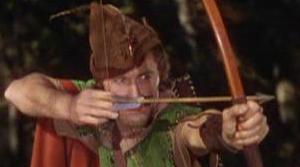
The Adventures of Robin Hood (Michael Curtiz, 1938)
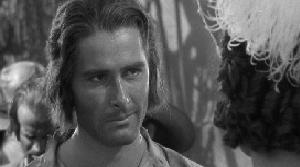
The Adventures of Robin Hood could very well be the quintessential adventure film, where almost everything, from the colorful costumes to the convenient casting, was right. It's one of the plenty collaborations between Austrian born director Michael Curtiz (who succeeded to helm the film when the studio thought previous director William Keighley's action scenes weren't lively enough), Errol Flynn (who was second choice after James Cagney got out of Warner), Olivia de Havilland, and musical maestro, Erich Wolfgang Korngold. Yet despite the familiarity with the team-up, The Adventures of Robin Hood stands out with its delightful hues, its gracious adventurism, its portrayal of pure and honest heroism and gallantry, and its joyous, if not very innocent romantic center.
The tale of Robin Hood has escaped its native English roots, and has become a universal story of bravery against oppression. When King Richard the Lionheart was called to fight for Christianity in the Crusades, his brother John (Claude Rains), and a horde of treacherous nobles, including Sir Guy of Gisbourne (Basil Rathbone), and the cowardly Sheriff of Nottingham, devise a plan to take over the throne by heavily taxing the peasantry, in the guise of collecting ransom for the safe return of the rightful king. Tired at the awful maltreatment of the ruling Normans against the poor Saxons, Robin Hood (Errol Flynn) bands up with other disgruntled citizens in the nearby forest of Sherwood. They steal from the rich, and hopefully collect enough money to pay ransom for their king, while providing food and shelter for the oppressed Saxons.
De Havilland plays Lady Marian, who like most other swashbuckling Curtiz films, provide a welcome air of gentle femininity within the frequent sword fights and rumbles. In Technicolor, her face is even more radiant, her cheeks as powerfully rosy that it won't make anybody wonder why the brash Robin Hood would sacrifice his freedom to catch a glimpse of the fair maid in the middle of the night. Their chemistry together brightens up the screen, and tickles one's fancy in the most cinematically and unembarrasedly romantic way. When Robin Hood plays a trick at Marian, toyingly declaring that he ought to be captured just to hear from Marian's lips that she does love him, you aren't flustered by the schmaltz of the scheme, but you somehow root that Marian delivers another kiss, after saying her sweet goodbyes.
Then there's Flynn's perpetual rival, Rathbone. Rathbone's contempt against the merry bandit transcends the screen, that when the two finally engage in a duel, it's as exciting as Marian and Robin Hood exchanging kisses. And the duel is wonderfully shot within the huge halls of the set of Nottingham Castle. While the rest of the cast engage in chaotic swordplay, the two exchange in a delightful duel, where honor and gallantry in fighting isn't forgotten. The actual physical clashing of their swords create much tension, and when replaced by their shadows, in an ingenious shot, one can almost imagine the reality of the tension between the two actors.
All this is enunciated with Korngold's adventurous melodies that will have you humming hours after the film has ended. Korngold has a way of emphasizing action, romanticism, giddy and fun cinematic emotions with a beat of his drum, or the sudden rush of a medley of notes. His music aspires action. The Adventures of Robin Hood can be easily described as almost technically pitch perfect. I have a few problems with some of the jokes falling out of place, but overall, it's an enjoyable viewing experience. Surprisingly, the film was released in 1938, and still, decades after, it retains its cinematic charm and continues to inspire pure-blooded gallantry, at least to the young ones.