
Shake, Rattle and Roll 8 (Rahyan Carlos, Topel Lee & Mike Tuviera, 2006)
If you ask me what the best thing that came out of Regal Studios these past few years, I'd tell you with a straight face that it is their films from the indefatigable Shake, Rattle and Roll franchise. While most people are waiting for the end of the franchise, I, on the other hand, eagerly await the next film. If you're going to ask me why I hold the horror trilogy in such high esteem, I'd bluntly answer because it's always interesting; as opposed to their Mano Po franchise, or the never ending Joel Lamangan melodramas. Just last year, the franchise exposed to the Filipino masses the works of independent filmmakers Rico Maria Ilarde (his Aquarium is a far cry from his Ang Babaeng Putik (Woman of Mud, 2001) or Sa Ilalim ng Cogon (Beneath the Cogon, 2005)) and Richard Somes (his Ang Lihim ng San Joaquin (The Secret of San Joaquin) surprised me by inflicting film history lessons with his recreation of the typical aswang tale).
The eighth installment to the long-running franchise has three young directors helming three different tales of horror and the supernatural. The older Shake, Rattle and Roll films never bothered to connect the short films with at least similar themes or recurring characters; Shake, Rattle and Roll 8 manages to instill within the three works a narrative device that connects them. Moreover, the three short films in this installment are all situated in Metro Manila, or at least has its main characters dependent on urban living. With that, a subtle theme surfaces. There seems to be a careful commentary on urban living wherein urbanites are too busy or too preoccupied to meticulously observe the suspect trappings of their day-to-day life.
Rahyan Carlos (who wrote and directed the awful Pamahiin (Superstition, 2006)) helms the first episode entitled 13th Floor. Carlos manages to churn out a product that is generic, without being utterly repulsive. The plot follows a company of birthday party specialists that was employed by a couple living on the fourteenth floor of a residential building for the birthday of their only daughter. The party starts and they find out that the daughter's guests are all ghosts --- tragic victims of a fire that engulfed the building which used to be an orphanage. Carlos has a good collection of comedians to do the comedy work for him --- Bearwin Meily, Janus del Prado (who I thought was gifted with pitch-perfect comedic timing), Keanna Reeves (who wears her shirt to proclaim that her gargantuan breasts are a joke by themselves), theater veterans Robert Sena and Isay Alvarez. The rest of the film, including the technicals, is merely patchwork for Carlos. It's entertaining but completely forgettable.
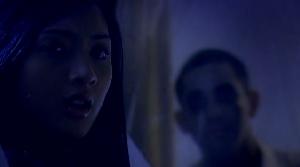
Music video director Topel Lee picks up from what Carlos left behind. Lee is one director who has a unique eye for aesthetics. He begins his episode entitled Yaya (Nanny) with only the hands of the yet to be uncovered nanny walking towards a suburban dwelling. Leaves wilt and plants die as she passes by; Lee wants to make it clear that the monster here is no mere creature but a being of extreme evil that death and destruction are mere consequences of her passing by. She is employed by a mother (Sheryl Cruz) to take care of her two offsprings; a baby girl and a trouble making kid (Nash Aguas). We first see the face of the new nanny (Iza Calzado); Calzado is a tall lady with distinct yet calm facial features; her casting is a brilliant decision as she's one of the few young actresses who can effectively limit gestures and still remain effective. The little kid starts to suspect that their new nanny is an aswang (a vampiric monster who feeds on little children and the livers of adults). He starts questioning around and prepares himself for a self-imposed battle for his and his baby sister's survival.
Lee directs with masterful precision. There are very few cheap thrills or forced shocks. Instead Lee punctures your guard with a compelling scenario he infuses with his perfectionist visuals. With cinematographer J.A. Tadena, he conjures a suburban paradise that suddenly turns into a children's nightmare with the introduction of Calzado's nanny-from-hell. You instantly root for the kid (Aguas has a natural charm that draws you to his plight). In one sequence wherein Lee shows off his comfort zone (MTV's), we dutifully follow the kid's mission in building up an arsenal of traditional weapons against the folkloric monster with the aid of Von de Guzman's enchanting yet apt music scoring. It's a wonderful, wonderful episode that beautifully portrays the horrorful nightmarish vision of evil masquerading as a household help appearing suddenly to disrupt the peace of suburban living, all seen in the point of view of an innocent yet hardy boy.
More ambitious is Mike Tuviera's LRT, the third and final episode of the film. Like in his first feature film Txt (2006) wherein he reveals the cellular phone as an instrument of supernatural evil, Tuviera again uses a modern tool of convenience as the harbinger of chills and death. A group of passengers find themselves trapped when their coach diverts from its usual route ending up in the locked servicing terminal of the LRT (light rail transit). The terminal is the home of a mysterious monster who feeds on the hearts of its victims. It's a wonderful mix of monster feed --- there's the hero (Keempee de Leon), the hero's love interest (Manilyn Reynes) and her asthmatic son, a host of employees, a teenage couple, a band of petty criminals, and a persistent evangelist.
The episode plays out like a shortened version of a Guillermo del Toro monster flick (some portions I thought were inspired by del Toro's Mimic (1997) and scenes from Hellboy (2004)). Tuviera keeps the suspense at a reasonable high, only sometimes interrupted by illogical placements of cheesy dialogue between the hero and his former girlfriend. The film is technically brilliant; de Guzman's musical score emphasizes the setting by using industrial rock elements, Odyssey Flores' cinematography is exquisitely executed, the editing is quick yet judicious. When I thought LRT as merely effective but has really nothing else to say, Tuviera surprises me with a twist which I thought was very brave, if not politically motivated or at least leads to several conclusions of political, or if you're one who is allergic to allusions to present politics, societal nature.
I thought Shake, Rattle and Roll 8 might be one of the most consistent entries to the franchise. There are no clear masterpieces (no Ishmael Bernal's Fridyider (Frigidaire) or Somes' Ang Lihim ng San Joaquin), but there are no outright disappointments (Emmanuel Borlaza's Baso (Glass)) either. Overall, it's one thrilling ride from start to finish; and I'm not afraid to shout "I want more!"




_p1wm%20.jpg)








.jpg)


