Wednesday, November 29, 2006

Donsol (2006)


Donsol (Adolfo Alix Jr., 2006)

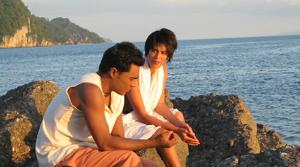
Daniel (Sid Lucero) is a B.I.O. or butanding (whale sharks) interaction officer. Every year, the shores of the town of Donsol become the mating grounds for the whale sharks, inviting hordes of tourists from all over the world to the once-sleepy fishing town. Fisher folk would exchange their nets in exchange for more lucrative employment as tourist guides. Teresa (Angel Aquino) is a breast-cancer survivor who accompanies her journalist friend Mars (Cherie Gil) to Donsol. Harboring a secret memory with the tourist town, she courageously tries to overcome that memory by revisiting the calming blue waters that team with gentle whale sharks, and in the process, find love in the persona of Daniel.

First time director Adolfo Alix Jr. is no stranger to filmmaking. He has written several scripts for Gil Portes including Mga Munting Tinig (Small Voices, 2002), Homecoming (2003), Mourning Girls (2006), Beautiful Life (2004), among others. They're not exactly films I would've been proud of; Portes' films are drowned with misplaced art film cliches and borrowed (or outrightly plagiarized) plot lines. Zhang Yimou is an obvious influence on the script of Mga Munting Tinig, Mark Meily on Mourning Girls; Homecoming is too embarrassingly bad and mishandled that influences are muddled in its overgloating melodramatics.

Donsol is more well-written and less self-indulgent than his previous scripts but to consider it original is overly off-tangent. May I remind you of that beautiful and criminally underseen Jeffrey Jeturian melodrama Minsan Pa (One Moment More, 2004), scripted by the incomparable Armando Lao. The similarities are uncanny: Minsan Pa is also about a tour guide (of Cebu City) who falls in love with a tourist from Manila. The big difference between the two scripts is the depth; Lao doesn't merely create a character, he creates a real person whose interactions with the people around him, whether permanent (his parents, siblings) or transient (tourists, friends), are as important to the film as the main storyline. Alix's script is shallow. Above the love story between Daniel and Teresa, there is nothing else that draws emotions. Minsan Pa has multi-layered storylines; Donsol has disposable side plots and disposable supporting characters.

The themes are also alike. Donsol struggles to flesh out the temporary nature of romantic relationships of people like Daniel, who would meet females daily; beds them but never really feels an emotional fulfillment. Minsan Pa gives us a complete picture of that exact transitory relationship, then moves on without batting a regretful eyelash. Donsol is petrified in that love story, which makes its overly dramatic ending disappointingly unfulfilling.

But to completely diss Donsol as Armando Lao-lite is a disservice to the technical merits of this low budget feature. Seeded by a grant of the Cinemalaya Film Festival (the festival that bestowed upon us Ang Pagdadalaga ni Maximo Oliveros (The Blossoming of Maximo Oliveros, Aureaus Solito, 2005)), Donsol boasts of beautiful imagery that stretched the capabilities of digital filmmaking. The underwater scenes, which also feature the gentle whale sharks, are breathtaking. The blue skies, the untampered sea vistas, the highlighted tourist spots, are all captured excellently. While cinematographer Eli Balce did the best he can do with his medium, I can't help but imagine how the film would look if it were shot in 35mm. Probably breathtaking, we'll never know.

Alix actually directs better than he writes. There's a moody restraint that inhabits the textures, the colors, and the plotting of his feature; that is the same restraint I wish Portes had. I admire how he handled the breast cancer scenario with mature hands. There's a tendency of overemphasizing tragedy, Alix downplays and thus rejoices in the few moments of celluloid-printed joy.

Tuesday, November 28, 2006

Happy Feet (2006)


Happy Feet (George Miller, 2006)

Penguins, those tuxedo-ed flightless birds of the Antarctic, are adorably cute. Children know this, which is probably the reason why Happy Feet would do well in the box office, the same way the doc March of the Penguins (Luc Jacquet, 2005) did rather well despite its National Geographic-appropriate genre. Now, let the penguins sing contemporary songs, dance, tap-dance, and you have just discovered the cure for depression. George Miller, who also directed post-apocalyptic cult classics Mad Max (1979) and its sequels who turned nice and fuzzy upon hitting the jackpot in the talking animals/family pic genre with Babe (Chris Noonan, 1995; which he produced) and Babe: Pig in the City (1998), won't be satisfied in treading the Pixar path to success (brilliant CGI yet generic story lines). Instead, he conjures religious allegories, semi-political and environmental activism and places them upon the shoulders of those black and white cuddly fowls.

Choreographed penguins merrily outdo each other's love songs to catch the attention of top chick Norma Jean (voiced by Nicole Kidman). Memphis (Hugh Jackman), Elvis-impersonating honcho manages to win the love of Norma Jean. Their love produces Mumble (Elijah Wood), who never manages to outgrow his fuzzy feathers or develop the proper vocal muscles to churn out a mate-worthy heart song. Mumble, however, has the gift of tap-dancing, which he will use in his mission to discover the roots behind the fish shortage in their colony.

Mumble figures that the root to the fish shortage is the appearance of "aliens" in their icy midst. Second-hand stories from a predator hawk and later an amorous penguin named Lovelace (Robin Williams, who also lends his voice to one of Mumble's Latino penguin crew). The plot is stretched beyond plausible terms and it might take some minutes of disbelief before everything becomes agreeable again. Just when the connection between these singing penguins and the human world turns apparent, the story takes us to Mumble's epic quest against the backdrop of heavy blizzards, pessimistic elephant seals, hungry killer whales, and a first-hand experience with the "aliens"'s devious and greedy mechanisms. The period of adjustment from fantastical glee to Miller's preachy realism might have stunted the already problematic pacing, but in the end, everything works.

It feels like Miller had much less of a rhythm than his heroic Mumble. Absent the many musical numbers and the glorious dance routines, Happy Feet makes the unfortunate mistake of burdening itself with the duty of making itself look good on IMAX. That simply meant that there will be a number of idiotic action sequences, of avalanches and snow-diving and underwater chases, which somehow interrupt the flow of the film's narrative. I would probably appreciate the artistic and technical merits of those showoff-y interludes if i saw it on IMAX but since I didn't, they felt more gratuitous than pertinent. I may come off as a grumpy killjoy since those sequences are the money moments of any CGI film but I'm sure Happy Feet can carry itself finely without overindulging it's lifelike computer creations.

Nitpicking aside, Happy Feet is genuinely filling entertainment. I expected mere eye candy but I came out of the theater with my present cynicism challenged. Happy Feet's greatest success is probably its ability to conjure pure and sincere emotions from the white icy landscapes of its settings and the shallow pixels of its digital origins, the latter being a truly great feat.

Monday, November 27, 2006

A Good Year (2006)


A Good Year (Ridley Scott, 2006)

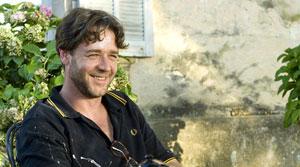
If there was one adjective to describe the viewing experience that was Ridley Scott's A Good Year, it would've been "uncomfortable." Despite the relaxing visuals trustworthy Scott has afforded us (the golden sunlit fields of Provence, the rustic and gorgeously aged chateau, the beautiful and near-perfect Marion Cotillard), there's that feeling that things and sensations are out of place in the movie. Scott is a skilled craftsman. He after all has made plenty of films in different genres with surprising ease and understandable success. He has made historical epics (Gladiator (2000) and Kingdom of Heaven (2005)), war films (Black Hawk Down (2001)), heist-comedy (Matchstick Men (2003)), buddy road movie (Thelma and Louise (1991)), suspense-horror (Alien (1979) and Hannibal (2001)), dystopian sci-fi (Blade Runner (1982)), fantasy (Legend (1985)) and some other flicks that can't simply be boxed in a particular genre (G.I. Jane (1997)). A Good Year is a rom-com with hints of European art flick (in its most pedestrian sense --- think Cinema Paradiso (Giuseppe Tornatore, 1988) or all those other Academy-loved French swooners) and a tad inspiration from the genre that Sideways (Alexander Payne, 2004) resurfaced (the wine-film). Still infused with Scott's technical expertise, A Good Year just can't get past the boundaries of genre-discomfort, and thus, just couldn't work.

A Good Year is adapted from Scott's long-time friend Peter Mayle's novel, which was supposedly truncated and modified to fit Scott's creative impulses. It tackles Max Skinner (Russell Crowe), a ruthless and proudly dishonest stocks trader, who is forcedly sent to Provence to receive his inheritance from reclusive uncle Henry (Albert Finney). Through constant flashbacks, we learn of Max's experience during the summers he spent with his uncle in the latter's vineyard --- which now produces undrinkable and bad-tasting wine. Max plans to sell the vineyard for what it's worth, while flirting with village beauty-and-cafe waitress Fanny Chenal (Cotillard). Things get complicated when Christie Roberts (Abbie Cornish), Henry's offspring from a California fling, surface.

Russel Crowe, that rugged man who's diverted audiences from his off-screen asshole-ness by playing a heroic schizo-mathematician and aging boxing champ, is no Hugh Grant, who despite his off-screen persona of being a whore-loving chap has transcended into celluloid rom-com royalty. Crowe simply can't do physical comedy without looking awkward and artificial. His smooth-talking and anti-genuine romantic quips can't be fathomed from an objective point-of-view. A Good Year, being a Crowe-starrer suffers because of this. A more convincing and sympathetic actor (or if Crowe just tried harder by not looking as embarrassed as he already is) could've made wonders to this Provencal time-passer.

A sideplot involving a fabled bottled wine was completely forgotten when the film enters its last third. The plot simply floats like a drunken butterfly, unable to control which way it wanted to go, finally landing an ending out of mere convenience. It's all shiny and fuzzy, probably like the golden mornings which are so beautifully shot by Scott's cinematographer Philippe Le Sourd (his experience in lighting and framing French films made A Good Year's look genuine --- probably the only thing genuine in this feel-good flick). However, the film's gorgeous visuals can't remove that distinct bad taste of talented artists trying so hard to fit into a nebulous genre. It also doesn't help that the film is populated with art film tropes --- the hardworking French laborer, his sassy wife, his aging father for comic relief, and his annoyingly over-present canine for further and unneeded comic relief.

Sunday, November 26, 2006

Akeelah and the Bee (2006)


Akeelah and the Bee (Doug Atchison, 2006)

Eleven-year old Akeelah Anderson (Keke Palmer) has a gift for words. It's probably genetic: her dad (who was shot to death when she was a little girl) plays scrabble, probably with expertise. Ever since her dad's death, she, and her two brothers, have been kept alive by her overworking mother (Angela Bassett). The gift for words isn't exactly a boon to Akeelah. She usually gets A's in her spelling tests; A's she would quickly hide out of embarrassment. Crenshaw, her South L.A. public school, isn't really the school where you can brag your intellectual achievements. Mediocrity pervade the educational system; bullies would terrorize those who achieve or scoff at any notion that someone is excelling in something.

Akeelah and the Bee is the story of Akeelah's journey from being the closet gifted speller to the champion of the Scripps Spelling Bee in Washington D.C.. The story isn't exactly original. You've seen it before, in many different shapes. The Sister Act films showed unlikely chorale singers succeed to impress non-believers. Director Ron Howard has a few of these films under his belt (most of which would undeservedly win numerous awards): A Beautiful Mind (2001), last year's Cinderella Man (2005). Like all the cited films, Akeelah would have to face all the adversities (her lower middle-class neighborhood, her bullies, her rapper-wannabe brother, the Korean-American rival) in her life to reach her goals.

Of course, she doesn't do it alone. She gets help from university professor Dr. Larabee (Laurence Fishburne) who is also hiding a painful tragedy in his life. In one of the spelling bee competitions, she meets Javier (J. R. Villareal), overly friendly spelling bee competitor and Latino lover-in-the-making. It's all very formulaic which might be the reason why it's also quite harmless as opposed to the other fictional spelling bee film that got released after the hit doc Spellbound (Jeffrey Blitz, 2002). Bee Season (Scott McGehee & David Siegel, 2005) has a dysfunctional family struggling to repair itself while its main character, a speller, goes about winning bee after bee; it's directors Scott McGehee and David Siegel has other thing in mind other than the rote satisfaction of success against adversity. They would delve into philosophy and the supernatural linkages of spelling and life. Akeelah and the Bee seems very safe and trite in comparison.

Everything falls into place. Director Doug Atchison knows his material is Hallmark-quality fluff and directs it as such. The film looks satisfyingly polished. There's an abundance of generic preachiness; the film quotes a lot from Mandela and Dr. Larabee seems persistent on incorporating greatness in the simplicity of spelling and word deconstruction. It all feels very fuzzy and nice. The niceness is upped by Keke Palmer's surprisingly good performance (if a little girl upstages more experienced thesps Fishburne and Bassett, you do know she's special or that the screenplay has been unfairly underwritten for the supporting cast). Overall, Akeelah and the Bee is embarrassingly cute --- spelling bees, little kids stealing kisses from little girls, whole neighborhoods (the gang banger neighborhood, at that) rallying behind the unlikely champion. Atchison seems to want something deeper from the entire bee business, but his sugar-coated confection can barely rise beyond its genre to say anything out of the ordinary.

Ang Pamana (2006)


Ang Pamana (Romeo Candido, 2006)
English Title: The Inheritance

Canadian-Filipino director Romeo Candido uses Filipino folkloric monsters to scare his audiences in Ang Pamana (The Inheritance). It's not exactly new for Filipino horror films to bank on such monsters to scare: almost all of the Shake, Rattle and Roll films have an episode involving a mythical monster (most memorable is Peque Gallaga's Manananggal (The Monster)), there has been a couple of other manananggal flicks, some tianak (monster babies) shockers, and numerous other features and television episodes that derive scares from mythic monsters. Film outfits and directors follow suit turning Filipino folklore into a lucrative cinematic enterprise. The ushering of J-horror with Hideo Nakata's Ringu (1998) has made almost all of East Asia, Philippines included, copying its tested scare techniques, limiting cinematic horror in the grasp of long-haired, pail-skinned, nubile female ghosts. Candido, in Ang Pamana veers away from J-horror without necessarily forgetting the techniques altogether (Candido does borrow a few scare tactics from J-horror). The result is more interesting and engrossing than it is scary. Nevertheless, I was satisfied and entertained.

Probably Candido's novel contribution to the Filipino monster sub-genre is that he films it from the point-of-view of the expatriate, the balikbayans who have exchanged the natural beauty of the motherland for the pill-popping culture of Canada. He drops two Canadian-Filipino youths, siblings Johnny (Darrel Gamotin) and Anna (Nadine Villasin), right smack in the middle of the monster-infested family estate (which they have inherited from their superstitious grandmother (Caroline Mangosing)). Their cousin Vanessa (Phoemela Baranda), who also inherits, thus co-owns the huge property with her expatriate cousins, opts to plant marijuana and have fun with her three friends (two of which would later urinate on the mounds of soils that are said to be the homes of the dwende - Filipinized vengeful elves whose demeanor can be discerned by their color).

Candido plays the balikbayan thread rather well. Much of the humor is gathered from the balikbayan's initial bewilderment of the Filipino cultural ticks --- the way the head of the family has to pray before meals no matter how short and inconsequential the prayer is; the erupting bickering from aunt and uncle regarding the plots of land they have inherited; bickering turns into measurements of the debts of gratitude the matriarch has for her children. Humor turns into ominousness when Johnny, Anna and Vanessa arrive at their newly acquired farm. The weirdness, the looming atmosphere that folklore has merged with reality, the introductions of the several places and several family secrets start creeping into the storyline; impregnating the film with so much promise that sadly falls flat with a climax that disappointingly lacks the subtlety of the film's pick-up.

And that's not the only problem of the film. Musical score by Gerard Salonga and the occasional accompanying songs (written and composed by Candido) are quite good. While Ang Pamana is technically competent, Candido's visuals leave too much to be desired. Odyssey Flores' cinematography is crisp and beautiful when the camera is still, but most of the time, the camera is interrupted by Candido's impatient editing and his opting to move his frame out and about, making my eyes beg for some semblance of constancy. It's a head-ache inducing ordeal, and it's really something Candido could've avoided, or if he can't, at least incorporated to the storyline. Candido could've watched how Gallaga directed Manananggal (third part of the first Shake, Rattle and Roll)with coherent ease; the transformation of the barrio lass to the monster in the former film made Ang Pamana's own transformation a pitiful imitation, and the subsequent chase sequence a bore when compared to the manananggal terrorizing the closely guarded nipa hut of Gallaga's film.

Candido is already writing a sequel to the film. There are too many questions left unanswered, and numerous plot holes that need to be filled. With all its problems, there still so much to be enjoyed from the film. I cannot deny that I left the theater somewhat fulfilled yet internally bewildered: here are our home-bred producers and filmmakers sitting their lazy copycat asses trying to figure out how else the J-Horror girly ghost can be modified when there's a whole treasure chest of folklore that is waiting to be mined for cinematic ideas. And it had to be a Canadian born and bred young director to make us aware of that forgotten fact.

Friday, November 24, 2006

California Split (1974)


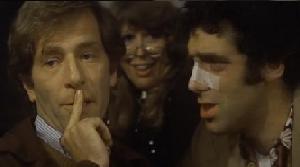
California Split (Robert Altman, 1974)

Robert Altman's hardly seen masterpiece California Split is a film about gambling; the same way as it is a film about two men who fortuitously meet up, team up, separate, re-meet, and take risks (with not a bit of any homo erotic consequences of a buddy pic). More accurately however, California Split is mostly about nothing: the two new buds, Charlie (Elliott Gould) and Bill (George Segal) mostly spend the entire time betting and winning, from the poker tables to the horse races to the boxing matches. They also talk about nothing of valuable import: conversations float from one topic to another; a dialogue about a bet regarding the seven dwarves evolve (or devolve) into one about Dumbo, to the political repercussions of having a black crow sing a song about how he saw an elephant fly. Yet with all its light nothingness, California Split entertains quite astoundingly.

It's a film wherein Altman is in his most excessive. The overlapping dialogues make an entry right from the start with an introductory lesson on poker-playing overlapping with Charlie's monologues turning into a very heightened and exciting game of poker (which Altman denies us from actually taking part in). We only see what Altman wants us to see. He envelopes us immediately with an atmosphere of constant chaos; the same chaos that addicted gamblers breath and take in as fuel for their supposed streaks of good fortune. It takes time for the audience to get used to Altman's unsparing techniques, yet its quite rewarding. There's so much to observe from Altman's filmed surroundings (the other gamblers' quirks and characteristics, the whore in the casino-bound bar and her gambling mother, the like-minded excitedness of those betting on their favorite horses or boxers). California Split is much a film that delights in the gambling subculture as it is a film about the two buddies' road to huge dollar wins.

A conflict belatedly arises only midway. Charlie disappears mysteriously. Will loses big time; garners a huge debt from a loan shark which gets only bigger when he loses to another poker game; he wallows in self-pity in a local bar where a patron scoffs at his manliness; he tries to turn-around by sleeping with one of the whores Charlie lives with but that's not much of a success. He gambles everything --- sells his typewriter (he writes for a magazine), his automobile (for lower than its market value), and basic logic (he opts to gamble everything in Reno which is probably the second choice for gamblers; Las Vegas is much nearer and offers a more user-friendly environment for gamblers). Will returns; joins his quest for the big bucks of Reno; gets vindication from a poker room-dwelling sore loser.

It's almost inevitable that Altman makes his heroes win (they do), and that's not really what we're excited about. The more interesting bit about the film's climax (if we can call it that) is how the two buddies win. Loud-mouthed optimist Charlie is forced to stay in the background; swallow his pride as Will gamble their hard-earned money away. There's a gratifying sensation seeing Charlie get his mojos squashed by Will in exchange for a continuous lucky streak. It's especially enjoyable since we've seen Charlie get humiliated from losing, getting threatened by a puny loan shark, getting unexpectedly insulted by a not-so-attractive social climber, getting a huge turn-off in the midst of the start of passionate love-making. Seeing Will humiliate Charlie is elevated into a piece of entertainment in itself. The one-two punch of Altman's filmmaking is achieved when he ends an exciting streak with utter flatness --- Will feels unfulfilled (that streak wasn't enough; he's had so much of losing that winning has lost its curious delicacy; it's high stakes for him next); Charlie, on the other hand, will enjoy his winning; he is after all, the shmuck of the gambling underbellies; win or lose, he wins.

Wednesday, November 22, 2006

Borat: Cultural Learnings of America for Make Benefit Glorious Nation of Kazakhstan (2006)


Borat: Cultural Learnings of America for Make Benefit Glorious Nation of Kazakhstan (Larry Charles, 2006)

Borat: Cultural Learnings of America for Make Benefit Glorious Nation of Kazakhstan (Borat for short) has been greeted with hype long before its release in theaters. Portions edited out of the less than 90-minute feature have landed in Youtube and other video-sharing websites to the delight of those who are eagerly awaiting to be delightfully offended by the made-up Kazakh reporter, conceived and played by Brit-Jewish comedian Sacha Baron Cohen. Way before Borat was actually seen by majority of its rabid followers, the media has hounded the character. Cohen has made countless appearances in late night shows (as Borat of course), bragging about all the publicity his movie has gathered, all the lawsuits that have piled upon his lap, and all the hype his film has made upon itself.

The plot basically follows Borat Sagdiyev from his native country Kazakhstan (well, it really could've been any country) who is sent to America with his producer Azamat Bagatov (a very courageous Ken Davitian --- those who've seen the film would know why) to make a documentary about America, well, for the benefit of his glorious nation (really now?). He discovers virginal beauty (yeah right?) of Pamela Anderson while watching an episode of Baywatch in his hotel room. He convinces his producer to a cross-country trip to Malibu, California. The plot is as thin as onion skin, but it does make a good excuse for Borat to visit the many cultural landmarks of America: NYC, Atlanta, Texas, California.

Impressively, Borat succeeds beyond expectations. I laughed and I laughed and I laughed. I'm sure many will be offended since there's so much to be offended about. Cohen does not hold back --- Gays, Jews, Feminists, Rednecks, and of course the glorious nation of Kazakhstan have been offended by the comedian's deceptive filmmaking in the guise of a real documentary. Yet, interestingly, it is that film's irreverent and disrespectful nature that makes it absolutely hilarious. Borat merely provides for a vehicle to invite America's well-kept xenophobia or the social dynamics that have kept the intolerance into passable norms --- and it's all funny. We laugh when a guy suddenly runs for his life when the smiling Borat greets him with a man-to-man peck. We chuckle when Borat's supposed ignorance is exchanged with a lack of patience and understanding by the feminists (who themselves have worked decades for equality). True, it's all a joke, but part of the joke is the fact that the joke is played on us, on our own ignorance and xenophobia; and it's such a beautiful experience to hear and see the audience laugh their hearts out knowing that.

Of course, that's my take on the film's undeniable humor and I have to admit that's a bit of rationalization on my part: Borat is indeed a guilty pleasure. It is also an offensive and obnoxious piece of entertainment. It's the type of entertainment that will drive people into two different opposing camps: those who buy it as funny and accept its offensiveness as mere tools for laughter, and those who take it seriously and are too uptight to open their hearts for a bit of self-ridicule (the way Cohen did as he is Jewish, and much of the film's humor may be deemed anti-Semitic). As for me, with all the problems of the world, I'm grateful for this film who sees beyond the seriousness of the world's conflicts and notes with a drip of limit-breaking irreverence that at some point of our day-to-day pondering and reflection, a hearty laugh might actually help.

Sunday, November 19, 2006

Wag Kang Lilingon (2006)


Wag Kang Lilingon (Quark Henares & Jerry Lopez Sineneng, 2006)
English Title: Don't Look Back

Star Cinema and Viva's team-up to make Wag Kang Lilingon (Don't Look Back), an omnibus of two horror shorts, might prove worthwhile for the two commercial film production outfits as the film packs on audience-adored twists and shocks (a sure come-on for the typical horror film viewer). Beyond those twists (some of which, I can smell a mile away), there's really nothing much that Wag Kang Lilingon has to offer. It's quite disappointing really, as I adored Quark Henares' previous film Keka (2003), and this is one of the few occasions for which prolific Ricky Lee writes a horror screenplay (Ricky Lee also penned one half of Magandang Hatinggabi (Good Midnight, Laurenti Dyogi, 1998)). I was expecting to be rocked, I left the theater rattled and disturbed (Henares has one more offering this year --- Super Noypi (2006) for this year's Metro Manila Film Festival; should I start lowering my expectations?).

Actually, it is Henares' episode, Uyayi (Lullaby) that proves to be the film's better half. Uyayi explores the investigation of a night shift nurse Melissa (Anne Curtis) on the numerous deaths that have happened and are happening on the hospital grounds. With the help of his journalist boyfriend James (Marvin Agustin) who undercovers as a hospital patient, Melissa starts doubting the sanity of a grumpy and at times autistic doctor (Raymond Bagatsing). It's far from original --- you can actually detect which films Henares picked his inspirations from: There's a scene that eerily resembles Kiyoshi Kurosawa's Kairo (Pulse, 2001), ghosts and mysteries haunting a hospital is also the focal point of Masayuki Ochiai's Infection (2004). Finally, there's also an interesting resemblance with Henares' own student film A Date With Jao Mapa (1999), a short film wherein a lady fan baits famous actor Jao Mapa into a date, only to turn psycho on him.

Henares pervades his half of the film with his trademark quirks (cinematographer Lyle Sacris shoots the film so beautifully that there's such a noticeable divide when the film starts to scare or when it starts to make us swoon). I've always thought that Henares is more convincing in depicting romantic relationships, than genre (Keka (2003) is ultimately a rom-com disguised as a revenge film and erstwhile police procedural). Here, a generous amount of screentime is used to enunciate Melissa and James' relationship: much of it is Henares trademark cute, cuddly and breezy. The horror elements are done sparingly (a few of the imposed shocks, there's a bit of gore, and Romero-inspired undead); it pales in comparison to the Japanese counterparts named, but Henares is a novice in horror, and he's just directing a script that was written for him; a probable cause for the film's downfall as Henares is as good a writer as he is a filmmaker. Ricky Lee's story and script tries so hard to cover all the holes and answer all the questions, thus the numerous excrutiating revalatory sequences. Looking back, I can't help but, again, admire the way Henares ended Keka --- full of questions and possibilities, questions are left as unanswered questions; it works well that way.

The other and longer half is Jerry Lopez Sineneng's Salamin (Mirror). Sineneng is one of Star Cinema's horses in its stable of filmmakers and thus, he has directed almost everything --- melodrama, teenybopper rom-coms, comedy, sitcoms. Salamin, I think, is his first stab at horror and sadly, the episode overflows with excesses. A family moves into a large empty house with suspiciously low rent (the family members should have watched Ishmael Bernal's Fridyider (Frigidaire) before accepting a housing offer that's too good to be true). One night, they discover a large mirror and unwittingly opens a portal to the spirit world. Ghosts of the past and the future now haunt them wherever they go.

There's a huge difference between Henares' tiptop detailry with Sineneng's television quality aesthetics. The production is a mixed bag --- special effects are overdone to the point of hilarity, newly painted walls adorn a supposed decades old mansion. The crispness and glossiness of the cinematography can't simply hide the defects of Sineneng's filmmaking. Moreover, the film is gratingly noisy --- the musical score is uncontrolled; the actors and actresses' scream to their lungs' absolute torture. The acceptable quality of Henares' first episode is betrayed by this one that when the twist (a connection between the two films) is revealed, it forces you to ask the question: Why hire two directors then to make a film that is essentially one? The answer: big studio gimmickry. The result: a half-baked effort; and we all know which half isn't baked properly.

Saturday, November 18, 2006

The Wind That Shakes the Barley (2006)


The Wind That Shakes the Barley (Ken Loach, 2006)

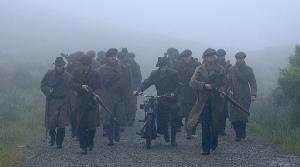
A group of men play jovially in the green fields of an unnamed village in Ireland. They go home to meet with their family members. The opening sequences can be of any era in the island's modern history, until a gang of Black and Tans (paramilitary "soldiers" sheltered by the British monarchy to quell the Irish rebellion) arrives and starts to harass the men, along with their family. They are ordered to answer their questions truthfully, then stripped for weapons. One man is headstrong and answers the harassments with brave reluctance; he gets murdered. The palpability of the Brit's oppression is now felt by the Irish villagers, forcing them to join the independence cause of the IRA. Damien (Cillian Murphy), who also witnesses the murder opts to go to London and start his career in medicine. Another example of the Black and Tan's brutality at the train station forces Damien to return to his village; swear allegiance with his more militaristic brother Teddy (Padraic Delaney) to the independence cause; and start military training.

Ken Loach's surprise Cannes winner The Wind That Shakes the Barley details the Irish independence cause, not through the eyes of its primary movers and noted personalities, but by the direct recepients of the effects of the politics and its resulting warfare. It's wonderful filmmaking by Loach. The title is drawn from the lyrics of an Irish patriotic ditty we hear sung by the women in the early parts of the film. The film shares the melancholic quality of the song; the film's evocation of the pristine greens of the grass fields --- turned in a matter of minutes into battlefields littered with dead soldiers and patches of irrevocable sacrifices of soul and morality. The same transient nature of the Irish landscape is shared by the film's turn of events; like its introduction wherein a game in the fields is transformed into a political meeting by the oppressive Black and Tans; like members of the independence cause turning in a matter of minutes (with the help of intimidation and duress) into faultless traitors; like friends turning into executioners; more importantly, midway into the film, compatriots turning into rivals, much more intimately, a brother, turning into an enemy.

The two halves of the film is divided by a truce, an event that is ironically made known to the characters right after one of the film's bleakest moment: Damien, along with his co-fighters watch (without taking action; their rifles have run out of ammunition) the Black and Tans harrasing his girlfriend and burning their house. A short period of jubilation occurs afterwards until, through a silent film reel, they learn the contents of the proposed treaty offered by the British. The political party is crushed by a schism. One half wants to continue the cause, the other wants to accept the treaty to deflect a possible and more horrific retaliation by the British Army. History paves way, the treaty is ratified, and Damien and Teddy find themselves in opposing camps.

The Wind That Shakes the Barley aches with historical burden. It somewhat points an angry finger against imperialist Britain for the present state of Irish politics. In one point of the film, a land-owner accused by the IRA of treachery accuses that if the cause succeeds, the land will turn into a backwater nation run by Catholic priests. The prediction of the land-owner rings true as Ireland hasn't arose from the ghosts of its violent historical past. The obvious manipulation of the colonial powers, the heartbreaking break-up of friendships and families, by death, by treachery, and by the common attributes of war turn Loach's The Wind That Shakes the Barley a sincere, achingly poignant and sometimes too painfully accurate look at a nation's inglorious past, which still haunts the country's psyche up to this day.

Black (2005)


Black (Sanjay Leela Bhansali, 2005)

To say that Black is a departure for director Sanjay Leela Bhansali is somewhat of an inaccuracy. Bhansali has already tackled the plight of people with disabilities in his debut feature Khamoshi: A Musicale (1996). While it is true that Black lacks the long song and dance numbers that distinguish Bollywood cinema, the film is as Bollywood as Bollywood can be; and it is also as much a Bhansali film as the opulent remake of Devdas (2002) is. The sets here seem to be a continuation of the opulent and empty halls of Devdas' period drama --- The palatial mansion of the McNally's, the university premises, even the teacher's darkened room, these places all resemble stages rather than true places that exist in pre-Independence India.

It is probably the excesses of Bhansali's cinematic style that prove to be Black's stumbling ground. There is not a tinge of poverty, of class struggle, or even of cultural distinction in the film; which might be in tune with Bhansali's wishes of making a universal film with universal themes. I thought it was a tad overdone. With all of Black's emotional power, there's always that lingering sense of unreality that keeps you from truly appreciating the film.

If there's one thing that keeps Black from stinking like a Hollywood (thus, dishonest) tearjerker is that Bhansali professes a sincere love for the characters he has concocted and the plights and conflicts he has infused them with. Michelle McNally (Rani Mukherjee, young Michelle is portrayed with a heartbreaking pathos by Ayesha Kapur) was born blind and deaf. Her father (Dhritiman Chaterji) has given up on her while her; he lets her eat like an animal, attaches a cowbell on her hip, again, like a pet rather than a daughter. Her mother (Shernaz Patel) is depicted with a lot more compassion; she looks at her child with a maternal concern that is most of the time, as powerful as it is overacted. The film however belongs to the character of Mr. Sahai, the alcoholic teacher who puts all his faith, his talent, and his life to make sure that Michelle learns how to live normally with her disabilities. The teacher is played with lively zeal by Bollywood veteran actor Amitabh Bachchan; Bachchan never descends to the silliness that made Robin Williams' professor in Dead Poet's Society (Peter Weir, 1989) a tedious presence, but instead incorporates a surprising restraint and ultimately human face to the deteriorating character.

Black, with all its faults and excesses, is still heaps and bounds above your Oscar-baiting Hollywood tearjerker. It's unembarrassed by its obviousness; each scene that begs for your tears is accompanied by the most poetically heart-tugging of dialogues and the most heightened of musical orchestrations. While I can smell a scene that undeservedly pushes its audience to tears with technical gimmickry instead of the material's true humanity (I Am Sam (Jessie Nelson, 2001) comes to mind), Black does its emotional whoring with both technical gimmickry (Bollywood does like to do everything with a bang, tearjerking included) and the fact that the story, the characters, their plights which are piles upon piles, are infused with bonafide sincerity.