Showing posts with label India. Show all posts

Saturday, April 11, 2009

Amar Akbar Anthony (1977)


Amar Akbar Anthony (Manmohan Desai, 1977)

There is enough story in the forty minute opening of Manmohan Desai's Amar Akbar Anthony to fill up an entire month's worth of melodrama. Kishanlal (Pran) ex-convict is released from prison only to find out that Robert (Jeevan), his boss who promised to take care of his family if he takes full responsibility over a hit-and-run accident he did not commit, has broken his pledge and left his wife (Nirupa Roy) afflicted with tuberculosis and his children starving. He goes to Robert's mansion, and pleads for the support that Robert owes him, but instead of getting what he deserves, is humiliated and forced out of the mansion. He fights back by shooting Robert with a gun, but fails to kill him, and thereafter, escapes from the mansion using one of Robert's cars that contains a crate full of gold bars. He goes home and finds out through a letter that his wife has left to kill herself. He takes his three children, leaves them to safety inside a park while he is being chased by Robert's men. The three children are then separated: the youngest is adopted by a Muslim pacifist; the middle child is taken cared of by a Catholic priest; and the eldest is raised by a Hindu police officer. The mother fails to kill herself, and instead, is blinded by a freak accident. Kishanlal falls from a cliff, and is presumed dead by the police, although he actually has escaped from the accident with a crate full of gold.

In a matter of forty minutes, director Desai manages to separate the three boys from each other and their parents through narrative twists and turns that appear out of nowhere, and thereafter reunites them with their mother in a sequence that serves as the film's belated opening credits: the three children, now grown up, are all inside a hospital room, donating blood to their blind mother and all of them not knowing that they are related. Its an outrageous concept, and cinematographer Peter Pereira's camerawork matches the outrageousness of the concept, focusing on the viscuous blood flowing from the siblings' arms and into their mother, focusing and de-focusing, shifting angles to enunciate the very unique circumstance of their reunion. Amar (Vinod Khanna), the eldest brother, is now a police inspector. Anthony (Amitabh Bachchan), the middle child, manages a liquor bar, while responsibly donating half of his profits to the Catholic Church. Akbar (Rishi Kapoor), the youngest, is a performer. Desai stretches the film for another two hours or so, infusing the narrative with upbeat action sequences, syrupy romance, and catchy melodies, before arriving at its predictably happy ending.

However, despite the film's obvious leaning towards plebeian considerations, it remains to be unbelievably entertaining. Desai commits to the impossibility and implausibility of the film's convoluted affairs; when the film purports sentimentality, it not only opts for shallow tears, it requires wails, screches, and enlarged gestures; when the film flirts with kitsch, it is unsatisfied with choreographed song numbers but decides that Bachchan pop out of an Easter Egg, singing a hilarious ditty ("My Name is Anthony Gonsalvez") that starts off with a long-winded yet incomprehensible speech that sounds scholarly but doesn't really mean anything; when it describes villainy, its unsubtle manifestations of human evil, from physical characteristics (bared teeth and gorilla-like muscularity) to heartless processes (Robert, in a showcase of his malevolence, orders Kishenlal to clean his shoes using his shirt's sleeve), are more than instructive of the characters' moral predisposition, they are also downright hilarious; when it involves romance, it triplicates the cheese and the corniness, giving each of the brothers a beautiful partner to court and ultimately win over. The humor, whether intended or unintended, adds to the allure of this undeniably charming flick.

It is Desai's particular preference for simple-minded pleasures fuels the film from start to finish. Desai manages to delegate the film's more-than-obvious political commentary (the three boys being separated on India's independence day, under the statue of Gandhi, and raised by India's three largest religious factions), fresh in its hopefulness on the nation's religious dynamics, in the background, not totally indispensible in the overall enjoyment of the film, but adds a possible discourse about the cinema that Amar Akbar Anthony represents. Amar Akbar Anthony is populist in its sensibilities yet not totally lacking of a say on the world-view that is current during its time. While the film is definitely unpolished, it possesses an energy, a certain rhythm, an inarguable sincerity to simply amuse without leaving any baggage or concern, that makes one forget of its blatant inadequacies and excesses.

Thursday, November 15, 2007

Dilwale Dulhania Le Jayenge (1995)


Dilwale Dulhania Le Jayenge (Aditya Chopra, 1995)
English Title: The Brave Heart Will Take the Bride

Only in Bollywood do you have films that stretch past the three-hour mark and still manage to be authentically engrossing. Only in Bollywood films do you have plotlines (sometimes borrowed from Hollywood or elsewhere) that are rehashed to death, choreographed show-stopping musical numbers that pop out suddenly, actors and actresses that practice histrionics in their method of acting and still remain enjoyable and surprisingly refreshing. Only in India would you have a film like Dilwale Dulhania Le Jayenge (The Brave Heart Will Take the Bride), a well-made but rather conventional romantic melodrama, have commercial public screenings for untiring patrons years after its initial release.

Dilwale Dulhania Le Jayenge is the first feature film of Aditya Chopra, son of legendary Yash Chopra, prolific director of such movies like Dhool Ka Phool (Blossom of Dust, 1959), Deewaar (The Wall, 1975), and most recently Veer-Zaara (2004), and even more prolific producer to several other well-loved hits. At the young age of 24, Aditya Chopra has crafted what would become one of the most successful Bollywood film of all time. It is not a great film, merely a pleasant one. Evidence of Chopra's inexperience is abundant, like the frequent flatness of his visuals (those unaccompanied by majestic geographic backdrops or loud colors, such as when the sequences happen indoors, are relatively plain-looking). However, the film's success is of course not surprising as Dilwale Dulhania Le Jayenge has all the elements of a Bollywood hit in near-perfect mix: an unchallenging thus extremely watchable and rewatchable plot, doses of enjoyable musical numbers, bits of lowbrow comedy (slapstick, witty one-liners, and other unembarrassed attempts for laughter), some action including a sequence featuring thunderous slaps on the face and a brawl scene, and most importantly, one big and unsubtle heart.

The film tells the story of two London-bred Indians, Simran (Kajol, a lovely actress with perfectly shaped eyes), who is engaged to marry the son of her father's best bud back in India, and Raj (Bollywood superstar Shahrukh Khan), happy-go-lucky son of a doting millionaire. The two meet during their one-month long excursion in Europe, a rather lengthy affair that predictably begins with the two exchanging looks of annoyance and ends with them magically falling in love. This love-hate struggle for that romantic link that would sustain the challenges to come comprises half of the film. The father's plan to have Simran wed his friend's son pushes through forcing Raj to relocate to India, assimilate into the household of the groom-to-be, and hopefully or magically convince Simran's family to have Simran marry him instead.

Dilwale Dulhania Le Jayenge is mostly interesting because it strikes a balance between two conflicting values, that of tradition and progress. "Habits left unchanged tend to become necessity-like," explains Simran's younger sister when she joked about her mother's insistence on calling his father every morning just to find out if he reached work safely. That phrase seems to be the film's starting point in its goal to ease the challenging strictness of Hindi culture. The traditions, considered by Simran's father as his family's only linkages to the homeland they left two decades ago, are guarded from being tainted by foreign influences, which is exactly how Raj is portrayed: brash, careless, and wasteful Hindi-European hybrid. Following tradition, he keeps true the promise made to a friend to have their children marry, compromising love and affection from the marital bonds.

The film puts that tradition in the spotlight but tangentially criticizes the necessities produced by the habits forged by tradition. In one touching scene, the mother placates Simran, weeping because of her inescapable misfortune. She tells her of how she was told of the equality between men and women, and how all her life she was deprived of that so-called equality leading her to promise Simran when she was a baby to assure her a life of happiness. She recants her promise, surrendering that women do not even have the right to give such promises. In that scene, we see how a strict appraisal of tradition is tantamount to a deprivation of some facets of humanity. That scene is sad, uncharacteristically so in a movie that bursts with such mirthful energy.

Despite that, the film relishes in tradition where it matters. Raj, supposedly the Indian who was lured to the liberalities of the West, exemplifies tradition and progress in harmony. Faced with the dilemma of losing her love to the whims of an agreement made decades ago, he still chooses to have the father give his blessings instead of whisking Simran away with him. He grounds his belief with object rationality, as explained in his impassioned speech to Simran and her family, that to elope with Simran is tantamount to severing treasured ties with the family. Even during the final suspenseful moment, Raj keeps his well-tempered adherence to tradition with absolutely no clue whether his gamble will pay off or cause him to spend a lifetime of heartache and regret. Whatever happens, the conclusion remains sumptuous, truly deserving of the three hours spent arriving to it.

Friday, June 01, 2007

Kaagaz Ke Phool (1959)


Kaagaz Ke Phool (Guru Dutt, 1959)
English Title: Paper Flowers

I initially thought Pyaasa (Thirst, 1957) is the greatest musicale ever made, until I decided to watch Kaagaz Ke Phool (Paper Flowers) again. These two films by the great Indian filmmaker Guru Dutt have affected me tremendously. While Pyaasa is the more perfect film between the two, Kaagaz Ke Phool is more poignant, more memorable, and more beautiful to look at and listen to.

The opening is probably the most tragic entrance ever put in celluloid. An old man (Guru Dutt) passes through the gates of a film studio, stops by the imposing structure of the film studio. The framing of the old man's entrance to the studio shows the man made minuscule by a statue that marks the building. The man finally enters the studio. Beams of dust-littered light give the studio an eerie, forgotten atmosphere. The old man climbs up a flight of stairs, then starts singing of his fate. We become aware that it is not the studio that has been forgotten, it is the man who has been forgotten by the studio, the industry, the crowds that once adored him and his work. The old man, Suresh Sinha, used to be a very successful film director. Superimposed on his defeated teary face were moments of his former glory, with the elegance of the cinema where his film is met with applause by a crowd of cheering moviegoers.

Despite the successes in his field, there is something that is lacking in his life. Estranged from his wife (Veena) and daughter (Kumari Naaz), he focuses on his craft, with a project of adapting the tragic tale of Devdas. One rainy night, he chances upon Shanti (Waheeda Rehman). He offers the girl his coat, which she then returns to him one shooting day. Sinha notices virtues of innocence and simplicity in Shanti, requisites to the Devdas heroine and thus recruits her to star in the film, unknowing that he is starting to fall for her.

The film is beautiful. V. K. Murthy's cinematography adequately captures the film's melancholy and sadness through evocative framing and purposeful lighting. Giant shafts of light are utilized during the film's resonant moments such as during the film's love theme Waqt ne kiya (sung by Geeta Dutt), wherein Sinha catches Shanti knitting alone one early morning in the film's studio. The two at once recognize themselves as two lonely people who uniquely understand each other and such recognition, and given their difficult circumstances, becomes for them "sweet calamity," in a way that social norms and their respective fates prevent themselves from being with each other. Murthy's shafts of light give a quietly hopeful quality to the film's doomed lovers. It visually makes the aches more poignant as a tinge of unnatural beauty is revealed for an equally beautiful relationship prevented by the cruelty of human life.

Accompanying Murthy's grandiose visuals are the music composed by S. D. Burman, with lyrics written by Kaifi Azmi. One of the more notable songs is performed by Shanti, who relates to a group of kids a story about how the numbers kept on fighting to the detriment of the youngest number (1), forcing it to meet up with a same-fated number (0) to create a ten, which is again forcedly separated by other numbers. The melody, which is utterly simple and gratifyingly jovial, actually sounds like a nursery rhyme. However, it is burdened with the task of summarizing the entire film to little children. The result is a fascinating summary that is successful, embarrassingly too simple that the children relate to the message, singing and dancing along the happy rhythm of the song. Yet, it feels like that simplicity cannot exist in a world that is more interested in fame, success, class structures, and norms, something still alien to Shanti's wards' innocent minds.

If there is such a thing as imperfection in a film that perfectly captures the treacherous movements of life, more specifically life that is involved in movie-making, it is the side plot of Rocky (played by wonderful Bollywood comedian, Johnny Walker), Sinha's brother-in-law who constantly travels to Mumbai to race horses and hang out with movie people. He is disdained by his family for his unusual ways. Walker gives a welcome comedic air to the tragic affair but his inclusion in the film itself is more of a distraction rather than a pertinent entry. Seeing the film again, my initial reactions to Rocky's side plot remains. However, this narrative hiccup (by director Dutt and writer Abrar Alvi) makes the film mysteriously interesting. For sure, Rocky is that single character that connects the two impenetrable classes. He's the only important character who's free to choose his fate, certainly unlike Sinha or Shanti who are trapped with their tragic fates, and persistently evades anything that will take that freedom away.

Kaagaz Ke Phool is Dutt's most personal film. It is prophetic as it is autobiographic. Pyaasa may be the better and more coherent film, but if I were asked point blank without given any time to think, I would probably say that this film is my favorite of Dutt's films. It is one of the greatest, if not the greatest, film about filmmaking ever made.

******
This is my contribution to the Movies About Movies Blog-a-Thon at goatdogblog.

Monday, May 14, 2007

Rang De Basanti (2006)


Rang De Basanti (Rakesh Omprakash Mehra, 2006)
English Title: Paint It Yellow

Sue (Alice Patten) is a British filmmaker who wants to make a film about the young revolutionaries that inspired India's independence movement. After being rejected by her producers (they said that Bhagat Singh will not make any money, as compared to films about Mohandas Gandhi), she packs her bags and flies off to India to start a film from scratch. With the help of Sonia (Soha Ali Khan), she completes her cast consisting of happy-go-lucky college students whose lives start to mirror the lives of the idealistic martyrs of Sue's film.

Rang de Basanti, translated into English as "Paint It Yellow," is an edgy Bollywood film. It is overtly political and has a message that can easily be mistaken by its viewers as consenting to vigilante justice. Its brand of patriotic martyrism would raise the eyebrows of those who acknowledge modernist grievance procedure, through the supposedly available and free windows that democracy provides. It seems that writer-director Rakesh Omprakash Mehra, in an attempt to convert anti-colonialist aspirations to the ires of India's disgruntled youth, has come up with a film whose raison d'etre can easily be misunderstood. In his attempt to put upon a pedestal neglected patriots like Bhagat Singh and his band of revolutionaries, he also gives a brash go-signal for unflinching and unlawful activism.

It's a message film, which is all wrapped-up with the refreshing and generally jovial film methodology of Bollywood. There's an attempt to lessen the unreality of the song-and-dance numbers as most of the numbers are filmed in MTV-fashion instead of the traditional Bollywood way wherein characters would suddenly start singing and dancing. There's a genuine effort to reach out to the film's targeted audience, the youth. The film's heroes are all representative of the carefree generation whose main preoccupation in life is to find means to get away from the growing economic troubles of India, while still enjoying the obvious elements of their youth --- their bachelor-hood, nights of endless alcohol-drinking, road trips, and so forth.

It's beautifully made. The historical portions of the film (supposedly made by Sue; although I'm quite surprised she was able to make what seems to be a well-made film with only one camera and a non-existent crew) are done with sepia tones while the contemporary portions are filmed with lush glossy colors.

The cast's rapport, I must admit, is quite magnetic. Aamir Khan, who plays someone who is half of his real age, carries off the role with enjoyable game-ness; his wisecracks and witticisms never feel forced and his abrupt change from the group's joker to its unofficial leader is made comfortably palatable by the actor's range and undeniable charm. It is that effective camaraderie that embraces the film's emotional core; their individual interactions pulsate up to the point wherein what Mehra seeks to establish is tested (early in the second half of the film wherein the bonds of friendship are tested by governmental intrusion) --- the effect is wonderful; through what seems to be contrived and corny, a heartfelt depth becomes apparent.

Rang De Basanti is a problematic film. It is undoubtedly made with sincere rousing spirit, but the result can be construed to mean anything from espousing terrorism to comforting the Indian youth. It is best when treated as merely a piece of entertainment, with a rousing message that is intertwined with its emotional core. As for me, I'll take it for what it is --- a mainstream Bollywood film that seeks to push the envelopes of the healthy yet rather conservative national cinema, and quite successfully at that.

Tuesday, February 06, 2007

Jalsaghar (1958)


Jalsaghar (Satyajit Ray, 1958)
English Title: The Music Room

Satyajit Ray's Jalsaghar (The Music Room) is bookended by an image of an ornate chandelier swinging against a black background. The same chandelier is the centerpiece of the jalsaghar (or concert room) of landlord Huzur Bizwambhar Roy (Chhabi Biswas). It's a beautiful room --- large portraits of Huzur's ancestors adorn the wall; a large mirror backdrops each musical performance; majestic pillars serve as both pointers to the palatial status of Huzul's mansion and as sturdy backbones of the manor. It's truly a magnificent room, but there's an air of decay, of a fading glory to it. It's the same look that pervades the entire Roy mansion --- the lone imposing figure in a vast field of grass and crops but its walls are deteriorating; its master quickly fading along with the extravagance of the past.

Huzur is first shown as a weak, almost invalid man. He hears distant music and asks his loyal servant as to where such music comes from; Mahim Ganguly (Gangapada Basu) is celebrating his son's initiation. He wonders if he was invited; he was, but not personally. It's a brilliant opening scene. Ray instantly captures the lost splendor as Huzur is depicted as someone who seems to have just awoken from a long slumber; surprised as to how the world has changed and how he has completely lost touch with life. Ray's cinematographer Subrata Mitra showcases how little Huzur is against his mansion (he is seen in the rooftop) and the lands he presumably owns (there's a sense of vastness of empty and fallow land from the viewpoint of Huzur's rooftop). More importantly, Ray focuses on Huzur's facial features; Chhabi Biswas' eyes are rightfully deep and hurt and his face's lines evoke a forced aging.

And aged he has, at least after three years from the moment he rides his favorite horse home; and being greeted by his servants announcing a visitor --- Mahim, who was then an enterprising businessman asking a favor from the landowner. The Huzur we first see atop his mansion and the Huzur from the flashback are almost two entirely different personas; the former is weak and detached from the world while the latter celebrates life. He throws a concert to celebrate his own son's coming-of-age. Ray wades his camera from the musicians to the audience; Huzur in absolute satisfaction; nouveau rich Mahim uncomfortably getting used to classical Hindustani music. Huzur's pragmatic wife is clearly disappointed as her jewels were mortgaged to fund the party. The Roy family's coffers are thinning; the rivers are diminishing their estate; yet they remain to be their community's remaining aristocrat with a lifestyle that became their opium or addiction.

The second concert of Huzur, funded wastefully from the few remaining jewelry of his wife and a mere afterthought by Huzur to top Mahim's house blessing, showcases a traditional Hindustani singer whose vocal prowess seems to match the atmospheric dread that will meet Huzur's wife and son's untimely demise. It's a powerful sequence; Ray lands his camera to the little indications of trouble (the uncomfortable swinging of the grand chandelier, the insect swimming in the expensive wine) before lashing out in an explicitly dramatic turn-of-events (Ray's powerful tableau of Huzur grasping desperately for his son's dead body).

The third concert, funded from the last few coins of a deadened estate, features a performer dancing to the beat of drums. The milieu has changed; Mahim has crossed-over to modernity (he arrives by automobile and has more than enough reasons to treat the faded aristocrat with much less reverence) and perhaps thinks that the modern age brings with it a complete erasure of the fact that he is merely a usurer's son; Huzur's jalsaghar is less grand with less servants and furnishings (Mahim scoffs at Huzur's last hurrah, complaining at the lack of fanners to ease the heat and humidity). The performance upstages all the deterioration, the faded glories, and the lingering poverty that surrounds Huzur, and in his final determination of class, reprimands Mahim in tipping the excellent dancer before the host. He throws his family's final fortune signalling the belated end of the landowning Roy clan.

In Ray's closing sequence, Huzur sees and fears the lights of his jalsaghar being doused (among other signals of his demise; a spider roaming in his portrait, his drunken ode to the blood (which is the lone reminder of his majesty) that flows in his veins and his lineage) before being reminded by his servant that it is dawn. He rides his horse before being thrown to his death. It's an entirely tragic affair and despite all of Huzur's flaws and his impracticality, there's a lingering grace in Ray's convicted depiction of the landowning class (Ray is himself a descendant of a long line of landowners). Huzur's passing is treated with a reverent mourning, mostly by his loyal servants as well as the film's viewers who are drawn to the aristocrat's addicted reliance on a faded and forgotten glory, not out of characteristic imperfection but of a misguided placing by a class-ed society entering the age of equal opportunities. Like the chandelier swinging in the opening and ending of Jalsaghar (as well as that stormy night of Huzur's family members' deaths), a breeze of change is more than felt, set in a background of indiscernible darkness.

Saturday, November 18, 2006

Black (2005)


Black (Sanjay Leela Bhansali, 2005)

To say that Black is a departure for director Sanjay Leela Bhansali is somewhat of an inaccuracy. Bhansali has already tackled the plight of people with disabilities in his debut feature Khamoshi: A Musicale (1996). While it is true that Black lacks the long song and dance numbers that distinguish Bollywood cinema, the film is as Bollywood as Bollywood can be; and it is also as much a Bhansali film as the opulent remake of Devdas (2002) is. The sets here seem to be a continuation of the opulent and empty halls of Devdas' period drama --- The palatial mansion of the McNally's, the university premises, even the teacher's darkened room, these places all resemble stages rather than true places that exist in pre-Independence India.

It is probably the excesses of Bhansali's cinematic style that prove to be Black's stumbling ground. There is not a tinge of poverty, of class struggle, or even of cultural distinction in the film; which might be in tune with Bhansali's wishes of making a universal film with universal themes. I thought it was a tad overdone. With all of Black's emotional power, there's always that lingering sense of unreality that keeps you from truly appreciating the film.

If there's one thing that keeps Black from stinking like a Hollywood (thus, dishonest) tearjerker is that Bhansali professes a sincere love for the characters he has concocted and the plights and conflicts he has infused them with. Michelle McNally (Rani Mukherjee, young Michelle is portrayed with a heartbreaking pathos by Ayesha Kapur) was born blind and deaf. Her father (Dhritiman Chaterji) has given up on her while her; he lets her eat like an animal, attaches a cowbell on her hip, again, like a pet rather than a daughter. Her mother (Shernaz Patel) is depicted with a lot more compassion; she looks at her child with a maternal concern that is most of the time, as powerful as it is overacted. The film however belongs to the character of Mr. Sahai, the alcoholic teacher who puts all his faith, his talent, and his life to make sure that Michelle learns how to live normally with her disabilities. The teacher is played with lively zeal by Bollywood veteran actor Amitabh Bachchan; Bachchan never descends to the silliness that made Robin Williams' professor in Dead Poet's Society (Peter Weir, 1989) a tedious presence, but instead incorporates a surprising restraint and ultimately human face to the deteriorating character.

Black, with all its faults and excesses, is still heaps and bounds above your Oscar-baiting Hollywood tearjerker. It's unembarrassed by its obviousness; each scene that begs for your tears is accompanied by the most poetically heart-tugging of dialogues and the most heightened of musical orchestrations. While I can smell a scene that undeservedly pushes its audience to tears with technical gimmickry instead of the material's true humanity (I Am Sam (Jessie Nelson, 2001) comes to mind), Black does its emotional whoring with both technical gimmickry (Bollywood does like to do everything with a bang, tearjerking included) and the fact that the story, the characters, their plights which are piles upon piles, are infused with bonafide sincerity.

Monday, September 11, 2006

Shatranj ke Khilari (1977)


Shatranj ke Khilari (Satyajit Ray, 1977)
English Title: The Chess Players

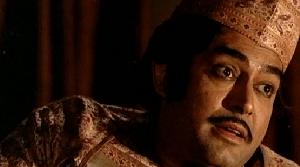
In an early scene in Satyajit Ray's only Urdu language film Shatranj ke Khilari (The Chess Players), General Outram (Richard Attenborough) interrogates Captain Weston (Tom Alter) regarding the conduct of Oudh monarch Wajid Ali Shah (Amjad Khan). The English-speaking Outram, curious of the supposed incompetencies of the Oudh king as shown by a report stating that the king spends an entire day poetry-reciting, songwriting, and tending to his impossibly large harem, requests that Weston recite one of the king's verses and the latter does so. He translates it to English as per request, and Outram thinks of the verse as not really of exceptional merit. Outram then reveals the British India Company's plans to depose the king of his crown and the administration of Oudh. The scene sets the conflict in the film while showcasing the outright clashes of culture of the invading British and the Muslim citizens of Oudh.

Shatranj ke Khilari is set in the last days of King Wahid's rule over the province of Oudh. The British has expressed to renege on the centuries old agreement that assured the royal family of the throne while providing gold for the British to advance their military. The agreement has made the ruling king lax and instead of actually administering to his subjects, he spends most of his time tending to his poetry, kite-flying, and his many wives and concubines. While the king is troubling over the impending advancement of the British military to conquer his kingdom, aristocrats Mirza (Sanjeev Kumar) and Meer (Saeed Jaffrey), descendants of brave warriors of a venerated past king, spend most of their time playing chess while their domestic lives and their nation suffer.

Shatranj ke Khilari is considered one of Ray's weaker efforts. It is notably different from Ray's most famous films as first, it is not in Bengali, second, Ray lets go of his neo-realist roots to create a film that feels and looks like a colorful and richly-adorned pageant, and lastly and connected to the second point, it is historically grounded paving way for more intellectual discussion rather than humanism. In fact, the film begins with an academic opener narrated by Bollywood superstar Amitabh Bachchan. The opener feels more like a teaching tool for history students complete with intricate discussions on Urdu culture, Urdu-British relations, and an instructional (if not simplistically humorous) short animated portions.

The rest of Shatranj ke Khilari plays out like a confused Bunuel film, only there are no bourgeoisie or any structured religion to poke fun on. The two aristocratic friends insist on playing a game of chess no matter what, and their efforts to do such is actually quite funny. Mirza's wife is so jealous of the game that she steals the ivory pieces, leading the two friends to try to borrow the pieces of their dying lawyer, and then finally ending up using household vegetables just to continue their pastime. Similarly, Meer doesn't acknowledge the blunt fact that his wife is cheating because she leads him to think that she's also enthralled with the game. Those clever bits by Ray flush out the dulling gravity of the history lesson Ray insists upon.

The film ends with Oudh being delivered to the British without any resistance and violence. The two friends find themselves in an abandoned house just outside the capital city of Lucknow. While the entire kingdom is being served out to the Brits on a silver platter without any hesitation whatsoever, tension is created when in a fit of losing, one of the friends lash out to personally insult the other. The only gun blast heard when Oudh was finally invaded by the British was when in the tensest of that momentary tension, Meer accidentally shoots his friend in the sleeve of his arm. That the entire political history of India has been mere minds playing a long winded game of chess, and it is an expected eventuality, that through stratagems and notions of friendship, that one will finally shout "checkmate" and corner the opponent to withdraw.

Friday, August 25, 2006

The Warrior (2001)


The Warrior (Asif Kapadia, 2001)

Director Asif Kapadia's first feature film The Warrior is what a person may unbashedly describe as a mongrel film. The story is based on a Japanese tale, adapted to an Indian setting, directed by a Brit-Indian who co-penned it with an Englishman, photographed by a German-Nigerian cinematographer, scored by an Italian, with a Bollywood star for the main lead, and hundreds of Indians as extras, all funded with money sourced from the Great Britain and Germany. Despite the confusion that may arise out of the mixed nationalities of the people behind the production, The Warrior is a simplistic epic whose raison d'etre can be likened to the recurring themes of Western-genre films.

It's basically a revision of Sergio Leone's The Good, The Bad, and The Ugly (1966) trimmed down from sprawling historical epic to near-silent parable. That simply means that there's a lot less of the fun, the testosterone, and the adventure of the spaghetti western, and instead of Clint Eastwood who figures out a way to use his gunslinging skills for arguably moral ends, we have the titular warrior who completely erases violence from his vocabulary to live a life in the serene splendor of the foothills of the Himalayas.

The titular character (Irfan Khan) is a hired thug of the local landowner who exacts revenge from his non-paying tenants by ordering the warrior and his horde to pillage and burn the villages of those who can't pay. The point of catharsis for the warrior is when he almost kills a little girl who is wearing the necklace of his son. Almost immediately, he withdraws from his former life of killing to finally reunite with his hometown. The warrior's betrayal of his duty angers the landowner and orders the other mercenaries to hunt him down, and in the process, killing his only son. Instead of vengeance, the warrior quietly journeys to his hometown, meeting a petty thief (Noor Mani) and a perceptive blind woman (Damayanti Marfatia) on the way.

One thing that can be said about The Warrior is that it is gorgeous. Cinematographer Roman Osin captures the change of landscape from harsh deserts to the peaceful mountains with a touch of visual poetry. There's so much beauty to behold in the film that one may consider the film's visual touches a mirage to the barrenness of the material. It is acknowledged that The Warrior's story has meager roots. Co-writer Tim Miller describes the source as a fable about the son of a warrior who is killed for lying to save his father when a cruel landowner asks whether the beheaded man his minions has just killed is his father.

Kapadia and Miller muse as to what could've happened to the father, who doesn't figure anymore in the Japanese fable. Their conclusion is that the father suddenly leaves his life of violence, which is totally acceptable if Kapadia merely took a strong-willed insistence on the entire catharsis. In the film, the change is so sudden, far-too mystical and abstract, to have you suddenly rooting for the changed hero. All his life he led a life of violence, doing the bidding of his cruel master, and even training his son to follow his footsteps, and in a whim, he lets go of such without a care.

Kapadia insists on telling his tale as minimally as possible. He relies on Irfan Khan's subtle gestures to move his plot, but as such, he often stumbles in his struggle for simplicity. The result is quite a hefty bore. True, I was enchanted by the scenery, lullaby-ed by the musical score, and lead on by the afterthought of a parable, but in the end, it all feels so dull, so inherently pointless, that I adopted a conclusion that the film is mostly pretentious, insincere, and confused. Kapadia sought to utilize his European film theories learned from film school, with what he thought was an adept knowledge of his Indian roots, but fails to understand that his unvocalized tale staggers with the weight of his overly zealous visuals.

Saturday, August 05, 2006

Swades (2004)


Swades (Ashutosh Gowariker, 2004)
English Title: Our Country

Almost every thinktank, hospital, educational facility, technical departments of huge corporations would have a non-resident Indian (NRI) as employee, either as a technical expert or specialist. Indians have migrated out of their nation with the hopes of finding better opportunities for living, education, or social acceptance. It is actually not endemic to India, but to almost every nation that has suffered poverty and severe social inequalities. Families would migrate all over the world to find immediate solutions to a more impending concern: which is their very own comfort, and their children's future. Yet as the title song of the Ashutosh Gowariker's follow-up to the critically acclaimed cricket epic Lagaan chants: an invisible bond between oneself and one's country will keep you coming back. Such is the dilemma of Swades protagonist who has achieved much recognition and fulfillment abroad, but has fallen in love with the land he left more than a decade ago.

Mohan Bhargav (Shahrukh Khan) is the film's protagonist, a technical expert for NASA who is initiating a project involving launching a satellite that will measure global precipitation. On the day of the project's press conference, he suddenly feels the urge to visit India and bring back his beloved nanny and surrogate mother Kaveri (Kishori Balal) to America and take care of her. He returns to India and discovers that Kaveri was taken out of the old folks' home and brought to a remote village. He rents a station wagon and travels to the remote village. There, he falls in love with an independent, strong-willed school teacher Gita (Gayatri Joshi), while slowly nurturing a growing love for the village's simple life and adherence to tradition.

Swades has a clear message. It works best as a letter to each and every Indian to nurture a love for the country they have conveniently left. It also works as a caution to all Indians that there are traditions that delay growth, and that mere reliance on one's age-old traditions and culture is a mere excuse to keep one's attention to the country's more pressing problems. Of course, much of what has been said here is spoken directly by the characters in the film, which is one problem that keeps me from completely falling in love with the film: it is preachy and repetitive in this insistence. Such preachiness may have been the result of Gowariker's clear passions at work. Here, Gowariker shows much more personality, much more individuality than the technical expertise which he showcased in Lagaan.

Lagaan is a much-lauded film, mostly because it was able to provide entertainment from the impossibly complex sport of cricket, complicated with Bollywood-type song numbers and blatant melodrama. Swades is much more personal I think, which might impede appreciation. The song numbers a lot more meaningful and more incidental to the plot, and the melodrama more grounded on humanism than on narrative romanticism. What Swades lacks is technical polish. The film tends to slowdown, something I rarely felt in Lagaan's more than three hours running time.

There are several scenes of note here, but one scene, actually a song number, struck an emotional cord with me. The scene opens with a film being shown in the village center. The brahmin and the rich people on the correct side of the white cloth used as a screen, and the less privileged and the people of lower caste, on the wrong side of the cloth, seeing the movie in mirror image. The power dies, and the song number begins, about the stars and how a star may be brilliant in its lonesome, but create a clear picture when together. The cloth is torn down by the protagonist who dances, in true Hollywood fashion, with the village children who discard the traditional caste system. It is beautiful despite the obvious kitsch. There are several other scenes that simply and directly portray India's plight, and numerous scenes that showcase the land and more imporantly, the people's beauty. After three and so hours of Gowariker's filmmaking, there is a clear acknowledgment that Swades is not merely entertainment fare, it is a love song to a nation most of its citizens are willing to give up for personal comforts.

Friday, July 28, 2006

Baazi (1951)


Baazi (Guru Dutt, 1951)
English Title: The Wager

Guru Dutt's Bollywood career can be said to have been a direct result of his friendship with actor Dev Anand. It is said that the two artists who were then struggling to make it big in Bollywood, made a pact to help each other when one gets a break. Anand promised that if he ever produces a film, Dutt would direct it; and Dutt promised that if he ever directed a film, he would have Anand to star in it. Anand hit it big first, and subsequently produced a film. As promised, he asked Dutt to direct it. The result is Baazi (The Wager). Baazi is the start of Gutt's illustrious career. After Baazi's success, Dutt would produce and direct a least two undeniable masterpieces, Pyaasa (Thirst, 1957) and Kaagaz Ke Phool (Paper Flowers, 1959). Anand would continue to star in big Bollywood productions, among which are several greats from different directors.

Baazi is about Madan (Dev Anand), an unemployed young man who is taking care of his ailing sister. Madan is a likable guy and he seems to attract many friends despite his very playful attitude. Madan also has the gift of luck. He is often seen in gambling places in the underbellies of the city trying his luck in the different games to earn a few bucks to buy medicine for his sister. A representative of a huge gambling circuit which masquerading as a legitimate night club, invites him to work for them, luring rich businessmen and royalty to their den and cheating them off their cash. Rajani (Kalpana Kartik), a public doctor and the daughter of a millionaire, meets Madan while tending to his sister. The two slowly fall in love, but because the difference in class, neither of the two can make a move. Because of dire circumstances involving his sick sister, Madan accepts the shady job offered him, and would have to wager his life, his love, and his honor to gain the little things his poverty has prevented him from getting, including much-need treatment for his sister.

Baazi, being the directorial debut of Dutt doesn't show much of what the director would be capable of in his later films. However, it is distinct from the film that Dutt is gifted in setting up an atmosphere that is appropriate to the film's mood. Much of the film is shot in sound stages, and one can instantly observe poorly painted sets. However, Dutt takes control of the budgetary constraints and still manages to come up with tight visuals: mainly focusing on close-ups of his actors and actresses' faces, or clever blocking that takes the eye away from the lack of scenery.

Baazi is an urban crime tale and its structure is very similar to the film noirs that are very popular in America. Naturally, Dutt doesn't sway by giving second-rate visuals to his Bollywood noir. The opening sequence in itself shows a director who knows what he wants: the camera following a mysterious character down the dark alleyways of the city leading to damp, and dangerous gambling nests. He sets his audience up for a tale of mystery, of danger, where each and every character is capable of treachery. He creates an urban world that looks and feels much like a gambling den, where every move requires a wager, and oftentimes there is a need to bluff and a need to just fold and give up, and rely on the impression that lady luck is with you.

However, Baazi is not entirely noir. While the film has noir elements, most of that downward spiraling noir heroes experience only happens during the last thirty minutes of the film. There are no clear femme fatales, female characters whose role in the narrative is to accompany the hero to his eventual descent. It can be argued that Leena (Geeta Bali), the nightclub dancer is this noir's femme fatale. However, Dutt has always had a soft spot for women, and paints Leena with much respect despite her lowly profession. The mood is much more cheerful than its American counterparts, mostly due to the fact that scenes are separated by song and dance number, composed by the great S. D. Burman. The film does not center on the noir elements, but the theme of Madan's metaphorical wager of everything that matters to him he has in exchange for monetary comforts and his sister's welfare. The film's heart does not belong in the film's attraction and utilization of crime, but to the well-told romance-against-all-odds between Madan and Rajani.

Monday, July 17, 2006

Pyaasa (1957)


Pyaasa (Guru Dutt, 1957)
English Title: Thirst

The first Guru Dutt film I saw is Kaagaz Ke Phool (Paper Flowers, 1959), a film about a filmmaker trapped in the middle of a love triangle between a former wife and his muse, and choked by the public's overwhelming expectations of him. It has been said that the film (a box office failure in India) mirrors too much the life of Dutt, whose string of successes ended with his suicide. I was beholden by the film, which was an almost perfect marriage of beautiful black and white photography, understated musicality, lovely lyricism, as orchestrated by Dutt's perfectionist direction. I thought Kaagaz Ke Phool is Dutt's lone masterpiece, until now. Pyaasa (Thirst), made a few years before Kaagaz Ke Phool is even lovelier, more lyrical, and more fine tuned.

While Kaagaz Ke Phool's hero was a filmmaker, Pyaasa focuses on a different kind of artist --- the poet. Vijay (Guru Dutt), is a poet whose works are quickly dismissed by publishers. Driven out by his brothers, Vijay lives in the streets where he meets Gulabo (Waheeda Rehman), a prostitute who accidentally buys Vijay's poems from a junk shop. Vijay's thirst for recognition, both from the public and his former sweetheart Meena (Mala Sinha), leads him to work for rich publisher and Meena's husband Mr. Ghosh (Rehman), who jealously dismisses Vijay after knowing of his wife's former relations with the young poet.

From the start of the film, Dutt introduces us immediately to his character's poetry. He also subtly opens our knowledge to the film's theme. Vijay is lying beside a pond, poetry is sung in the background: about a bee being intoxicated by nectar, and how we it is inevitable that we cannot contribute to this world. The visuals move from Vijay to a bee gathering nectar from a flower, only to be crushed by a man walking past. We see Vijay startled by the mindless destruction. He then travels to his publisher's office, and we realize that like the bee, he is also mindlessly destroyed.

Dutt populates his film with this kind of rich mixture of imagery, poetry, and music. It's as if Dutt has so much to say that his intentions cannot merely be covered by plain cinematics. Another moving scene is where Vijay, intoxicated after learning that his mother has died, goes out with his friends to Calcutta's red light district. Dutt's camera wildly motions as a street dancer feverishly dances as her baby is suffering from sickness. Dutt segues to a song number about prostitution and how a so-called noble land can exist with such treatment of its women. The lyrics is powerful enough to move, but mixed with the gorgeous music, Dutt's wonderful acting and directing, the fluid camera movement and gorgeous lighting, you have one of the most telling, most emotional cinematic sequences about prostitution ever put on screen.

Pyaasa is the film wherein Dutt found collaborators who would fit his film style perfectly. Before that, it was only Dutt and screenwriter Abrar Alvi who crafter their magic together. Of course, V.K. Murthy's cinematography has given Dutt's previous films topnotch visuals. In Pyaasa, Dutt discovered S.D. Burnam, whose music does not require itself to be the centerpiece of each scene but is ravishing in its subtlety. Dutt also discovered his lyricist Sahir Ludhianvi, whose poetic verses can be regarded as first class literature by themselves. Burnam and Ludhianvi's songs mix very well with Dutt's style of putting his musical numbers as backdrops to his cinematic style. An example here is when street performers sing a song about the thirst for love, whcih is perfectly counterpointed by Gulabo finally realizing that she is in love with Vijay. There are no loud instruments, or intricate choreography, just a melody that can distinctly mold into the film's scenery, and lyrics that pertain directly to Dutt's intentions. It is that marriage of all these elements that make Pyaasa a perfect film.

Finally, Mala Sinha, who beautifully balances a materialistic exterior and an interior longing to love the poor poet, is also a newcomer. Waheeda Rehman, that beautiful woman with perfectly sorrowful chestnut eyes, was handpicked personally by Dutt to portray the prostitute with the heart of gold. Years later, in Kaagaz Ke Phool, Rehman would portray the director's love interest, who is curiously, a newly discovered actress. In Pyaasa, Rehman provides the film with the focal point for Dutt's rich emotions and perfectly drawn melodrama. She gives Dutt's themes a visual form.

It is quite interesting to note that Pyaasa is not really original in its storyline. It resembles timeless tales of poets and sages falling for women of lower classes. The love triangle here is similar to that of Devdas, which was filmed two times by two different directors, before Pyaasa was released. In fact, Dutt's themes aren't all very new. They've been the topic of stories, novels, epics, poems written ages before Dutt's time. However, the magic here is that Dutt borrows plots, themes, and characters, and breathes into them his personal touch and perfectionist eye, and the result is simply, the most beautiful, probably the greatest unsung musicale ever made.