Showing posts with label Tsui Hark. Show all posts

Tuesday, November 20, 2007

Triangle (2007)


Triangle (Tsui Hark, Ringo Lam & Johnnie To, 2007)
Cantonese Title: Tie saam gok

The concept is to die for. Three of Hong Kong's best directors (Tsui Hark, prime mover of the Hong Kong new wave; Ringo Lam, whose City on Fire (1987) practically initiated the overrated career of Quentin Tarantino with his American version, Reservoir Dogs (1992); and Johnnie To, one of the most consistent and most exciting genre directors around) agree to make one feature film but unlike the usual triptychs (like Three (Kim Ji-woon, Nonzee Nimibutr, and Peter Chan, 2002), Three: Extremes (Park Chan-wook, Takashi Miike, and Fruit Chan, 2004) and Eros (Michaelangelo Antonioni, Steven Soderbergh and Wong Kar-wai, 2004)) where the helmers would create short films merely connected by a thematic or some other flimsier thread, the trio would make one continuous narrative laid down by Tsui, pumped up by Lam, and wrapped up by To.

Aptly titled Triangle, the film starts off with three friends: blond-haired mama's boy and taxi driver Fai (Louis Koo), antiques dealer Mok (Sun Honglei), and nearly bankrupt husband Bo (Simon Yam) to an unfaithful psychotic wife Ling (Kelly Lin). The three, while discussing a possible heist that would instantly give them much-needed big bucks, is given a tip by a mysterious man of a treasure hidden inside the legislative building. The three head off to retrieve the treasure as the triad members they conned and the renegade cop (Lam Ka-tung), who is having an affair with Ling, hunt them down.

Despite all the contrivances, the inconsistencies, and the confusion, everything works. The film isn't divided into portions but it's quite obvious who directs which part. The frenetically edited first third of the film, where the characters are introduced and the basic conceit of the narrative is put into the table (quite delirious in the amount of information that is let out of the pandora's box), is obviously Tsui's doing (the same director of manic fantasy fests Zu: Warriors from the Magic Mountain (1983), its disappointing sequel Zu Warriors (2001), and Seven Swords (2005), and riveting actioner Time and Tide (2000)). The madness is then grounded by Lam, putting some teeth and psychology to Tsui's hard lucked protagonists, while setting up connections that would lead to To's grand finale, where the director merges his knack for comedy and his exquisite eye for bullet ballets in a near-operatic shootout in a grass and scarecrow covered field.

There's a consonant flow to the trio directors' predicated chaos. Each director is responsible for his segment in the film, with only the previous director's final output as guidance and cue for their part. Despite the freedom, the film didn't end up as a flagrant mess, which is not very surprising. Tsui, Lam and To, along with Hong Kong's other legendary directors (like John Woo, Wilson Yip, even Wong Kar-wai), have established the running themes, the prominent styles, and the basic narrative framework that define the former British colony's mainstream cinema. The three directors have decades of films and common experiences to make sure that Triangle falls within the borders of convention (and thus, render it commercially viable and extremely watchable). At most, it is To who takes the most risks, and comes out contributing the most to the narrative, without sacrificing his trademark quips. He basically uses every bit of conceit initiated by Tsui, incorporates the surfacing themes by Lam, and completes the picture with a surprising turn and a loud and flaunting bang, thus, turning Triangle into one memorable romp.

You'd think that with the differing productions (separated by months, depending on the actors' schedules) and directing styles, Triangle will end up as a merely entertaining experiment without any real depth to chew on. Actually, the film pretty much rehashes the well-entrenched theme of honor and loyalty in Hong Kong cinema. In the midst of the clinging temptations of a multimillion-dollar treasure, three men with varying motivations (the final goal is the big bucks but: Fai is trapped in the middle of various obligations from his dissonant relationships with the cops, the gangsters, and his two partners in crime; Bo is struggling with his wife's love affair with a cop dealt upon by his insolvency while reminiscing his abruptly ended marriage with his first wife; Mok is contemplating between his financial crisis and his precious moral stance) manage to overcome the hindrances and the odds that differentiate them, and retain or salvage what they value the most.

It also doesn't hurt that the oft-told parable, which the film really is, is overflowing with the three directors' distinct styles. Triangle leaves you throbbing and satisfied, hooked by the idiosyncratic small time would-be crooks Tsui introduces and weaves together, moved by the romantic dance inside an abandoned factory provided for by Lam's instinctive designs, and finally swept by hilariously extended switch-ups and the over-the-top moonlit gun play To gambled around with.

Tuesday, August 29, 2006

Shanghai Blues (1984)


Shanghai Blues (Tsui Hark, 1984)
Cantonese Title: Shanghai zhi ye

Shanghai Blues, one of Tsui Hark's earlier films, is a romantic-comedy set in Shanghai right after liberation from Imperial Japan. It's a delightful romp that tickles the senses and amuses the heart. Shanghai is lit with neon lights, and citizens shield themselves from the rain with brightly colored umbrellas. Although the city is torn with post-war inflation, the atmosphere is pretty much hopeful setting the tone right for a cheerful comedy of errors. Beggars set-up their tents with money gathered from selling their blood, but still insist in camaraderie and music. Nightclubs are littered with perverts and thugs but backstage, the showgirls argue and fight in slapstick coordination. It's really entertaining despite the abundance of on screen corniness.

It starts just before the Japanese invasion. Do-re-mi (Kenny Bee) is a clown who quits performing to join the army and fight for liberation. During a stampede, he accidentally pushes a short-haired girl under the bridge. The two get to know each other's pasts and promise to meet at that exact spot right after the liberation. However, just before they know each other's names, they are again separated by a rioting stampede.

Ten years after, Do-re-mi returns to Shanghai and chances upon ill-fortuned girl Stool (Sally Yeh), who finds herself homeless and money-less when her wallet is snatched from her. Stool is taken home by kind-hearted Shu-shu (Sylvia Chang), a kind-hearted showgirl who coincidentally lives right below Do-re-mi's apartment. Do-re-mi thinks Stool is his mysterious soul mate, when it is actually Shu-shu. The result is a chaotically amusing love triangle that delights in moments and scenes of confusion.

There is constant motion in the plot. Tsui seems unrelenting and uninterested in momentary stops to at least invest in romantic air and silence. The film keeps on moving. A supposed scene that would have the audience sigh a romantically satisfied sigh is disturbed by a comedic punch. Tsui doesn't intend to please himself with rom-com conventions, and instead, picks up the pace of his setting, a Shanghai that has just survived the war and is trying to get back on its knees, only to experience another take-over (not really shown onscreen but you can feel the onslaught of Communism with the beggars calling each other comrades).

It's an impressive early feature for Tsui, who would later make a name for himself as one of Hong Kong's most important directors. Despite the use of typical Hong Kong comedic antics (meaning, there will be a lot of jokes and slapstick moments that seem irrelevant, lowbrow or just plain unfunny), its authentically charming. Tsui infuses songs and dances within the film, lending Shanghai Blues a melodic feel that usually erupts in downright silliness.

Tsui has a natural talent for editing. The final twenty minutes of the film is a frenzied collection of scenes that exclamate in a finale that satisfyingly concludes the entire set-up. Yet Tsui doesn't end the film in a peaceful conclusion but instead stages the reunion in a confusingly crowded train ride to Hong Kong. I know it's cliche but it just fits within the confabulated madness that Tsui stormed up. With all the cat fights, the misunderstandings, the miscommunication, the humorous song and dance numbers, the seemingly pointless plot maneuvering, it is quite understandable why Tsui decided to end with a note of romantic resonance in a backdrop of feverish rowdiness, inside a fast-paced train ride and within the vision of hundreds who are trying to escape the hopelessness of Shanghai for the initial promise of Hong Kong.

Friday, August 18, 2006

Zu: Warriors from the Magic Mountain (1983)


Zu: Warriors from the Magic Mountain (Tsui Hark, 1983)
Cantonese Title: Suk san: Sun Suk san geen hap

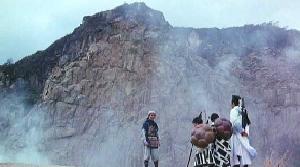
Although Tsui Hark has directed a few features before, it was Zu: Warriors from the Magic Mountain that catapulted him to Hong Kong's pop consciousness. It's no surprise, Tsui's previous efforts were mostly trashy, genre films that didn't rake in enough money at the Hong Kong box office. Zu: Warriors from the Magic Mountain was a success from the start. It starred up and coming up Hong Kong superstars and is a variation of a genre that Chinese moviegoers delighted in: the wuxia. Moreover, the film boasted of Hollywood-level special effects, and that certainly aroused the curiosity of those who were enchanted by George Lucas' Star Wars (1977).

Zu: Warriors from the Magic Mountain is a cinematic adaptation of an old Chinese tale. It is about a young soldier, Ti (Biao Yuen), who finds himself tired of the endless fighting between the different factions of Zu. Upon luckily escaping a battlefield, he chances upon a cave wherein he is attacked by an evil force, only to be rescued by traveling swordsman Ting Yin (Adam Cheng). The duo then enters the temple of evil, with a monk and his student, and fights out the leader of all evil, which eventually escapes, only to return as the Blood Demon, which is momentarily encapsulated by an aging kung fu master (Sammo Hung), giving the heroes a month to look for the twin swords that will supposedly stop the Blood Demon from hatching and destroy the world.

If my attempt to make a synopsis of the film is confusing to you, I can't really blame you, as I had a difficult time following the film's plot which changes in movement in a sudden flick of a finger. Tsui's pacing is feverish, obviously making the story suffer in exchange for visual tricks and grandiose set pieces. But from what I gathered from the fast forwarded fantasy, the film is actually quite straightforward and lacks a complexity most film viewers are aching for in current cinema. Tsui throws away any notion of time, making the eventualities in the film, more fluid, thus creating an illusion that the lines between good and evil are simple and thick. Characters find themselves switching sides in constant variation. Ting Yin starts out as a virtuous swordsman, then ends up as a possessed demon. The ice countess (Brigitte Lin) is first encountered as a fiery witch, then turning into an indistinguishable side character, and finally sacrifices herself in the name of everything good. Virtues are learned in up tempo manner, and the same are discarded even faster. The only person who stays the same is Ti, the hero who is tired of unclear sides. He is after all the young soldier for a side that is distinguished by just colors, instead of moral rights and wrongs, or even ideologies of justice and its opposite.

Tsui remakes Zu: Warriors from the Magic Mountain for the new millennium replacing the outdated special effects of 1983 with an over-reliance to CGI. I haven't seen the remake in its entirety, but from the little of what I saw, I just gave up. It literally looked like shit, and lacked the earthiness, the fanciful mindlessness of Tsui's filmmaking less than two decades ago. Zu: Warriors from the Magic Mountain is far from being the masterpiece others would like to have it. I actually didn't like it, despite having a lot of fun watching the characters fly in ease, and do magic kung fu in frantic fashion. It's more of a historical curiosity, an example of how to mesh special effects and filmmaking in an almost seamless marriage, without the benefit of an understandable and definable story.