Showing posts with label 1968 Films. Show all posts

Thursday, June 28, 2007

Kuroneko (1968)


Kuroneko (Kaneto Shindô, 1968)
English Title: Black Cat From the Grove

With Kuroneko (Black Cat From the Grove), director Kaneto Shindô dissects the divide that separates the classes in medieval Japan. The opening scene shows a solitary hut that is enveloped by a bamboo forest. Hordes of samurai warriors appear from the forest, slowly walking towards the hut. Inside the hut are two peasant women quietly eating their lunch. The warriors start grabbing their rice, and unsated, start raping the two women in horrid succession. The warriors leave the two unconscious women and the hut burning.

It's a disquieting introduction. Shindô doesn't emboss the sequence with any musical score, as we only hear the crickets chirping, the stream running, and the few shrieks and grunts by the women and the invading horde. It reinforces the feeling that the samurais arrived, pillaged, and disappeared with hardly anybody noticing and anyone really caring. Later in the film, the samurai leader would defend his class by stating that it is the powerful that rule over the weak; that there's no rationale in hating the samurai class. His statement is of course pure folly as we have witnessed with immense efficiency how the samurai and war can directly affect the comman folk.

Kuroneko is of course a kaidan (ghost story) and the two women resurface as vengeful spirits who roam the night to lure wandering samurai into their abode. After seducing the samurai with gratitude, flattery, cups of warm sake, and sex, the two would finish him off with a violent bite in the neck --- the same way a tame black cat would pounce on his master. The treachery keeps them alive; and it fuels their vendetta against the warmongers who ruined their lives in an unnoticed heartbeat.

The warriors would of course retaliate. Several mighty samurais have died and the samurai lord orders Gintoki (Kichiemon Nakamura), fresh from an unexpected victory against a formidable fighter, to investigate and destroy the spirits. Gintoki turns out to be the husband and the son of the murdered women; yet the twist is that Gintoki is no longer a peasant but a samurai, and thus an appropriate victim to the wraiths' murderous plans. The blurring of these roles are treated with unabashed tenderness --- Gintoki and his wife (Kiwaki Taichi) would thereafter spend several days in romantic bliss, unmindful of each other's missions to destroy each other.

It is obvious that Shindô admires this class-less happiness. He shoots the couple's scenes together in an eroticically gorgeous manner; quite different from the wife's previous seductions wherein the men are ravenous for flesh. The sequence is poignant; coupled with the mother (Nobuko Otowa)'s painful dance (again, different from the more rabid dance performed during their murderous sessions) and the couples' incandescent lovemaking, there's no denying that the class-crossing dilemma is the ultimate heart of the film.

Shindô tells the story with a dutiful eye for detail --- the bamboo grove is made eerie by the fog; the wardrobe and the make-up applied to the two wraiths; the intricate detail that surfaces the amusing stereotypes (the mustache and the body hair of the samurai leader, the transformation of Gintoki from filthy peasant to titled samurai by several buckets of warm water); the perfect lighting (especially inside the wraiths' abode). Kuroneko is simply wonderful cinema. It is scary not because of jarring sound effects or sudden visual stimuli, but because it draws you in into the hapless drama, and the irrevocable damage caused by war and the men whose fortunes are rooted from it.

Monday, February 19, 2007

The Great Silence (1968)


The Great Silence (Sergio Corbucci, 1968)
Italian Title: Il Grande Silenzio

French actor Jean-Louis Trintignant, as a favor for the film's producer who turns out to be a good friend, agrees to star in a Sergio Corbucci spaghetti western, with the request that he doesn't memorize any lines for the film. In keeping with the promise, Trintignant plays the film's tragic hero, Silenzio, a mute gunslinger whose vocal cords were removed as a child when he witnesses his parents' deaths by a group of bounty hunters. It becomes his life's mission to rid the Old West of these greedy bounty hunters.

The Great Silence starts with Silenzio riding through a backdrop of white snow while hidden bounty hunters are aiming to assassinate him. With his automatic pistol, he outspeeds his predators, killing each hunter except for one who opts to renege bounty hunting in exchange for his life. Silenzio instead shoots both his hands to assure the promise; in a fit of desperation, the sole survivor tries to shoot the hero with his bloody hands, but is shot by a group of bandits who are holing themselves in the snowy wildnerness of Utah. These bandits are eagerly awaiting the promised amnesty by the new governor, before returning to the town of Snow Hill to lead normal lives. Forced to steal by the involuntary exile, each bandit's head costs a few hundred of dollars; the entire horde is a treasure trove for these greedy bounty hunters traveling the wilderness like ravenous wolves. Most ravenous of them is Tigrero (Klaus Kinski) --- treacherous, morbid, and extremely greedy. He puts to death four bandits including the husband of Pauline (Vonetta McGee), a big-eyed dark beauty who recruits Silenzio to avenge the death of her husband.

The souls of the characters of this western is fueled by greed, vengeance and lust, which makes the romantic heart of the film irresistable and touching. The hearts of Silenzio and Pauline frozen by hate and revenge suddenly melt in a surprising moment, gradually lensed with ponderous close-ups and alluring hues of flesh and yellow by cinematographer Silvano Ippoliti, and backgrounded with a seductive melody composed by Ennio Morricone. During that moment, it felt that the characters transformed from filmic legends, into real characters who, through a sudden gush of emotions, develop humanity and imperfection, getting them closer to mortality. If I may add, I also want to believe that it is probably Silenzio's first real sexual and romantic encounter (his lack of communicative prowess lessens his relational marketability, and his vengeance-consumed soul keeps his mind centered into completing his life's mission), thus suddenly making him very vulnerable.

The film ends in a brutal and cynical note. Its an ending that unshrouds Hollywood-started mythos of the invincibility of the gunslinging hero and the unconquerability of good against patent evil. The way Corbucci depicts the villains (especially Kinski whose mere colden blue-eyed gaze sends shivers down my spine) and the overly-oppressed victims (with the impending idea that a dawn of forgiveness through the governmental amnesty is arriving soon) makes the conclusion even more painful and heartbreaking.

In a way, the cynicism is grounded in visual, thematic and emotional consistency: the neverending snow that hides rifles and corpses, the perpetual cycle of vengeance and violence, the ineptitude and inutile of the law and law enforcers. Everybody is at fault even the film's hero and his love interest, even the dozens of part-time bandits awaiting freedom from their past crimes. When the whole world has been corrupted by by-the-book readings of state-legislated penal laws, and peddling of human lives, it is nature's law that is followed. Silenzio became weak when he fell in love with Paulin, and according to nature, only the strong shall inherit the world.

Tuesday, September 12, 2006

The Little Norse Prince (1968)


The Little Norse Prince (Isao Takahata, 1968)
Japanese Title: Taiyo no oji: Horusu no daiboken

It was a rocky relationship between Isao Takahata and his producers at Toei Studios. The studio bigwigs wanted an animated film styled after the ones made by the Disney Studios in America. They wanted to have song and dance numbers, talking animals, and a story that would cater predominantly to young kids.

The story Takahata wanted to film was an Ainu folktale, translated to the screen by puppet-theater drama writer Kazuo Fuzakawa, but the bigwigs thought that setting it in aboriginal Japan would turn off the masses, thus a more Westernized (more specifically Scandinavian) setting was used. After three years of development, the film was released and it was a financial flop. However, little did the bigwigs in Toei or even Takahata (or probably even Hayao Miyazaki who also worked in this film as "chief animator and concept artist") that The Little Norse Prince would spawn an entire culture of Japanese anime and animated films that have in them a natural literary quality as compared to the comedy-oriented ones that are being created in the West.

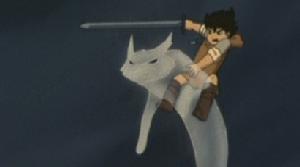
The Little Norse Prince quickly springs up as soon as the studio credits end. Horus is fighting a pack of wolves with his trusty axe and ends up being rescued by an rock golem. Stuck in the rock golem's shoulder is a rusty sword which Horus removes ala King Arthur. When his grandfather dies, Horus, along with his talking bear friend, travels to a village which is being pestered by a fish monster. Horus rescues the village, brings to them a mysterious girl named Hilda, and protects them from an evil demon named Grunwuld who is behind all the wolves, the fish monsters, and the rats that hound the human village.

The animation of The Little Norse Prince, if compared to the later efforts of Takahata and Miyazaki, might feel a little bit outdated. However, knowing that the film was finished in 1968, it is quite astounding how the movements of the characters, and the colors, and the concepts are so very fluidly developed. The animation feels a bit more Western (the lines on the characters are much more distinct as compared to the more recent anime efforts, the designs also look very Disney-esque), probably to the insistence of Toei Studios. They did get their talking animals, with Horus' best pal bear, and Hilda's companions, a talking squirrel and owl. They also got their song numbers, which I must say give the film a very literary and mythical quality that I very much enjoyed.

Probably more important than the technical advances of The Little Norse Prince is the fact that the film, despite its straightforward narrative, is very much deeply-layered (probably to the annoyance of the studio bigwigs). The character of Hilda is not merely the romantic partner of the hero, but is also the center of a psychological and moral battle. Hilda is an embattled character who has to choose between the inevitability of death by siding with the humans, or eternal life by siding with Grunwald who lets her wear an amulet of life. It's a stirring dilemma that is quite revolutionary at that time, especially when narrative animation is mostly restricted to children fare. Also, The Little Norse Prince feels especially epic. Horus' battles with the different monsters and demons create a folkloric or mythical depth to the entire feature that I was quite surprised to find out that the film's story was not sourced from Norse mythology, or even a richly adorned children's book, but from an Ainu folktale.

Many might say that The Little Norse Prince's value is more for its historical contribution rather than its inherent artistic merits. I disagree. Even if let's say, the entire anime revolution didn't erupt from the film's growing cult status, the film still holds a powerful storytelling sincerity that is very much affecting and resonating even to adults. The film's narrative simplicity transcends the cutesy animation, or the fact that animals do talk in the feature, or the plentiful songs. Forgetting it's important place in film history, watching The Little Norse Prince feels like being told a sprawling epic tale where good always triumphs against evil.

******
This post is my contribution to Joe's Movie Corner: Ghiblog-a-thon.