Showing posts with label 2002 Films. Show all posts

Monday, June 20, 2011

Basal Banar (2002)


Basal Banar (Auraeus Solito, 2002)
English Title: Sacred Ritual of Truth

The most unique of sunsets opens Auraeus Solito’s Basal Banar (Sacred Ritual of Truth). The distant coast and the clouds are but shadows to the mysterious red, blue, and white of the darkening sky. There can never be a more appropriate introduction. In a single visual, Solito introduces Palawan as this land that is mysterious, grandiose, and sadly, much burdened by problems any paradise may expect but should never deserve. From that otherworldly view of Palawan from the sea and through rivers and thick jungles, the film elegantly takes its viewers into the heart of the land, its people.

Solito has the advantage of capturing Palawan not from the vantage point of an absolute stranger but of a returning son. Instead of depicting Palawan’s people with the coldness and distance of an uninvolved documentarian, he positions himself as equally affected, giving the documentary a sense of reverence when depicting the more intimate details of the island’s culture and urgency when forwarding an advocacy.

Solito, schooled in Manila, prides himself of his Palaw’an heritage, a heritage that would guide him through several of his narrative features, all of which would give ample light to the unknown and marginalized, from the gay youths of Ang Pagdadalaga ni Maximo Oliveros (The Blossoming of Maximo Oliveros, 2005) and Boy (2009) to the rare geniuses of Pisay (Philippine Science, 2007). It is only with Busong (Palawan Fate, 2011) that Solito was able to give his beloved Palawan undivided attention. In the film, he drapes his adulation with high definition images of a timeless paradise that curiously mingles with the very real and the infinitely current, creating something of a beautiful anachronism that is a more than apt summary of the situation in Palawan.

Basal Banar is an essential precursor and companion piece to Busong. Where Busong is dreamlike and artistic in its imagery, Basal Banar is organic and unrehearsed. Its aesthetics is borrowed directly from nature and the people that partake of nature.

Even the music and the sound design are essential facets of what is seen. The songs sung by the natives are little stories by themselves, tackling everything from sacred rituals to mundane domestic dilemmas. There are also songs heard from the radio, transmitted straight from Malaysia, the closest neighbor to the island. The songs heard in the film are essential to the story it tells, efficiently painting the island’s demographic as not comprised solely of the natives who have resided first in the island but also the newcomers. Solito, by encompassing the entire wealth of humanity that resides in Palawan, enlarges the scope of the struggle, deepens the pains caused by modernization and the inequity of the concept of property, a concept that is incongruous to the concept of community that has kept peace in the island, a concept that has displaced an entire people from a land they and their ancestors have considered home for centuries.

The documentary climaxes with a journey by Solito and other men and women to plot the ancestral domain that is supposedly protected by law. Hundreds of kilometers and several hours of arduous travel are reduced to several key minutes through time lapse. The effect is tremendous. It is in equal portions a campaign that would supposedly end the injustices caused by government-sponsored land-grabbing and a celebration of unity among people of various ethnic groups, educational attainments, professions, and personal histories. Basal Banar, in turn, becomes that rare documentary that forgoes dwelling in the evils humanity can be capable of by concluding in a note of triumphant hope.

Sunday, July 29, 2007

Hesus Rebolusyonaryo (2002)


Hesus Rebolusyonaryo (Lav Diaz, 2002)
English Title: Hesus the Revolutionary

Lav Diaz's vision of our nation's near-future is not very different from how it is presently. The only differences are that streets and alleys are deserted at night, checkpoints where erring citizens are lined up to sing the National Anthem (snatched by Diaz from memories of his childhood) are placed instead. Despite that, literature and art flourishes amidst fascist asphyxiation. The nation has experienced similar circumstances under the Marcos regime, and faint but resounding reminders under the present regime. This is Diaz’s science fiction, which in turn is a wry observation of the state of the Philippine nation. There is not a spark of progress in display asManila in 2011 looks very much like Manila in 1990, made more melancholic by the uncomfortable stillness under the military junta. Instead, an atmosphere of paranoia pervades the near-noxious air.

General Racellos (Lawrence Espinosa) controls the land through the television and the radio. Announcements and bits of propaganda are disseminated with mechanical certainty; the true artists are working underground or fighting for freedom. Hesus (a quietly intense Mark Anthony Fernandez) is the film’s hero --- he’s a poet, a gunfighter, a leader of the masses. His burden is an enveloping feeling of guilt, from killing his comrades as ordered by the mysterious Miguel Reynante (Ronnie Lazaro) --- their revolutionary unit’s methods seem as fascist as the government’s.

Hesus’ redemption is owed not to his movement, but to his nation. His poem, read by Col. Simon (perfectly interpreted by Joel Lamangan) while he’s in a coma, discusses the joyful simplicities of life as disrupted by that certain corruption that has killed the nation; it is sorrowful and powerful the way the poem weaves the nation with spoken images of the family. Throughout the film, Hesus travels, hunted by government troops, directionless. We witness his nightmare-like dreams --- memories from his childhood in Bicol, fantasies of Hilda (Donita Rose), miraculously cured of her blindness. That’s his utopia, bright and green as opposed to the grey and drab shadowy exteriors of Manila.

Diaz’s aesthetics is pitch-perfect. Slow to the point of stubbornness, yet it’s never dull. He knows when to cut at the right time; Diaz won’t cease to prolong a scene until he is satisfied that the emotions, the pain are succinctly conveyed. When Hesus kills all his comrades, Diaz doesn’t cut at the moment the last comrade is shot death. Instead, he lingers to show Hesus wallowing with self-doubt and guilt inflicted by the massacre.

Diaz also shows an adept sense of humor. Col. Simon waits for Hesus to wake up from his coma; Lamangan (brilliant, brilliant thespian) walks around, plays Hesus’ music, and prances to the rhythm of the music, before reading to him his poem. Overly extended, the dead pan humor breathes diversion (although, not at all distracting) to Diaz’s straightforward intentions.

The numerous action scenes (probably put to placate Lily Monteverde, the film’s producer) are coherently directed (there’s strategy in the action; none of the illogical and badly conceived shoot-outs that are typical to Filipino action films). There’s a meticulous concern for the mechanics of the action sequences --- the shadows of the dimly lit corridors, corners and wide spaces become invitations to danger. It’s refreshing to finally watch a smartly directed action film.

Hesus Rebolusyonaryo was made from a measly few millions and was expected to make profit. It failed miserably in the box office (notwithstanding the presence of Fernandez and Rose, all bankable actors) and closed after a couple of days from its opening (films usually would last a week before being replaced). That’s the sad fate of this nation; that when finally, an intelligent and homegrown science fiction is released, Filipinos opt to march in zombie-like fashion to the latest Hollywood extravaganza. Talk about fascism in cinema.

Monday, May 07, 2007

On the Occasion of Remembering the Turning Gate (2002)


On the Occasion of Remembering the Turning Gate (Hong Sang-soo, 2002)
Korean Title: Saenghwalui balgyeon

The titles of Hong Sang-soo films are by themselves exquisite works of art. Virgin Stripped Bare By Her Bachelors (2000) is a bastardization of the title of Marcel Duchamp's artwork; Duchamp's art itself turning into a sort of formal instruction for Hong's narrative experimentations. It is actually quite unfortunate that Hong's fourth film, its international title is On the Occasion of Remembering the Turning Gate, is abridged merely for commercial and practical convenience without recognizing the implications of the abridgment.

More popularly referred to as merely Turning Gate (the title of the film in its American DVD release), the film is conveniently straightforward but like Virgin Stripped Bare By Her Bachelors, it can be logically divided into two distinct parts. The first part involves the typical Hong man-child Gyung-soo (Kim Sang-kyung), an actor whose last film was a commercial flop, who sojourns to a remote tourist town to visit his childhood friend. While vacationing, he is introduced to dancer Myung-sook (Ye Ji-won) who becomes romantically attached to him. The second part of the film concerns Gyung-soo's unexpected detour on his way back to Seoul. He meets Seon-young (Sang Mi Chu) on the train, follows her to her home, and becomes romantically and inconveniently linked to her, despite the knowledge that she is already married.

While touring an ancient Buddhist temple, Gyung-soo is told of the tale of the turning gate --- about a peasant who falls in love with a princess but is killed by the princess' father; upon reincarnation, the peasant turns into a snake who traps the princess. The princess thus enters the buddhist temple's turning gate asking the snake to wait for her. After several hours, the snake becomes impatient and tries to enter the gate but is prevented by rain, and thunder; thus, convincing him to just turn back and walk away.

The convenient interpretation to the film is that it is a modern retelling of the ancient Korean fable; that Hong merely reconstructs the fable turning the peasant man into Gyung-soo, the princess as the married Seon-young and the supervening events as direct allegories to the ancient tale. However, I do not see it as simply as that and Hong is an artist more enamored by the psychological implications of the past and memories than by simplistic re-introductions of Korean culture into modern life.

On the Occasion of Remembering the Turning Gate concerns itself with the past and with that human ability to transport the past into the present --- through memories. Examine the first scene. Gyung-soo gets a call from a childhood friend, and a minute or two is spent in order for him to recall and place the voice with his reconstruction of the past. When his present state no longer suits his life (as when he wasn't cast as a player in a director's subsequent film), his escape mechanism is to go back to the past --- by visiting that childhood friend and as a side-effect, see the ancient places and hear the old tales. His relationship with Myung-sook turned sour and again, he seeks an escape; much further into the past.

Seon-young is at first a mere afterthought, a deviation from a relationship that within a few days rose and failed. Then, she gets re-introduced as an object of his past --- and Gyung-soo again undergoes the procedure of remembering her. Seon-young then becomes that object of Gyung-soo's past that he can never achieve and gain, but he perseveres. Alas, the knowledge of the tale of the turning gate consumes him. In the intertitle where we are led to believe that Gyung-soo remembers the tale of the turning gate, we become witnesses of the unwanted effects of a mis-remembered and mis-appropriated past. In Gyung-soo's case, he becomes impotent in bed, and is man-handled by the impression that he is the snake in the ancient fable. The conclusion of the film is more of a signifier that Hong has completed his uncomfortable exploration of a man who is unable to reconcile the past and the present (with his uncommon inability to remember, or remember correctly), and not merely as a closing to a modern and straightforward re-telling of an ancient Korean tale.

The utter simplification of the film's title gives you the impression that the film is merely about the tale, which for me is only one of the nuggets of the past that Gyung-soo would have to wrestle with. The film is much more than that --- it concerns the act of remembrance and of inviting oneself to an unexplored past. Hong gives us clues --- prolonged moments that connote both the serenity and chaos of remembering, that book written by the centennial author who killed himself (I'd like to believe that a hundred years on Earth would invite further misapprehensions with the past), the dual-format observed, and the almost coincidental re-acquaintances with objects of Gyung-soo's past.

Sunday, April 22, 2007

Decasia (2002)


Decasia (Bill Morrison, 2002)

Decay, in its most technical sense, connotes deterioration. It is a chemical process that transforms a substance (molecularly) into something less brilliant, something practically different and substantially lesser than its former self. In Bill Morrison's mind, however, decay is something else. It is the connective force that weaves borrowed footages together. It is the narrative force that supplies both characters and logic to disconnected scenes. It is the unique aesthetic; it is the theme; it is the entire film.

Decasia is composed of snippets of footages from various films that have suffered from different levels of decay. It's quite fascinating how nebulous clouds of what seems to be a mix of vinegar, film, and other chemicals reveal decipherable images --- a geisha beside a window, two romantic lovers amidst a serene lake. At first glance, the feeling gathered is remorse. These identifiable beautiful images have been transformed, over time and human neglect, into monstrous formations.

The formations however become so familiar in the film, so mobile and life-like that the feeling of remorse transforms to absolute hypnotism. The revealed identifiable images have turned into the background, the formations are now the protagonists. Morrison identifies the film decay with life itself --- footages of bacteria, of insects, leaves, and other plants are comparable in motion and appearance with the formations. Moreover, Morrison suddenly conflicts us by telling us an equally nebulous story of life. A decaying footage of childbirth, of developmental progression, of human pain, joy and other emotions join the mix. Hollywood has also become a victim of decay; and equally lends its stories, its melodramatic anthems, its slapstick comedy into the bunch --- further completing the cycle of humanity.

The decay has become the embellishment in Morrison's tale. It becomes the enemy of humanity (there's a sequence wherein a boxer continually punches the formation of film decay; amazing visual wit, I thought). It is also the obliterator of human error, of our imperfections --- in one sequence, a man seduces a girl while the decaying formation partially censors the actions. It accompanies human tragedy (a sequence wherein a mother is revealed her dead son; looks like a scene from a well-produced Hollywood flick), and desperation (there is also a sequence wherein what seems to be men are rescued from a mine). It modifies; in a sequence that ordinarily is charming and pious (a group of kids marching in a nun-operated school), the decay and contrast discoloration affects the atmosphere to the point of reversing child-like innocence into horror and bad faith.

The film's aesthetic and thematic suggestions are only enunciated by Michael Gordon's haunting score. In one interesting sequence wherein decaying footages of children playing in a theme park, Gordon's score emulates the glaring noise of locomotion. The effect is undeniable; with the invading visuals of decay and Gordon's suggestive music, the innocence of children playing is transformed into the stress, the clarity of danger of everyday commute, of man's day-to-day world.

Morrison's avant-garde techniques aren't as offputting as to claim Decasia as a difficult film to pursue. Morrison is actually very generous; he amplifies cohesion, he makes his work impersonal as to attract universal appeal. He has a story to tell, yet that story is not as strict as a declared narrative. It is open to various interpretations; even his themes are as open-ended as his narrative. There's a wild play of visual, aural, and thematic metaphors that invite you to take part in his cinematic game of redefining decay. Morrison's film is junk art, in its most innovative sense. It's quite brilliant.

Monday, October 09, 2006

The Man Without a Past (2002)


The Man Without a Past (Aki Kaurismaki, 2002)
Finnish Title: Mies vailla menneisyyttä

Aki Kaurismaki's The Man Without a Past is so disarmingly simple that it's such a treat in our present cinematic world that fetishizes in complex convoluted plot lines and stories that are grounded upon unexpected twists and turns. If it weren't for the stylish use of colors and the droll yet motivated blankness of Kaurismaki's visuals, The Man Without a Past would be convincing as a 50's Hollywood film. Also, Kaurismaki's humor can be traced to Jim Jarmusch rather than the comedic geniuses of the golden age of Hollywood cinema.

A man (Markku Peltola) is mugged and left as dead by a band of thugs. He awakes, wrapped in white bandage, and the first thing he does is to fix his broken nose (a rather funny note as Kaurismaki would be using Peltola's prominent nose through the numerous profile shots that pervade the film). The man turns out to be like the invisible man who unwraps his bandages and learns that he is as transparent as air. Instead of the curse of invisibility, the man is cursed (or gifted) with the sudden disappearance of his memory. He moves in an empty container van near the ship docks of Helsinki, and starts to work as a crew for the Salvation Army, where he meets and falls in love with Irma (Kati Outinen).

It's a funny predicament the man lands himself into. He is consistently bullied by the head honcho of the homeless community, with a female dog named 'Hannibal.' The local chapter of the Salvation Army plays routine music that is much too old and safe for the tastes of the miserable denizens of the container vans. Even his girlfriend Irma is a perpetual virgin, morose and manly when wearing her outfit, and still morose but rises a few notches in terms of femininity whenever she's in casual wear with the titular amnesiac. Kaurismaki doesn't go for hilarity. Instead, he persists in deadpan humor, letting the absurdity of the scenario seep into his audience's cognition which in turn, brings about well-earned chuckles. The dialogue is slight, but that adds to the mysterious charm of the film which somehow survives with the cleverness and ingenuity of Kaurismaki's directorial designs.

Kaurismaki intends to end the film with a subtle twist --- a throwback to the cleverer sci-fi features of classic Hollywood --- and ultimately happily concludes the unfortunate tale of the man. It's a worthwhile film, despite the fact that the plot plays out like a straightforward feature which is absolutely devoid of contemporary notions of climaxes. Instead, Kaurismaki draws out interest by staging even more absurd scenarios out of the already absurd groundwork that he has mustered. A bank robber steals his money from the bank, and then asks the man, to deliver the money to the unpaid laborers which he has neglected to pay --- that is just one of the paradoxical statements that glue this film of virile paradoxes. Each of these little scenarios, little scenes, bring about a conclusion that makes you want to watch the film again to see the subtle nuances Kaurismaki placed in the film.

Wednesday, September 13, 2006

Gerry (2002)


Gerry (Gus Van Sant, 2002)

Right after three commercially viable and successful films, one of which earned him an Oscar nomination (Good Will Hunting, 1997), it's very surprising that Gus Van Sant follow it up with a film like Gerry. Gerry is basically a film about nothing, but despite that, it's always fascinating. From the lengthy opening sequence of two guys (Casey Affleck and Matt Damon) driving past the highway accompanied by the music of Arvo Pärt, you instantly get hypnotized by the alluring non-predicament. Once the enchantment of filmed car rides wears off, Van Sant instantly brings you back to mundane Earth by having the two men alight their car and follow a track. Everything seems normal (they even meet fellow trackers which they return a friendly hello to), until the predicament of this non-predicament film creeps in. The duo gets lost in the middle of Death Valley.

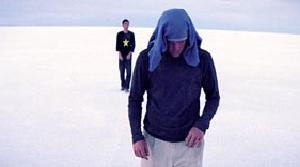
The rest of the film is a repetitive sequence of the two walking past the rocky landscape or the barren desert, and again, despite that, it's still very fascinating. There are occasional breaks in the repetition. Conversations between the two are captured. These are mostly discussions on mundane non-topics yet in these conversations we gather that both of them are named "Gerry." Yet, we are really unsure of that since the characters use "gerry" so many times that the term might not even mean their names, but some kind of a mysterious code which we might never ever find out. The breaks also have moments of humor: One of the guy finds himself "rock-marooned" and insists that the other guy make him a dust mattress so he won't break his ankle. Other than that, it's mostly quiet and dull sequences of them walking, and the brown landscape baking.

Is the film, like the surroundings it shows, lifeless? Not really. In fact, despite the fact that the austere plot is stretched to fill up the running time, there's a gradual growth in Van Sant's visual pallette that I find very interesting. Little by little, the landscape's life is sucked by the two characters' eventual demise. Green plants disappear, tumbleweeds make an entrance, and everything becomes deathly white. In one surreal sequence, we find the two walking in an uncomfortable stance and pace amongst the paleness of their surroundings. Again, it's a very quiet moment but is not without the thunderous gasps for life, the only reminders that they are not zombies but actual human beings who find themselves dying in the middle of the Death Valley.

That troubling scene is repeated by Van Sant in his next feature Elephant (2003) wherein one of the students would play a computer game where the characters being shot and killed look frighteningly similar to the dying men in Gerry amongst the bare desolate backdrop. It's almost exactly the same, except for the fact that in Elephant, the two Gerry's are transformed into bitmap images, but in the same way, are unwitting targets of the unpredictability of death. We later know that the computer images being shot are representative of their victims in their planned shooting spree in their school. In Gerry, death arrives in casual and almost luxurious fashion, spending almost two hours of relaxed and gradual pacing to sink its teeth in its victims' sorry necks.

Sunday, July 30, 2006

Irreversible (2002)


Irreversible (Gaspar Noé, 2002)

Gaspar Noé, ever the provocateur, starts his film in what he thinks is witty and creative, but what I think is, sheer gimmickry. End credits roll in unreadable, unrecognizable fonts, with only a few notable names visible and of course, ending the supposed end credits one very distinguishable, very readable name: Noé. For those who are unready to face gore, violence, and cruelty, the name Noé in itself would have you fleeing the theater, or pressing the stop button of your dvd player. For those unfamiliar, the first sequences are enough warning that this film might not just be your cup of tea. Cameras revolving in mindless abandon, following an invisible force that only stops when something that is supposedly important to the story, which is told in reverse, is ensuing. It begins with two old men chatting and bantering about so-so philosophical talk, giving notice to the film's slogan: Time destroys everything.

The siren of the ambulance disrupts the chat, and the camera flies and brings us to a gay club aptly named "The Rectum" where everything and anything happens. After a longwinded introduction to the gay bar where the camera traverses the intestine-like hallways capturing men fucking and other private acts, we are introduced to the film's main male characters: Marcus (Vincent Cassel), angry and obsessed in searching for a man named Tapeworm for revenge, and Pierre (Albert Dupontel), the rational thinker who pleads Marcus to stop and just visit his hospitalized girlfriend Alex (Monica Bellucci). The entire prolonged search ends in an ultra-violent note involving a fire extinguisher and a man's massacred head, computer generated of course.

Noé brandishes his unique visuals, accompanied by a soundtrack composed of grating droning noises mixed with electronic music, and an introduction that will naturally attract our curious minds. Noé grabs us by our throats and forces us to strain our eyes, deafen our ears, and stretch our moral limitations with his film. After the violent sequence inside the Rectum, Noé stages an also-violent rape sequence complete with digitally manufacture genitalia and blood. It is quite obvious that Noé works in a purely visceral level, but the question remains, is there anything deep underneath all this violence, all this blood, and abnormality. Sad to say, Noé still remains to be just a provocateur, never a philosopher as Irreversible is all gimmickry and techniques masquerading as art.

Fans will defend the film as an accurate depiction of violence begetting violence, or that the film's tagline explains everything that ensues. I don't buy it. It's just a simple revenge plot told backwards with the intention to just shock us and in the end, shock us even more with puny regrets over a sideplot involving an unborn baby. The gimmick may have done its job, but without it, the story isn't really as novel as it thinks it is.

I also don't get it why Noé has to clothe the film a frankly obnoxious visual style. Defenders will say that it is to offer a difference from the chaos of the start of the film, and the bright, comforting summer hues at the film's end. Again, I don't buy it. Sure, the camera is less jerky but the visual style is still present. The camera still flies, sweeps and does complete acrobatic exercises from the start to the end. The colors may be different, but that is due to the fact that there is such a thing as day and night. Symbolisms may be abound, but these differences are merely skin-deep and not enough to warrant a visual style that promises something grandiose in content. The same can be said about the soundtrack: the film ends with a classical score as compared to the jarring noise of the beginning, any amateur filmmaker can come up with the same kind of cinematic metaphor. Noé still doesn't impress.

I suggest you see the film for what it is. Take away the fire extinguisher scene and the rape scene, and you're left with boring banter and some uninteresting improvision. Also, we get around thirty minutes of Cassel fuming mad with his mouth blurting out threat after threat to anyone and everyone who might stop him from his plan for revenge. Cassel, given better material, can add depth to the character. We also get a sizable amount of time seeing Monica Bellucci naked, or in various levels of undress, and I guess that amounts to something good. Other than that, I see Irreversible as a prime example of what I can describe as the new age of Euro-trash, films created to pass off violence, shock, and sex as art.

Monday, July 24, 2006

Springtime in a Small Town (2002)


Springtime in a Small Town (Tian Zhuangzhuang, 2002)
Mandarin Title: Xiao cheng zhi chun

Mu Fei's Spring in a Small Town (1948) has the distinction of being the greatest Chinese film ever made, at least according to a list created by a group of Chinese film critics. It's an odd choice. Spring in a Small Town is minimalistic. Its plot is sparse, and its characters are very few and quite disconnected from each other, as can be assessed from their disconcerted conversations with each other. However, Spring in a Small Town conveys an emotionality that is visibly astounding. It is free from any histrionics or melodramatics and possesses an inert intensity that gives inward meaning to the unfeeling conversations depicted on screen.

In 2002, after ten years of absence from filmmaking by oft-praised director Tian Zhuanzhuang, he releases his version of Mu's film entitled Springtime in a Small Town. Rather than completely reworking the storyline or the characters to fit into today's social climate, Tian faithfully follows Mu's film. His modifications only visible in slight plot details and visual style. Springtime in a Small Town is for Tian a handsome ode to the understated craftsmanship of these old Chinese film masters; where style and substance majestically weave in a product that is purely magical.

The plot is essentially the same. In a town ravaged by war, Liyan (Wu Jun), chronically ill and morose husband, and Yuwen (Hu Jingfan), dutiful yet emotionally distant wife, live in their estate along with their longtime servant Huang (Ye Xiao Keng) and Liyan's younger sister (Lu Si Si). Arriving alongside spring is Liyan's former schoolmate Zhang (Xin Bai Qing), who also turns out to be Yuwen's childhood sweetheart. Love triangles emerge as their lives suddenly intertwine during that short duration of time and within the small space enclosed by crumbling walls of that war-ravaged estate within a war-ravaged little town.

The biggest difference between Tian and Mu's films is that the latter is being told from Yuwen's perspective, as explicated by the narration. Tian goes for objectivity, removing the narration and implying that the story be told from a perspective of a disconnected outsider. Moreover, Mu's placing of the entire emotional dilemma as a burden of a single character focuses on feminine longing and regret which Tian's version lacks. Tian's film, while still peering Yuwen, is scattered in its presentation and the emotional impact. It is more focused on Zhang, the stranger, who is torn apart by his loyalty to his best friend, his lifelong longing for his best friend's wife, and that emerging reminder of his youth and the mistakes that go along with it in the personage of Liyan's younger sister. On the other hand, the narration in Mu's film culminates in an ending that fleshes out the theme of life's morose character, and that its stillness might be ruined by a visitor that brings with it memories of the past. It also reveals that there is life after the film's end, and Yuwen's feelings haven't faded along with the departure of Zhang. Thus, Mu's film brings with it the idea that the temporary stay of the visitor has caused ripples in that family's very still pond.

There are other differences: certain scenes are prolonged and actions are enunciated, an additional scene that fleshes out Zhang and Liyan's little sister's relationship, the characters are given more time to sit around, relax, and reflect on emotions and thoughts. Tian sees the need to envelop his audience with the complex happenings in the house. He wafts his camera like an observant spy through the courtyard, catching the characters during intimate confessionals, or in moments of solitary inactions, or in their dramatic or subtly romantic interludes.

The cinematography by Mark Li Ping-bing is exquisite. Li evokes a similar visual tone with the one he used in Wong Kar Wai's In the Mood for Love (2000) to create an air of unaccomplished love affairs and strong emotions hiding in a wall of traditional propriety. His camera is constantly moving in careful yet deliberate fashion, making use of the house and the town's ruinous quality as instruments for his quiet observation. The hues are rich; the acting is subtle yet tremendous; the directing is sublime. The film is very very beautifully made. That said, while Mu's original film is arguably superior to Tian's remake, Tian's film undoubtedly holds considerable power.