Showing posts with label Aki Kaurismaki. Show all posts

Monday, April 23, 2007

Hamlet Goes Business (1987)


Hamlet Goes Business (Aki Kaurismäki, 1987)
Finnish Title: Hamlet liikemaailmassa

Aki Kaurismäki's Hamlet Goes Business is a pretty much accurate re-telling of William Shakespeare's famous tragedy Hamlet. The characters are the same, most of the plot points are retained, yet quite interestingly, it's an entirely different creature. First and foremost, i is more of a comedy, the type of comedy that Kaurismäki famously makes --- droll, deadpan, at times comical, and always funny.

It is set in Finland, or more specifically corporate Finland (inside cement buildings and boardrooms), wherein the poisoning of the father of Hamlet (Pirkka-Pekka Petelius) has caused a stir in a corporation that owns sawmills and other plants within the area. Immature Hamlet inherits more than half of the corporation's stocks, while Klaus (Esko Salminen), who we first see switching a poisoned drink with another while torridly kissing Gertrud (Elina Salo) who is on her way to serve her husband his nightly drink, becomes board chairman and opts to sell the company's assets to buy a substantial share in the world's production of rubber ducks. Unenchanting Ofelia (Kati Outinen) spends most of her time deflecting Hamlet's sexual advances --- her Polonius (Esko Nikkari) and brother Lauri (Kari Väänänen) have their own separate plans for their respective futures.

Hamlet Goes Business has been described as a satire on corporate greed. The film, by converting one of Shakespeare's most notable plays that portrays humanity in its most complex into this flatly noir-ish if not overly simplistic tale, succeeds in using Shakespeare's narrative while disposing of any of its resounding themes and replacing them with Kaurismäki's irreverent observations of the blatant inhumanity in corporate affairs. Relationships are as black and white as the film's gorgeous cinematography. Relationships aren't invested with emotions or virtues like trust, confidence, or friendship. Instead, treachery and ill motives flow smoothly from these characters, very much like rubber ducks getting manufactures in clockwork fashion by huge machines.

Hamlet is, I believe, Shakespeare's most complicatedly human character. His existence in literature is through his tale of vengeance; yet that is complexed with his human traits --- his needs to assure himself of his father's murderer (despite that being revealed by his father's ghost), his uncertain romantic affections with Ophelia, his even more uncertain musings about his own existence and humanity's place in this world. Shakespeare has given him beautiful soliloquys to express his encompassing mistrust with humanity and himself. Yet, in the end, as fate and his own doings would've led him to a quickened turn of events (that famous climax that ends with a foreign prince's recognition of his life's honor), it is his character's fallible nature that makes him distinctly human, and deserving of the respect afforded to him.

Kaurismäki's Hamlet is anything but respectable. His uncertainty for his actions are hinged on the character's selfishness rather than a genuine recognition of human error. His affections for Ofelia is more predatory and sexual. He begs that Ofelia give up her virginity, and in an instance where he tries to comingle love with his lust, he is unable to confront Ofelia. He doesn't have comrades, only employees --- yet he has this illusion of being the center of everything. Shakespeare acknowledges Hamlet as a character deserving of his attention; yet Kaurismäki's Hamlet forces the attention to himself (him being the controlling shareholder of the corporation, him being the employer and the wealthy man, him being the only son of his widowed mother).

And that is also where Kaurismäki treads away from Shakespeare's narrative. Shakespeare ends his play with recognition for his beloved character. Kaurismäki turns Hamlet into quite the bastard, and concludes his borrowed story justly without overriding the new themes of his carefully crafted modification of Shakespeare's beloved classic.

******
This post is my contribution to Coffee, Coffee and More Coffee: The William Shakespeare Blog-A-Thon.

Saturday, March 31, 2007

Lights in the Dusk (2006)


Lights in the Dusk (Aki Kaurismäki, 2006)
Finnish Title: Laitakaupungin valot

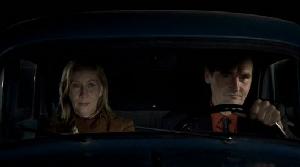
It's a tired plot; similar to the stories so often told in the film noirs of the past decades. The story of a man spiraling down to his dismal fate, often contributed by his irresistible attraction to blonde beauties. Aki Kaurismäki has dabbled a similar structure more successfully with his The Man Without a Past (2002); wherein the protagonist loses his entire memory during the first few minutes and traverses the path to self-discovery and self-identity. Lights in the Dusk is a lot drearier in atmosphere. While still brimming with Kaurismäki's brand of droll humor, the film seems to have been possessed by a spirit of pessimism. From its initial shots where the protagonist wanders in his lonesome while checking up on the mall he guards at night (Kaurismäki cruelly injects the background music of an opera singing a love song in Finnish; as if to insist on his protagonist his unwavering lack of luck in life and love), there's already a hint that the film will play on tragedy and cruel twists of inevitable destiny.

There's absolutely no point in self-discovery as the protagonist in this film, lonely night guard Koistinen (Janne Hyytiäinen), knows his place in the world. He's the absolute loser. He dreams of grandeur (of starting up his own corporation), but has no backers and guarantors to secure his initial loan, as none trust him and all ridicule him, except for fellow loner Aila (Maria Heiskanen), proprietress of a hotdog kiosk Koistinen frequents. In one scene, after being rudely avoided by a bar girl and being mistaken as an inanimate object by the men's room, he looks straight to the camera --- the actor's eyes, his glum pout longs for attention, almost begging, always pathetic. When hot blond Mirja (Maria Järvenhelmi) suddenly asks to sit with him in a 24-hour cafe, he is infused with a sudden urge of being somebody. He tries it out by trying to save a dog that's been left by a group of muscled bullies, and quite predictably, fails and is beaten up. It's a string of bad luck of Koistinen, swelled by faux opportunities and false hopes.

The film is consistently pretty. Timo Salminen's cinematography captures an absurdist's version of Helsinki --- uncharacteristically empty, bare, and infertile for a modern capital city. The citizens who do populate the city have glass stares and dull personalities; they are as bland as the monochromatic backgrounds Kaurismäki puts his characters' faces and body unto. The city, like in The Man Without a Past, serves as an accurate barometer of the protagonist's mental and emotional status --- Sad, friendless, cold, and unusually content with such pitiful predicament.

Lights in the Dusk, while still thematically consistent with Kaurismäki's ouvre, is a tad disappointing. It's borrowed plot, only distinguished by Kaurismäki's brand visual and deadpan humor, is too convinced of itself to initiate much greater depths as explored in The Man Without a Past. The film is predictable, as well as Kaurismäki's stylistic ticks (the prolonged shots before the fade-outs, the perfectionist musical cues, the chromatic tones, the dull acting and dialogue deliveries); it feels more like a second-rate repeat of what Kaurismäki has done more successfully in the past.

Unfortunately, while filmmakers of Kaurismäki's cinematic nature like Tsai Ming-liang, Apichatpong Weerasethakul, among others are exploring worlds and universes, it seems that the Finnish director has remained content of his stagnant stature. I'm hoping Kaurismäki soon finds his light in the dusk, the same way Koistinen belatedly does in this film's nebulous conclusion.

Monday, October 09, 2006

The Man Without a Past (2002)


The Man Without a Past (Aki Kaurismaki, 2002)
Finnish Title: Mies vailla menneisyyttä

Aki Kaurismaki's The Man Without a Past is so disarmingly simple that it's such a treat in our present cinematic world that fetishizes in complex convoluted plot lines and stories that are grounded upon unexpected twists and turns. If it weren't for the stylish use of colors and the droll yet motivated blankness of Kaurismaki's visuals, The Man Without a Past would be convincing as a 50's Hollywood film. Also, Kaurismaki's humor can be traced to Jim Jarmusch rather than the comedic geniuses of the golden age of Hollywood cinema.

A man (Markku Peltola) is mugged and left as dead by a band of thugs. He awakes, wrapped in white bandage, and the first thing he does is to fix his broken nose (a rather funny note as Kaurismaki would be using Peltola's prominent nose through the numerous profile shots that pervade the film). The man turns out to be like the invisible man who unwraps his bandages and learns that he is as transparent as air. Instead of the curse of invisibility, the man is cursed (or gifted) with the sudden disappearance of his memory. He moves in an empty container van near the ship docks of Helsinki, and starts to work as a crew for the Salvation Army, where he meets and falls in love with Irma (Kati Outinen).

It's a funny predicament the man lands himself into. He is consistently bullied by the head honcho of the homeless community, with a female dog named 'Hannibal.' The local chapter of the Salvation Army plays routine music that is much too old and safe for the tastes of the miserable denizens of the container vans. Even his girlfriend Irma is a perpetual virgin, morose and manly when wearing her outfit, and still morose but rises a few notches in terms of femininity whenever she's in casual wear with the titular amnesiac. Kaurismaki doesn't go for hilarity. Instead, he persists in deadpan humor, letting the absurdity of the scenario seep into his audience's cognition which in turn, brings about well-earned chuckles. The dialogue is slight, but that adds to the mysterious charm of the film which somehow survives with the cleverness and ingenuity of Kaurismaki's directorial designs.

Kaurismaki intends to end the film with a subtle twist --- a throwback to the cleverer sci-fi features of classic Hollywood --- and ultimately happily concludes the unfortunate tale of the man. It's a worthwhile film, despite the fact that the plot plays out like a straightforward feature which is absolutely devoid of contemporary notions of climaxes. Instead, Kaurismaki draws out interest by staging even more absurd scenarios out of the already absurd groundwork that he has mustered. A bank robber steals his money from the bank, and then asks the man, to deliver the money to the unpaid laborers which he has neglected to pay --- that is just one of the paradoxical statements that glue this film of virile paradoxes. Each of these little scenarios, little scenes, bring about a conclusion that makes you want to watch the film again to see the subtle nuances Kaurismaki placed in the film.