Showing posts with label Hong Kong. Show all posts

Sunday, October 12, 2008

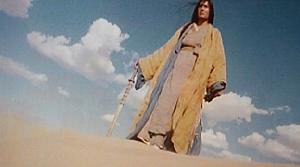
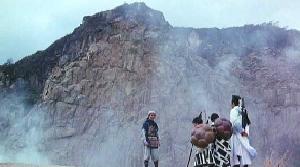
Three Kingdoms: Resurrection of the Dragon (2008)


Three Kingdoms: Resurrection of the Dragon (Daniel Lee, 2008)

The voice of Luo Ping-an (Sammo Hung), a recruiter for the army of Liu, greets us in Daniel Lee's Three Kingdoms: Resurrection of the Dragon, an imperfectly executed but altogether interesting take on Luo Guanzhong's 14th century The Romance of the Three Kingdoms, a revered piece of Chinese literature that details the power struggles between the warring successors of the Han Dynasty. Luo Ping-an recalls the first time he met Zhao Zilong (Andy Lau), an ordinary foot soldier whose only ambition is to provide for his future family, a modest ambition compared to Luo's dreams of returning to his hometown a celebrated city. As Zhao Zilong starts to showcase his fighting prowess rise from the ranks to become one of the Liu army's generals, Luo Ping-an remains a low-ranking soldier.

It is this perspective from Luo Ping-an's forgotten onlooker that makes Three Kingdoms: Resurrection of the Dragon a worthwhile film. He becomes the film's unsteady heart. As an adaptation of The Romace of the Three Kingdoms, the film feels hurried and truncated. As an ode to heroism and bonds of brotherhood, it is actually quite engaging, if not moving. During one of the film's final moments, Luo Ping-an and Zhao Zilong share a scene where both become defenseless to each other, with Luo Ping-an's admission of his repressed envy and Zhao Zilong's revelation of his weakness. It is a beautifully directed and composed scene, where heroes and icons are unmasked and become human. Ready for their final battle, Luo Ping-an beats the war gong, announcing to the invading forces that Zhao Zilong, the undefeated hero of Liu's army, is ready for his attack. Given that momentary but enduring glint of humanity, Zhao Zilong's final battle, its aftermath we can only guess from the film's end notes, becomes laced with an emotional depth that has been absent in the film's numerous battle scenes.

The film struggles through its initial sequences, accommodated by some stunningly choreographed (by Sammo Hung) although haphazardly shot and edited action sequences, before being fast-forwarded decades past Zhao Zilong's rise to the top, with several other characters (the four other generals and Zhao Zilong's transitory love interest) of little importance to the film's narrative being introduced only to be killed off or totally forgotten in the next ten minutes. The narrative and emotional bulk of the film happens during Zhao Zilong's final expedition. With Luo Ping-an at his side and his favorite lieutenants (all of whom are given little or no characterization) behind him, Zhao Zilong faces the army headed by Cao Ying (Maggie Q), the graceful yet ruthless general of Cao's superior army.

Here, the film starts to take a different cue and becomes a grounded observation of fleeting heroism and both the necessity and expenses of warfare. Lee makes an effort to equalize both factions, characterizing Cao Ying as cunning yet noble, in a careful step to blur the lines between good and evil in the battleground. Lee decreases the tempo, allows his camera to fully linger and capture the vast plains and deserts, and gives ample room for his audience to understand the conflicts boiling within Zhao Zilong's aging hero and Luo Ping-an's pathetic onlooker. Like one of Sergio Leone's grand Westerns where genre conventions and characters are maintained yet enlarged to encapsulate a bevy of themes, Three Kingdoms: Resurrection of the Dragon almost succeeded in doing the same with the genre, if not for the film's clunky storytelling and its need to placate commercial forces.

While Lee clearly has the vision and the ambition to mount a film adaptation of The Romance of the Three Kingdoms and the film seems adequately justified as a whole, the film feels problematic on many fronts. The technical aspects of the film mirror Lee's grand ambition: the armies are fortified with thousands of extras, the production is littered with astounding details, the music is reminiscent of Ennio Morricone's memorable melodies for Leone's famous spaghetti westerns, the art direction is both apt and astounding, the cinematography is breathtaking, especially when Lee's camera covers the almost endless expanse of the country that is being fought for. However, amidst the luster of the film's production values, Lee seems unable to cohere the elements into a clearly flowing narrative. The film ultimately suffers from inconsistent plotting and incongruous action filmmaking.

Sunday, September 07, 2008

The Warlords (2007)


The Warlords (Peter Chan, 2007)
Mandarin Title: Tau ming chong

The Warlords is something of an anomaly in Peter Chan's career. Chan is most famous for charming romances and comedies like Comrades, Almost a Love Story (1996), a love story between two Mainlanders (Leon Lai and Maggie Cheung), both of whom migrate to Hong Kong and later to New York, that spans several decades and Perhaps Love (2005), which details a love triangle that arises in the set of a musical film. Going Home, the episode he directed for Pan-Asian horror triptych Three (2002), is about a father (Eric Tsang) and his son who moves in a dilapidated residential building where longtime resident (Lai) keeps a gruesome although ultimately heartbreaking secret. Chan's films have always featured strong female characters (Cheung in Comrades, Zhou Sun as feisty movie star in Perhaps Love, Kate Capshaw as forty something divorcee who gets intimate with a younger man in The Love Letter (1999), or even Eugenia Yuan as Lai's dead wife in Going Home).

Thus, The Warlords, which Chan claims as his attempt to bring back themes of male camaraderie and loyalty of 80's and 90's Hong Kong cinema, is a totally different creature in Chan's growing filmography. In fact, The Warlords features no strong female character. Lian (Xu Jinglei), the object of desire of both General Pang Qingyun (Jet Li) and Zhao Erhu (Andy Lau), is treated more as a plot device rather than a definite character. She indistinctly beds with both men, with her motives and aspirations conveniently overshadowed by the men who dominate the picture.

Notwithstanding this evident departure in themes, Chan succeeds in crafting a genuinely engaging picture. Inspired by Cheng Cheh's The Blood Brothers (1973) which is based on a historical event wherein a governor was assassinated in the late nineteenth century, The Warlords is about three men, Pang, Zhao and Jiang Wuyang (Takeshi Kaneshiro) whose fraternal pledge is tested under the pressures of surviving starvation and violence dealt upon by the Taiping Rebellion (whose death count supposedly outnumbers that of the second World War) and later on, the political ambitions and intrigues that accompany their wartime successes. Chan indulges in detailing the three men's intricate relationship, starting from explicating their personalities, differentiating their goals and motivations, inevitably leading to a clash of gargantuan egos, especially of Pang and Zhao's, who nearing the end of the film have come into a deadlock in their objectives.

More gargantuan than the clashing egos of the film's main characters are the battle scenes, choreographed, directed and shot with masterful precision and an exquisite attention to detail by Chan and his crew. The battle scenes do not have the operatic flourish of Zhang Yimou's Hero (2002) and Curse of the Golden Flower (2006) or the theatrical affluence of Feng Xiaogang's The Banquet (2006). Chan approaches the battles with a grittier and more realistic tone, with dust and grime filling up the frames and severed limbs and fallen bodies punctuating the action. The battle scenes are simply spectacular. There's an undeniable visual splendor and energy beneath the pandemonium and violence that Chan adeptly orchestrates.

The Warlords also features one of Li's best performances. His embattled general, the lone survivor of a failed campaign where all his soldiers died, is vulnerable and emotional, traits that Li's usual cinematic personalities hardly possess. He performs alongside Lau and Kaneshiro, actors who have earned acclaim from more dramatic roles, and gives the most memorable performance of the three. Above everything, The Warlords, proves that Chan is a formidable filmmaker, with the ability to stage stunning and sweeping battle scenes without sacrificing characterization and storytelling.

Saturday, May 10, 2008

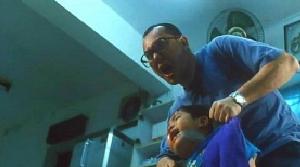
CJ7 (2008)


CJ7 (Stephen Chow, 2008)
Cantonese Title: Cheung Gong 7 hou

There's an almost unanimous assessment among most Western viewers and critics that Stephen Chow's CJ7 is substantially inferior to his last two successes, Shaolin Soccer (2001) and Kung Fu Hustle (2004). I would tend to agree. CJ7, predominantly a reworking of the formula popularized by Steven Spielberg's tearjerking classic E. T. (1982), and regurgitated in the eighties through the early nineties with several immemorable children's fare (does anybody remember Mac and Me?), is about a boy named Dicky (Xu Jiao, who is actually a girl) who discovers the titular dog-like alien creature that eventually teaches him a thing or two about life and growing up.

Ti (Chow), Dicky's father works as a casual employee in one of the city's many construction sites. Despite his serious financial struggle, he maintains that Dicky be provided quality good education by sending him to an expensive exclusive school. Naturally, Dicky becomes the center of attention of his teachers and bullying classmates, especially with his dirty uniform and sewn-and-resewn shoes. He imagines that his newfound pet, named CJ7 following the popular robot toy dogs, would help him get better grades but as it turns out, the alien pet is actually useless in that department, causing Dicky's grades to plummet.

What essentially separates CJ7 from the numerous similar films that were made before it is the fact that it is written, directed, and produced by Chow, whose unique brand of comedy has survived through the digital age by utilizing digital effects for brashly outrageous comic effect. Chow uses the same technique here. By mixing digital effects (including the completely digitized alien pet which looks like a cross between a Pokemon and a gummy bear) and his traditional comedy, Chow was able to rise a little bit higher than his meager material, creating a film that may not be as hilarious as his last two efforts but is at least very watchable.

Chow has always made frankly sentimental films, although usually blanketed by his boisterous comic sensibilities. For example, that middling love angle between Chow's character and the psoriasis-infected lady in Shaolin Soccer was conveniently draped by the out-of-this-world soccer battles; or the melodramatic linkage between the good-for-nothing bum and the deaf ice cream vendor was made a mere sideplot in Kung Fu Hustle. Despite the consistent proliferation of what is essentially kitschy and corny in his films, Chow seems always able to balance slapstick and sentiment, creating films that are oddly effective as creative outputs and products for mass consumption. CJ7 is designed similarly, although this time, Chow's sentimentality overtook his clever humor, for better or for worse. The imbalance is at first off-putting, but after a while, it gets reasonable and rather enjoyable.

Thus, there is no surprise that Chow made this film. It is only a matter of time. It is inaccurate to say that CJ7 is a cop-out for the always-reliable Chow since there is still a bit of irreverence and wickedness underneath all of Chow's syrupy storytelling (seriously, no other filmmaker, apart from Dolphy, a revered Filipino comedian, who can portray the poor this comically (where cockroach-killing is family bonding time) and still come out as respectful and more importantly, funny). As I've said, CJ7 is definitely not as good as Shaolin Soccer, Kung Fu Hustle or many of Chow's less known movies from the nineties, but it is most certainly miles better than the lifeless, tepid, and uninspired children's fare Hollywood has been producing through the years.

Tuesday, November 20, 2007

Triangle (2007)


Triangle (Tsui Hark, Ringo Lam & Johnnie To, 2007)
Cantonese Title: Tie saam gok

The concept is to die for. Three of Hong Kong's best directors (Tsui Hark, prime mover of the Hong Kong new wave; Ringo Lam, whose City on Fire (1987) practically initiated the overrated career of Quentin Tarantino with his American version, Reservoir Dogs (1992); and Johnnie To, one of the most consistent and most exciting genre directors around) agree to make one feature film but unlike the usual triptychs (like Three (Kim Ji-woon, Nonzee Nimibutr, and Peter Chan, 2002), Three: Extremes (Park Chan-wook, Takashi Miike, and Fruit Chan, 2004) and Eros (Michaelangelo Antonioni, Steven Soderbergh and Wong Kar-wai, 2004)) where the helmers would create short films merely connected by a thematic or some other flimsier thread, the trio would make one continuous narrative laid down by Tsui, pumped up by Lam, and wrapped up by To.

Aptly titled Triangle, the film starts off with three friends: blond-haired mama's boy and taxi driver Fai (Louis Koo), antiques dealer Mok (Sun Honglei), and nearly bankrupt husband Bo (Simon Yam) to an unfaithful psychotic wife Ling (Kelly Lin). The three, while discussing a possible heist that would instantly give them much-needed big bucks, is given a tip by a mysterious man of a treasure hidden inside the legislative building. The three head off to retrieve the treasure as the triad members they conned and the renegade cop (Lam Ka-tung), who is having an affair with Ling, hunt them down.

Despite all the contrivances, the inconsistencies, and the confusion, everything works. The film isn't divided into portions but it's quite obvious who directs which part. The frenetically edited first third of the film, where the characters are introduced and the basic conceit of the narrative is put into the table (quite delirious in the amount of information that is let out of the pandora's box), is obviously Tsui's doing (the same director of manic fantasy fests Zu: Warriors from the Magic Mountain (1983), its disappointing sequel Zu Warriors (2001), and Seven Swords (2005), and riveting actioner Time and Tide (2000)). The madness is then grounded by Lam, putting some teeth and psychology to Tsui's hard lucked protagonists, while setting up connections that would lead to To's grand finale, where the director merges his knack for comedy and his exquisite eye for bullet ballets in a near-operatic shootout in a grass and scarecrow covered field.

There's a consonant flow to the trio directors' predicated chaos. Each director is responsible for his segment in the film, with only the previous director's final output as guidance and cue for their part. Despite the freedom, the film didn't end up as a flagrant mess, which is not very surprising. Tsui, Lam and To, along with Hong Kong's other legendary directors (like John Woo, Wilson Yip, even Wong Kar-wai), have established the running themes, the prominent styles, and the basic narrative framework that define the former British colony's mainstream cinema. The three directors have decades of films and common experiences to make sure that Triangle falls within the borders of convention (and thus, render it commercially viable and extremely watchable). At most, it is To who takes the most risks, and comes out contributing the most to the narrative, without sacrificing his trademark quips. He basically uses every bit of conceit initiated by Tsui, incorporates the surfacing themes by Lam, and completes the picture with a surprising turn and a loud and flaunting bang, thus, turning Triangle into one memorable romp.

You'd think that with the differing productions (separated by months, depending on the actors' schedules) and directing styles, Triangle will end up as a merely entertaining experiment without any real depth to chew on. Actually, the film pretty much rehashes the well-entrenched theme of honor and loyalty in Hong Kong cinema. In the midst of the clinging temptations of a multimillion-dollar treasure, three men with varying motivations (the final goal is the big bucks but: Fai is trapped in the middle of various obligations from his dissonant relationships with the cops, the gangsters, and his two partners in crime; Bo is struggling with his wife's love affair with a cop dealt upon by his insolvency while reminiscing his abruptly ended marriage with his first wife; Mok is contemplating between his financial crisis and his precious moral stance) manage to overcome the hindrances and the odds that differentiate them, and retain or salvage what they value the most.

It also doesn't hurt that the oft-told parable, which the film really is, is overflowing with the three directors' distinct styles. Triangle leaves you throbbing and satisfied, hooked by the idiosyncratic small time would-be crooks Tsui introduces and weaves together, moved by the romantic dance inside an abandoned factory provided for by Lam's instinctive designs, and finally swept by hilariously extended switch-ups and the over-the-top moonlit gun play To gambled around with.

Wednesday, March 07, 2007

Painted Skin (1993)


Painted Skin (King Hu, 1993)
Mandarin Title: Hua pi zhi yinyang fawang

King Hu has made great films in his lifetime; these films defined the wuxia genre; films like Come Drink With Me (1966), Dragon Inn (1966), and his masterpiece A Touch of Zen (1969). Aside from forwarding the thematics and stylistics of the genre, his films and stature influenced many directors. Ang Lee's bamboo fight scenes in Crouching Tiger, Hidden Dragon (2000) was borrowed from a similar scene in A Touch of Zen. Zhang Yimou's House of Flying Daggers (2004) evokes a similar intrepid adventurism as many of Hu's wuxia features. Tsui Hark, one of the defining directors of 80's and 90's Hong Kong cinema acknowledges Hu as a direct influence to his artistry. He even tapped Hu to co-direct Swordsman (1990), but after discovering a difference in working habits (Hu was too slow), removed him from the directing team while keeping his name, out of respect, in the credits.

Hu's final film, Painted Skin, surfaced in the early 90's. It wasn't greeted with critical laurels. It seems that Hu, unlike Tsui who was reactive to the burgeoning influence of the globalization of American cinmea, wasn't evolving as a director. Painted Skin, although quite similar in the sub-genre revitalized by Tsui's A Chinese Ghost Story (1987), is bothered with a bumpy pace and a narrative slightness. However, to completely dismiss Painted Skin as a failure in Hu's filmography is completely out of place. True, the film is probably the weakest in Hu's works, but it's something of a last hurrah to the classy, the lyrical, the intrepid filmmaking that defined 60's and 70's Hong Kong cinema. Moreover, Hu's visuals is as tight as before --- there's a grandiose and graceful quality to his filmmaking that seemingly transcends the genre's limitations; his editing is as quick and crisp as ever --- the film actually utilizes very little extraneous effects (wire-fu, pre-CGI visual effects) as Hu's editing adequately fills in the illusion of action and flash.

Painted Skin concerns the plight of You Feng (Joey Wong), a ghost who is prevented from descending to hell to be reincarnated into the mortal world by the Yin-Yang king. She escapes to earth, where she blindly meets a scholar-philanderer Wang (Adam Cheng). Wang adopts You Feng, unaware that she is a ghost. When he sees her repainting her face, he seeks the help of two Taoist monks to try to remove the spirit from his home. You Feng then travels with the two Taoist monks to seek the help of the High Priest (Sammo Hung) to defeat the Yin-Yank king and restore the natural flow of spirits and the process of reincarnation.

The problem with Painted Skin is that there is an inherent absence of rapport in between its characters. The motivations behind their decisions are skewed; their rationale for being seems to be a result of predestination rather than human appropriation. You Feng's plight seems to be too unexplainedly great, especially for the Yin-Yang king to get worried over for. Even the High Priest's reasons for helping You Feng is individualistic instead of heroic; the same can be said for the lecherous scholar who claims You Feng as his concubine rather than an object for good deeds. Hu's world seems to have transformed from being a battleground of virtues and camaraderie into a stage of blurred lines between good and evil.

There is not one character that represents virtue, not even human imperfection. Instead, Hu forwards a scenario wherein confusion abound in terms of the characters' station in the moral ladder. Facades are put into a thematic spotlight. You Feng wears a painted human face to lure help; The High Priest pretends to be a lowly peasant to hide his godly powers; The yin-yang king has invisibility powers, represents an orderly rebellious bureaucratic government against the natural flow, and possesses human bodies to pave the way for his plans. In a way, the slightly told battle against a single evil is revoked of its benevolent ideals by the fact that there is nothing to grab, nothing to take in, with no character to represent the human plight, as opposed to Hu's more successful films --- probably the reason why Painted Skin is seen as a failure rather than a mild addition to Hu's filmography.

Monday, February 05, 2007

Exiled (2006)


Exiled (Johnnie To, 2006)
Cantonese Title: Fong juk

If Sergio Leone had lived to this day, witnessing the economics of filming in Asia rather than in the now-expensive tourist havens of Italy and Spain, his output might've looked like Johnnie To's Exiled. Exiled is touted as an unofficial sequel to To' The Mission (1999), a triad film that mixed male-bonding camaraderie with the most eye-popping of bullet ballets. While the film is indeed a reunion-of-sorts for The Mission's actors, the characters are entirely different. Despite that, a tinge of nostalgia accompanies the viewing experience.

A knock on the door opens the film. Tai (Francis Ng) is looking for Wo (Nick Cheung) from a homely woman (Josie Ho) struggling to pretend that she does not know of any Wo. Tai and his pal Cat (Roy Cheung) await as another knock on the door by Blaze (Anthony Wong) and pal Fat (Lam Set) forces the woman to say the same lie. The four men meet uncomfortably in the cobblestone plaza across the woman's apartment; the Sergio-esque tense silence eased only by waves of familiarity and former friendship by the two opposing duos. Wo arrives, and Blaze and Tai follow him to his apartment. Again, To prepares us for a gun fight while evoking Leone; Blaze and Tai prepare their cartridges as Wo reloads his gun. It's Johnnie To-cool; only improved by the fact that the scene was not only perfunctory cool but showcases To's gun fight economics. Each bullet has a target; one lands in Blaze's bullet-proof vest; some in the door floatingly dancing in the rhythm of gunshots. The five thereafter reconcile and relive their younger years, to the wrath of Blaze's boss Fay (Simon Yam).

Macau's distinct mix of Portuguese and Oriental architecture makes the Leone-esqueness of To's filmmaking easier to digest. The score, clearly inspired by the moving melodics of Ennio Morricone, set the action at flawless pace while enunciate the raw sentimentality and emotionality of the film's affairs. While To's actors may not have the soul-stabbing blue eyes and the sun-baked faces of Leone's cowboys, they surely possess the same sense of internal and moral conflict --- just look at Anthony Wong's troubled eyes or Francis Ng's intensity in keeping their crew together and intact. Their struggle inhabit the plentiful gun fights; pumping up the visuals of bodies bursting red with sprays of blood, of sparks from exploding guns, of bullets surely hitting targets, with indelible romanticism.

To enters Peckinpah territory with its visceral depiction of bodily harm and violence. Not only that, Exiled is set in pre-turnover Macau; when gangster lords are modifying their plans to suit the change of the times, when fraternity and loyalty between gang members are forgotten idealisms, when triad members such as Blaze, Tai and Wo are a dying breed. It's the same as the Old West Peckinpah is mourning over in his ultra-violent features. The uncertainty of the times enunciated by these men's reliance on a coin whenever faced by a difficult question of where to go and what to do. It certainly felt like To is lyrically ushering the passing of these men; in a way he only knows possible.

A seemingly extraneous character features in Exiled. A prostitute played by Ellen Chan conveniently appears throughout the feature; first, at the hotel where the crew gather possible jobs; second, at the mercenary surgeon's apartment, and lastly, again, at the hotel during the final showdown. I thought that the character wasn't merely placed there to be a recurring joke, or an embellishment, or as an add-on to the female-deprived film. The film ends with the prostitute being the only one living in the hotel; the gangsters did not survive the turn-over and have, one by one, waved their final gestures of farewell. She carries the bags of gold out the hotel. Is To implying something here? that when all these men of honor have died out, the capitalist whores inherit the earth? Possible.

Friday, October 13, 2006

Rouge (1987)


Rouge (Stanley Kwan, 1987)
Cantonese Title: Yin ji kau

Master 12 (Leslie Cheung), so-named because he is the 12th son in the Chan family, falls in love with Fleur (Anita Mui), a charmingly demure courtesan who fetches hundreds of dollars for the mere touching of her neck or ear. The master showers the courtesan with numerous gifts, which in turn, is rewarded by the courtesan with her love. Undaunted by the master's family's refusal to their relationship, the two live together forcing the master to work as an extra for a Chinese opera staging. Their relationship tragically ends when both decide to die by suicide, promising each other to meet up in the afterlife. Fifty three years later, Fleur reappears in her traditional cheongsam in the office of newspaper editor Yuen (Alex Man) asking for the editor to print an ad for a missing person. Fleur follows Yuen until he discovers that Fleur is a ghost. Yuen, with his girlfriend (Emily Chu), helps the melancholic Fleur to find her lover who failed to meet her in the afterlife.

Produced by Jackie Chan, Rouge is an odd ghost story as the film does not seek to draw out horror from the supernatural scenario. Instead, the film is quite disarmingly romantic. You are instantly drawn to what may seem like a timeless romance the moment Master 12 hears the low-toned yet seductive singing voice of Fleur echo through the hallways of the brothel. When the two meet for the first time, a gorgeous exchange of carefully placed flirtation, pervades the party. This is followed by a courting sequence which is equal if not greater in romantic atmosphere as the initial meeting of the two. The Master await Fleur patiently as the latter go out and about seemingly testing the love and intentions of the man courting her. Just from the introductory scenes, the hallucinatory scent of romantic passions can be felt floating the beautifully designed walls and windows of the brothel.

The film is beautifully shot by Bill Wong, and is the third feature of Stanley Kwan, who directs the film with quiet yet assured pacing. The interchanging of time periods is significantly done in a logical manner, assuring the feeling of sad nostalgia as the classically dressed ghost sees movie theaters and ancient shops turned into commercial spaces and highways. Above the external changes of the Hong Kong landscape, a theme of the huge differences of romanticism between Fleur's age and the present age surfaces. Unwittingly, the editor and his girlfriend's relationship is tested and is put upon a microscope when they are swept by the courtesan's sad story. In one scene, the girlfriend asks the editor if he'd commit suicide for her, both of them said no. As the story progresses, Kwan seems to persist with the idea that it is not the quality of the sacrifices one would commit for the survival of romantic relationships that has changed, but the fact that such ability to commit such sacrifices is inherent to the person, depending on his or her experiences in life or his or her capacity to love unflinchingly. The ending of the film suggests the idea that it is the courtesan's experiences (Kwan always had a soft spot in portraying women who are stepped upon) that gave her the determination to commit the suicide, and not the fact that the quality of relationships of old is much stronger than in the present.

The performances of both Anita Mui and Leslie Cheung are magnificent. Mui isn't exactly the prettiest of actresses, but her face possesses a unique sultry and seductively sorrowful quality that keeps her rather flat character interesting, despite that all she does is wait and stare and talk. My main problem with the film is that I don't quite buy the efforts given by the editor and his girlfriend in finding where Master 12 is. The editor and his girlfriend come up with the silliest of scenarios to explain the mysterious numbers, and to help Fleur in finding her lover. The supernatural doens't always jive with the grounded realities of the film. It is also unfortunate that there is a certain lack of humor that could've helped Kwan's droll pacing to move forward. On the other hand, the film is beautiful to look at, and the tragic relationship between Fleur and her lover is enough to keep you watching until the rather emotionally unfulfilling end.

Friday, September 29, 2006

Ashes of Time (1994)


Ashes of Time (Wong Kar Wai, 1994)
Cantonese Title: Dung che sai duk

In Wong Kar Wai's Ashes of Time, there is no present. Wong allows his characters to narrate their respective plots in a way wherein the imagery shown seems to be more like splices of memory rather than events taking place in the present. It's not the wisest of cinematic narrative techniques. For sure, it's not one to ensure commercial success (Ashes of Time was a box office failure especially when compared to its huge budget and the amount of time to make it). However, the technique ensures the film a detachedness that turns the beautiful visuals into moving poetic images rather than plot-driving mechanisms. Indeed the film feels and moves like a dream --- disconnected and inhabits a vague passionate form that sweetly blends into a mythical reality.

Ashes of Time took many years to make that Wong made Chungking Express (1994) in the middle of the former's production. It's every Hong Kong director's dream project. It includes almost everyone who's somebody in Hong Kong show business, and as cinematographer, Wong only had Christopher Doyle, arguably the best cinematographer around, to work with. Wong also had legendary Sammo Hung to direct the action choreography (although I really can't tell since the action is filmed like a mnemonic blur to insist on the artistry of the fight scenes). But in the hands of Wong, almost all of the intrinsic positive aspects of the production is completely wiped off, and instead, reshuffles everything to make a masterpiece that is completely his own, not Doyle's, not Hung's, not even the top actors and actresses that are in his employ. Ashes of Time is such a dizzying yet heartfelt vision that it is undeniably Wong's.

The plot is based on a traditional Chinese tale, but is transformed into an episodic glance of the intimate love lives of sword fighting heroes. It's a rather thoughtful transformation. When typical films of the genre would concentrate on virtues of brotherhood, heroism, and valor, Wong decides to pervade his film with non-virtues of romance, infidelity, burning passions, regret, and mistrust. Ouyang Feng (Leslie Cheung) is an agent for mercenaries. People with problems would come up to his desert house to negotiate murders and assassinations. Yearly, his friend Huang Yaoshi (Tony Leung Ka-fai) would visit him in his lonely abode. One time, Huang Yaoshi brings him a pot of magical wine which erases memories of the past. Ouyang Feng doesn't drink a drop of the wine, but Huang does so. One of Ouyang Feng's clients is Yang (Brigitte Lin), a warrior who dons both masculine and feminine attire and is known as Yin when she's female, who wants to have Huang Yaoshi killed for breaking a promise. Ouyang Feng finds work for a number of mercenaries. One of the mercenaries who used to be employed by Ouyang Feng is a swordsman (Tony Leung Chiu-wai) who longs to be back to his hometown before he turns thirty, the age wherein his doctor predicts he will lose his sight completely. Another warrior that is employed with Ouyang Feng is Hung Chi (Jackie Cheung), a bare-footed yet fast-handed swordsman who is constantly being followed by his wife.

It's not a very easy plot to follow, and Wong complicates the story by telling it with mere glimpses. However, Wong makes one thing clear --- that the film is not interested in heroics but in the repressed emotions and longing that are trapped inside the hearts of these powerful swordsmen. The cinematography tells it all. Wong shoots the action scenes with a sense of perpetual slow motion. It seems that the violence and the sword fights are mere blurs in the memories of these heroes, that it is impossible to coherently put them in visual form. Doyle's camera keeps on detailing faces and other objects of note rather than accurately showing each motion of the sword or piece of flesh that gets wounded or punctured. However, when scenes of intimacy occur such as during a night wherein a longing Yin caresses the body of a sleeping Ouyang Feng, and Ouyang Feng doesn't react since he's imagining the caresses to be from a woman (Maggie Cheung) he has left behing long ago, Doyle's camera suddenly oozes with a passionate intensity that is quite accurate with what humans really recall. It is those precious moments of intense emotions, and not those wherein emotions are heightened artificially by violence and adrenaline, that is retained in our memory.

Ashes of Time is arguably Wong's more ambitious film. With the film, he injects the genre with a very rich human emotional complexity sacrificing narrative coherence, choreographic grace, and literary resonance. Instead, Wong declares these genre caricatures as passionate human beings being tormented by a state of everlasting mnemonic religiosity. It is that torturous adherence to a sorrowful memory that drives them to seek an easy way out by downing a wine that relieves them from memories of the past like in Huang Yaoshi's case, or by merely following a fate dictated by an inescapable past like Hung Chi's travels with his wife would tell. But as Ouyang Feng states in the end, the magical wine is merely a joke, an unrealistic dream, that men wish for but can never really attain.

Tuesday, August 29, 2006

Shanghai Blues (1984)


Shanghai Blues (Tsui Hark, 1984)
Cantonese Title: Shanghai zhi ye

Shanghai Blues, one of Tsui Hark's earlier films, is a romantic-comedy set in Shanghai right after liberation from Imperial Japan. It's a delightful romp that tickles the senses and amuses the heart. Shanghai is lit with neon lights, and citizens shield themselves from the rain with brightly colored umbrellas. Although the city is torn with post-war inflation, the atmosphere is pretty much hopeful setting the tone right for a cheerful comedy of errors. Beggars set-up their tents with money gathered from selling their blood, but still insist in camaraderie and music. Nightclubs are littered with perverts and thugs but backstage, the showgirls argue and fight in slapstick coordination. It's really entertaining despite the abundance of on screen corniness.

It starts just before the Japanese invasion. Do-re-mi (Kenny Bee) is a clown who quits performing to join the army and fight for liberation. During a stampede, he accidentally pushes a short-haired girl under the bridge. The two get to know each other's pasts and promise to meet at that exact spot right after the liberation. However, just before they know each other's names, they are again separated by a rioting stampede.

Ten years after, Do-re-mi returns to Shanghai and chances upon ill-fortuned girl Stool (Sally Yeh), who finds herself homeless and money-less when her wallet is snatched from her. Stool is taken home by kind-hearted Shu-shu (Sylvia Chang), a kind-hearted showgirl who coincidentally lives right below Do-re-mi's apartment. Do-re-mi thinks Stool is his mysterious soul mate, when it is actually Shu-shu. The result is a chaotically amusing love triangle that delights in moments and scenes of confusion.

There is constant motion in the plot. Tsui seems unrelenting and uninterested in momentary stops to at least invest in romantic air and silence. The film keeps on moving. A supposed scene that would have the audience sigh a romantically satisfied sigh is disturbed by a comedic punch. Tsui doesn't intend to please himself with rom-com conventions, and instead, picks up the pace of his setting, a Shanghai that has just survived the war and is trying to get back on its knees, only to experience another take-over (not really shown onscreen but you can feel the onslaught of Communism with the beggars calling each other comrades).

It's an impressive early feature for Tsui, who would later make a name for himself as one of Hong Kong's most important directors. Despite the use of typical Hong Kong comedic antics (meaning, there will be a lot of jokes and slapstick moments that seem irrelevant, lowbrow or just plain unfunny), its authentically charming. Tsui infuses songs and dances within the film, lending Shanghai Blues a melodic feel that usually erupts in downright silliness.

Tsui has a natural talent for editing. The final twenty minutes of the film is a frenzied collection of scenes that exclamate in a finale that satisfyingly concludes the entire set-up. Yet Tsui doesn't end the film in a peaceful conclusion but instead stages the reunion in a confusingly crowded train ride to Hong Kong. I know it's cliche but it just fits within the confabulated madness that Tsui stormed up. With all the cat fights, the misunderstandings, the miscommunication, the humorous song and dance numbers, the seemingly pointless plot maneuvering, it is quite understandable why Tsui decided to end with a note of romantic resonance in a backdrop of feverish rowdiness, inside a fast-paced train ride and within the vision of hundreds who are trying to escape the hopelessness of Shanghai for the initial promise of Hong Kong.

Friday, August 18, 2006

Zu: Warriors from the Magic Mountain (1983)


Zu: Warriors from the Magic Mountain (Tsui Hark, 1983)
Cantonese Title: Suk san: Sun Suk san geen hap

Although Tsui Hark has directed a few features before, it was Zu: Warriors from the Magic Mountain that catapulted him to Hong Kong's pop consciousness. It's no surprise, Tsui's previous efforts were mostly trashy, genre films that didn't rake in enough money at the Hong Kong box office. Zu: Warriors from the Magic Mountain was a success from the start. It starred up and coming up Hong Kong superstars and is a variation of a genre that Chinese moviegoers delighted in: the wuxia. Moreover, the film boasted of Hollywood-level special effects, and that certainly aroused the curiosity of those who were enchanted by George Lucas' Star Wars (1977).

Zu: Warriors from the Magic Mountain is a cinematic adaptation of an old Chinese tale. It is about a young soldier, Ti (Biao Yuen), who finds himself tired of the endless fighting between the different factions of Zu. Upon luckily escaping a battlefield, he chances upon a cave wherein he is attacked by an evil force, only to be rescued by traveling swordsman Ting Yin (Adam Cheng). The duo then enters the temple of evil, with a monk and his student, and fights out the leader of all evil, which eventually escapes, only to return as the Blood Demon, which is momentarily encapsulated by an aging kung fu master (Sammo Hung), giving the heroes a month to look for the twin swords that will supposedly stop the Blood Demon from hatching and destroy the world.

If my attempt to make a synopsis of the film is confusing to you, I can't really blame you, as I had a difficult time following the film's plot which changes in movement in a sudden flick of a finger. Tsui's pacing is feverish, obviously making the story suffer in exchange for visual tricks and grandiose set pieces. But from what I gathered from the fast forwarded fantasy, the film is actually quite straightforward and lacks a complexity most film viewers are aching for in current cinema. Tsui throws away any notion of time, making the eventualities in the film, more fluid, thus creating an illusion that the lines between good and evil are simple and thick. Characters find themselves switching sides in constant variation. Ting Yin starts out as a virtuous swordsman, then ends up as a possessed demon. The ice countess (Brigitte Lin) is first encountered as a fiery witch, then turning into an indistinguishable side character, and finally sacrifices herself in the name of everything good. Virtues are learned in up tempo manner, and the same are discarded even faster. The only person who stays the same is Ti, the hero who is tired of unclear sides. He is after all the young soldier for a side that is distinguished by just colors, instead of moral rights and wrongs, or even ideologies of justice and its opposite.

Tsui remakes Zu: Warriors from the Magic Mountain for the new millennium replacing the outdated special effects of 1983 with an over-reliance to CGI. I haven't seen the remake in its entirety, but from the little of what I saw, I just gave up. It literally looked like shit, and lacked the earthiness, the fanciful mindlessness of Tsui's filmmaking less than two decades ago. Zu: Warriors from the Magic Mountain is far from being the masterpiece others would like to have it. I actually didn't like it, despite having a lot of fun watching the characters fly in ease, and do magic kung fu in frantic fashion. It's more of a historical curiosity, an example of how to mesh special effects and filmmaking in an almost seamless marriage, without the benefit of an understandable and definable story.

Tuesday, July 25, 2006

Last Hurrah for Chivalry (1978)


Last Hurrah for Chivalry (John Woo, 1978)
Cantonese Title: Hao xia

John Woo reached his directorial peaks during the late eighties and the early nineties when he focused his talents in telling the stories of the misunderstood guns-for-hire set deep within the underbellies of troubled Hong Kong. It is Woo's consistent tackling of themes of bond, honor, brotherhood and loyalty that gave him an instant access to the international circuit. Coupled with that, Woo understands cinema, the way colors and movements are utilized to enunciate emotions. Last Hurrah for Chivalry, directed by John Woo in 1978, did not use guns or urban settings. Its characters do not don leather jackets and do not smoke cigarettes. Instead, swords, poles and fists are the weapons of choice, and the carriers of such weapons are long-haired heroes sipping Chinese wine as they struggle to outlive a violent rumble.

Essentially, Last Hurrah for Chivalry is a tale of revenge. Inherent in the tale are the themes of friendship and loyalty. Kao (Lau Kong), out of vengeance, wants to kill his family's murderer, Pai (Lee Hoi San), an evil kung fu master who frequently maims and dismembers his students during his daily kung fu exercises. Kao, however, is a weakling, and therefore, devises a plan to attract famous swordsman Chang (Wei Pai), who gave up sword-fighting to take care of his sick mother, to his cause. Kao befriends Chang, and Chang, being the gullible brute, falls for it and promises to avenge Kao's family. Chang develops a mysterious friendship with fellow swordsman Green (Damian Lau), and the two storm Pai's mansion to do Kao's bidding, not knowing that Kao has grander and more evil plans brewing inside his mind.

The plot is simple and takes its cue from the different Shaw Brothers and Cathay kung fu films that went before it. However, the story, written by Woo, is curiously lacking female characters. Aside from the supposed love interest of Green, a kindhearted courtesan who pleads Green to withdraw from his swordsman-for-hire profession, the film is devoid of any feminine representations. Such weakness for developing female characters is evident in Woo who foregos portraying realistic and complete romantic relationships to flesh out the complexities of male bonding. It is noteworthy that Woo doesn't build his characters' relationships through small talk or conversations but through the numerous staged fights. Truly, Woo's philosophy that true friendship is ushered in times of need, where the threat of death is eminent, is a focal point of Last Hurrah for Chivalry.

The two heroes of the film, Chang and Green, are prototypes of the many violent yet morally upright heroes of Woo's later films. Simplistic in characterization and drawing their personalities from oft-used stereotypes, the two heroes aren't very intriguing. The mastermind of the evil plans, Kao the weakly academician, is the one true interesting character of the film. His immoral maneuverings, his snakely charms, his undying insistence on vengeance, marks him as a villain of complexity. During the final battle, after the many murders that is caused by his brutal treachery, he is portrayed as no longer human but is masked in deathly pale make-up, donning his former master's garb but seems to unfitting that he looks more like a vampire rather than a kung fu master, and has a mysterious ability to become invisible and to take flight. It is such corruption that transforms a man of former credibility (during the earlier scenes, you'd still be convinced that Kao has legit rationale) into a monster that is devoid of any humanity.

Last Hurrah for Chivalry does not disappoint in the action department. Woo has a competent understanding on how action scenes are filmed. He acknowledges the fact that these action scenes should be exquisitely choreographed and more importantly, these exquisite action choreography should be captured without any impediments. Woo being a trainee under legendary director Cheng Cheh, Last Hurrah for Chivalry feels like his thesis work. If that is so, it is indubitable that Woo passed with flying colors.

Friday, July 14, 2006

The Untold Story (1992)


The Untold Story (Herman Yau, 1992)
Cantonese Title: Baat sin faan dim ji yan yuk cha siu baau

The plot of Herman Yau's cult classic The Untold Story is not unfamiliar. It has been told repeatedly in the form of tall tales, tabloid stories, and urban legends. However, unlike the the bizarre tales reserved in hush-hush settings or sleepovers, Yau actually presents evidence that his film is based on a true story. An actual case happened in the port-city of Macau. Part police procedural, part sadistic gross-out spectacle, and part soft-porn romp, The Untold Story is quite an achievement in exploitation filmmaking.

Wong Chi-hang (Anthony Wong) is the new owner of the Eight Immortals Restaurant. With his unkempt hairdo and eyeglasses whose frames are as big as coasters, Wong does not have the common look, not even the slightest indication, of a mass murderer. As it turns out, looks can be deceiving because Wong is in fact a serial killer who has killed the previous restaurant owner's family, and each and every employee that crosses his path. To add sickness to his propensity for murder, the meat buns that he serves the customers of his restaurant are actually are filled with a sizable serving of ground human meat, freshly harvested from his victims.

Anthony Wong, whose size and good looks can be an unnecessary burden in giving life to the role of a murderous lunatic, pulls off a performance that is unsettling yet believable. His huge eyes give off an uncomfortable sense of evil brewing beneath his normal guy-exterior. Actually, the entire film is carried by Wong whose character beat off Hannibal Lecter in the insanity department. While Lecter is a man of intellect, Wong is your everyday man, a man who you'd probably encounter in one of your trips in Chinatown. Lecter's profession makes him harmless to the general public but Wong's is a bane to all health inspectors and especially those, who are more interested in quick, tasty and more importantly cheap lunches. Finally, Lecter is far too intelligent as his plans are perfectly planned and timed. Wong is dumb and crude, and his motivations are primarily human without the need for much philosophical or cultural musings.

The film's biggest downfall is the unsatisfying portrayal of the police. Lecter is provided with brilliant captors and chasers, There is Will Graham in Manhunter (Michael Mann 1986), and and Clarise Starling in The Silence of the Lambs (Jonathan Demme, 1991) and Hannibal (Ridley Scott, 2001). Wong is given the Macau police, or as how Yau, producer Danny Lee, and the screenwriters depict them. Wong's captors are a bunch of chauvinistic stereotypical cops and a man-crazed lady cop whose side story is far too distracting to be of any material import to the film. The cops are basically there as plot devices, utilized just to push the film forward, to represent the fact that crime does not pay and even if you have the most inhumane, dumbest, and ridiculous police team in the world, the crook will end either in jail or dead. This inadequate and insulting representation of civility and order is ultimately a huge disservice to the maniacal villainy of Wong.

That is how The Untold Story is told. It moves forward when we are given glimpses of Wong's insanity, but slows down or completely halts when we are offered the perspectives of the law enforcers. While Yau's vision is enjoyably brutal, with scenes that are unflinching and unforgiving to the unwary viewer, as blood gush out of opened up arteries like glorious fountains, limbs are thrown like, and men, women, and children are slain like ordinary cattle, it evidently struggles and ultimately suffers when the exploitation stops.