Showing posts with label 1987 Films. Show all posts

Monday, April 23, 2007

Hamlet Goes Business (1987)


Hamlet Goes Business (Aki Kaurismäki, 1987)
Finnish Title: Hamlet liikemaailmassa

Aki Kaurismäki's Hamlet Goes Business is a pretty much accurate re-telling of William Shakespeare's famous tragedy Hamlet. The characters are the same, most of the plot points are retained, yet quite interestingly, it's an entirely different creature. First and foremost, i is more of a comedy, the type of comedy that Kaurismäki famously makes --- droll, deadpan, at times comical, and always funny.

It is set in Finland, or more specifically corporate Finland (inside cement buildings and boardrooms), wherein the poisoning of the father of Hamlet (Pirkka-Pekka Petelius) has caused a stir in a corporation that owns sawmills and other plants within the area. Immature Hamlet inherits more than half of the corporation's stocks, while Klaus (Esko Salminen), who we first see switching a poisoned drink with another while torridly kissing Gertrud (Elina Salo) who is on her way to serve her husband his nightly drink, becomes board chairman and opts to sell the company's assets to buy a substantial share in the world's production of rubber ducks. Unenchanting Ofelia (Kati Outinen) spends most of her time deflecting Hamlet's sexual advances --- her Polonius (Esko Nikkari) and brother Lauri (Kari Väänänen) have their own separate plans for their respective futures.

Hamlet Goes Business has been described as a satire on corporate greed. The film, by converting one of Shakespeare's most notable plays that portrays humanity in its most complex into this flatly noir-ish if not overly simplistic tale, succeeds in using Shakespeare's narrative while disposing of any of its resounding themes and replacing them with Kaurismäki's irreverent observations of the blatant inhumanity in corporate affairs. Relationships are as black and white as the film's gorgeous cinematography. Relationships aren't invested with emotions or virtues like trust, confidence, or friendship. Instead, treachery and ill motives flow smoothly from these characters, very much like rubber ducks getting manufactures in clockwork fashion by huge machines.

Hamlet is, I believe, Shakespeare's most complicatedly human character. His existence in literature is through his tale of vengeance; yet that is complexed with his human traits --- his needs to assure himself of his father's murderer (despite that being revealed by his father's ghost), his uncertain romantic affections with Ophelia, his even more uncertain musings about his own existence and humanity's place in this world. Shakespeare has given him beautiful soliloquys to express his encompassing mistrust with humanity and himself. Yet, in the end, as fate and his own doings would've led him to a quickened turn of events (that famous climax that ends with a foreign prince's recognition of his life's honor), it is his character's fallible nature that makes him distinctly human, and deserving of the respect afforded to him.

Kaurismäki's Hamlet is anything but respectable. His uncertainty for his actions are hinged on the character's selfishness rather than a genuine recognition of human error. His affections for Ofelia is more predatory and sexual. He begs that Ofelia give up her virginity, and in an instance where he tries to comingle love with his lust, he is unable to confront Ofelia. He doesn't have comrades, only employees --- yet he has this illusion of being the center of everything. Shakespeare acknowledges Hamlet as a character deserving of his attention; yet Kaurismäki's Hamlet forces the attention to himself (him being the controlling shareholder of the corporation, him being the employer and the wealthy man, him being the only son of his widowed mother).

And that is also where Kaurismäki treads away from Shakespeare's narrative. Shakespeare ends his play with recognition for his beloved character. Kaurismäki turns Hamlet into quite the bastard, and concludes his borrowed story justly without overriding the new themes of his carefully crafted modification of Shakespeare's beloved classic.

******
This post is my contribution to Coffee, Coffee and More Coffee: The William Shakespeare Blog-A-Thon.

Monday, December 25, 2006

How Wan-Fô Was Saved (1987)


How Wan-Fô Was Saved (René Laloux, 1987)
French Title: Comment Wang-Fo fut sauvé

Watch René Laloux's animation now with eyes trained to detect the individual strands of fur in a character or the realistic human-like movements of digitized children and your bound for disappointment. Laloux's animation is not about emulation of what's real. Animation is after all a means to release the restrictions of reality. Laloux's most popular feature The Fantastic Planet does not have anatomically accurate beings; it is sci-fi and its world is populated by blue skinned aliens, little humanoid creatures, a host of bizarre fauna, and a compelling environment that stretches the boundaries of human imagination. Laloux has made only three feature length films in his career; most of his other works are short films. How Wan-Fô Was Saved is his favorite among his works. Adapted from a short story of Marguerite Yourcenar, which is also rewritten adaptation of a Chinese parable, How Wan-Fô Was Saved is told in a simplistic yet thought-provoking manner that is quite absent from the mainstream animated cinema of today which seems to be more interested in mundane details than adept storytelling.

The animation is coarse. Laloux is not interested in smooth movements. His characters are limited in their mobility; most of the action is suggested by the narration which supplies a level of psychology to the immobile artworks. Yet with the little movement that is portrayed, the accuracy of human experience is felt. The air of alcohol intoxication is portrayed with deliberate accuracy by Laloux using the most economic of details. From the point of view of the narrator, the apprentice of master painter Wan-Fô, the entire tavern feels alive in a drunken man's perspective. Movement is slower; laughter is louder; visual points of interest are more profound (a lady roasting a pig; his master's finger painting spilled wine; personal musings of the depth of art).

With less than fifteen minutes, Laloux was able to manipulate a story to serve his philosophical interests. He details the master and his apprentice's capture and delivery to the emperor of the Han kingdom. He emotionally paints a background tale on the pale-skinned emperor; his character design establishes himself as a heartless villain, but his back story tells otherwise. He plants an indefatigable sense of loyalty in the apprentice's character for his master and his master's craft, to the point of lethal jealousy for his beautiful wife. In a sense, the characters of How Wan-Fô Was Saved are as alien as the humanoid citizens of The Fantastic Planet, despite being grounded on an exotic yet real Chinese culture, with their warped psychology that befits the constructs of its narrative genre.

The ending is even more brilliant. The apprentice is punished for loyally defending his master; the palace guards behead the defensive apprentice and Laloux does not shy away from the portrayal of violence. He nonchalantly depicts the beheading as mere background noise --- a thud accompanying the animated fall of the headless body. Wan-Fô is ordered to complete a painting that has been bothering the emperor since his childhood days. Again, Laloux insists on immobility. Bystanders and the emperor statically watch the master complete the painting of a vast ocean; then the painting bursts with life, a little boat inches closer and closer to rescue the old master from his fate. Laloux, before he did his first animated short film, worked for a psychiatric ward and has opted to describe his cinema as schizophrenic. In a sense, Laloux achieves an unfathomable excellence in planting imaginative unrealism in his animated works; he allows us to lose ourselves in our imagination and join the old master in his escape from the clutches of a tyrant who misunderstands the value of art.

******
This post is my contribution to the Short Film Blog-A-Thon hosted in Only the Cinema and Culture Snob.

Friday, October 13, 2006

Rouge (1987)


Rouge (Stanley Kwan, 1987)
Cantonese Title: Yin ji kau

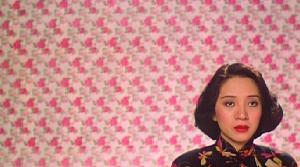
Master 12 (Leslie Cheung), so-named because he is the 12th son in the Chan family, falls in love with Fleur (Anita Mui), a charmingly demure courtesan who fetches hundreds of dollars for the mere touching of her neck or ear. The master showers the courtesan with numerous gifts, which in turn, is rewarded by the courtesan with her love. Undaunted by the master's family's refusal to their relationship, the two live together forcing the master to work as an extra for a Chinese opera staging. Their relationship tragically ends when both decide to die by suicide, promising each other to meet up in the afterlife. Fifty three years later, Fleur reappears in her traditional cheongsam in the office of newspaper editor Yuen (Alex Man) asking for the editor to print an ad for a missing person. Fleur follows Yuen until he discovers that Fleur is a ghost. Yuen, with his girlfriend (Emily Chu), helps the melancholic Fleur to find her lover who failed to meet her in the afterlife.

Produced by Jackie Chan, Rouge is an odd ghost story as the film does not seek to draw out horror from the supernatural scenario. Instead, the film is quite disarmingly romantic. You are instantly drawn to what may seem like a timeless romance the moment Master 12 hears the low-toned yet seductive singing voice of Fleur echo through the hallways of the brothel. When the two meet for the first time, a gorgeous exchange of carefully placed flirtation, pervades the party. This is followed by a courting sequence which is equal if not greater in romantic atmosphere as the initial meeting of the two. The Master await Fleur patiently as the latter go out and about seemingly testing the love and intentions of the man courting her. Just from the introductory scenes, the hallucinatory scent of romantic passions can be felt floating the beautifully designed walls and windows of the brothel.

The film is beautifully shot by Bill Wong, and is the third feature of Stanley Kwan, who directs the film with quiet yet assured pacing. The interchanging of time periods is significantly done in a logical manner, assuring the feeling of sad nostalgia as the classically dressed ghost sees movie theaters and ancient shops turned into commercial spaces and highways. Above the external changes of the Hong Kong landscape, a theme of the huge differences of romanticism between Fleur's age and the present age surfaces. Unwittingly, the editor and his girlfriend's relationship is tested and is put upon a microscope when they are swept by the courtesan's sad story. In one scene, the girlfriend asks the editor if he'd commit suicide for her, both of them said no. As the story progresses, Kwan seems to persist with the idea that it is not the quality of the sacrifices one would commit for the survival of romantic relationships that has changed, but the fact that such ability to commit such sacrifices is inherent to the person, depending on his or her experiences in life or his or her capacity to love unflinchingly. The ending of the film suggests the idea that it is the courtesan's experiences (Kwan always had a soft spot in portraying women who are stepped upon) that gave her the determination to commit the suicide, and not the fact that the quality of relationships of old is much stronger than in the present.

The performances of both Anita Mui and Leslie Cheung are magnificent. Mui isn't exactly the prettiest of actresses, but her face possesses a unique sultry and seductively sorrowful quality that keeps her rather flat character interesting, despite that all she does is wait and stare and talk. My main problem with the film is that I don't quite buy the efforts given by the editor and his girlfriend in finding where Master 12 is. The editor and his girlfriend come up with the silliest of scenarios to explain the mysterious numbers, and to help Fleur in finding her lover. The supernatural doens't always jive with the grounded realities of the film. It is also unfortunate that there is a certain lack of humor that could've helped Kwan's droll pacing to move forward. On the other hand, the film is beautiful to look at, and the tragic relationship between Fleur and her lover is enough to keep you watching until the rather emotionally unfulfilling end.

Sunday, August 27, 2006

Prince of Darkness (1987)


Prince of Darkness (John Carpenter, 1987)

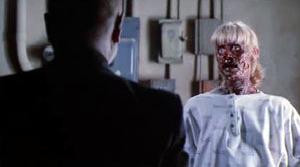
To describe John Carpenter's Prince of Darkness as merely a fine piece of horror cinema is to give this film a huge disservice. Prince of Darkness is more than horror, it's actually a very interesting piece of science fiction, that dabbles in occultism and the age-old mysticism that have always surrounded organized religion. Although the film contains zombies, demons, roaches, worms, beheading, blood, and a lot of screaming, the main thrust, the oomph that makes Prince of Darkness special is the way Carpenter attacked the tired and almost cliche theme of the devil boss himself taking over the Earth.

Instead of doing the film in the conventional horror way: witches, Satanists or other demoniacs who urge for their master to make his apocalyptic entrance in our world, Carpenter cooks up this whole theory wherein Satan is actually a creature from another dimension, or planet, and the Catholic Church has kept hidden inside a glass structure (which looks like a cheaply made bright green lava lamp) the Prince of Darkness, which awakens just in that moment where a supernova just exploded and some light particles, or quarks, or whatever, lands in Earth to urge the ooze to turn into an actual living creature, which infects everything it touches like a mind-controlling parasite. Carpenter's theory is complex, he uses scientific banter to raise the film's standing much higher. There's talk of telepathy, visual signals from the future, quantum physics, Catholic history that Carpenter struggles to jive and mix into a coherent whole. Surprisingly, it works and despite the kookiness of it all, is actually very entertaining.

Carpenter starts it off wonderfully. A priest mysteriously dies leaving a key to a darkened chamber in a closed-down church. A man, Brian (Jameson Parker) stalks a beautiful girl Catherine (Lisa Blount)who turns out to be his classmate in a philosophy-physics class under Professor Birack (Victor Wong). The key left behind by the dead priest is used by another priest (Donald Pleasance), who troubled by what he discovered, contacts Professor Birack, who in return, instructs his students who are experts in physics and other scientists to spend a weekend in the abandoned church to measure the happenings in scientific terms, and find out what can be done.

The premise is fantastic and Carpenter's filmmaking is quite admirable. His script (using pseudonym Martin Quatermass) maybe heavy handed but Carpenter's filmmaking makes up for such, using deadpan humor, or expert scare and shock tactics to allow the viewer to swallow the implausibility of everything. It's fine horror, with tinges of Romero zombie-fest (with the homeless schizophrenics surrounding the church in hordes), Italian schlock (there's an abundance of worms, and other creepy crawlers), and American exorcism scares (the near-latter part reminded me a bit of William Friedkin's The Exorcist). The sci-fi angle is more for thrills and chills rather than serious thinking, but Carpenter's insistence on the far-fetched theory may give the film some sudden pauses to its near-perfect pacing, but everything is forgiven when Carpenter turns the last twenty minutes into a hair-raising, mind boggling, exhilarating ride to a conclusion that will leave you scratching your head by how Carpenter came up with an unexpected stroke of genius.

******
This post is my contribution to Lazy Eye Theater: John Carpenter Blog-A-Thon.