Showing posts with label 1997 Films. Show all posts

Sunday, June 05, 2011

Manananggal in Manila (1997)


Manananggal in Manila (Mario O'Hara, 1997)
English Title: Monster in Manila

Mario O’Hara’s Manananggal in Manila (Monster in Manila) takes its cue from Roman Polanski who has mined domestic paranoia for dread in films like Rosemary's Baby (1968) and The Tenant (1976). Terry (Angelika dela Cruz), who is living in a condominium building with her sister (Aiza Seguerra), is pregnant. Unfortunately, the father of her baby has abandoned her. Beatriz (Alma Concepcion), a model, has moved in next door and starts to befriend her. Right after Beatriz's move, mysterious deaths are reported, with the bodies of the victims disemboweled, giving rise to conclusions that a manananggal (a monster that looks like an ordinary woman except that the upper part of her body separates from the lower part when it hunts for its prey) is responsible for the several murders.

Manananggal in Manila is essentially two separate movies melded into one out of convenience and commercial viability. The first one’s the attempt to update Peque Gallaga’s Manananggal episode in the first Shake, Rattle and Roll (1984). This is where O’Hara stumbles. Given the meager budget and the time constraints O’Hara has to work with, the film ultimately suffers, bearing all the evidence of its lack of ample financing. The wings of the manananggal are obviously assembled from plastic. The animated sequences (where the winged monster flies into the sky against the full moon and the parting scene where an ominous full moon slowly appears in the night) are pathetically executed. Sometimes, O’Hara does away with special effects by communicating terror through editing, nuanced and resourceful cinematography, or inventive sound effects.

The other film is far more interesting. O’Hara, more than just depicting evil through a monster sourced from myths and ghost stories, explores the nuances of that evil. Concepcion, sans the prosthetics she dons in the film’s climactic scenes, inhabits the role with astounding ease. There’s urgency in her attempts to seduce Terry to befriend her, to ease her out of the comfort of living the life of a single mother who consciously fantasizes about a boyfriend who cares about her instead of simply accepting the fact the he has left her, and finally, to slowly be liberated from the clutches of morality and be angry and vengeful, making her the proper vessel for herself. The film is most successful when it aspires for this kind of internal dread, more introspective and conceptual rather than the cheap scares and unintended humor of low-rent visual effects.

O’Hara’s Manila fronts a facade of normalcy. However, underneath the concrete of its many high-rise residential towers and the cautious demeanours of its denizens lies an unspoken fear, a shared understanding that the supernatural exists alongside ordinary problems. It is a city that bears the same haunted quality of Dario Argento’s Freiburg, New York City and Rome in Suspiria (1977), Inferno (1980), and The Mother of Tears (2007), respectively. The city becomes an apt dwelling place for the evil monster, who other than its look and its craving for human innards and babies has been transformed from a random mythological monster into an embodiment of evil, which is not necessarily defined by violent and destructive acts but by characteristics that are more human in nature, such as greed, lust and guiltless vindictiveness.

Manananggal in Manila is low-budget, high-concept horror. At first glance and especially with its crude and laughable special effects, the film seems to be nothing more than a hodgepodge of incongruent elements struggling to make logical sense. It is easily dismissible as nothing more than an attempt by its producers to rake in the most profit out of the littlest of capital. However, there is certainly something more to the film than its numerous glaringly bad parts. Unfortunately, the patience and persistence to see through the mess are traits that are rarely found in moviegoers fed with the seamless but empty spectacles Hollywood provides.

Monday, September 11, 2006

Shatranj ke Khilari (1977)


Shatranj ke Khilari (Satyajit Ray, 1977)
English Title: The Chess Players

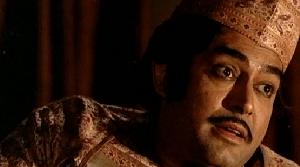
In an early scene in Satyajit Ray's only Urdu language film Shatranj ke Khilari (The Chess Players), General Outram (Richard Attenborough) interrogates Captain Weston (Tom Alter) regarding the conduct of Oudh monarch Wajid Ali Shah (Amjad Khan). The English-speaking Outram, curious of the supposed incompetencies of the Oudh king as shown by a report stating that the king spends an entire day poetry-reciting, songwriting, and tending to his impossibly large harem, requests that Weston recite one of the king's verses and the latter does so. He translates it to English as per request, and Outram thinks of the verse as not really of exceptional merit. Outram then reveals the British India Company's plans to depose the king of his crown and the administration of Oudh. The scene sets the conflict in the film while showcasing the outright clashes of culture of the invading British and the Muslim citizens of Oudh.

Shatranj ke Khilari is set in the last days of King Wahid's rule over the province of Oudh. The British has expressed to renege on the centuries old agreement that assured the royal family of the throne while providing gold for the British to advance their military. The agreement has made the ruling king lax and instead of actually administering to his subjects, he spends most of his time tending to his poetry, kite-flying, and his many wives and concubines. While the king is troubling over the impending advancement of the British military to conquer his kingdom, aristocrats Mirza (Sanjeev Kumar) and Meer (Saeed Jaffrey), descendants of brave warriors of a venerated past king, spend most of their time playing chess while their domestic lives and their nation suffer.

Shatranj ke Khilari is considered one of Ray's weaker efforts. It is notably different from Ray's most famous films as first, it is not in Bengali, second, Ray lets go of his neo-realist roots to create a film that feels and looks like a colorful and richly-adorned pageant, and lastly and connected to the second point, it is historically grounded paving way for more intellectual discussion rather than humanism. In fact, the film begins with an academic opener narrated by Bollywood superstar Amitabh Bachchan. The opener feels more like a teaching tool for history students complete with intricate discussions on Urdu culture, Urdu-British relations, and an instructional (if not simplistically humorous) short animated portions.

The rest of Shatranj ke Khilari plays out like a confused Bunuel film, only there are no bourgeoisie or any structured religion to poke fun on. The two aristocratic friends insist on playing a game of chess no matter what, and their efforts to do such is actually quite funny. Mirza's wife is so jealous of the game that she steals the ivory pieces, leading the two friends to try to borrow the pieces of their dying lawyer, and then finally ending up using household vegetables just to continue their pastime. Similarly, Meer doesn't acknowledge the blunt fact that his wife is cheating because she leads him to think that she's also enthralled with the game. Those clever bits by Ray flush out the dulling gravity of the history lesson Ray insists upon.

The film ends with Oudh being delivered to the British without any resistance and violence. The two friends find themselves in an abandoned house just outside the capital city of Lucknow. While the entire kingdom is being served out to the Brits on a silver platter without any hesitation whatsoever, tension is created when in a fit of losing, one of the friends lash out to personally insult the other. The only gun blast heard when Oudh was finally invaded by the British was when in the tensest of that momentary tension, Meer accidentally shoots his friend in the sleeve of his arm. That the entire political history of India has been mere minds playing a long winded game of chess, and it is an expected eventuality, that through stratagems and notions of friendship, that one will finally shout "checkmate" and corner the opponent to withdraw.

Saturday, August 19, 2006

Dang Bireley and the Young Gangsters (1997)


Dang Bireley and the Young Gangsters (Nonzee Nimibutr, 1997)
Thai Title: 2499 antapan krong muang

Nonzee Nimibutr's debut feature film Dang Bireley and the Young Gangsters is probably the influential Thai director's best film. Nimibutr's usual faults, his haphazard style of storytelling, his overly emphasized sense of cultural mood and atmosphere, his incomprehensible editing style, are at an all-time low here. The film, while good, is not exactly a brilliant piece of filmmaking. It lacks subtlety, but it does effectively evoke the chaotic discord of 50's Bangkok where social and political unrest reflects in the city's youth's lack of direction.

Dang Bireley (Jesdaporn Pholdee) killed his first man when he was thirteen, while trying to defend his mother, a street prostitute. Growing up, he mixed with the wrong crowd and inevitably formed a gang with his friends, Lam (Noppachai Muttaweevong), mercurial Pu Bottlebomb (Supakorn Kitsuwon) and his trusty lapdog Dum. Dang's best pal is Piak (Attaporn Teemakorn), the son of a Buddhist monk. He tries his best to keep Piak from joining his gang, even to the point of lending him money for his schooling, but after Piak middled in a gang war between Pu and his college friends, he is expelled from college, and breaks up Dang's friendship with Pu, causing a lifelong rift between the two.

Dang Bireley is an actual gangster who lived in Bangkok in the 50's. The film is told from the point of view of an middle-aged Piak who narrates the tale while reminiscing his youthful days. Dang Bireley's idol is James Dean and his life basically mirrors that of the Hollywood bad boy. Dean died in a car accident, and Dang dies the same way, of course, after figuring himself in a couple of adventures, which is the bulk of Nimibutr's film. Nimibutr recreates 50's Bangkok with unassuming ease, using costumes, settings, props and music that effectively capture the decade.

The film is beautifully photographed, further emphasizing the colorfully exciting era. Nimibutr doesn't plunge the film within Thailand's political landscape and centers mainly on the lives of the young gangsters. Whatever notion of social unrest is told from Piak's remorseful narration, and from there, we get a sense of what's really happening in the grander scale. Nimibutr's intimate portrait of the Thai youth is actually quite engaging. Although Nimibutr tends to direct overbearingly, using different lens, or slow motion, in different levels of success, the film still comes off as surprisingly coherent, and the characters, although psychologically simple, don't make decisions based on karma or fate, which is usually my complaint over Nimibutr's film characters who tend to do things not out of logic, but out of principles that may be foreign to non-Buddhists.

Dang Bireley and the Young Gangsters is violent. There's no constraint in depicting bloody battles, which range from alleyway rumbles consisting of student fighting it out with lead pipes and chains, to street wars where bullets fly and bottle bombs explode. Nimibutr's filmmaking reenacts the mindless wanton, the unrepressed angst that pervades Thailand's youth who take American pop culture much too seriously. It is as if these young gangsters do not really see the need to become gangsters, but out of trying to emulate their idols, gravitate towards the overhyped myths of these rock and roll and celluloid legends. I doubt James Dean and Elvis Presley will figure themselves in these youth wars that involve actual deaths and somewhat politically motivated attacks, but the tall tales surrounding their personalities provide inspiration for wrongly-placed notions of righteousness and blank bravery for the youth who circumstantially find themselves in a troubled era of political and social confusion.

Tuesday, August 01, 2006

The Ice Storm (1997)


The Ice Storm (Ang Lee, 1997)

Ang Lee's status as one of the more important directors of this generation has been solidified by his existential swordplay adventure Crouching Tiger, Hidden Dragon (2000) and Academy Award-nominated homosexual romantic weeper Brokeback Mountain (2005). Of course, there's that failed yet interesting attempt to put comic book hero the Hulk into philosophical perspective and a bunch of relationship comedies set within his Asian-American cultural context. In 1997, Ang Lee directed The Ice Storm from a screenplay adapted from a Rick Moody novel by his long-time collaborator James Schamus. The moody drama about the lives of two dysfunctional suburban families, I thought, is Ang Lee's most accomplished film.

Thanksgiving week and the Hoods are preparing for the arrival of their son, Paul (Tobey Maguire). What seems like a normal suburban middle-class family is in fact a bunch of discordant relationships surely bursting with repressed emotions. Ben (Kevin Kline) and Elena (Joan Allen) have put off marriage counseling in the guise that their marriage is actually going very well. Their fourteen year old daughter Wendy (Christina Ricci) is experimenting with her sexuality with her boyfriend, Mikey (Elijah Wood), one of the two sons of the Hoods' nextdoor neighbors, the Carvers. The Carvers are in a similar mess. The patriarch Jim (Jamey Sheridan) is always away for business, while his wife Janey (Sigourney Weaver), taking advantage of her husband's frequent prolonged leaves, maintains an affair with Ben. Sandy, the youngest of the Carver siblings, is an introverted mess.

The Ice Storm is a complicated relationship piece whose success hinges on atmosphere and mood. The screenplay by Schamus is pretty detailed and the dialogue externally calm yet brimming with context. There's a curious absence of rhythm in the film. Instead, Lee allows the events to flow, and the characters to trigger what I think is a natural reaction in the film's setting. Interestingly, the film's backdrop is during the 70's where America is facing a political crisis with Richard Nixon's administration. More interestingly, the adults in the film care more for alcohol and swingers' games rather than the state of the nation, while it is the children who follow-up the political weather. A visible boundary separates the concerns of the adults and the children, and as a result, creates a hindrance to normal familial functions.


Lee depicts with painful clarity the irony that subsists in American suburbia: where discontent, boredom, repression, and amorality displaces the human need to actually communicate. In a telling scene between Ben Hood and Janey Carver, Ben tries to woo Janey into small talk. Janey boredly replies "I don't need another husband." Even the seemingly amoral act of infidelity has turned into a mere bartering of their naked bodies in the efforts of extinguishing their primal and animalistic needs.

Lee begins the film with a narration by Paul Hood about how the family unit is one's biggest enemy, basing his observations from a Fantastic Four comic book where Mr. Fantastic had to sacrifice his son. It is an interesting note from Paul, who is perhaps the most disassociated character in the film. His perceptions are based mostly from the news he gathers from his sister, and the usual external quirks he observes during his short visits. I believe that Paul's observation runs counter to the two suburban families' experience. Unlike the comic book tale, the complexities of these family's dysfunction do not arise out of the members' superpowers, or in the real world and its inherent personalities, but by a society that has lost all notion of what is moral, as observed in a larger perspective of the nation's politics. Unlike the superheroes which are given the power to do as they please without the otherworldly guidance of fate and cosmic design, the characters of this film would go on doing their thing if it weren't for a sudden impetus for change, the titular ice storm, that would serve saving grace for the two families.

Wednesday, July 26, 2006

Deconstructing Harry (1997)


Deconstructing Harry (Woody Allen, 1997)

Woody Allen is first and foremost a writer who can direct films. He takes his cinematic cues from his favorite directors, most notably Ingmar Bergman. He sometimes experiments with the medium, modifying the mood, the style, and the form. However, the writing is still distinctly Allen. Allen's screenplays would always have that neurotic New Yorker, usually played by him. This neurotic New Yorker has a variety of professions: usually a novelist, a writer, or anything that has to do with the imagination. He is often well-off, with enough money to support his vices which include alcohol, anti-depressants, and the occasional whore. Finally, the neurotic New Yorker is more often than not, a fast-talker, his mouth spewing line after line of witty retorts that need no impetus to get released. This character feels like a window to Allen's brain.

While there is that comfort of knowing exactly what to expect from an Allen-written and directed picture, that predictability, I believe, is one of Allen's pitfalls. Allen has a narcissistic tendency that can be observed in all his films: his characters would always be molded from him. In Deconstructing Harry, Allen's recreation of Wild Strawberries (Ingmar Bergman, 1957), Allen recreates his standard protagonist, a famous novelist who is invited by the university that kicked him out to be honored for his life's work. Harry Block (Allen), the character's name obviously alluding to his writer's block is a deplorable character. He married twice, has one child from an irate ex-wife, several mistresses, and few real friends. He is a potential alcoholic who subsists in popping pills for emotional comfort, has a major problem with Judaism despite being a Jew, which eventually causes him to have a rift with his sister. With too many personality quirks for an aging man, Harry has a hard time finding anyone who is willing to accompany him to his former alma mater, to the point that he had to pay off a prostitute five hundred dollars just to be with him for that day.

As I've said, Harry is not a very lovable character. Allen however, supplies him with natural wit, and a gift for writing which in turn, becomes the window for the audience to discover what exactly is happening inside the mind of Harry. Allen shifts from the real world of Harry to Harry's literary creations which are obviously based from Harry's real life events, with the characters' names just changed to little effect or comfort. This effect, the switching from real life to fictional, is where the film got its name. Deconstructing Harry is in fact a deconstruction of the main character, what makes him click, what psychoanalytical explanation can be garnered to give justice to such an imbalanced character, what aspects of his real life determines his literary decisions. Actually, the little stories are pretty interesting and could have made feature films if they weren't part of the whole process of deconstructing Allen's stereotypical neurotic.

Deconstructing Harry is one interesting mess of a film. Incongruently edited, blandly shot, and with a story that can be described as a collection of half-baked although brilliantly written comic sketches, the film may be a struggle to watch. The conclusion feels a bit too self-congratulatory for comfort. While I may have complaints, the mess actually becomes rather enjoyable after a while. The little bits and pieces mesh pleasantly, revealing a likable side to a character whose ability to throw witty lines and to write stories cannot save him from being deplored. Also, I have always enjoyed Allen's brand of cynical humor, which comes in huge doses here.