Showing posts with label 1938 Films. Show all posts

Monday, August 14, 2006

The Adventures of Robin Hood (1938)


The Adventures of Robin Hood (Michael Curtiz, 1938)

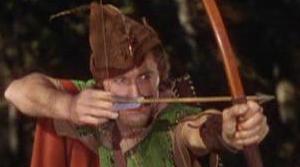
The Adventures of Robin Hood could very well be the quintessential adventure film, where almost everything, from the colorful costumes to the convenient casting, was right. It's one of the plenty collaborations between Austrian born director Michael Curtiz (who succeeded to helm the film when the studio thought previous director William Keighley's action scenes weren't lively enough), Errol Flynn (who was second choice after James Cagney got out of Warner), Olivia de Havilland, and musical maestro, Erich Wolfgang Korngold. Yet despite the familiarity with the team-up, The Adventures of Robin Hood stands out with its delightful hues, its gracious adventurism, its portrayal of pure and honest heroism and gallantry, and its joyous, if not very innocent romantic center.

The tale of Robin Hood has escaped its native English roots, and has become a universal story of bravery against oppression. When King Richard the Lionheart was called to fight for Christianity in the Crusades, his brother John (Claude Rains), and a horde of treacherous nobles, including Sir Guy of Gisbourne (Basil Rathbone), and the cowardly Sheriff of Nottingham, devise a plan to take over the throne by heavily taxing the peasantry, in the guise of collecting ransom for the safe return of the rightful king. Tired at the awful maltreatment of the ruling Normans against the poor Saxons, Robin Hood (Errol Flynn) bands up with other disgruntled citizens in the nearby forest of Sherwood. They steal from the rich, and hopefully collect enough money to pay ransom for their king, while providing food and shelter for the oppressed Saxons.

De Havilland plays Lady Marian, who like most other swashbuckling Curtiz films, provide a welcome air of gentle femininity within the frequent sword fights and rumbles. In Technicolor, her face is even more radiant, her cheeks as powerfully rosy that it won't make anybody wonder why the brash Robin Hood would sacrifice his freedom to catch a glimpse of the fair maid in the middle of the night. Their chemistry together brightens up the screen, and tickles one's fancy in the most cinematically and unembarrasedly romantic way. When Robin Hood plays a trick at Marian, toyingly declaring that he ought to be captured just to hear from Marian's lips that she does love him, you aren't flustered by the schmaltz of the scheme, but you somehow root that Marian delivers another kiss, after saying her sweet goodbyes.

Then there's Flynn's perpetual rival, Rathbone. Rathbone's contempt against the merry bandit transcends the screen, that when the two finally engage in a duel, it's as exciting as Marian and Robin Hood exchanging kisses. And the duel is wonderfully shot within the huge halls of the set of Nottingham Castle. While the rest of the cast engage in chaotic swordplay, the two exchange in a delightful duel, where honor and gallantry in fighting isn't forgotten. The actual physical clashing of their swords create much tension, and when replaced by their shadows, in an ingenious shot, one can almost imagine the reality of the tension between the two actors.

All this is enunciated with Korngold's adventurous melodies that will have you humming hours after the film has ended. Korngold has a way of emphasizing action, romanticism, giddy and fun cinematic emotions with a beat of his drum, or the sudden rush of a medley of notes. His music aspires action. The Adventures of Robin Hood can be easily described as almost technically pitch perfect. I have a few problems with some of the jokes falling out of place, but overall, it's an enjoyable viewing experience. Surprisingly, the film was released in 1938, and still, decades after, it retains its cinematic charm and continues to inspire pure-blooded gallantry, at least to the young ones.

Saturday, August 05, 2006

Sinners in Paradise (1938)


Sinners in Paradise (James Whale, 1938)

In 1938, stuck in the middle of a quagmire of studio politics, James Whale was assigned to direct a feature film which would turn out to be the most disappointing film Whale has ever attached his name to. The film, Sinners in Paradise, is in one word, disastrous. The film opened to negative reviews from both critics and the audience. However, is Whale exactly the one to blame for the cinematic disaster? When Carl Laemmle sold Universal Studios, the result was the ouster of both Laemmle and Carl Laemmle, Jr as head of the studio, lessening Whale's clout within the Hollywood film factory. Whale's level of scrutiny, from the casting, and the script development is completely absent from the film and Whale's task was to merely sit behind the camera and see to it that the script turns into a coherent, watchable whole. That's what Whale basically did, turn a ridiculously bad screenplay by Harold Buckley into something watchable.

A group of outcasts, misfits and other personalities of ill repute find themselves trapped in an island in the middle of the Pacific Ocean when their seaplane that was supposedly bringing them to China, crashes. The survivors include an all knowing and despicable state senator, two competing businessmen who trade in guns and ammunition, a rich heiress escaping a labor strike in one of her factories, a criminal on the run, another criminal personality who decides to tell on her former colleagues, a cranky airplane steward, a nurse who barters her marriage for an opportunity to work in a Shanghai hospital, and a mother who is off to China to visit her only son. In the island, the different personalities are forced to survive under the mercy of the island's only residents, Jim Taylor (John Boles), who owns the boat parked comfortably near the beach, and his man-servant Ping (Willie Fung).

There's an obvious lack of Whale's usual directorial flourish. Given a measly budget, Whale makes most of what he has. Much of the special effects is laughable. The airplane crash abandons all notions of logic as the miniature plane undergoes turbulence that is most possibly fatal, but the characters in that plane standing up in the plane's aisle as if they were merely experiencing a slight meteorological bump instead of the plot's typhoon. The island itself looks drab and makes you wish for the intricate production designs that dressed up Whale's previous projects. The acting is passable, with most of the actors and actresses, delivering their lines in theatrical fashion, making most of what little characterization the screenplay has to offer.

It's not that the story is hideous, it's just that the writing is so uninspired, the comedy so practically dead, and the plot movement so uncreative, that the film can literally be much worse if given to any director with less talent than Whale. I think the story is actually serviceable, with some similarities with Whale's previous Frankenstein (1931) and The Bride of Frankenstein (1935) where we are introduced to characters so arrogant that they opt to create life and play around with such creations. Here, Jim Taylor comes off as a Dr. Frankenstein type of character whose erstwhile purpose was to build an artificial community of sinners in a remote Pacific island. However, the similarities end there as Jim Taylor devolves into a character that is much less than the maniacal scientist in the famous horror classics.

Taylor turns into a romantic figure whose experimantations in forced community building is stunted by the fact that the participants in the community are mere cardboard cut-outs of stereotypical social misfits or upper class snobs. Taylor himself is trapped in a romantic storm with divorcee Anne Wesson (Madge Evans), which leaves him a character as uninteresting as the island survivors. It's a missed opportunity. Whale can handle comedy most efficiently when it oozes with sarcasm, irony, and deadpan commentary. However, when the comedy is forced down your throat with slapstick, middle-brow humor, it simply wouldn't work no matter how inspired the direction could be. The possible story that examines man's insatiable need to be like gods, by creating artificial communities, is completely lost with this mess.