Showing posts with label Classic Hollywood. Show all posts

Wednesday, September 10, 2008

The Good Fairy (1935)


The Good Fairy (William Wyler, 1935)

William Wyler's The Good Fairy, adapted from Ferenc Molnár's play by legendary screenwriter and director Preston Sturges, is basically about Luisa Ginglebusher (Margaret Sullavan), an orphan girl who is picked by a theater owner (Alan Hale) to be his theater's usherette. Luisa, fresh from the orphanage and thus naive in the ways of men, skirts from the insistent prodding of the men (the most humorously insistent of which is played by Cesar Romero) waiting outside for the usherettes to get out by pretending to be the wife of theater patron and hotel waiter Detlaff (Reginald Owen), who then invites Luisa to a posh party hosted in the hotel he works for.

In the party, Luisa gets acquainted with Konrad (Frank Morgan), a wealthy meat trader. When Konrad loses control of himself and starts promising Luisa luxurious things, Luisa, in order to again skirt men's advances, tells Konrad that she is married. Konrad thinks of a way to resolve the deadlock and proposes that he makes Luisa's husband rich so the husband can shower her with expensive things. Luisa randomly chooses a name from the phonebook: Dr. Max Sporum (Herbert Marshall), an impoverished lawyer whose only dream is to purchase a state-of-the-art pencil sharpener. Luisa, in turn, becomes the good fairy (of the story she often tells the other orphans in the asylum) to Sporum, who, because of her fabricated representations to Konrad, becomes appointed the very well-salaried general counsel for Konrad's meat company.

The Good Fairy is a film that shines because of sheer charm. Margaret Sullavan, from the first time we see her relating the story of the good fairy to the other orphans to her weepy apologies when her innocent ruse has been discovered, possesses undeniable charisma that carries the picture from beginning to end. She literally transforms from tomboyish waif to lovelorn maiden in a matter of an hour and a half, and loses none of the appeal she started with. Later in the film, Luisa tries on one of the "genuine foxines" that are on sale in the department store while waiting for Sporum to finish his shave. She looks at herself in the mirror, beautiful and sophisticated and aware of it (the shot is framed in such a way that we see Luisa reflected in endless layers of mirror reflections, dancing as if she had an entire troupe behind her). It's a gorgeously shot scene, one that aptly visualizes Luisa' transition from innocent orphan to a damsel in love for the first time, with Sporum absent his unsightly beard.

The film's innate charm carries over to the supporting cast. Morgan's Konrad, who is initially seen as lecherous predator, sheds that particular image and becomes one of the picture's more lovable characters: bumbling, generous, loony, lonely, and at times aloof. Marshall's Sporum also transforms, from pathetic loser, a victim and recipient of life's circumstances and dumb luck, to a dashing leading man, infusing the picture with delirious romance although belatedly.

Wyler's direction is competent, with a few moments wherein he complements Sturges' screenplay with clever touches, like in the flashy scene with the mirrors in the department store or Luisa experiencing her first movie (a melodrama of some sort where it seems like a woman is begging her man to forgive her, with the latter unaffectionately throwing the line "Go!" over and over again), drowning in the emotions of the unintelligible sequence that happens in the silver screen. Sturges' screenplay makes most of the material. The film is essentially light, a breeze to watch from start to finish, enjoyably sprinkled with gregarious conversations that are sure to enchant.

Wednesday, January 23, 2008

I Walked With a Zombie (1943)


I Walked With a Zombie (Jacques Tourneur, 1943)

I Walk With a Zombie, director Jacques Tourneur's second collaboration with producer Val Lewton after the huge commercial success that is Cat People (1942), is laced with such enigmatic flavor that despite its B-movie roots, it begs to be seen and re-seen, understood and re-understood for beneath the overly simplistic plotting is an indiscriminate mystery, forcing varying reactions and appreciations in every viewing. From the initial scene, a long shot of the serene beach where a woman and a tall Black man are walking side by side which is accompanied by the opening credits, the film at once commands a sense of camouflaged complexity. While that scene is an obvious literal visualization of the film's title since the woman, Betsy (a lovely Frances Dee) the Canadian nurse who narrates the events that ensue, is literally walking with zombie Carrefour (Darby Jones, whose roles in films seem limited to African natives, or zombies), it doesn't dwell on the exact sensationalism the title seems to try to invoke and instead shifts the picture's direction elsewhere, somewhere calmer, possibly romantic, and infinitely open.

The film, or at least most of it, is structured like the memoir of Betsy. Told without a notion of urgency, her story formally begins with her being interviewed for a job as a nurse in the Caribbean island of St. Sebastian. She is then employed by Paul Holland (Tom Conway), the island's sugar plantation manager, to take care of his wife Jessica (Christine Gordon) who is suffering from what logically could be a mental illness. Holland, whose apparent sorrow and other Byronic qualities seem to have a desirous effect on Betsy, as she starts toying around the idea of developing love for the poetically somber manager. To complicate matters, Wesley Rand (James Ellison), Holland's half-brother, sees Betsy's arrival as a repetition of the longstanding feud he has with Holland over Jessica's affection, a feud that is suggested to be the primary cause of Jessica's current situation. Betsy gets involved in a whirlwind of familial and romantic controversies spiced up by local traditions of voodoo and a general atmosphere of blanketed island misery.

Quite interesting is how Lewton (who, though uncredited, comes up with the final draft of his films' screenplays) keeps almost the entire film within the perspective and point of view of his female protagonist. Thus, whatever intrigue or controversy the film touches upon is limited to Betsy's actual knowledge from whatever she witnesses, overhears, participates in, and remembers, which is very scarce considering that she is a newcomer to the island and not privy to the whispered conversations in the mansion or the littered gossip in the streets. This turns the film into an jigsaw puzzle with several of the key pieces missing, showcasing an incomplete yet still delectable and appreciable portrait of a story that weaves both the supernatural and the familiar, and requiring further participation and a great dose of imagination and creativity from the viewer to truly come alive. This is what essentially makes the film a towering achievement in B-movie making. Instead of covering all the corners of essential storytelling and spoon feeding the audience with what essentially is a quickly manufactured and ultimately commercial narrative, it leaves considerable spaces for mystery and intrigue thus converting the humble confines of the plot into a myriad of eternally morphing emotions and directions.

Moreover, the female perspective reinforces the essentially amorous thrust of the film despite its unglamorous title and its horror film tendencies. I Walked With a Zombie is conveyed with what feels like a quietly cognizant tendency. It is as if the film was being told through the eyes of a passive participant who gets thrown in an affair that catches her unaware and awakens her longings for the unworldly and the dreamy. This makes the exotic setting even more irresistible and alluring. Most remarkable is how Tourneur's expert use of the shadows keeps the visuals three-dimensional in a way that what happens outside the frame of the picture is also conveyed through the movements of the shadows, thus enunciating the importance of setting to the overall tone of the film.

In a rather startling although largely unobserved turn in the film, the perspective is taken away from Betsy. Wesley, troubled by the revelation of her mother (Edith Barrett) regarding Jessica being a zombie, decides to end everything by releasing her from the estate, pulling out the arrow from the figurehead (called "Ti-Misery") and piercing Jessica with it, before being forced into the shores of the island. It's a remarkable sequence, one that doesn't exactly share the consistent tone of the film, purging whatever female psychology and logic into the equation and replacing it with a cryptic and clearly mystical rationale. Apart from the suggested guilt and pity of Wesley, there is little clear motivation that would drive the deathly conclusion and to add further curiosity to the affair, Carrefour's towering presence, following Wesley in his doubtable salvaging of Jessica's soul, becomes the solitary logic in the abrupt madness. His presence, made overtly poetic and surreal with Tourneur's dramatic blocking (the scene where Carrefour's body accentuates the frame which details Wesley carrying Jessica's body in the beach is remarkably beautiful), becomes the climax's ingenious rallying point, the radical shift from Betsy's point of view to that of the island's. After all, the only witness to the portrayed sequence is Carrefour, zombie, servant of the island and quite possibly the symbol of the islanders' servile psychology.

From then, we no longer hear Betsy's ethereal voice-over which is replaced by a male one, more earthy and hardened, probably coming from one of the islanders' as the accent suggests. From dreamy and romantic, it becomes shaded with a pious dolor. It wraps up the film with a moralistic tone, accusing Wesley and Jessica with sinfulness and deserving of death and wishing the virtuous living, Holland and Betsy who is nestled in the former's close embrace and is now a subject of observation rather than an observer, a blessed life. The most interesting thing about the shifting of perspective from Betsy to the islanders is the thematic implication it suggests. Throughout the film, we are enchanted by the regales of the privileged Caucasian woman, living outside the perimeters of the culture that at first is represented by its beauty ("Palm trees," she repeats as she plays around with the idea of working in a Caribbean isle) but is then modified by the romantic entanglements that ensued. Such is aptly diluted by an ending that suggests and puts into a more palpable manner the disillusionment Holland so poetically manifests to Betsy while she was daydreaming on the ship to St. Sebastian. For a brief yet momentous instance, we get a glimpse of the natives' psychology, the simplistic morality, the faithfulness to the whims of nature and fortune, the subservient mentality that backdrops the ending's patent although slightly hopeful melancholy.

Wednesday, June 27, 2007

The Invisible Man (1933)


The Invisible Man (James Whale, 1933)

You can definitely predict the spectacle, that beneath the horrid bandages and the sunglasses is nothing. However, when Claude Rains starts unraveling his face, there's always that jolting effect no matter how many times you've correctly predicted the spectacle. It probably stems from James Whale's apt opening, with the heavily covered man walking past the snowstorm, arriving at a jolly little inn with jolly people. His physical predisposition and his unlikable aura counters the warmth of the inn where he intends to stay. He chooses to keep himself a mystery and when egged on by the innkeeper, he finally reveals himself and goes about on a rampage of petty and more serious crimes.

If anything, the invisible man's criminal activities are, during it's time, quite alarming, and his motivations are not really based on rationality. There's always an element of surprise in his malevolence and his concept of power is downright disturbing. Whale commits his crimes into celluloid with unassuming spontaneity. They're almost designed like comedic set pieces, as when the invisible man dons a pair of trousers and scares a woman away while singing a limerick; or when he throws a bald man's hat into the creek. However, Whale doesn't hold back when the invisible man commits his graver offenses, as when the invisible man makes two men fall down a cliff, or steals a box full of money from the bank, or derails a train, with the same alarming spontaneity of his lesser crimes. That indifference makes him more ferocious; his invisibility makes him all-powerful.

It's not that the invisible man is pure evil. You can always still sense his humanity: the way he pleads for more time from the innkeeper just so he can find a remedy for his invisibility; or when his voice softens when he learns that Flora (Gloria Stewart) is on her way. Actually, that is what makes the film so irresistibly interesting, the same way Frankenstein (1930) and The Bride of Frankenstein (1935) are outstanding horror pictures. Whale would always posit a lurking humanity beneath the monstrous exterior or lack of exterior, in this case.

The metaphor of invisibility is apt. It is power that shields the man from impunity but with the aftereffect of completely removing the possessor's identity and his whole place in this world. There are only traces of his former life, but the controlling facet is his invisibility. That skews his reason. His noble purposes are tainted with evil motivations. There dividing line between good and evil are dimmed.

It is for that reason that the film's ending, despite its questionably syrupy circumstance, is very appropriate. While in his deathbed, the invisible man is suddenly revealed, bit per bit, until we see his face, completely peaceful and at ease. We understand his plight as power is indeed tempting and damning. We also understand that despite the horrifying crimes he has committed, the illogical rationale still stems from his position of disadvantage, that his case conditions his mindset for such circumstances and that the help of science and the mysterious chemical he added in his invisibility serum are not the main causes for his insanity, but his human condition. He cannot get his life's love or his peers' approval because he was so poor to begin with, leading him to be jealous and destined to be continuously betrayed.

Friday, January 19, 2007

Lured (1947)


Lured (Douglas Sirk, 1947)

This is post-war, pre-Magnificent Obsession (1954) Douglas Sirk film. Fritz Lang, Robert Siodmak, and Edgar Ulmer have already made dents on the noir genre. While still irresistably beautiful, the way Lured opens with a pretty face aboard a bus to meet her deadly lover (always covered by the shiny damp cement walls or the shadows or the man selling newspapers tagged with the headlines about a suspect serial killer), there's always a feeling that we've seen this before. Sirk cuts to Scotland Yard where we get a glimpse of the investigatory work of Britain's agents; they pinpoint the unique marks of the typewritten poem, explains the similarities of the killer's poetry with that of a certain Baudelaire.

Club dancer Sandra Carpenter (Lucille Ball) is introduced to us. She's no dumb beauty; when her friend tells her about marrying a stranger she met through the newspaper personals section, she quickly throws questions and queries to quell her curiosity. True enough, her friend becomes the next victim of the mysterious killer. She is tapped by Scotland Yard to undercover for them. She passes off as everything each personal asks her to be, until she finally discovers who the mysterious killer is. Along the way, she flirts with debonair urbanite Robert Fleming (George Sanders), who somehow lures her to his beguiling charms, or killer's instincts; a prospect Sirk plays with and keeps hidden until the film's conclusion.

Sirk keeps the noir elements muted. There's an uncharacteristic romanticism to Sirk's crime-thriller; the way Fleming almost always shows up during perfect opportunities for romantic interludes, the way Carpenter is drifted from a supposed undercover life of crime-busting to a stable romantic opportunity, the way Sirk keeps the plot from floating in standard noir world weariness by portraying Carpenter as always hopeful and always optimistic. Moreover, Sirk makes minimal use of noir visual elements; almost everything happens indoors (very graciously decorated) and when Sirk does make use of noir visual elements, it almost always ends up in uncharacteristic triumph instead of the standard downward spiraling that characterizes noir plotlines. When Carpenter meets up with world-class fashion designer (played with impeccable passion by character actor Boris Karloff) under the dimly lit streets of London, it makes us assume that a plot-connected tragedy will ensue. The opposite happens; Karloff turns out to be a deranged has-been, setting up a fashion show for a crowd of dogs and mannequins; Ball chews up the scene with her sarcastic face before the sequence ends with Ball being rescued by another undercover cop (George Zucco, who from then on, provides unessential humor to the feature).

Lured is quite overlong. It's uncertainty on what it is actually makes its uncomfortable length apparent. The middle part strays the film in so many directions, almost to explicit tedium. It seems that Sirk is quietly enjoying the cat-and-mouse game that got us hooked, and is unable to confidently give off a satisfactory conclusion to the exercise. But he does (after several minutes of dull exposition); when the culprit is finally revealed, Sirk gives us another taste of his pressure pot cinematics: he puts Carpenter and the evil culprit inside the living room; Sirk's eye for extravagantly capturing lush interiors serves him well by turning the climactic scene into something out of a sick melodrama (an unready exclamation for hidden lustful longing, a surprised and slightly affronted object of affection; a passionate expression of that longing that tumults (although not exactly to serve the culprit's intentions) into one happy ending).

Thursday, January 18, 2007

Love Me Tonight (1932)


Love Me Tonight (Rouben Mamoulian, 1932)

It was love at first sight for me. Rouben Mamoulian establishes something remarkably wondrous from the film's getgo: sleepy Paris waking up to the beat of a workman's hammer; the snores of a sleeping bum, noise from the city's chimneys, old ladies in their morning chores add to the rhythm of the city. Mamoulian's camera enters through the window of an apartment introducing us to still drowsy tailor Maurice Courtelin (Maurice Chavalier), singing a catchy ditty while walking and flirting his way to shop.

The enjoyable inventiveness of the initial sequence is matched when Maurice sings composer-lyricist duo Rodgers and Hart's catchy song "Isn't It Romantic." Way before Maurice meets his romance, Princess Jeanette (Jeanette MacDonald), the little tune he hums to his satisfied customer reaches her by being passed from customer, to traveling songwriter, to a battalion of soldiers, to a violin-wielding gypsy boy to the lonesome princess in her chateaus' balcony. It is only when the viscount of Paris (Charles Ruggles) neglects to pay his clothing dues that Maurice is forced to visit the chateaus, and by pretending to be a baron, finally get a chance to make his pre-destined princess fall in love with him.

It's truly ahead of its time. It's pre-code sensibilities made it possible for seemingly raunchy exchanges between the characters. The song "Mimi," sung by Maurice upon catching the fanciful princess parading in the chateaus grounds, waves around innuendos in its giddy melodics and rhythm while Mamoulian amuses us by utilizing close ups of Chavelier and MacDonald's faces with their evolving emotional reactions and reflexes. Witticism and underhanded humor, and a little touch of rhyme and rhythm in word selection, turn the always entertaining dialogues into delightful extensions of the film's lovely musical pieces.

Watching Love Me Tonight instantly turns Baz Luhrmann's Moulin Rouge (2001) into a hyperactive mess. It's quite nice to note that everything Luhrmann tried to innovate in the musical genre was already committed into film in 1932 by the inventive Mamoulian. Love Me Tonight has everything, and more importantly, the inventiveness is not splattered into the feature like a Jackson Pollock painting. Instead, the visual gimmickry are all placed carefully and in sensiblemanner. When Maurice pleads that the hunting party leave slowly and silently so as to not wake up the sleeping stag, Mamoulian cleverly captures the party's retreat in slow motion. Similarly, when Maurice and the princess finally exchange their vows of love to each other, the night sequence is followed by Maurice waking up to the dreamy titular song which is complemented by Mamoulian splitting the screen with the sleeping (and suggestively satisfied) princess.

A race between the horse-riding princess and a charging train caps this lovely film. Again, Mamoulian expertly edits the sequence. He masterfully times shots of the train's hardworking engines, the rapid landings of the horse's legs, and the lovers faces and creates an exhilerating sequence that is comparable to the delightful chase and race sequences of the films of the silent era. It's a reminder as to how Mamoulian (who before directing for films, worked as a theater director) understands the purpose of sound in film; that it is not enough that the feature feign excitement by pumping up the music or adding heart pounding sound effects. The visuals should catch up with the tempo of the sequence and that music and sound merely complement what should already be visually portrayed; it is a trait that adheres to silent film traditions, and remarkably works in this musicale.

Thursday, September 07, 2006

Modern Times (1936)


Modern Times (Charlie Chaplin, 1936)

In Modern Times, the iconic cinematic character The Tramp (Chaplin) is pitted against the woes of modernization. It's largely a pressing issue, even today, wherein humanity is enslaved by a culture of dehumanization based on the rapidly improving state of our technology and processes. Men and women become enslaved by the machineries of the money-hungry corporate world not knowing that they have trapped themselves, as The Tramp would literally show, in one of the giant wheels that keep the world fat and greedy.

Much more than it is a pressing issue, it is also depressing. With the advent of machines that can do almost anything (the film showcases an instrument that automatically feeds the laborers thus minimizing inefficiency by obliterating lunch hours), human beings are turned into just mere parts of a gigantic machinery and individualism is poised as an unneeded bother. The magic of Charlie Chaplin's film is that out of the pressing and depressing issues he decided to tackle, he still has the nerve to tell us to smile and enjoy, and quite frankly, he succeeds.

Chaplin's antics are wonderful. We first see The Tramp as a laborer in a factory. It's a funny sight, the minuscule Tramp forcing himself to keep up with the speeding conveyor belt, and annoying his co-workers, towering and somehow have been able to merge themselves with the machine. The factory itself is fantastic. An art-deco type of building with large contraptions composed of wheels, levers, and belts (it reminds me of Fritz Lang's futuristic world in Metropolis). The president sits in his office and observes his workers via cameras installed in almost every part of the building, which points out the idea that again, privacy is an inefficient human trait and shouldn't be a part of the workplace. The Tramp is booted off the factory after a nervous breakdown and mistakenly identified as a labor leader, is imprisoned.

The Tramp later on meets a waif (Paulette Goddard) and in a tender yet humorous scene dreams up of a life they will have together inside a suburban house. It's a tender and beautiful scene, amped up by Chaplin most recognizable musical composition. Their duo is hopeful that within a world that seems to have forgotten humanity for efficiency and wealth, they will find a place that will appreciate humanity's beauty. The Tramp finds a job at a department store, and there, the dream is extended with the waif skateboarding at the toy section or enjoying the comforts of a luxurious bedroom.

But again, the Tramp seems to be followed by misfortune, and is again booted off from the job. Finally, they find a job in a restaurant. The waif as a dancer, and the Tramp as a singer-waiter. Their misfortune ends in a hopeful scene that Chaplin originally intended as a tragic scene where the duo will be separated forever. The present ending is much more indelible and is a ray of hope in a world that persists to dispose of human traits in pursuit of material things the modern world has imposed on everyone.

Modern Times is Chaplin's last silent film. Interestingly, the film cannot strictly be considered a silent film as sound is an important element in the film. Human voices are only heard from mechanical sources. First, from the monitor where the corporation president details his orders. Second, from a recorded message from the inventors of the feeding machine. Third, from the radio. We finally hear human voices from a human source only when there's singing (by the restaurant singing waiters, and lastly, from The Tramp who utters his first words in film --- complete gibberish as he forgot the lyrics to his song).

Chaplin seems to be commenting on how humanity has been engulfed by a culture of machinery that the only voices that matter are those coming from machines themselves. In a final note, Chaplin insists that humanity does not persist as secondary machines. Humanity should persist as emotional creatures, and that human voices should be heard not to belittle human individuality and emotionality but to strengthen it with humor and enjoyment, thus, the songs. In the end, Chaplin's message is clear --- just smile.

Saturday, August 19, 2006

The Night of the Hunter (1955)


The Night of the Hunter (Charles Laughton, 1955)

Prolific actor Charles Laughton's only directorial work The Night of the Hunter begins in darkness, with the stars providing illumination. From the night sky appears the faces of children, and in the center, the calm and tender face of silent film superstar Lillian Gish telling biblical passages as an introduction to this parable-like tale of good and evil, and of innocence and sin. The film then cuts to an overview of a riverside community where playing children discover the body of a woman. Then it cuts to the film's most memorable character, Harry Powell (Robert Mitchum), driving down the road and conversing with his supposed God. We get the impression that the man is possibly deranged, and is either a self-righteous vindicator of Christianity, or merely a petty criminal who conveniently hides behind a mask of piety. Either way, we do know he's evil.

Powell finds himself imprisoned with a certain Ben Harper who killed two men and stole ten thousand dollars, and hiding them in a secret place his two children only knows where. After release, Powell travels to town and tries to squeeze from the children the location of the loot, even to the point of marrying their widowed mother, Willa (Shelley Winters), killing her, and then chasing the two children from their hometown to another riverside haven.

The Night of the Hunter is possibly one of the most terrifying films ever made. Laughton possesses a confident visual style that mirrors Orson Welles in his debut feature. Laughton's visual compositions are twisted, atmospheric and beautiful. Moreover, his distinctive artistic style is flawless. One just has to watch young John Harper (Billy Chapin) tell his little sister Pearl (Sally Jane Bruce) the story of an African king, when he is suddenly interrupted by an imposing shadow. He looks outside and discovers a man standing by the solitary oil-lit street lamp. That seamless mixture of flawless direction, impeccable photography, graceful acting, and delirious writing makes every scene in this film classic suspense filmmaking.

Then there's the famous river scene which begins with a feverish chase between Powell and the two kids. Amidst the calm starry sky, little Pearl sings an equally calming lullaby. Yet we are all aware of what happened and what may possibly happen, but Laughton has the gall to sequence this dreamy scene that might probably be confused as a scene out of a fairy tale, if not viewed in the film's concept. The result is something nightmarishly surreal, a thing of cinematic beauty. The whole river sequence is wondrous, and it makes one wish that Laughton directed more films, but alas, The Night of the Hunter failed at the box office and Laughton swore he'd never direct another film again. James Agee supposedly adapted the screenplay from a David Grubb novel, but Robert Mitchum says in his autobiography that Laughton actually disliked Agee's screenplay, and just paid the screenwriter, and completely rewrote everything uncredited.

The Night of the Hunter is arguably one of the best films that purely depict good and evil. It bravely features children who are targets of violent and traumatic harm, over money they'd probably never ever use. There's an abundance of biblical allusions in the film, and the last third of the film features what probably may be the most simplistic yet captivating battle between good and evil. No, it doesn't feature a host of demons hording the children, being protected by beautiful angels. It actually just involves Harry Powell guarding the estate of Rachel Cooper (Lillian Gish), a kindly old woman who adopts children, including the two Harper kids. They engage in a duet that might very well be as detailed as warring factions of good and evil. Powell's baritone and Cooper's grandmotherly voice marrying in an enchanting gospel song: Laughton's cinematic tactics is just so deliriously magical that the film might very well be declared as sinful.

Monday, August 14, 2006

The Adventures of Robin Hood (1938)


The Adventures of Robin Hood (Michael Curtiz, 1938)

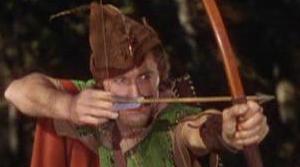
The Adventures of Robin Hood could very well be the quintessential adventure film, where almost everything, from the colorful costumes to the convenient casting, was right. It's one of the plenty collaborations between Austrian born director Michael Curtiz (who succeeded to helm the film when the studio thought previous director William Keighley's action scenes weren't lively enough), Errol Flynn (who was second choice after James Cagney got out of Warner), Olivia de Havilland, and musical maestro, Erich Wolfgang Korngold. Yet despite the familiarity with the team-up, The Adventures of Robin Hood stands out with its delightful hues, its gracious adventurism, its portrayal of pure and honest heroism and gallantry, and its joyous, if not very innocent romantic center.

The tale of Robin Hood has escaped its native English roots, and has become a universal story of bravery against oppression. When King Richard the Lionheart was called to fight for Christianity in the Crusades, his brother John (Claude Rains), and a horde of treacherous nobles, including Sir Guy of Gisbourne (Basil Rathbone), and the cowardly Sheriff of Nottingham, devise a plan to take over the throne by heavily taxing the peasantry, in the guise of collecting ransom for the safe return of the rightful king. Tired at the awful maltreatment of the ruling Normans against the poor Saxons, Robin Hood (Errol Flynn) bands up with other disgruntled citizens in the nearby forest of Sherwood. They steal from the rich, and hopefully collect enough money to pay ransom for their king, while providing food and shelter for the oppressed Saxons.

De Havilland plays Lady Marian, who like most other swashbuckling Curtiz films, provide a welcome air of gentle femininity within the frequent sword fights and rumbles. In Technicolor, her face is even more radiant, her cheeks as powerfully rosy that it won't make anybody wonder why the brash Robin Hood would sacrifice his freedom to catch a glimpse of the fair maid in the middle of the night. Their chemistry together brightens up the screen, and tickles one's fancy in the most cinematically and unembarrasedly romantic way. When Robin Hood plays a trick at Marian, toyingly declaring that he ought to be captured just to hear from Marian's lips that she does love him, you aren't flustered by the schmaltz of the scheme, but you somehow root that Marian delivers another kiss, after saying her sweet goodbyes.

Then there's Flynn's perpetual rival, Rathbone. Rathbone's contempt against the merry bandit transcends the screen, that when the two finally engage in a duel, it's as exciting as Marian and Robin Hood exchanging kisses. And the duel is wonderfully shot within the huge halls of the set of Nottingham Castle. While the rest of the cast engage in chaotic swordplay, the two exchange in a delightful duel, where honor and gallantry in fighting isn't forgotten. The actual physical clashing of their swords create much tension, and when replaced by their shadows, in an ingenious shot, one can almost imagine the reality of the tension between the two actors.

All this is enunciated with Korngold's adventurous melodies that will have you humming hours after the film has ended. Korngold has a way of emphasizing action, romanticism, giddy and fun cinematic emotions with a beat of his drum, or the sudden rush of a medley of notes. His music aspires action. The Adventures of Robin Hood can be easily described as almost technically pitch perfect. I have a few problems with some of the jokes falling out of place, but overall, it's an enjoyable viewing experience. Surprisingly, the film was released in 1938, and still, decades after, it retains its cinematic charm and continues to inspire pure-blooded gallantry, at least to the young ones.

Wednesday, August 09, 2006

Captain Blood (1935)


Captain Blood (Michael Curtiz, 1935)

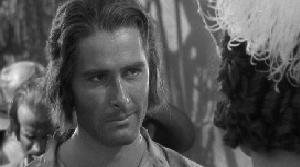
Michael Curtiz's Captain Blood marks the first starring role for Aussie-born actor Errol Flynn, which got the part of the brash yet chivalrous doctor-turned-slave-turned-pirate Peter Blood, after the role got turned down by two previous actors. It also marks Flynn's first collaboration with the prolific Hollywood director, and his co-star Olivia de Havilland. Much like many firsts, the film's got to be very good to inspire continuations, and Captain Blood is exactly that: a vastly entertaining, although conventionally romantic swashbuckling film.

The story is set within the political turmoil of 17th century England where tyrant King James has been executing rebels with heartless ease. Dr. Blood is caught while tending to a wounded rebel, and is punished alongside them and is supposedly to be hanged for treason, when it is suggested that they just be shipped to Port Royal in Jamaica as slaves. Arabella Bishop (de Havilland), niece of the plantation-owning Col. Bishop (Lionel Atwill) buys off the misjudged doctor, eliciting reluctant sparks of romance between the two. Blood and his crew escape by capturing a Spanish privateer and lives a life of piracy, as they are enemies to their own country, and outcasts in other nations.

Flynn is a fortunate discovery here. His sharp facial features, his noble yet confident swagger, his expressive eyes, are perfect for the Hollywoodized adventurer. He is ripe for romance, danger, and swordfights. His scenes with Basil Rathbone (who plays a French pirate captain whom Captain Blood is unfortunate enough to team up with) swells with stiff competition, and their swordfight becomes the highlight for this swashbuckling film. De Havilland is a gorgeous and much-needed presence in this testosterone-filled adventure romp. Though homosexual undertones may be gathered with Captain Blood's uncomfortable friendship with navigator Jeremy Pitt (Ross Alexander), they're merely undertones and half-baked guesses as the film is essentially about swordfights, ship battles, and brave young men stealing the hearts of dainty females with merely an act of chivalry and an ounce of bravery.

Curtiz's direction is precise, though it is often uneven when the film invariably changes mood. There are attempts at comedy, but most of them are outdated or the comic timing not as perfectly constructed into the film. The cinematography is also uneven but oddly beautiful. England is shown as lifeless and unexciting with its interiors unattractive and bare. The Caribbean, on the other hand, is full of life and the rumbles and the ship gun battles, are fiery with visionary energy. Much of the gun battles are lifted from the silent film The Sea Hawk, directed by Frank Lloyd, but to point out such recycling for criticism is nitpicking. Erich Wolfgang Korngold's musical arrangements add much to the cinematic excitement the Curtiz, his cast, and his crew has cooked up, and much of today's musical directors could learn a thing or two from Korngold's apt use of musical rhythm and melody in evoking a sense of adventure and romanticism that is very natural to the film.

Saturday, August 05, 2006

Sinners in Paradise (1938)


Sinners in Paradise (James Whale, 1938)

In 1938, stuck in the middle of a quagmire of studio politics, James Whale was assigned to direct a feature film which would turn out to be the most disappointing film Whale has ever attached his name to. The film, Sinners in Paradise, is in one word, disastrous. The film opened to negative reviews from both critics and the audience. However, is Whale exactly the one to blame for the cinematic disaster? When Carl Laemmle sold Universal Studios, the result was the ouster of both Laemmle and Carl Laemmle, Jr as head of the studio, lessening Whale's clout within the Hollywood film factory. Whale's level of scrutiny, from the casting, and the script development is completely absent from the film and Whale's task was to merely sit behind the camera and see to it that the script turns into a coherent, watchable whole. That's what Whale basically did, turn a ridiculously bad screenplay by Harold Buckley into something watchable.

A group of outcasts, misfits and other personalities of ill repute find themselves trapped in an island in the middle of the Pacific Ocean when their seaplane that was supposedly bringing them to China, crashes. The survivors include an all knowing and despicable state senator, two competing businessmen who trade in guns and ammunition, a rich heiress escaping a labor strike in one of her factories, a criminal on the run, another criminal personality who decides to tell on her former colleagues, a cranky airplane steward, a nurse who barters her marriage for an opportunity to work in a Shanghai hospital, and a mother who is off to China to visit her only son. In the island, the different personalities are forced to survive under the mercy of the island's only residents, Jim Taylor (John Boles), who owns the boat parked comfortably near the beach, and his man-servant Ping (Willie Fung).

There's an obvious lack of Whale's usual directorial flourish. Given a measly budget, Whale makes most of what he has. Much of the special effects is laughable. The airplane crash abandons all notions of logic as the miniature plane undergoes turbulence that is most possibly fatal, but the characters in that plane standing up in the plane's aisle as if they were merely experiencing a slight meteorological bump instead of the plot's typhoon. The island itself looks drab and makes you wish for the intricate production designs that dressed up Whale's previous projects. The acting is passable, with most of the actors and actresses, delivering their lines in theatrical fashion, making most of what little characterization the screenplay has to offer.

It's not that the story is hideous, it's just that the writing is so uninspired, the comedy so practically dead, and the plot movement so uncreative, that the film can literally be much worse if given to any director with less talent than Whale. I think the story is actually serviceable, with some similarities with Whale's previous Frankenstein (1931) and The Bride of Frankenstein (1935) where we are introduced to characters so arrogant that they opt to create life and play around with such creations. Here, Jim Taylor comes off as a Dr. Frankenstein type of character whose erstwhile purpose was to build an artificial community of sinners in a remote Pacific island. However, the similarities end there as Jim Taylor devolves into a character that is much less than the maniacal scientist in the famous horror classics.

Taylor turns into a romantic figure whose experimantations in forced community building is stunted by the fact that the participants in the community are mere cardboard cut-outs of stereotypical social misfits or upper class snobs. Taylor himself is trapped in a romantic storm with divorcee Anne Wesson (Madge Evans), which leaves him a character as uninteresting as the island survivors. It's a missed opportunity. Whale can handle comedy most efficiently when it oozes with sarcasm, irony, and deadpan commentary. However, when the comedy is forced down your throat with slapstick, middle-brow humor, it simply wouldn't work no matter how inspired the direction could be. The possible story that examines man's insatiable need to be like gods, by creating artificial communities, is completely lost with this mess.

Friday, August 04, 2006

The Bride of Frankenstein (1935)


The Bride of Frankenstein (James Whale, 1935)

James Whale's Frankenstein (1931) left me at awe. Men trying to be gods, creating monsters. Monsters of moral ambiguity, dramatically trying to catch the light. Monsters as mere children, misshapen, misunderstood and later on, prosecuted. It' is an experience that will leave any viewer horrified, and suspicious of the possible answers to the many questions left unanswered. James Whale, who originally didn't want to revisit the tale, ups the stakes and cooks up a sequel that further examines the humanity of the monster, the insatiability of all humanity, and all that existential, religio-social conceptions of morality. The sequel, The Bride of Frankenstein, although impossible, is a vast improvement over its predecessor.

The Bride of Frankenstein opens on a stormy night, inside a beautiful mansion where two men are discussing poetry and literature as a lady is doing some stitching in her dainty chair. We learn that the lady is no ordinary woman, but is actually Mary Shelley (Elsa Lanchester), the creator of the story of Frankenstein and his monster. She then proceeds in telling what happened after the fiery conclusion of the first film. The monster (Boris Karloff) has survived and in an effort to save himself, kills townspeople who are trying to harm him. Dr. Henry Frankenstein (Colin Clive) is recuperating from his injuries when a mysterious visitor Dr. Pretorius (Ernest Thesiger) pays him a visit, and offers him a team-up to create another monster, a female monster who would serve as the monster's mate, and from there create a world of "gods and monsters."

The monster is stalking the woods and the nearby houses where he is continuouosly chased by angry mobs. Although injured and afraid, he becomes attracted to the beautiful music from a nearby hut. The owner is a blind man who befriends the monsters and teaches him basic words. The scene is quite moving, despite the overt religiosity that surrounds it. The background music features church tunes, the old blind man prays and thanks God for giving him a friend in his times of loneliness, and the monster, for the first time, sheds a tear. It could've ended there where a well-deserved bliss is finally granted to the misunderstood creature. However, the joyous and playful exchanges of smiles and elementary words are aborted when two huntsmen disrupt their momentary glee and attack the monster, chasing him again into the woods. The monster flees but is now armed with a learned sense of good and evil.

The monster hides in a crypt and longs for friendship from a beautiful corpse. There, he chances upon Dr. Pretorius, who has been stealing corpses for his experiments. They make a pact. Dr. Pretorius is a prime character in the film. He is the very personality of evil and Whale doesn't put upon him any question of moral ambiguity. His experiments are unlike that of Dr. Frankenstein's. He actually creates life from his very own sources: black magic, as Dr. Frankenstein calls it.

The results are misshapen, unholy creatures. Miniature versions of royalty, clergy, a pitiful mermaid, a ballerina, and finally a demon, who Pretorius admits he has a bit of resemblance with. He comes in the film, always with an offer to the human characters that they can either accept or desist, a literary trait of the devil who delights in obligations and contracts as read from the stories of Faust and Daniel Webster. Here, the devil, as Dr. Pretorius, makes two contracts: one with Dr. Frankenstein and one with Frankenstein's monster. The objects of the contracts are similar: for the doctor, the safety of her bride; and for the monster, companionship.

The film climaxes in the creation of the monster's mate. Much has been said about the homosexual undertones of Dr. Frankenstein and Dr. Pretorius' team-up: Frankenstein as the overworked father, and Pretorius as the mother who makes sure everything is alright. It holds ground here as its quite evident in Whale's direction. However, much more than that, the climax here is very technically well-staged. It literally has you grabbing your seat, waiting to see what happens to the experiment, and if successful, if the experiment will go as planned. The conclusion is both humorous and fitting. The monster's mate is dressed in a white flowing dress, with her eyes wide with curiosity or fear, and her head constantly bobbing up and down. The monster descends waiting to see his bride. The music reminds you of a bizarre wedding song. The two finally exchange glances. Like any other human being in the village, the female creation shrieks in horror. The bride thereafter settles and sits down. The monster proceeds to sit beside her and attempts holds her hand. The female monster again shrieks at the sight of the monster, and the monster gives up.

Brilliantly staged, masterfully directed, superbly acted by both Karloff and Elsa Lanchester, the scene is a culmination, or a fitting conclusion to all of the spice and the excitement held over the supposed marriage between the two monsters. The film ends in a bittersweet note. Dr. Frankenstein and his wife escape through the help of the monster who makes a final decision: that he, who is a created out of evil, despite learning goodness and evil through the inherent kindness of the blind man, and with his supposed mate, and the conniving devil-incarnate Dr. Pretorius, should perish, leaving a world that is bereft of evil, although tainted.

Saturday, July 29, 2006

Frankenstein (1931)


Frankenstein (James Whale, 1931)

After the success of Tod Browning's Dracula (1931), Universal Studios began production for an adaptation of Mary Shelley's novel about a scientist who recreates life. The production was originally to be directed by Robert Florey, and the monster was to be played by Dracula star Bela Lugosi. However, Florey was later replaced by rising director James Whale, and Lugosi backed out of the role since there wasn't a single line spoken in the monster role, hurting his ego. Boris Karloff was given the role of the monster and the rest, as cliche as it may sound, is history. James Whale's Frankenstein, despite its substantial difference to Shelley's novel, is the most enduring version of the tale. Ahead of its time, the film remarkably put a sympathetic human trait to the monster, blurring the edges of the notion that monsters are purely evil. Here, the monster is portrayed as misunderstood child, not a terrorizing fiend.

Henry Frankenstein (Colin Clive), kicked out of medical school for his insane obsession of creating life, has holed himself in an abandoned watchtower with Fritz (Dwight Frye), his hunchbacked assistant. Elizabeth (Mae Clarke), Henry's fiancee, and Victor (John Bowles), his best friend, have become worried over Henry's long absence and decided to see what he's up to. They bring along Henry's professor Dr. Waldman (Edward Van Sloan) to the watchtower where they witness the birth of Frankenstein's monster (Karloff).

The film offers us two variations of the monster. The most obvious one is of course, Frankenstein's creation and the other is Henry Frankenstein himself. In one of the film's early scenes, Frankenstein and his assistant are shown waiting on a burial and right after the mourners have left, the two start exhuming the remains in frenzied abandon. Thereafter, they steal a corpse tied to a post, and finally, the assistant robs from the medical university a freshly harvested brain (of a criminal, though). Whale shows Frankenstein as utterly insane, equal to being blasphemous. Frankenstein's obsession is not entirely for mere discovery, but for being equal to God, as shown when his experiment was accomplished and with disquieting glee, he announces that he knows how he feels to be God. Whale's Henry Frankenstein is not merely a mad scientist, but an insatiable beast. He represents man in its most insatiable, whose inability to be satisfied has caused him to puncture the threshold of what is moral, all in the name of science.

Once Henry Frankenstein recovers from this insanity, he becomes less interesting. Thus, Whale focuses his attention to the other monster and depicts him with touches of humanity despite its terrifying exterior. We first see the monster in a scene where Henry Frankenstein tries to show Dr. Waldman that there is nothing evil with his creation. Truly, the monster's first sequences show him as a child with very little motor skills and cognitive understanding. Like a toddler learning how to walk, he carefully steps toward his father, Frankenstein. This culminates in one of the film's most beautiful scenes where Henry Frankenstein opens a window, and the monster, attracted towards the light, stretches his arms to gather the illumination. It is a scene that summarizes the conflict within the monster: it is inherently a product of twisted morality, but is in itself, searching for light. That scene also foreshadows a more important sequence that will follow, where the monster commits murder, not out of spite or out of his brain's criminal tendencies, but out of childlike innocence.

Whale's tragic depiction of the monster may probably be understood as a reflection of his homosexuality within the conservative social framework of the thirties. It's a valid point as Shelley's novel depicts the monster as what it really is, a murderous monster. However, the more interesting reading of the monster's humanity is the fact that the monster is indeed just a child, and because of its imposing features, is misunderstood by everyone except, initially by its creator, and another creature of innocence, a little girl who welcomes the monster undaunted, but attracted to it as if it were a peer. The monster's attraction towards beautiful things, and its violent reaction towards pain and fear are mere attachments of its supposed youth.

Frankenstein became Whale's ticket to success. Despite having directed a few features before it, it was Frankenstein that put him in the map, and deservedly so. Whale's direction here is sublime. His imagery ranges from beautiful to simply poetic. Another masterfully directed sequence is when a father walks by the town, carrying the lifeless body of his daughter. He starts alone, and Whale shows the shocked faces of the townpeople who were only a few minutes ago, joyfully celebrating. Slowly, the the single man multiplies and turns into a whole mob of angry townsfolk out to destroy Frankenstein's monster. The monster's demise is much more poignant: a little misunderstood child, wailing and crying, trapped inside a burning windmill surrounded by the same townspeople who have judged it as evil way before understanding what it truly is.

Friday, July 28, 2006

The Devil-Doll (1936)


The Devil-Doll (Tod Browning, 1936)

Ah, Tod Browning, king of the cinematic macabre. He after all brought to us the cinematic representation of Count Dracula that will forever haunt our collective consciousness. The year later, he released a film that featured the most grusome, grotesque and visually unappealing freaks. The release of his 1932 Freaks resulted in a turnaround in Browning's illustrious career. That film was shelved, banned, booed, truncated. It toured the United States like the freaks it depicted, merely a sideshow feature disowned by the studio that gave birth to it. Browning directed a few more films before retiring completely. One of his last features is The Devil-Doll, which is more of a sci-fi revenge tale rather than a horror story of the grotesque and the weird.

The Devil-Doll actually features three characters who are all transformed into grotesque creatures by their personal goals and convictions. Marcel (Henry B. Walthall) has escaped from prison with his prison buddy Paul Lavond (Lionel Barrymore). They inch their way to Marcel's house in a remote island where Marcel seeks to continue his life's passion, which is science. In the house, Marcel's wife Malita (Rafaela Ottiano) has nearly perfected their experimentations on a process that will shrink creatures into a sixth of their original size. However, the drawback is that the brains will shrink too, causing these creatures to lose their memories and other mental functions, allowing them to be mere miniature puppets of their masters who can telepathically order them around. After experimenting with the couple's imbecile servant Lachna (Grace Ford), Marcel dies leaving Malita and Paul to continue his work.

Paul has no intention in pursuing Marcel's scientific experimentations, as he thinks shrinking people is morally wrong. However, he uses Malita to take revenge on the three former bank associates who framed him and caused him to rot in jail for seventeen years. Paul and Malita fly to Paris and devise a plan to suit Paul's goals. Paul dresses up as an elderly toymaker who stalks the three bankers with her "dolls" and tries to win back the affection of his estranged daughter Lorraine (Maureen O'Sullivan).

The three freaks of the film are Marcel, Malita and Paul. All three have been grotesquely mutated by their respective passions: Marcel, with his benevolent yet twisted need to shrink all humanity to solve world hunger, Malita, with her undaunted devotion to her husband's passion, and Paul, with his desperate need to clear his name or just merely clear the world of the three men who robbed him of his fortunes, freedom and his family. All three have different levels of moral perception yet all three are undeniably swallowed by their personal motivations. The effect is a less visual representation, although the white highlights in Malita's hair and the twisting of Paul's facial features spell out evil in bold letters, of evil.

I have some problems with the film. The sideplot involving Paul's relationship with his daughter is touching at first, but when the film culminates with a need to wrap-up the emotional estrangement of the daughter to her criminal father, Browning suddenly falters in visualizing the resolution.

The Devil-Doll is very well-made considering that it was not provided a generous budget. Browning tends to drown in his inability to control dialogue but given a tight script (written by Guy Endore, Garrett Fort and the more famous Erich von Stronheim from a novel "Burn Witch Burn" by Abraham Merritt), and a better cast, you almost feel that Browning has grown up from his dialogue-centered deficiency. The biggest surprise here is that Browning's camera finally moves in a more fluid manner. Browning's usual visual technique is to wonder at his gothic sets or his freaky cast by using static and steady camera positions. Here, his camera follows movement which is probably due to the fact that The Devil-Doll is special effects extensive. The camera follows the miniaturized characters who flawlessly mix with the normal sized men and women to do what they're told: a cinematic wonder decades before Peter Jackson used computers, midgets, and camera tricks to do the same in The Lord of the Rings.

In one of the film's most memorable sequences, one of Paul's dolls drop from a Christmas ornament and with the use of his miniature size, dodges and escapes the vision of the Parisian policemen who are guarding the last remaining banker that Paul wants vengeance from. Browning cuts the sequence from the beautifully rendered special effects of the miniature actor running around giant legs and tables, the facial expressions of a frightened banker who is unaware what he is up against, and a beautiful monstrance that tells both the banker and the audience the time and the reckoning of Paul's death threat. The mixture of special effects, of Browning's ability to handle moments of disbelief and terror, of the excellent cast, and the more stable visuals create an atmosphere that takes away the hokum of the science fiction ploy.

Sunday, July 23, 2006

Dracula (1931)


Dracula (Tod Browning, 1931)

Despite the many reincarnations of Count Dracula in film, from Francis Ford Coppola's more baroque and literal Dracula to Wes Craven's more liberal approach, it is the official first, not taking the fact that Murnau's Noseferatu (1922) was the first unofficial adaptation of Bram Stoker's vampire novel, that still haunts the collective consciousness of the public. Tod Browning's Dracula was the start of a craze. It was a box office hit and resulted in Universal Studios to commission James Whale into filming Frankenstein (1931), hoping to get the exact, if not better, box office results of their first monster movie. It is a success because it sort of played with the audience's xenophobic tendencies, pushing them away from their comfort zones and replacing these zones with characters with heavily accentuated Eastern European butchering of the English language and locales that imply a sense of mystery coupled with the grave understanding that danger is near.

Browning's film starts in absolute majesty and mystery. A carriage is shown travelling down a mountain pass. Browning then shows a conversation inside the carriage. A man warns his fellow passengers to be wary of the night as it is the night that Nosferatu and her brides are stalking for victims. The resulting scenes create a heavier atmosphere of impending terror. The village where the carriage stops are inhabited by men and women whose faces clearly outline an unspeakable fear. When English real estate agent Renfield (Dwight Frye) insists that he be driven to the mountain pass as another carriage is waiting for him there at midnight, the villagers pleads that he stay the night. Upon speaking that it is Count Dracula's carriage that is awaiting him, the villagers withdraw in obvious fear and just offer him a crucifix to protect him.

The film reaches its peak when Renfield finally arrives in Count Dracula's castle. The castle is magnificent. Despite its appearance of decay, it still shows impressions of a former opulence. Huge pillars adorn the vast hallway and its centerpiece is a wide stairway, although sadly adorned by cobwebs gives off a stature of awe. Dracula (Bela Lugosi) welcomes Renfield. His distinct accent breaks the long minutes of silence. Dracula, using Renfield as his pawn, finally makes his way to London and lures a doctor's beautiful daughter Mina (Helen Chandler), only to be stopped by Professor Van Helsing (Edward Van Sloan) and Mina's sweetheart John (David Manners).

I mentioned that the film reaches its peak in Count Dracula's castle, which is a scene that is scarcely fifteen minutes from the beginning. When the film reaches the part where Dracula reaches London, the gothic magnificence of the early scenes is transformed into a rather bland affair. Bogged down by a sudden change in atmosphere, the film struggles to imitate the dormant horror depicted in the early scenes. Most of the scenes are executed theatrically. Moreover, the romantic interludes between Mina and John are simply meandering. John comes off as a whiny, bratty, and insignificant sidekick to the curious, more reasonable, and rational Professor Van Helsing. The explanation scenes right in the middle of the film stunts the film's capacity for horror, despite the fact that Dracula does make quick appearances to pump up these scenes of revelation. It is only when another gigantic setpiece is introduced, the abbey where Dracula takes his day breaks, that the film again touches the level of horror it introduced us with. The huge staircase where a murder would take place, the underground graveyard, the wooden doors, are not as memorable as Count Dracula's castle but are enough to give an end to this classic horror feature.

Tod Browning's direction here feels impeded especially when compared to his work in Freaks (1932). The film shines when the scenes are blanketed with silence which allows the audience to marvel at Browning's visual treats. This is after all Browning's first sound film, and it shows him struggling with the new medium. However, there's a certain mastery in the visuals: Count Dracula's castle, the vampires waking up with only their fingers appearing from the open lids of their coffins, the foggy mountain pass, the three brides of the count slowly walking towards an unconscious Renfield, the hypnotizing eyes of the famous count. They are all wonderfully staged and marvelously photographed by cinematographer Karl Freund. The film derives its horror from these nightmarish images rather than from the sloppy storytelling. The dialogues are insignificant save for a few insightful conversations such as the count's brief conversation with Mina's friend Lucy (Frances Dade) about the notion that there are some things much worse than death.

The film then truly belongs to Bela Lugosi, who donned the vampire's affluent clothes and gave this version of Dracula near-immortal status. Lugosi's stylish depictions of the famous vampire are clear and effective, delivering a sense of dread to his openly foreign character. Even Lugosi's faults, his linguistic deficiency, has added to the charm that will forever inhabit the character. Lugosi's acting style is a mixture of both the overemphasized body movements of the silent era and the more audible, more repressed facial expressions of the sound era. Despite the several attempts to poke humor into Lugosi's portrayal in several future films, upon viewing of Browning's film, Lugosi still terrifies, signifying that despite the film having aged, it is still pertinent.

Thursday, July 20, 2006

Freaks (1932)


Freaks (Tod Browning, 1932)

It's an inevitable psychological response, humans tend to repel, disassociate, or react violently when shown something that is foreign like an unnatural misrepresentation of the human form. These unnatural misrepresentations however are not mere fantasies found in story books, they are real and more often than not, are hidden from the public eye, creating an unconscious stigma. It's an inevitable reaction, as let's say in the opening sequence of Tod Browning's infamous film Freaks where a man barters off his wares, a spectacle of sideshow freaks, that the men would get wide-eyed in suspicion and disgust, and women would shriek in horror. The man then explains to his customers how the freak came to be, and Browning invites us to partake of a story of carnival freaks intermingling with the rest of the human world.

The story of Freaks concerns itself with Cleo (Olga Baclanova), a trapeze whose grace and beauty have wooed Hans (Harry Earles), a wealthy midget, into showering her with praises and expensive gifts. Cleo, along with her lover, a strongman named Hercules (Henry Victor), comes up with a plan to steal Han's vast inheritance, by Cleo marrying the lovestruck midget and eventually poisoning him and thus inheriting the midget's vast fortune. Cleo and Hercules' plan does not end as intended, as the other sideshow freaks guard their brood with fraternal zeal. The duo get what they deserve, as plan for vengeance is brainstormed by the malformed and their sympathizers.

Freaks has been misunderstood over time. It is only now that the film is getting the recognition it deserves. Quickly disowned by MGM after being hugely criticized by the public for its seemingly exploitative use of real freaks, the film was later on exhibited in freak shows, and was added an introductory statement that whitewashes its supposed exploitative intent. The film was also shortened by thirty minutes, and a happy ending was eventually introduced in exchange for a much more bothersome one: which reportedly involves Hercules would be singing soprano, after being castrated by the vengeful band of freaks. The original ending would be lost forever. The present form of Browning's film is far from his vision. Entire sideplots have been erased, and characterization has been sidetracked in favor of quick and easy spectacle.

Interestingly though, the present form of Freaks still showcases Browning as a talented filmmaker. Browning was able to envision and realize visuals and scenes that elicit nightmarish horror while maintaining a natural and bothersome ease. Browning shocks, but is not intent on merely shocking for he eases his film with the utilizition of the freaks' unnatural bodily form as centerpoints for his intentions of both horror and sympathy. In one scene, Browning shows a group of pinheads, limbless individuals, and dwarves playing in a forest clearing. What is evoked is not only a discomforting spectacle of horror but a sense of innocence and childlike naivety these freaks also exude. They are in fact the ones fearing those who would oppress them. That fear enables them to band together, creating a code that would guide and protect them from the whims of the non-freaks. The code is highest in their hierarchy of beliefs, making them overcome both inherent fear and innocence with the motivation of protecting their own. That becomes the centerpiece of Browning's horror, that psychological transformation of these seemingly safe and friendly beings from playful children to murderous and vindictive monsters.

The pinnacle of such horror is depicted in the final sequences which were depicted with frightening sensibility. The carnival caravans being driven in a row underneath a dark rainy sky where the slight light from the scarce lamps and the occasional thunderous lightning are the only sources of illumination. Within these caravans, the freaks are brainstorming a plan for vengeance. One brilliant scene involves Hans revealing that he knows of Cleo and Hercules' plan, forcing Cleo to recant when she becomes surrounded by three other freaks carrying a knife, a gun, and one playing an uncomfortable tune with his flute. The sequence climaxes in the culmination of the freaks' plan for revenge. The filmmaking is absolutely impressive. Browning mixes shock and creeping horror when the freaks slowly crawl, walk, squirm towards the villains. It is thus unfortunate that Freaks became a victim of studio politics and misconceptions since what we have now is a mere abridged film. One wonders if we'll ever be granted the brilliance of Browning's original vision.