Showing posts with label 1973 Films. Show all posts

Sunday, April 08, 2007

Lady Snowblood (1973)


Lady Snowblood (Toshiya Fujita, 1973)
Japanese Title: Shurayukihime

To claim that Toshiya Fujita's Lady Snowblood is artful cinema, while not totally impossible, is verging on the absurd. The film cannot hide its true ambitions with Fujita's over-the-top visuals and methods. Exploitative as it may seem with its plentiful geysers of blood, Lady Snowblood provides a deep and understanding portrait of a woman whose existence on Earth has been predestined by oppression and violence. Forgo of the usual trappings of samurai cinema of its usually disrespected sort, and you'll discover that the film is quite good --- and deserves better attention than just a mere footnote in Quentin Tarantino's Kill Bill films (2003-2004).

Adapted from manga books written by Kazuo Koike (of Lone Wolf and Cub fame), the film starts off with a scene inside a women's prison. A prisoner is suffering through a difficult labor; the irony of the scene is that when the baby is finally released to the world, there is not a notion of happiness or festivity in the air (for sure, even in a women's prison, the miracle of childbirth will cause a stir in the melancholy of the setting and situation). We later learn why the childbirth is no cause for celebration: the baby, named Yuki, has been tasked to continue her mother's mission of vengeance against those who have oppressed her. She was designed, planned, and created for that singular mission, hence, her being called a child of the netherworlds.

Fujita cuts to Yuki, now grown up to be a fine-looking lady (played by Meiko Kaji), donning an immaculate white kimono and holding a purple parasol while walking in an alley. A carriage carrying an important-looking fellow, and guarded by several men, try to get past her. Yuki reveals a samurai blade from her parasol and cuts her way through the bodyguards, then finally, assassinating the boss with a blood-bursting and far-too-easy thrust of her sword. The action is quick (perhaps too quick to be deliciously enjoyed), but very graphic. Fountains of blood spring every time a limb is severed or a body part is punctured. Yuki remains silent and stern; her blade does her talking.

Divided into chapters, with occasional narration by an off-screen presence (who turns out to be a journalist; who somewhat becomes a love interest for the vengeful lady), Lady Snowblood has a literary feel that provides a level of predictability to the exercise: each chapter concerns an inevitable victim of Yuki's vengeance; all culminating in eye-popping bloodbath. Each chapter however contributes an internal strife, an emotional weight to Yuki's inherent burden.

Time has changed her mother's oppressors --- her first victim is now a mere petty gambler; harmless, pitiful, and with a kindly suffering daughter; her final victim is an integral part of her journalist-friend's life. Each vengeful act, each final killing separates her more from humanity --- yet, it is through those dastardly acts that she may achieve atonement and redemption. Yuki's complicated existence on earth, and her predestination as her mother's continued existence for vengeance can only be removed by completing that task, no matter what the consequences may be. Her suffering is quite great, I think --- she has been hypnotized and educated into believing that she belongs to the netherworlds yet in each step through her mission, she realizes her humanity; which makes that final showdown a difficult mental struggle (witness Yuki's unusual lack of lightning fast killing skills in the scene above the party --- there's that moment of remorse, of the possibility of choosing to not go through her task).

The film's end sequence is a telling and very potent scene of cinematic redemption: wounded Yuki (after being stabbed helplessly by the daughter of her first victim) falls into the snowy ground. She cups a handful of snow and puts it in her face which causes her to weep; the sun rises in the background. She finally can feel; she feels that snow (that same snow that was falling when she was born into a life for vengeance) is actually cold, and harsh. Vengeance too, has left her cold, alone, and dying.

******
This post is my contribution to The Bleeding Tree: The Trashy Movie Celebration Blog-A-Thon.

Sunday, November 12, 2006

Pat Garrett and Billy the Kid (1973)


Pat Garrett and Billy the Kid (Sam Peckinpah, 1973)

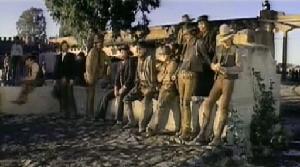
Bob Dylan's music accompanies the first killing in Pat Garrett and Billy the Kid. Pat Garrett (James Coburn) rides across New Mexico with some of his comrades. He is complaining with his weathered baritone about how one of his comrades is grazing sheep in his land. That comrade replies that the lease agreement they had involves his land and not Pat's. Pat scoffs at the law, the same law that he acknowledged when he was elected Sheriff of the land. A few moments after Pat's indignant scoffing, Pat Garrett is shot to death. Director Sam Peckinpah freeze frames the violence, and cross cuts the assassination with a flashback to a few decades ago wherein Billy the Kid (Kris Kristofferson) and his band are shooting chicken's heads. Pat Garrett and Billy the Kid is bookended with two deaths. Peckinpah is keen on reminding us that his film is an ode to a death, of Pat Garrett, of his pal-turned-nemesis Billy the Kid, and finally, of the Old West.

A younger Pat Garrett disrupts Billy the Kid's fun and invites him inside the saloon. After a few glasses of whiskey, Pat tells Billy to leave the area in five days, or he will be forced to chase him out. Pat and Billy were former friends. However, Pat has accepted the post of sheriff and with it the mission to end Billy's outlaw career. Now, they are formidable enemies, with Pat and his assured confidence and with Billy and his youthful wit and clever designs and trickery. Peckinpah lets his audience wade through the duo's mastery: gunfights after gunfights leave several casualties with the two standing alive and surviving.

Amidst the numerous bloody deaths, there is a distinct lyricism to Peckinpah's storytelling which is fascinatingly undaunted by the somewhat flawed narrative flow. It helps that Dylan lends his musicality to the film (he is also casted as the mysterious "Alias," one of Billy the Kid's erstwhile companions) which flavors the rustic scenery of New Mexico with a gorgeously apt romanticism. It also helps that Kristofferson (who is far older than the real Billy the Kid who died at 21) possesses a cool charm which is comparable to Coburn's sun-drenched and slightly exhausted macho offerings. Peckinpah's two anti-heroes are so iconic that his shifts from one storyline to another gets muddled and confusing. Peckinpah adds a host of other characters to keep Pat's hunt more interesting and the deaths and tortures numerous.

Pat Garrett and Billy the Kid is Peckinpah's personal ode to the death of the Old West, as encapsulated by the outlaw Billy the Kid. It seems that the sheriff Pat Garrett ultimately belongs to that era of free spirits unherded by commercialism-established laws and regulations, that when Pat Garrett was ultimately forced to shoot Billy the Kid, an appropriate response was to shoot his reflection in the mirror too: it's a mighty metaphor of Pat Garrett's death as compared to the uneventful portrayal of his assassination during the beginning and the end of the film. When Billy the Kid died and the rule of law reigned triumphant in the Frontier, personalities such as the Kid, Garrett, and their ragtag band of outlaws and rabid law enforcers have been stripped of their myths and accompanying lyricism. Death is no longer a legacy, but a mere expression of crime and punishment.

*****
This post is my contribution to This Savage Art: Sam Peckinpah Blog-A-Thon.

Friday, September 29, 2006

The Long Goodbye (1973)


The Long Goodbye (Robert Altman, 1973)

Private eye Philip Marlowe (Elliott Gould) is woken up by his cat in the middle of the night. The reasons for the awakening are as mundane as possible --- the cat needs to be fed --- but the events that tail Marlowe's sudden awakening seems to be more nightmarish than real. After bringing home from the thrift store some cat food that doesn't match to his cat's taste, an uninvited friend Terry Lennox (Jim Bouton) asks Marlowe to drive him to Tijuana, allegedly escaping some bit of trouble he has caused. The trouble seems to be a bit bigger than what was described when upon Marlowe's return, he is harrassed by the police who is investigating the murder of Lennox's wife. He is incarcerated for three days, and after release, is hired by a wealthy wife (Nina Van Pallandt) of an alcoholic novelist (Sterling Hayden) to locate and rescue the husband from the clutches of a quack psychiatrist (Henry Gibson).

The Long Goodbye is perhaps too bright to be a noir, but when night strikes and the mysteries start unraveling, it is almost indubitable that the film has noir roots. Set in Los Angeles where America is slowly mutating into a colony of new age fanatics. Marlowe lives in the penthouse of a tall compound building. His neighbors are a bunch of marijuana-smoking, yoga-practicing, and perpetually half naked women who seem to be catching the attention of Marlowe's frequently uninvited visitors. The Long Goodbye's Los Angeles is a town of degenerate weirdos, with Marlowe the biggest weirdo of them all. He frequently talks to himself when his only companion cat is in absentia. He is far too smart to be a private eye, and he states that his practice does not delve into divorce stuff --- probably the only client base private eyes have during the seventies. Like the gate guard of the exclusive beach side community who imitates noir screen actors and actresses, Marlowe seems to be living in a perpetual era of crime thrillers and murder mysteries when in fact, the seventies are slowly transforming into an age of police procedural and artless, mystery-less murders.

Leigh Brackett's dialogue, adapted from a Raymond Chandler novel, is populated with topnotch wit that oddly seems out-of-place underneath the bright California sun. The domestic drama between the writer and his wife is heightened by a sterling approach to the subtle emotions sparking between the two. The writer says that his writer's block is almost equal to his impotence, and the wife quickly alludes to the fact that their marriage has impotence written all over it. The net of connections between the original murder mystery and the beachside literary couple seems to be a lot looser than the noir of the forties or the fifties, but the written work, in the hands of Robert Altman flows with earnest ease, and welcomes parody and commentaries within the tense structure of the genre.

The Long Goodbye is supplemented by a repetitive playing of John Williams' somewhat incomplete song of the same title. The song never reaches a refrain or a second stanza but is often repeated in different styles and rhythm, and from different sources. Like Altman's film, the Williams song is smoky and nebulous in form. Altman's visuals inhabit a somewhat aerial form, often drifting in and out of locations then steadily concentrating on the face of Gould (and Gould's face isn't exactly one that matches the hardened faces of the anti-heroes of noir). It's an effective visual style, coupled with Altman's aural mastery. It's a dizzying roller coaster ride of perhaps the last murder mystery that Hollywood will make which is in the vein of the original noirs of old. Other films will follow suit, but I doubt they can replicate Altman's extraordinary vision and wit in telling this crime tale.

Wednesday, August 30, 2006

The Wicker Man (1973)


The Wicker Man (Robin Hardy, 1973)

The Wicker Man has been acknowledged by some as the greatest British horror film of all time. Although such accolade might be arguable, there is no doubt that Robin Hardy's first feature film and adaptation of Anthony Shaffer's novel of the same title has garnered quite a cult following since its release, to the point of being remade by director Neil LaBute. The film has accomplished quite a feat as there is no visceral manifestation of horror in the film. There are no ghosts, ghouls, or demons. But as they say, the best horror films are actually those that play with your mind and leads you to believe or actually feel a lingering danger. That is actually what The Wicker Man is most successful in. It sucks you in a seemingly normal police procedural and then keeps you paranoid as to what may and can happen.

Sergeant Howie (Edward Woodward) arrives by aeroplane to Summerisle to investigate a supposedly missing child. At first, the citizens of the island refuse to acknowledge that such child exists but upon further investigation, Sergeant Howie discovers that the island has rejected Christianity in favor of ancient paganism and somehow, the entire case of the missing child seems to be connected to the upcoming May Day Festival the Lord Summerisle (Christopher Lee) and the island's citizens are preparing for. A devout Christian, Sergeant Howie makes it both an official and personal mission to find the missing girl and see that everything is put in their proper place.

Like most horror films, the general attack is claustrophobia but here, director Robin Hardy does not make use of narrow hallways or prison-like spaces. He uniquely achieves the desired claustrophobic feel even with the island's beautiful greens and clear skies and generally cordial villagers. It is achieved by placing a single individual within a wall of potentially obnoxious and jarring principles. The sergeant is a highly principled personality and when surrounded by a culture that derives existence from potentially damaging beliefs of pagan gods and rituals, sexual rites and forms of merrymaking, deviant education, he is left uncomfortable and inevitably defensive. It's brilliant filmmaking. During the sergeant's first night, he is bothered by the innkeeper's daughter knocking on his walls and inviting him to join in. It is clear that he is tempted, but when the director couples the scene of temptation with a lush song and seductive if not cinematically off-placed dancing, it is almost ludicrous that the sergeant does not succumb. The point here is that the sergeant is obviously out-of-place in the island and whatever images he might find offensive and weird to his outsider sensibilities, is actually quite normal. In Summerisle, he is the invader, the outsider, and everything that is in accord to his beliefs and principles is strange and unwanted in the community.

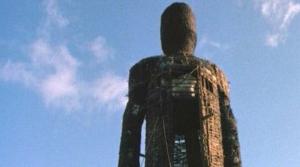
The plot further transforms from discomforting discovery in the first forty minutes, into an actual pagan orgy that leads to the film's twist. It's elegantly told. Hardy's visuals is quite clear-cut. Pagan rituals are depicted with an unnatural and almost magical quality while other scenes are mundane and straightforward. You can actually distinguish whether the scenes are real or not, based on the visual's dreamlike composition, but when the plot leads you to discover that there is actually no difference, and that the dream is actually taking place in the film's reality, its very disturbing and quite horrifying. Obviously, we take the stance of the unfortunate sergeant who finds himself a stranger in a time and age wherein he should supposedly feel in place and his beliefs are natural and common place. We are also turned off and shocked by the existence of pagan barbarism in an age of supposed civility and modern religion. It is that effective suggestion, and that arousal of suspicion, that makes The Wicker Man a fantastic horror film, even to this day.