Showing posts with label Robert Altman. Show all posts

Friday, November 24, 2006

California Split (1974)


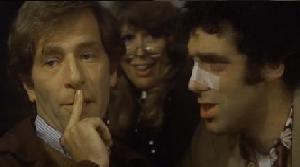
California Split (Robert Altman, 1974)

Robert Altman's hardly seen masterpiece California Split is a film about gambling; the same way as it is a film about two men who fortuitously meet up, team up, separate, re-meet, and take risks (with not a bit of any homo erotic consequences of a buddy pic). More accurately however, California Split is mostly about nothing: the two new buds, Charlie (Elliott Gould) and Bill (George Segal) mostly spend the entire time betting and winning, from the poker tables to the horse races to the boxing matches. They also talk about nothing of valuable import: conversations float from one topic to another; a dialogue about a bet regarding the seven dwarves evolve (or devolve) into one about Dumbo, to the political repercussions of having a black crow sing a song about how he saw an elephant fly. Yet with all its light nothingness, California Split entertains quite astoundingly.

It's a film wherein Altman is in his most excessive. The overlapping dialogues make an entry right from the start with an introductory lesson on poker-playing overlapping with Charlie's monologues turning into a very heightened and exciting game of poker (which Altman denies us from actually taking part in). We only see what Altman wants us to see. He envelopes us immediately with an atmosphere of constant chaos; the same chaos that addicted gamblers breath and take in as fuel for their supposed streaks of good fortune. It takes time for the audience to get used to Altman's unsparing techniques, yet its quite rewarding. There's so much to observe from Altman's filmed surroundings (the other gamblers' quirks and characteristics, the whore in the casino-bound bar and her gambling mother, the like-minded excitedness of those betting on their favorite horses or boxers). California Split is much a film that delights in the gambling subculture as it is a film about the two buddies' road to huge dollar wins.

A conflict belatedly arises only midway. Charlie disappears mysteriously. Will loses big time; garners a huge debt from a loan shark which gets only bigger when he loses to another poker game; he wallows in self-pity in a local bar where a patron scoffs at his manliness; he tries to turn-around by sleeping with one of the whores Charlie lives with but that's not much of a success. He gambles everything --- sells his typewriter (he writes for a magazine), his automobile (for lower than its market value), and basic logic (he opts to gamble everything in Reno which is probably the second choice for gamblers; Las Vegas is much nearer and offers a more user-friendly environment for gamblers). Will returns; joins his quest for the big bucks of Reno; gets vindication from a poker room-dwelling sore loser.

It's almost inevitable that Altman makes his heroes win (they do), and that's not really what we're excited about. The more interesting bit about the film's climax (if we can call it that) is how the two buddies win. Loud-mouthed optimist Charlie is forced to stay in the background; swallow his pride as Will gamble their hard-earned money away. There's a gratifying sensation seeing Charlie get his mojos squashed by Will in exchange for a continuous lucky streak. It's especially enjoyable since we've seen Charlie get humiliated from losing, getting threatened by a puny loan shark, getting unexpectedly insulted by a not-so-attractive social climber, getting a huge turn-off in the midst of the start of passionate love-making. Seeing Will humiliate Charlie is elevated into a piece of entertainment in itself. The one-two punch of Altman's filmmaking is achieved when he ends an exciting streak with utter flatness --- Will feels unfulfilled (that streak wasn't enough; he's had so much of losing that winning has lost its curious delicacy; it's high stakes for him next); Charlie, on the other hand, will enjoy his winning; he is after all, the shmuck of the gambling underbellies; win or lose, he wins.

Tuesday, October 10, 2006

A Prairie Home Companion (2006)


A Prairie Home Companion (Robert Altman, 2006)

At eighty one, Robert Altman has established himself as one of the world's most important artists. His films have defined what several decades of American filmmaking should look and feel, and with that, have spawned many admirers and copycats. His latest feature, A Prairie Home Companion is probably his most delightfully personal film. It might very well have been made by Altman as his swan song, that final masterpiece to cap a wonderful and illustrious career. A Prairie Home Companion is so preoccupied with death that it might be mistaken as morbid or depressing. It is not. The death A Prairie Home Companion envisions is a death that is inevitable but sweet. It is a death that symbolizes an end to a lifetime of wonderful moments and familial relationships.

When one of the longtime beloved performers (LQ Jones) suddenly dies awaiting his lover, Lola (Lindsay Lohan), the daughter of the one of the show's singing sisters Yolanda (Meryl Streep), insists that Garrison Keillor (who reprises his real life personage in the film) that people should know about the passing and that a moment of silence should be given to honor the man. Keillor declines noting that radio does not know silence, and more importantly, he doesn't want people to be forced to honor life. Lola cries and doesn't quite understand the wisdom to Keillor's words. She's in her teens and busies herself writing poetry about death and suicide, designating herself as an expert on mortality but when faced with death as close as that day, she succumbs to emotionality and dissolves the mask her teenage sensibilities have forced her to wear.

Death is such a pervading presence in the live radio show that although quite absurd, death actually shows up in the form of a seductive femme fatale (Virginia Madsen), all dressed in a white trench coat and dizzyingly glides through the many passageways of the theater, finally attracting the dim-witted and self-important security guard Guy Noir (Kevin Kline). Noir fashions himself a private eye, but instead has landed a job as security officer to the dying radio show. He talks and moves about like a forgotten leading man, without the dashing macho sexuality, causing him to rely on flirtation to establish his masculinity. Noir's character gives form to the nebulous array of live musical performances and notable talk about life and nostalgia by summing everything into a storyline which involves the Axeman (Tommy Lee Jones) closing down the show that played at the Fitzgerald Theater, a building that will be demolished to make way for a parking lot. There's a funny joke there on how vicious corporations take down little human businesses in favor of spaces for automobiles. Noir seeks the identity of the luscious femme fatale while finding ways to stop the Axeman from closing down the show which he himself (he tries so hard to be part of the musical cast and crew that in one scene, he insists on playing the piano as a signal, but I'm sure he just wants to let the crew know that he knows a bit about music and is not entirely an outsider to the radio show family) has become an integral part of his life.

Altman directs the film with a mixture of understated flair and grace. The antiquated theater contains narrow passageways leading to dusty wooden dressing rooms, where ghosts float in and out the rooms and to and fro the corridors. Altman's camera wafts through the theater like a a voyeur, catching the denizens of the radio show in their several conversations and banter, most of which are memorable throwbacks to past secret relationships, and discussions on dismissed opportunties. Altman's visual assuredness keeps the characters glued into one beautiful relationship, that when the Axeman finally arrives to tell the rumored closing down of the show, the film exudes a poignant note that simply breaks your heart. You've heard their stories, you've seen them sing and dance, you've participated in listening to their heartaches, their joys and their little discussions about nothing, that to see everything end with a cruel Texan destroying everything that he has no actual knowledge of is utterly painful.

The most heartbreaking of all is that that's probably what everybody is expecting from the aging Altman; that one day, the newspapers, radio programs, and entertainment shows will mourn his passing. Altman here is detailing the inevitability of death while showing that it's not all bad. He after all ends his film with a dubious note involving the angel of death staring through the celluloid and Noir trying to find out who's to die next by little hand signals. He follows up the ending by a joyous song that accompanies the end credits. Altman seems to see death as an expected result of the greatness of life, and that there's no point in mourning a passing, and instead, one should celebrate life, the same way the best way to celebrate the end of the radio program (which I believe, is still around) is to replay the memorable songs that have touched and affected the millions of patrons it has served the past thirty years.

Friday, September 29, 2006

The Long Goodbye (1973)


The Long Goodbye (Robert Altman, 1973)

Private eye Philip Marlowe (Elliott Gould) is woken up by his cat in the middle of the night. The reasons for the awakening are as mundane as possible --- the cat needs to be fed --- but the events that tail Marlowe's sudden awakening seems to be more nightmarish than real. After bringing home from the thrift store some cat food that doesn't match to his cat's taste, an uninvited friend Terry Lennox (Jim Bouton) asks Marlowe to drive him to Tijuana, allegedly escaping some bit of trouble he has caused. The trouble seems to be a bit bigger than what was described when upon Marlowe's return, he is harrassed by the police who is investigating the murder of Lennox's wife. He is incarcerated for three days, and after release, is hired by a wealthy wife (Nina Van Pallandt) of an alcoholic novelist (Sterling Hayden) to locate and rescue the husband from the clutches of a quack psychiatrist (Henry Gibson).

The Long Goodbye is perhaps too bright to be a noir, but when night strikes and the mysteries start unraveling, it is almost indubitable that the film has noir roots. Set in Los Angeles where America is slowly mutating into a colony of new age fanatics. Marlowe lives in the penthouse of a tall compound building. His neighbors are a bunch of marijuana-smoking, yoga-practicing, and perpetually half naked women who seem to be catching the attention of Marlowe's frequently uninvited visitors. The Long Goodbye's Los Angeles is a town of degenerate weirdos, with Marlowe the biggest weirdo of them all. He frequently talks to himself when his only companion cat is in absentia. He is far too smart to be a private eye, and he states that his practice does not delve into divorce stuff --- probably the only client base private eyes have during the seventies. Like the gate guard of the exclusive beach side community who imitates noir screen actors and actresses, Marlowe seems to be living in a perpetual era of crime thrillers and murder mysteries when in fact, the seventies are slowly transforming into an age of police procedural and artless, mystery-less murders.

Leigh Brackett's dialogue, adapted from a Raymond Chandler novel, is populated with topnotch wit that oddly seems out-of-place underneath the bright California sun. The domestic drama between the writer and his wife is heightened by a sterling approach to the subtle emotions sparking between the two. The writer says that his writer's block is almost equal to his impotence, and the wife quickly alludes to the fact that their marriage has impotence written all over it. The net of connections between the original murder mystery and the beachside literary couple seems to be a lot looser than the noir of the forties or the fifties, but the written work, in the hands of Robert Altman flows with earnest ease, and welcomes parody and commentaries within the tense structure of the genre.

The Long Goodbye is supplemented by a repetitive playing of John Williams' somewhat incomplete song of the same title. The song never reaches a refrain or a second stanza but is often repeated in different styles and rhythm, and from different sources. Like Altman's film, the Williams song is smoky and nebulous in form. Altman's visuals inhabit a somewhat aerial form, often drifting in and out of locations then steadily concentrating on the face of Gould (and Gould's face isn't exactly one that matches the hardened faces of the anti-heroes of noir). It's an effective visual style, coupled with Altman's aural mastery. It's a dizzying roller coaster ride of perhaps the last murder mystery that Hollywood will make which is in the vein of the original noirs of old. Other films will follow suit, but I doubt they can replicate Altman's extraordinary vision and wit in telling this crime tale.