Showing posts with label 1974 Films. Show all posts

Saturday, August 04, 2007

La Paloma: Ang Kalapating Ligaw (1974)


La Paloma: Ang Kalapating Ligaw (Joey Gosiengfiao, 1974)
English Title: La Paloma: The Lost Dove

In La Paloma: Ang Kalapating Ligaw (La Paloma: The Lost Dove), Joey Gosiengfiao stages a three-way war for the estate left behind by Don Lorenzo, who died supposedly by suicide. Anida (Vina Cansino), the pious and righteous widow, Paloma (Celia Rodriguez), actress and paramour of the deceased, and Soledad (Mona Lisa), Lorenzo's mother. They all have their reasons: Anida, to get what she thinks she deserves as suffering wife to a philandering husband; Paloma, to concretize the amor in her love affair with Don Lorenzo; and Soledad, for mere survival since her stay in the estate was merely tolerated by Anida.

It's quite an elegant picture, still hilariously funny but succumbing to vaporous wit and indulgent humor. It offers a satirical stab at the hypocricy of high society (at those times, very much coinciding with fervent religiosity). The moment Paloma steps into the mansion, tensions rise. Anida finally finds a formidable competitor (probably tired of pushing Soledad around with her mean gazes and vicious remarks). The rest of the mourners are even more shocked that a scandalous paramour has the guts to invade on a familial ritual, and probably scared that a woman of ill-repute (Paloma is an actress in Manila, and was rumored to be involved in several illicit affairs) would pollute the religiosity and purity of their town. Soledad, on the other hand, finds her trump card and cements her bargaining position.

Gosiengfiao has always been compared to foreign camp-master such as Pedro Almodovar or John Waters, but this early Gosiengfiao proves that his canvass is far more richer. La Paloma has Gosiengfiao playing with Buñuelian surrealism --- when Paloma walks at night to find Lorenzo's garden crawling with cockroaches and toads (elaborate statues and fountains are desecrated by those creepy crawlers), you know that Gosiengfiao is working at another level. Even the interiors of the mansion, with its high ceilings and staircases, have a sense of depleted morality --- empty, cold, and on the verge of both physical and moral deterioration.

Joel (Orestes Ojeda), a traveling gardener and guitarist arrives one day and offers his services to the embattled household. Anida's test is rather simple: make one flower bloom in the doomed garden. Joel instead turns his attention on Paloma, exhausted in defending her love for Lorenzo, and on the verge of a conversion to piety orchestrated by Anida, which practically consumes the life out of the free-spirited Paloma. Paloma is in the middle of that tug-of-war between Anida's persistent exorcism of Paloma's past and Joel's manly and amorous serenades.

The heat of the war culminates in court (there is literal heat as there's a lot of perspiring, fanning, and jeering crowds) where Paloma defends her stake in Lorenzo's estate and heart, and Anida uses her state as grieving widow to a philandering husband as a plea to the sentiments of the righteous mob. The several testimonies are all defiantly delivered pieces of oratory; which makes the entire judicial exercise exciting. Themes are weeded out from the film's extrinsic kitsch and humor --- we become aware that there's more to Paloma's character than a clawing and greedy diva; that she hides an emotional void that only the men she loved can fill. Gosiengfiao climaxes the film with a well-executed twist, ending the film with appropriate murderous intentions from the battle's rotting participants.

I make it sound like La Paloma is serious art. I don't think it is. It is however distinctly Gosiengfiao (and the numerous exchanges of elitistly witty and funny pieces of dialouge between the widow and the paramour (or at times, the mother) would make any audience rolling with laughter; or Joel's seductive poses (complete with suspenders and a guitar on his back, and a badly-rendered song to boot --- all preceding the Latino gardeners of Desperate Housewives)) --- commercial fare but surpasses the limits of being an object of commodity by the director's cinematic flair.

Friday, November 24, 2006

California Split (1974)


California Split (Robert Altman, 1974)

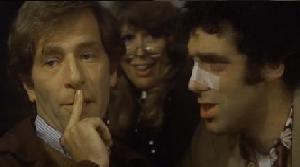
Robert Altman's hardly seen masterpiece California Split is a film about gambling; the same way as it is a film about two men who fortuitously meet up, team up, separate, re-meet, and take risks (with not a bit of any homo erotic consequences of a buddy pic). More accurately however, California Split is mostly about nothing: the two new buds, Charlie (Elliott Gould) and Bill (George Segal) mostly spend the entire time betting and winning, from the poker tables to the horse races to the boxing matches. They also talk about nothing of valuable import: conversations float from one topic to another; a dialogue about a bet regarding the seven dwarves evolve (or devolve) into one about Dumbo, to the political repercussions of having a black crow sing a song about how he saw an elephant fly. Yet with all its light nothingness, California Split entertains quite astoundingly.

It's a film wherein Altman is in his most excessive. The overlapping dialogues make an entry right from the start with an introductory lesson on poker-playing overlapping with Charlie's monologues turning into a very heightened and exciting game of poker (which Altman denies us from actually taking part in). We only see what Altman wants us to see. He envelopes us immediately with an atmosphere of constant chaos; the same chaos that addicted gamblers breath and take in as fuel for their supposed streaks of good fortune. It takes time for the audience to get used to Altman's unsparing techniques, yet its quite rewarding. There's so much to observe from Altman's filmed surroundings (the other gamblers' quirks and characteristics, the whore in the casino-bound bar and her gambling mother, the like-minded excitedness of those betting on their favorite horses or boxers). California Split is much a film that delights in the gambling subculture as it is a film about the two buddies' road to huge dollar wins.

A conflict belatedly arises only midway. Charlie disappears mysteriously. Will loses big time; garners a huge debt from a loan shark which gets only bigger when he loses to another poker game; he wallows in self-pity in a local bar where a patron scoffs at his manliness; he tries to turn-around by sleeping with one of the whores Charlie lives with but that's not much of a success. He gambles everything --- sells his typewriter (he writes for a magazine), his automobile (for lower than its market value), and basic logic (he opts to gamble everything in Reno which is probably the second choice for gamblers; Las Vegas is much nearer and offers a more user-friendly environment for gamblers). Will returns; joins his quest for the big bucks of Reno; gets vindication from a poker room-dwelling sore loser.

It's almost inevitable that Altman makes his heroes win (they do), and that's not really what we're excited about. The more interesting bit about the film's climax (if we can call it that) is how the two buddies win. Loud-mouthed optimist Charlie is forced to stay in the background; swallow his pride as Will gamble their hard-earned money away. There's a gratifying sensation seeing Charlie get his mojos squashed by Will in exchange for a continuous lucky streak. It's especially enjoyable since we've seen Charlie get humiliated from losing, getting threatened by a puny loan shark, getting unexpectedly insulted by a not-so-attractive social climber, getting a huge turn-off in the midst of the start of passionate love-making. Seeing Will humiliate Charlie is elevated into a piece of entertainment in itself. The one-two punch of Altman's filmmaking is achieved when he ends an exciting streak with utter flatness --- Will feels unfulfilled (that streak wasn't enough; he's had so much of losing that winning has lost its curious delicacy; it's high stakes for him next); Charlie, on the other hand, will enjoy his winning; he is after all, the shmuck of the gambling underbellies; win or lose, he wins.

Thursday, August 31, 2006

Immoral Tales (1974)


Immoral Tales (Walerian Borowczyk, 1974)
French Title: Contes immoraux

Walerian Borowczyk's Immoral Tales is a collection of four episodes whose common theme seems to be first, an abundance of naked female bodies, and second, naked female bodies participating in what can be conceived as immoral acts. These four episodes belong to four different time lines, different settings, with different degrees of immorality. Despite its judgmental title, Immoral Tales is filmed in unembarrassed objectivity and seems to be more immersed in the portrayal of moving flesh than actual commentary, which isn't all that bad since Borowczyk's camera knows how to light these light-skinned nymphs to the most sensuous and most titillating degree that despite the film's shallow-headed nature, I can't really complain.

The first episode concerns a man who goes to a bicycle trip with his younger cousin. They stop by the beach wherein the man decides to consummate his fantasy with the girl. While teaching the girl how tides work, the girl performs oral sex on the guy. The episode finishes with the girl insisting that there's more time for fun, but is rejected by the guy who says that what they did was not fun, but education. Borowczyk loves to fill his screen with flesh and purposely closes up on the female flesh in frenzied fashion. He intercuts the lovemaking scene with images of the sea, of a duck trying to fight a humongous wave, of seabirds flying by. It's obviously softcore pornography dressed up in art film sensibilities and this is actually the tamest of the bunch. It gets better.

The first episode is followed by the tale of a young girl who gets vocal messages from what she thinks is the Holy Spirit. She is punished by her guardian for disappearing after church service and is trapped inside a room for three days. She doesn't waste the time alone, and starts to look around for things to do, discovering "Therese the Philosopher" by de Sade, while being commanded by the voice that talks to her to let go. In a bizarre mix of de Sade and ignorant religiosity, the girl finds erotic uses for the vegetable left to her.

The third episode is about Countess Bathory (Paloma Picasso) who goes around Hungary's cantons and hamlets to steal away girls and bring them to her palace. Along with her servant, she watches these girls bathe, play, and fight until the time she poisons them all and lets them kill each other over the pearl-adorned dress she has promised to them. Bathory's madness culminates with her bathing in these ladies' blood, and caps the night with ritualistic lovemaking with her female servant.

The last episode is probably the most substantial of the lot. It is set during the 1400's when the Vatican is ruled by a immoral pope who has sired two children, a cardinal and Lucrezia Borgia (Florence Bellamy). While the pope, the cardinal and Lucrezia indulge in incestuous sexual acts, Savonarola is preaching against the immoralities that are being committed within the church. The episode ends with Savonarola being burned and Lucrezia's baby (one can only guess if it is sired by her pope father or cardinal brother) being baptized into the Catholic religion.

There's not much substance in Borowczyk's collection of episodes. The tales breeze away like forgotten wet dreams filmed in the most fantastically erotic way. The girls seem to give off an incandescent glow that makes the film burst with erotic energy. It is also quite obvious that Borowczyk (like the other prominent European erotica master Tinto Brass) has a little fetish for the female bum as such is very much in prominent display in almost all the episodes (especially the one involving the Countess Bochary). There's so much to be offended at with what's being depicted on screen --- incest, debauchery, sacrilege. However, it is almost a sure thing that Borowczyk meant that the moral angle of the film be taken as an afterthought, instead of as a driving force for the film. It's primary motivation is to tittilate, despite the oddness and the patent immorality of what's on screen. He wouldn't have filmed those sinning girls in loving, tender, and an almost angelic light if his purpose was to preach.

Sunday, August 20, 2006

Arabian Nights (1974)


Arabian Nights (Pier Paolo Pasolini, 1974)
Italian Title: Il fiore delle mille e una notte

Arabian Nights is Pier Paolo Pasolini's final entry to his Trilogy of Life, consisting of filmed adaptations of classic literature, The Decameron (1971) and The Canterbury Tales (1972). The films in the trilogy are supposedly Pasolini's least political films, whose main intent is to straightforwardly tell the stories in the film medium without any social or political fuss. The trilogy also shows Pasolini in his most sensual, where his gift for poetry does not merely exist in the beauty of words but in lush colors, exotic locales, and sexual charge. It is said that Arabian Nights is the laurel in the trilogy, as it is the most beautiful and most lyrical of the films. I'd have to agree, Arabian Nights is a towering achievement in storytelling.

The film starts with a young boy purchasing a slave, but eventually falls in love with the slave he bought. The girl is kidnapped and finds herself in a kingdom where she is proclaimed king. The boy then travels all over looking for the girl, and on his way, meets different personalities with different tales. Arabian Nights does not use the literary source's means of telling the story, wherein a princess is tasked to tell stories for a number of nights. Instead, Pasolini celebrates the vibrancy of life by infusing the primary tale with the ability to give birth to different tales. The primary tale gives way to a tale, and a character from that tale, gives way to another tale, and so on, and in the end, everything wraps up beautifully and one gets a dreamy feeling of satisfaction one usually arrives at as a child.

However, Arabian Nights is nowhere near a children's story. It is in fact very graphic in its portrayals of the chosen entries of the literary source. Instead of repeating the stories of Aladdin or Ali Baba, Pasolini chooses the more sexually charged entries and depicts them with a candidness that makes the scenes both unusually magical despite the rawness of the topic. Yet again, Pasolini strays away from magic and religion. Although some of the tales do involve a certain element of mysticism (a demon flying and turning a curious human into a monkey, a metal-plated night being destroyed by a young man who follows a whispered prophecy), such is kept to a minimum and is balanced by a healthy dose of accurate anthropology and cultural diversity Pasolini mastered in the two films (Medea (1969) and Oedipus Rex (1967)) before the trilogy of life. Arabian Nights is delightfully accurate, with Pasolini not limiting his settings to Arabic palaces, deserts, but goes to far-off places like Nepal or Africa, where most of the original tales of the literary source were set.

Arabian Nights is truly a celebration of life for Pasolini. To a certain extent, I can probably declare this as Pasolini's accurate portrayal of his wet dream. The storytelling is vibrant and his visuals are full of bright colors. His characters are young and robust. The boys are laidback and inutile, lazy and oftentimes mainly instructed by hormones instead of intellect. The females are cunning and sly, some are virtuous and some are flirts. When the characters collide, one can easily predict that they will copulate, or at least engage in violent combat. Pasolini does not make room for his usual political discourse, but instead lets the images and the scenery depict his humanity. No wonder Pasolini decided to end his Trilogy of Life with this, a gorgeous and appetizing orgy of man's innate nature to tell stories.