Showing posts with label 1992 Films. Show all posts

Sunday, November 13, 2011

Aliwan Paradise (1992)


Aliwan Paradise (Mike de Leon, 1992)

Mike de Leon’s Aliwan Paradise, one of the four shorts featured in Southern Winds, rings truest in this present age where poverty, as explicitly depicted and as source of an unquenchable desire for escape, has turned into an embarrassing necessity in our entertainment.

De Leon’s view of the future is both hilariously fantastic and uncomfortably real. Although obviously inspired by the near-fascist regime of Ferdinand Marcos, the film’s setting can be read as a caricature of a Filipino society that is addicted to the pleasure of illusions, to the fleetingly amusing, to the ephemeral and the unreal. The Philippines is obviously in a state of grave penury. People are crowded outside the theater of the Impresario (brilliantly played by Johnny Delgado) to take their chance at impressing him and his inutile jury to land a job. The Impresario, under strict orders by her superior (a woman who appears only as a sketch that looks a lot like Imelda Marcos), is looking for a new type of entertainment, something that has not been seen before, and something that will and should sell.

Outside, Julio Madiaga (Julio Diaz) and Ligaya Paradiso (Melissa de Leon), characters from Lino Brocka’s Maynila: sa Mga Kuko ng Liwanag (Manila in the Claws of Neon, 1975), reunite under more heartbreaking circumstances. While Brocka uses the characters as symbols for the Filipino’s tragic search for happiness, De Leon infuses the characters with biting cynicism. Julio, although still madly in love with his former sweetheart, is more aware of the world and its inhumane devices. Ligaya, on the other hand, has totally abandoned romanticism for fatalist worldliness. Their reunion, in rebellion to Brocka’s grappling with a certain sense of hopefulness although futile, becomes more of a resolution to ideals that have become insignificant in a world where survival is the lone virtue that is worth fighting for.

And survival seems to be the only virtue worth fighting for. As a former human rights bureaucrat blows fire while lecturing on literature and eats shards of glass while teaching basic arithmetic and a nurse strips down to her underwear while taking care of an elderly man, the nobility of profession is quickly abandoned by the very basic need to earn a living. Dignity is forgotten. Ligaya’s performance, a song and dance number that fancifully narrates the downfall of the Filipino woman, sums up the distance of how far society has been corrupted by poverty. Her private dealing with the Impresario only reinforces the abject desperation.

De Leon however mixes his cynicism with timeless wit and humor. Doy del Mundo’s screenplay is essentially a satire, resting more on the ingenuity of the idea rather than the lives of its characters or the depth of the narrative. However, the film graduates from the limitations of its being merely a satire. Like its thesis as to how entertainment has lorded over the Philippines from prior to it being colonized up to the present, the film’s prophetic observations as to how entertainment has turned from being a source of respite to a parasite that lives on woe and suffering is evidenced by reality.

Willie Revillame, whose sudden rise to fame happened decades after Aliwan Paradise, has the same wile as the Impresario, acknowledging the wealth in both feeding from and feeding the poor. Star Cinema and other mainstream studios, who would never have raised funds to produce such an enlightening piece of entertainment as Aliwan Paradise, has the same muteness as the Impresario’s jury, ignorant of their being conspirators in creating an economy out of the Filipinos’ ignorance by coming up with products that are comparable to instant noodles, filling but deadly. Independent filmmakers, who subscribe to Mike de Leon’s ideals but are inevitably trapped into mining stories from the fringes of society not by the noble need to expose but by the personal need for acknowledgement, are the Julios and Ligayas of our time, aware of the gnawing injustice of it all but have become knowing parts of that awful but inescapable system.

(Cross-published in Lagarista.)

Thursday, March 22, 2007

Bad Lieutenant (1992)


Bad Lieutenant (Abel Ferrara, 1992)

Director Abel Ferrara doesn't afford Harvey Keitel's character a name. He is merely called the lieutenant, a denomination that discusses the character's limited humanity. We are clearly made aware of his position. He is a ranking cop in New York City. The film opens with the lieutenant bringing his two sons to school; we become aware that he is also a family man. Yet these positions in society are mere afterthoughts as Ferrara is more interested in what makes this character special --- his hourly trespasses, his obvious contradictions, his unlikely story of redemption.

Right after bringing his kids to school, he sniffs some cocaine while listening to the radio about the Mets-Dodgers game. He bets an ungodly amount for the Dodgers; his stab at luck betrays him as the Mets inch their way slowly from a winless season to championship. He regularly visits a whore (Zoë Lund) whom he engages in different kinds of illegal drug treatments. He drinks while driving; he smashes his radio out of mere wrath; he consorts with prostitutes in sado-masochistic positions; he sneaks away illegal drugs from crime scenes and sells them to a Latino drug dealer; he blasphemes; he uses his positions to force sexual favors from lady trespassers.

In one scene, the lieutenant stands naked, howls pathetically with his arms outstretched (with no one to return the embracing gesture). The entire film tracks the lieutenant in all his vulnerable inglory as every capital sin is committed, as he marathons his way out of human virtue and rational forgiveness. Ferrara polarizes us, gets us angry and disgusted, before convincing us that he hasn't fallen so far out from grace to be irredeemable.

Aside from the spree sinning, the film explores the case of a nun (Frankie Thorn) who was raped by two Latino gangbangers. The rape itself is a thing of complete depravity. The statue of Mother Mary is pushed down the ground while the nun is perversely invaded by both malefactors; the crucifix used as an object of rape; the holy altar as the exact spot of the crime. In the lieutenant's mind, the case represents a way out of his ballooning debts to the gambling shark as a fifty thousand dollar reward is attached to the solution of the case. The lieutenant is faced with two options of redemption; an earthly one that keeps him attached to mortal pleasures and threats, and one which he realizes from an abrupt chat with the rape victim, a spiritual redemption that requires a harsh sacrifice.

Ferrara examines the dilemma of redemption under the most difficult of scenarios. Keitel portrays the lieutenant unforgivingly. The two merely give slight glimpses of humanity to the character, furthering the difficulty of accepting the conclusive redemption in the film. The cries and whimpers are almost inhuman in aural tone. Ferrara's depictions of the lieutenant's family life are mere traces of how far he has fallen. It's a dizzying spiral downfall by a man who has already fallen so far from grace; it's amazing how much more depravity he can commit to the point that the fantastic turnaround (Jesus Christ makes an appearance in a city depicted as modern Babylon --- mostly out of the lieutenant's drug-afflicted mixture of guilt, Catholic upbringing, and wild imagination) becomes a relatively unpalatable reward.

Ferrara has made a film of astounding depth and observant quality. It is unflinching in portrayal of humanity in its lowest yet despite that fact, it's a film that is interestingly religious (or Catholic, depending on your religious denomination). It's a film, with all its sleaze, violence, and celluloid-printed grease, that is more soul-affectingly powerful than Mel Gibson's Christ film. Each of the lieutenant's plentiful trespasses against morality bears a greater ache to the collective Catholicism than the rapid bloody whippings the cinematic Christ Gibson has created. The lieutenant's poignant yet open-ended redemption more uplifting and affecting than that final shot in Gibson's flick.

Tuesday, August 15, 2006

The Guard From Underground (1992)


The Guard From Underground (Kiyoshi Kurosawa, 1992)
Japanese Title: Jigoku no keibîn

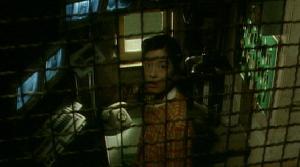
Kiyoshi Kurosawa is one of my favorite contemporary Japanese directors. All of his works after Cure are flat-out masterpieces (yes, even the much-maligned Bright Future), and one can only acknowledge Kurosawa's filmmaking as defiantly interesting, and never boring (yes, even in the much-maligned Bright Future). He's almost done everything. He started with soft core pornography, made a musicale, toyed with horror, drama, yakuza, science fiction, and the like, and he always manages to come up with something good. Kurosawa's The Guard From Underground is him seeking inspiration from one of his favorite American directors, Tobe Hooper (Hooper's Texas Chainsaw Massacre is said to be one of Kurosawa's favorite films), in crafting a uniquely Japanese slasher flick.

The Guard From Underground is set in an office building where beautiful museum curator Akiko Narushima (Makiko Kuno) is starting out to work as an expert adviser to the newly formed department that is tasked in trading in paintings for the corporation. The same day she first reports for work, a newly hired guard arrives. The guard, with an imposing height and frame, is Fujimaru (Yutaka Matsushige), a former sumo wrestler who is currently being sought out by the police for murdering his sumo colleague and his lover. It is never clear why the ex-wrestler is insanely bashing everybody's heads, or how he got the job as a security guard, despite the fact that he is being hunted down, and he is quite famous for being in all the newspapers. There's a correct assumption that logic needs to be thrown out the window for an hour and a half, and one just has to enjoy the brutal murders that will ensue within the corporate building.

The Guard From Underground comes from Kurosawa's pre-Cure days, meaning it was during the time that Kurosawa's films weren't thought-out, philosophically stimulating fare. It's almost impossible to justify The Guard From Underground in intelligent discourse as the enjoyment from watching the film doesn't emanate from the brain, but from the senses. For a low budget flick, the film is visually alluring. The corporate building looks more like an abandoned hospital, with its hallways narrow and unkempt, and its rooms deliver a feeling that pain and suffering must've happened within its walls. Kurosawa doesn't let his budgetary constraints lessen his film and instead shoots the hallways, the rooms, with quiet tension, his camera wading through the little spaces and catching the dastardly events in teasing detail. His brutality isn't showing the blood splurting out, or limbs getting chopped off and thrown out ala Takashi Miike, but instead, Kurosawa relishes in quick yet boisterous attacks to the senses. I guess that's the reason why his guard's weapon of choice is a club, or any blunt object. There's a lot more cringe to be garnered from hearing bones breaking, and skulls smashing than in actually seeing them.

Kurosawa populates the office building with a horde of queer characters. There's Akiko's officemates, an overly enthusiastic lady, an overly friendly man, a quiet and seemingly useless balding guy, and a sexual pervert for a boss. The human resources head is Hyodo (Hatsunori Hasegawa), who is quick to complain about his employees personality faults but can't see that he's squandering corporate money while he sleeps at work. There's really no point detailing these characters as complex human beings with feelings and emotions, since they're all dead by the time the film ends. It's quite clear that Kurosawa isn't interested in these characters, but instead, delights in the act of filmmaking. His filmmaking clearly overshadows the material. He washes the material with an over-the-top musical score that properly labels the screenplay as low-end fare, but in a way, Kurosawa's not taking the material seriously vitalizes the entire affair. There's one clever scene wherein Akiko is trapped inside the library, and the backdoor suddenly shakes and rattles, causing Akiko to panic. The sequence is shot interestingly, an example of the visceral terror Kurosawa is capable of, even though the scene belongs nowhere in the film's logic. The Guard From Underground is nowhere near the masterpieces Kurosawa will eventually make, but having said that, it's still watchable fare, at least for Kurosawa completists like me.

******
This review is my contribution to the Kiyoshi Kurosawa Blog-a-Thon at The Evening Class.

Friday, July 14, 2006

The Untold Story (1992)


The Untold Story (Herman Yau, 1992)
Cantonese Title: Baat sin faan dim ji yan yuk cha siu baau

The plot of Herman Yau's cult classic The Untold Story is not unfamiliar. It has been told repeatedly in the form of tall tales, tabloid stories, and urban legends. However, unlike the the bizarre tales reserved in hush-hush settings or sleepovers, Yau actually presents evidence that his film is based on a true story. An actual case happened in the port-city of Macau. Part police procedural, part sadistic gross-out spectacle, and part soft-porn romp, The Untold Story is quite an achievement in exploitation filmmaking.

Wong Chi-hang (Anthony Wong) is the new owner of the Eight Immortals Restaurant. With his unkempt hairdo and eyeglasses whose frames are as big as coasters, Wong does not have the common look, not even the slightest indication, of a mass murderer. As it turns out, looks can be deceiving because Wong is in fact a serial killer who has killed the previous restaurant owner's family, and each and every employee that crosses his path. To add sickness to his propensity for murder, the meat buns that he serves the customers of his restaurant are actually are filled with a sizable serving of ground human meat, freshly harvested from his victims.

Anthony Wong, whose size and good looks can be an unnecessary burden in giving life to the role of a murderous lunatic, pulls off a performance that is unsettling yet believable. His huge eyes give off an uncomfortable sense of evil brewing beneath his normal guy-exterior. Actually, the entire film is carried by Wong whose character beat off Hannibal Lecter in the insanity department. While Lecter is a man of intellect, Wong is your everyday man, a man who you'd probably encounter in one of your trips in Chinatown. Lecter's profession makes him harmless to the general public but Wong's is a bane to all health inspectors and especially those, who are more interested in quick, tasty and more importantly cheap lunches. Finally, Lecter is far too intelligent as his plans are perfectly planned and timed. Wong is dumb and crude, and his motivations are primarily human without the need for much philosophical or cultural musings.

The film's biggest downfall is the unsatisfying portrayal of the police. Lecter is provided with brilliant captors and chasers, There is Will Graham in Manhunter (Michael Mann 1986), and and Clarise Starling in The Silence of the Lambs (Jonathan Demme, 1991) and Hannibal (Ridley Scott, 2001). Wong is given the Macau police, or as how Yau, producer Danny Lee, and the screenwriters depict them. Wong's captors are a bunch of chauvinistic stereotypical cops and a man-crazed lady cop whose side story is far too distracting to be of any material import to the film. The cops are basically there as plot devices, utilized just to push the film forward, to represent the fact that crime does not pay and even if you have the most inhumane, dumbest, and ridiculous police team in the world, the crook will end either in jail or dead. This inadequate and insulting representation of civility and order is ultimately a huge disservice to the maniacal villainy of Wong.

That is how The Untold Story is told. It moves forward when we are given glimpses of Wong's insanity, but slows down or completely halts when we are offered the perspectives of the law enforcers. While Yau's vision is enjoyably brutal, with scenes that are unflinching and unforgiving to the unwary viewer, as blood gush out of opened up arteries like glorious fountains, limbs are thrown like, and men, women, and children are slain like ordinary cattle, it evidently struggles and ultimately suffers when the exploitation stops.