
Retribution (Kiyoshi Kurosawa, 2006)
Japanese Title: Sakebi
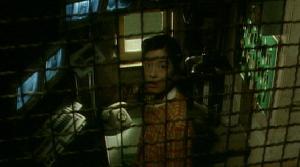
The murders in Kiyoshi Kurosawa's Retribution (Sakebi) have distinct commonalities leading detective Yoshioka (played by Kôji Yakusho) to think that they are linked together, either by a single killer or some bigger and ominous mysterious force. The victims are all drowned in saltwater in a nearly barren urban district in Tokyo which is slowly being reclaimed by the sea by a series of earthquakes. Yoshioka's dilemma deepens when clues start pouring in making it apparent that he might have been involved in the first murder of a woman in a bright red dress who has started appearing to him as a shrieking specter clamoring for attention.
It's set in the typical Kurosawa-esque Japan of generational decay and heightening social alienation. Like in Charisma (1999), where the forest bears the initial scars of the noxious tree, or in Pulse (2001), where an interconnected Japan fails to bridge the separated souls, or in the grandly offbeat Bright Future (2003), where its direction-less teens parade their youthful ennui in a manufactured landscape, where the setting carries the burden of society's ills.
The physical decay we see in Retribution of the remaining apartment buildings and the ones demolished (where the traces of their structures are the skeleton-like concrete pillars and puddles of rising saltwater eagerly grabbing the land stolen from them by the enterprising Japanese) mirrors the creeping decay that is slowly but surely enveloping Yoshioka. His preoccupation with the current series of murders, the daily visits from his crimson dressed wraith, and his girlfriend's less-than-constant visits force Yoshioka to combust internally; and you sense a tremendous fatigue both in his body and in his soul as if every ill memory of the past and the pressures of the present are conspiring to force him to decompose along with his surroundings.
Kurosawa weighs in escape and confrontation as solutions to Yoshioka's psychological torment. Yoshioka should either step out of his conflicted environment or face the so-called voice of truth which is society's primary sin, that of quiet indifference. The sin produces a moldering contempt that a person harbors for a loved one who firmly disassociates because of an unassessed air of self importance or just an innate collective callousness. It leads to the film's fatal dissatisfaction. Kurosawa dissects this dissatisfaction, the so-called contemporary woe (which is most probably not endemic to modern Japanese society). He treats it like an unstoppable tumor, a reason enough for a surprising doomsday scenario, much like the way he treats the collective depression in the riveting conclusion of Pulse. The intriguing irony in this Kurosawa ghost story is that the punishment for the living's ineptitude for the basic requirements of humanity is dealt with by the dead; and quite sarcastically, it is the dead which is most capable of boundless amounts of compassion and care, as shown near the end of the film.
A complaint most critics have with Retribution is that it is a Kurosawa pic that treads too closely to conventional horror narrative, something I really do not mind especially for a sub-genre that is supposedly on its extended death bed. I do not watch a Kurosawa film for the fineries of his storytelling (although his grand minimalism which often turns in awkward directions to ultimately satisfactory results is a Kurosawa trait that is undoubtedly unique only to his ouvre --- the way the intimate (or lacking in intimacy) finite chatters of workmates in Pulse would culminate in apocalypse; or the serial killings in Cure (1997) invite metaphysic musings; or the inward botanical engrossment of the characters in Charisma would end up in a road path to a cityscape on fire) but because of his inherent skill in maximizing mood and atmosphere without trespassing the boundaries of subtle taste (something Takashi Shimizu, sometimes Hideo Nakata, and most Asian horror practitioners tend to forget).
He completes his visual canvass, usually his camera is still as a corpse, and makes most of what he has by painting an entire picture of dread --- a morgue is visually bare yet the incessant swinging of the formalin apparatus forces an also incessant squeak that functions to broaden our already heightened senses; and an interrogation scene uncomfortably thickens when an invisible haunting attaches to the deranged prisoner. Whenever Kurosawa needs to utilize horror tropes (like the creepy long haired lady creeping for her kill), he outrages by going over-the-top: the bright red dress, the Superman flight tactics, the banshee-like shrieking.
If Retribution is an example of Kurosawa going conventional and commercial (the film is produced by the makers of The Grudge and its numerous remakes, both in the Japanese and English languages), then I am all for it. If the sub-genre needs a wake-up call from its brainless repetitiveness, Kurosawa, who is not even in his top form in this film, is the right man to do it.
******
This review is my contribution to the Kiyoshi Kurosawa Blog-a-Thon at The Evening Class.




_p1wm%20.jpg)




.jpg)




 netizens have visited this site.
