Showing posts with label 2003 Films. Show all posts

Monday, December 26, 2011

Magnifico (2003)


Magnifico (Maryo J. de los Reyes, 2003)

Curiously snubbed by the Metro Manila Film Festival during the same year the festival had films like Boy Vinarao’s Hula Mo... Huli Ko, Tony Reyes’ Lastikman and Enrico Quizon’s Home Along da Riber competing for the top plum, Maryo J. De los Reyes’ Magnifico was eventually released the following year to much critical recognition. Unfortunately, the film failed miserably in the box office. Nonetheless, the film, despite its very traditional filmmaking style, was way ahead of its time. In a way, it preceded the independent films of today in the sense that the story, more than the famous actors and actresses that lend their names and talent to the film, was the very vehicle that drove the film to acclaim. However, its unsuccessful local commercial run also preceded the mostly unsuccessful attempts of today’s independent films to break into mass consciousness.

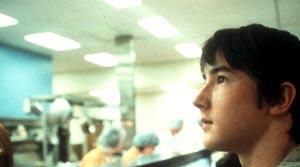
Written by Michiko Yamamoto, the film is about the titular young boy (then newcomer Jiro Manio) who attempts to give his ailing grandmother (Gloria Romero) a decent funeral. Along with his best friend, he naively goes around town, talking to various personalities or finding ways to earn money, to piece together his grandmother’s funeral, from the coffin that he constructs from the extra plywood he gathered from the local crafts factory to the actual lot wherein his grandmother would be buried.

Yamamoto crafts an entire town populated with quirky individuals with realistic intentions and motivations. Gerry, Magnifico’s father (Albert Martinez) who works as a carpenter working for the local crafts factory, seems to be content with his family and their modest lifestyle. Edna (Lorna Tolentino), Magnifico’s mother who is mostly left in the house to take care of both her sick mother-in-law and her daughter (Isabella de Leon) who is suffering from cerebral palsy, takes her lot in life with a lot less of her husband’s optimism. Magnifico’s elder brother, Miong (Danilo Barrios) has just returned home from Manila after losing his scholarship and is now trying to court the daughter (Girlie Sevilla) of the factory owner (Tonton Gutierrez) in an attempt to escape his family’s fate.

Around town are a bevy of similarly complicated lives. Domeng (Mark Gil), the town’s bus driver, still morose and mourning months after his mother’s demise, is oblivious to the charms of Cristy (Cherry Pie Picache), the town’s primary source of gossip and as a result, the rival of Tessie (Amy Austria). Ka Doring (Celia Rodriguez), the owner of the town’s lone funeral parlor, has turned into the town’s laughing stock because of her seemingly incurable hoarse speaking voice.

De Los Reyes’ directs with precision, making sure that each character adds up to the emotional heft of the story. Although brimming with acting talents, he never allows any of the supporting cast to overshadow Magnifico or his younger sister, whose heart-warming interactions turn out to be the centrepiece of this finely tuned drama. Lutgardo Labad’s beautifully composed score is probably one of the very few in recent Philippine cinema that is truly memorable and hummable. It is quiet and subdued at times and swells whenever necessary, allowing the film to sink deep into the hearts of its audience. Magnifico is a masterfully orchestrated tearjerker. Each of its individual elements are weaved perfectly to create an emotionally rousing experience that never feels slight or ill-conceived.

Magnifico is that rare children’s film that tackles mortality, the inevitability of death. It buffers the seriousness of its subject matter with levity and humor, allowing the children to create for the film an atmosphere of endearing innocence amidst the drollness of the affairs of the adults.

By portraying life as a colorful tapestry of relationships affected by small acts that are fuelled by good intentions, it emphasizes its value while underlining its fragility. It is hardly an empty product that exploits Filipino sensitivity for shocks and tears, like the many melodramas that populate the Metro Manila Film Festival that unfairly neglected it because of its lack of commercial appeal. It is genuinely moving, as it makes you familiar with its characters, allowing you to understand instead of merely witness their virtues, flaws, and humble ambitions. Undoubtedly, Magnifico is a film that will be remembered far longer than any of the films that made it to that miserably misinformed film festival that year.

(Cross-published in Lagarista.)

Saturday, March 15, 2008

www.XXX.com (2003)


www.XXX.com (Tikoy Aguiluz, 2003)

Tikoy Aguiluz released www.XXX.com during the waning years of the sexploitation boom in Philippine cinema which started in the late nineties and extended up to the early years of the new millenium. It's easy to accuse www.XXX.com as also primarily exploitative like other similarly-titled movies (like Talong (Eggplant, Mauro Gia Samonte, 1999), Balahibong Pusa (Pussy Hairs, Yam Laranas, 2001) or Itlog (Egg, Francis Posadas, 2002)), but as with most films by the reliable Aguiluz, the film has something truly intelligent boiling beneath its fleshy and sexy come-ons. It's a reactionary film in the sense that it tackles issues that were pertinent during its time like the proliferation of online prostitution, and the Philippine-made I LOVE YOU virus, a worm that has gained international infamy because of the damage it caused. These issues have wormed its way into the nation's collective consciousness through various media outlets that even to the technologically-challenged, the issues arouse a sincere curiosity, if not shame or disdain.

The film details the story of Joanna (Juliana Palermo), who returns to the Philippines from the United States after discovering that she is pregnant. Because of her limited money and her inability to find a job because she did not finish high school, she decides to take the offer of Rick (Gary Estrada), proprietor of an internet cafe and a pornographic website called Webdiva which concentrates on Filipino women, to star in his website. Although Joanna's reasons for entering the internet flesh trade is mostly financial, the film never implies her job as a source of exploitation. She is paid well, and as it turns out, discovers that she has an immense talent for seducing men worldwide. Habibi (Angelu de Leon), the expert webdiva, prides herself of her occupation. Prostitution is stripped of the usual grim disposition Philippine cinema has given it, where the girls would always be unassuming and naive nymphs from the barrios who are tricked into the business by shrewd thugs. Instead, prostitution, at least the online kind, becomes a tool for economic leverage for Joanna and the other models. In a larger scale, it can even be said that online prostitution also caused sexual leverage where men from all over the world mindlessly give their money to women who are forever unattainable fantasies.

The set-up here echoes the words of filmmaker Lav Diaz (who along with Jeffrey Jeturian had cameos in the film as interviewees for a news program) who implies that the internet has paved for the Filipinos an avenue for world domination. While the internet has undoubtedly made the world smaller by making communication easy, it has twisted humanity's perception of reality, where pertinent emotions are transmitted to persons with the not only the efficiency but also the inhumanity of digital sounds and pixelated images.

This is the world that Rick invests in. He is exactly the type of person who can and will make a quick buck out of the by-products of a world-wide social and philosophical revolution. Actor Estrada captures near-perfectly the very Faustian characteristic of Rick. He infuses Rick with worldly shrewdness and experience coupled with a very dangerous desperation. As such, Rick becomes this charming devil as he effortlessly mouths internet-age philosophies while recruiting Joanna into his prostitution ring. In one scene, he interrogates Joanna of the tongue ring she is wearing. He first sends a message of disapproval, supposedly suspicious of her inability to give oral sex, to the point of ordering her to remove it. He finally gets what he wants when he finally seduces Joanna to go down on him, on the impression of giving him a first hand experience of the benefits of the tongue ring. The scene is evidence of Rick's mastery of negotiation and bargaining; he is a capitalist beyond any kind of redemption.

Joanna falls in love with one of her customers, Spike (Carlo Maceda), a hacker who has been hired by the police to help out in its investigations regarding hacking and online prostitution. While the love story is clumsily fleshed out as we never really realize that Joanna and Spike's online flirting transcended their initial motivations of greed and lust respectively, it nevertheless grounds the film's lofty examinations with something earnestly plebeian. From its dim and compelling examinations on the internet, www.XXX.com suddenly takes a different more conventional route, introducing into the storyline the police operative that is targeting the Webdiva operations. The climax of the film involves the scheduled raid, made known to Spike by his commanding officer (PJ Abellana), allowing him to be there just at the right moment to rescue his online lover from harm. Rick devolves from cunning devil into crazed criminal, betraying all the subtle ruthlessness and innovativeness he once possessed, thus ending in what I feel is a hugely disappointing demise for the suave villain. However, Joanna, along with her co-webdivas, are finally caught. Their inevitable destinies, despite the financial freedom and personal contentment, seem to be intertwined with the rest of the poor, pathetic, and naive flesh traders that have become staple in the evening news: embarrassed women in various stages of undress with their towels, hands and hair covering their faces exposed and exploited on camera.

Is prostitution really exploitation, or is it female domination or at least an opportunity for social equality, as the film so lyrically emphasizes with Joanna's self-determination and Habibi's ability to provide despite being a single parent? In connection with the burgeoning presence of Filipinos in the seedier corners of the internet, is it really ludicrous to consider Diaz's suggestion that such are mere modes for Filipino world domination, or at least an opportunity for equality in an international arena that makes it impossible for poorer nations to gain an identity? These are the questions that www.XXX.com subtly proposes with its non-didactic and non-moralizing presentation of what are conventionally portrayed as social ills. Unfortunatly, it feels like the public and most close-minded critics can't go beyond the seemingly lascivious trappings director Aguiluz chose to drape the film with to reach a wider audience. That said, I believe www.XXX.com is a good, if not great misunderstood film.

Monday, January 28, 2008

Keka (2003)


Keka (Quark Henares, 2003)

Nearing the end of Quark Henares' Keka, everything stops to make way for a song and dance number, reminiscent of the ones that populated popular Philippine cinema during the eighties. It's reflective of Henares' undying affection for cinematic camp, and to finally direct one, complete with the obvious dubbing, the hilarious choreography, and the signature freeze-frame that would signal the rolling of the end credits of a cheesy comedy, is probably a dream come true for the then-young director. However, above the very personal reasons behind that number's existence in the movie is the fact that it's an enjoyable and very effective cinematic device for Henares to portray the inevitable realization of the repercussions of the actions done by Keka (played quite playfully by Katya Santos). The freeze frame thaws. The dancers leave. Keka is all alone, reciting her frank monologue about how life is different from the happy endings of the corny movies she cherishes and that the story will definitely not end when the director decides to freeze the frame during that moment of extreme happiness and start rolling the end credits. Her dilemma remains. She has killed four men out of vengeance and is now deeply in love with the cop tasked to solve the murder mystery she started.

Keka remains to be Henares' lone truly satisfying effort (apart from the several wonderful shorts he made during college, most especially A Date With Jao Mapa (1999), a film that playfully pits real life matinee idol Jao Mapa with one of his obsessive fans). Previous to Keka is Gamitan (2002), an unremarkable soft core pornographic picture wherein it is obvious that Henares was wrestling his artistic integrity with the viler commercial requirements of the movie studio that hired him. After Keka, Henares would be directing the more interesting half of Wag Kang Lilingon (Don't Look Back, 2006), a plot twist-reliant ghost story that had him team up with television hack Jerry Lopez Sineneng, and Super Noypi (2006), a miscalculated sci-fi fantasy picture made for the Metro Manila Film Festival that had too many untalented teenage stars yet too little spark, an apparent mismatch of talent and studio bickering. Its indubitable that Henares has real filmmaking talent and of equal importance to that talent, a graspable and workable sense of pop culture cultivated through the years of cinephilia mixed with arguably good taste. With Keka, Henares was able to utilize everything he has in a project he wanted to do thus the very good results.

The story of Keka will inevitably invite comparisons to other films that is fueled by vengeful women in a murderous rampage like Francois Truffaut's The Bride Wore Black (1968), about a widow who leaves town to kill the five men who killed her husband right after their marriage, Toshiya Fujita's Lady Snowblood (1973), about a lady samurai who was born to kill the perpetrators of the massacre of her family, and Lino Brocka's Angela Markado (Angela the Marked One, 1980), about a raped woman who swears to kill every single one of her rapists, among others. The amusing thing about Henares' film is that unlike the mentioned films wherein the women are adequately burdened with psychological anguish to fuel their quest for vengeance, Keka's motivation is comparably slight, a sudden spark of extreme emotion that led her to that obsessive and illogical of ridding the world of her boyfriend's killers. The intent of Henares for Keka is for her not to be taken seriously.

The emphasis here is not the depth of pain or emotional turmoil that led Keka to become a serial killer, but the insignificance of her motivation. That insignificant motivation is something we've become consistently aware of through the many stories and movies that romanticized that blur of a feeling, love. In a sense, Keka attempts to replicate what has been done countlessly before, to romanticize the concept of love and to exaggerate the feeling of losing such love. The film approaches the romanticization in a completely different manner, by converting the traditional sweetness that accompanies the feeling into a maniacal tendency that would easily erupt upon acquisition or loss of such emotion. Remarkably, the repercussions of Henares' decision to showcase the more extreme facet of being in love is not totally alien in reality. Henares pumps humor in the quirkiness and corniness of that feeling that will drive most of us drunk with depression or elation, depending on whether you lose it or earn it: such as when the cop Jason (played charmingly by Wendell Ramos), upon being dumped by his girlfriend the night he was going to propose to her, disastrously tries to keep his tears from falling when looking at an album of pictures of them together, before completely covering the face of his girlfriend with bits of masking tape; or when he finally gets Keka to drink with him and talk for hours in a roadside canteen, he expresses his delight with wild gestures of happiness, all to be seen by those who pass through that major thoroughfare.

Does it have anything important to say? I believe not, but is saying something important really important in cinema? What Keka does so proficiently is to commit to celluloid the idiosyncrasies of Henares' generation, the generation he shares with his main character Keka, the generation that was fed with the pure escapism of eighties pop culture and its larger-than-life representations of love and losing it. It is the reason why despite its fantastic elements and the several inconsistencies with reality (like the fraternity ambush inside the school building since smarter fratmen would choose a less conspicuous location; or the careless conversations in public about murder between Keka and her best friend Bhong (Vhong Navarro)), the overall feeling never strikes you as too strange or absurd. It's still very reachable, still very watchable.

In the end, Keka becomes less a tale of revenge and more a celebration of the irrational things we do for love. Keka is correct when she said that in reality, the story does not stop when the director decides to freeze the frame but what she could not foretell is that in her story, there is another thing that might just catch her by surprise. Although already deeply entangled in the series of murders she has committed, she has learnd to move on and has in fact, fallen in love with someone and in return, that someone has fallen in love with her.

In the film's brilliantly conceived conclusion, Keka is caught red handed by Jason in her apartment while engaging in a violent brawl with Bobby Domingo (Ryan Eigenmann), the last of her boyfriend's murderers. During that scene, something miraculous happens. Instead of ending in the realistic way Keka expected it to end as she has envisioned in her post-song-and-dance monologue, or ending in the escapist way those cheesy eighties movies would cause it to end through songs and freeze frames, it goes into a totally different direction, a direction that convincingly reiterates the thesis that if the sudden loss of love can cause a woman to turn into a killer, the sudden gain of it can cause the world to spin, turning a dire situation such as where one is cornered by a horde of armed policemen into a moment of pure bliss.

Tuesday, July 17, 2007

Ang Huling Birhen sa Lupa (2003)


Ang Huling Birhen sa Lupa (Joel Lamangan, 2003)
English Title: The Last Virgin

Ang Huling Birhen sa Lupa (The Last Virgin) takes its cue from Ishmael Bernal's masterpiece Himala (Miracle, 1982). Both films have practically the same conceit: a provincial town suddenly bursting with life and commerce because of a miracle. Both writer and director of the film worked under Bernal in Himala: screenwriter Racquel Villavicencio as production designer and director Joel Lamangan as crowd director.

The biggest difference between the two films is that Lamangan's lacks a coherent direction, while Bernal's is grand in its cornered simplicity (that famous line by Nora Aunor's character "walang himala, ang himala ay nasa puso ng tao," translated in English as "There are no miracles, miracles are in the heart of men," is practically the film's lyrical cornerstone). If there's a line that probably paraphrases Lamangan's film, it would be the one spoken by Lorena (Ara Mina) in the end of the film, "ang maidudulot lang ng kasakiman ay kahamakan," or "greed only results in tragedy." It's hardly an original or interesting theme to ground your film on, and Villavicencio and Lamangan know that, as shown by the rows and rows of narrative embellishments and subplots that muddle the film.

An epidemic left the seaside town of San Rosario in social and moral disarray. Extremes populate the town: the pious as exemplified by Cion (Maui Taylor), who sees the Virgin Mary (depicted visually as a modern-day burning bush) regularly, her saint-muttering ill mother, and the ex-nun who teaches catechism to the children; those who have lost their faith on religion are Lorena, Cion's older sister and town whore, the town captain (Elizabeth Oropesa), who explains her lack of faith as a result of her daughter's unexplained crippled-ness. When Fr. Emman (Jay Manalo), who washed ashore one day, starts conniving with Lorena in making up a miracle to elicit a steady income from the needy faithful, greed unhealthily mixes with the affairs of the soul.

It's played out as straight melodrama with several encounters that expand on the logical limitations of human reason, like that unexplainable mutation of the priest's sexual lusting for Lorena into something so easily referred to by Lorena as love, or the relative ease that the miracle goes out of proportion (Lamangan even reprises the carnivalesque crowds, complete with journalists and television crews, furthering the implausibility of the exercise; especially since Villavicencio's story hinges on fake clergymen, corrupt low-ranking government officials, and shady crooks --- certainly, a grandiose media coverage would cause unwanted attention to an enterprise that works best if kept in an intermediate level of awareness; enough to arouse needy patrons but not large enough to create suspicion with the government and the church).

But there are the details that are unintentionally funny that counter its aims for social commentary and realism, or even its meager attempts at effective melodrama: the insanely large polyester breasts of Taylor in gratuitous display (abnormally gifted for a fifteen year old lass), or the libidous climax that seems drawn out of the many other Filipino films that require rape scenes (this time, the decision to rape seems out of place --- Mike Magat's character is supposed to be an enterprising businessman; why then would he allow himself and his gang to deflower their most prized commodity), or even the ridiculous ending that gives the film's title its meaning: an unintended conclusion that there's such a thing as hymen that remains indestructible despite a vicious gang rape (either that, or the men of San Rosario are not so well-endowed); or maybe, the hymen is really such an invaluable commodity for sanctification that divine powers are needed to preserve its intactness. Nevertheless, it's just such a silly, silly film.

Monday, January 22, 2007

Riles (2003)


Riles (Life on the Tracks, Ditsi Carolino, 2003)

The Renomerons live around a feet away from the rail tracks. Their mornings, afternoons, and evenings are characterized by the predictable disruption of their routine whenever the train engine zooms past (in the documentary's opening shot, a gambling party is conveniently stopped to make way for the train). It's a literal living on the edge of life, and that description is mostly described by their very own routine. Eddie Renomeron is a balut (duck egg) vendor and earns a few hundreds of pesos per night. Pen Renomeron works as a part-time maid for a neighbor. Both their earnings seem never to be enough to pay for daily decent meals, and their monthly rent thus, the impending threat of their make-shift home being demolished to make room for a house extension by their wealthier neighbor.

Riles (Life on the Tracks) is documentary filmmaker Ditsi Carolino's ode to the resilience of the human spirit. The post-screening Q & A reveals Carolino's clear intent to portray subjects of inspiration, and not mere victims of urban poverty. She notes the process of her filmmaking; that she initially wanted to document the national elections but it evolved into something more human, she veered from the politics to document the realities of life; it turned out to be far more moving. Snippets of her previous plan resounds in the documentary. Senatorial candidate Winnie Monsod visits the dwellings in the rail tracks to ask for their votes. What ensues next is a debate on the merits of ex-president Joseph Estrada, charged with stealing government money but is well-loved by the urban poor. The poor start stating that Estrada never forgot them and would always visit to give them food and clothing. Monsod insensitively berates them by stating that what they need are jobs, and not food and clothing. In a sense, after watching the half hour that went by where the Renomerons literally struggle to earn food, you can't help but side with the poor. How can they start looking for jobs, when even the food they'll eat for dinner is as uncertain as winning from a gambling game?

Carolino possesses a perfect sense of narrative. She says that there were about 400 hours of footage, which she trimmed down to around seventy minutes, perfectly edited to play out a coherent narrative with slight touches of style and form. One of the favorite pastimes of Filipinos is to sing out their problems in the neighborhood videoke machine. In the film, the songs sung and heard through the machine divide the documentary: a domestic quarrel resulting from Eddie's drinking sprees with his best bud is capped with a weepy rendering of a popular love song; Pen's prayer for a longer life to see that her children and husband see it through their difficult life is capped with her touching ditty about motherhood.

Carolino is a formidable filmmaker whose heart is surely in the right place. Instead of utilizing the innate poverty of the slums of Manila as her passport to success, she instead focuses to document something more intimate, something more universal, probably less exotic and less intriguing, but definitely truthfully emotional. She captures the couple in periods of humanity --- their daily arguments, Eddie's flirtation with the bakeshop attendant, Pen's ever-consistent bouts of endless nagging. It's just fantastic how these couple retain the purest of humanity despite their living conditions, which Carolino also portrays unflinchingly: rats dwell alongside them, their ceiling leaks during rainy season, they try to make dinner for a huge family from a couple of potatoes and some eggs.

Carolino is clearly the tailor of this brilliantly woven tapestry of survival; the beautiful threads to complete the tapestry however are the Renomerons. Eddie possesses an affecting charm that is quite rare to people who are afflicted with poverty. He faces troubles with a string of jokes; and quite surprisingly, he's an effective comedian. Pen is a shining symbol of resilience; she survived through breast cancer, suffers through daily bouts of respiratory and skin disease, juggles their little finances with her family's needs and her own medicine (more often than not, sacrificing the latter for the former). Theirs is a human connection that every human being will not deem exotic or strange, despite the differences in stature in life, race, or nationality. Riles is a film with fully resounding themes and the sincerest portrayal of life in the slums.

Sunday, October 08, 2006

Goodbye Lenin! (2003)


Goodbye Lenin! (Wolfgang Becker, 2003)

After being left by her husband in favor of a more lucrative life in West Germany, Christiane (Katrin Sass) has decided to spend her life raising her two children properly and loyally serving socialist East Germany as a teacher. When her children grew up to become adults, nothing much has changed except that the unification of the two Germanys are coming close. Of course, the characters in the film do not know that, and when Christiane suffers a heart attack followed by an 8-month coma which is conveniently timed during the breaking of the Berlin Wall, the two children decide to keep the unification a secret from their mother who awakens without knowledge of the quick events that happened during the time she was unconscious.

It's an ingenious concept, I thought. A concept that is not entirely free from ridiculous inconsistencies, but in the end, is truly compelling. The democratic world saw the unification of Germany as the triumph of capitalism, but the inconvenient truth of a forcedly forgotten idealism towards socialism remains in the heart of former East Germans. Goodbye Lenin! seeks to visualize the hidden emotional impact of the unification by cooking up a comedic farce that is both emotionally deep and touching.

Wolfgang Becker directs the concept with able hands. Although there is a needless reliance to tired comedy, Becker still succeeds in creating a humorous attack to the historical event that this democratic world has considered a triumph. One scene that is charmingly funny yet also heartaching is when Christiane finally goes out from her room to discover a neighborhood that has changed since the time she suffered from coma. Katrin Sass walks weakly down her apartment, her face stoic from the lies that her children has supplied her ego, but is also unable to understand the presence of West Germans in her neighborhood, capitalist signs, and in one brilliant stroke of visual humor, a helicopter flying carrying the enormous bust of Lenin. But Becker doesn't direct the scene with humor in mind. He supplies the scene with a heartracing soundtrack that accompanies the resulting internal disagreement of the lies of the children and the mother's own reconciling of what she sees, and the effect is quite astounding.

Then Becker makes a huge cinematic mistake. He decides that the lie should go on, covering the amazing scene with another lie the son cooks up. I thought the brilliantly directed scene went down as an annoying emotional tease. I was expecting a difficult reckoning for the mother --- an uncovering of the life and the hard hitting fact that everything she lived for has turned into nothing when capitalism has ruled over socialism. Instead, Becker introduces more melodramatic elements into his film including a touching but not too original reunification of children and father, and so on. Sure, Becker, by following more commercial instincts, has made a more friendly film --- one that doesn't disagree with conventional wisdom of what is pleasant and acceptable. But upon deciding that, he forego what could've been truly impressive and devastating --- a mother breaking down from the treachery (although probably reasonable and rational) of the two most important parts of her life.

Wednesday, September 13, 2006

Café Lumière (2003)


Café Lumière (Hou Hsiao-hsien, 2003)
Japanese Title: Kôhî jikô

Hou Hsiao-hsien's Café Lumière, his tribute to the great Japanese director Yasujiro Ozu, ends with a spectacular image, trains criss-crossing each other. It's spectacular because it is so simple yet undeniably powerful: those noisy transportation vehicles chugging along in their sure paths all at the same time and in the same frame. Despite these trains' existence in that exact moment of time in that contained space of cinematographer Lee Pin Bing's frame, it seems that each of the train is not aware of the other's existence.

Like the trains are the characters in this Hou film, curiously opaque in their dealings with others and unable to relate emotionally. Yoko (Yo Hitoto) has just returned from Taiwan and is now in Japan researching about Taiwanese composer Jiang Wen-ye, who spent some years in Japan, even marrying a Japanese girl who he would later on abandon forever. Helping her is bookshop owner Hajime (Tadanobu Asano) whose hobby is to record the sounds of trains. There seems to be something going on between the two of them; something more than just mere companionship and less than a romantic relationship.

When Yoko arrives in Japan, the first in her to-call list is the geeky Hajime and while everyone (including her parents) gets a Taiwanese umbrella, Hajime's present is an expensive looking pocket watch (commemorating the anniversary of the building of the railways in Taiwan). Within the deliberate blurring of Yoko and Hajime's relationship is the preoccupation to discover the existence of the cafe Jiang Wen-ye frequented, a pastime that feels like the lifetime of their relationship. When the search ends, their trains depart from each other (not without a final visit; again, a rather opaque visit to a sick friend, than a burst of emotionality). Again, it is summed up in a beautiful scene: two disconnected trains meet up in a moment of time in the same tight frame. On one train is Yoko, and the other is Hajime unaware of each other's existence in those disconnected trains.

Then there's Yoko's relationship with her stepparents. After visiting Hajime in his shop, she visits her parents in their home and announces that she is pregnant to a Taiwanese student. This is Hou in his most Ozu-like. The blocking, the tatami-shots (low angle shots, just below the head), the hefty air of familial conflict that pervades the space that separates the characters. There's an undeniable tension that erupts when Yoko, and her parents are at the same frame: the silent and clearly disappointed father, the overly maternal stepmother, and the daughter who has distanced herself quite considerably from her family.

Ozu is clearly the most Japanese of all the Japanese directors. His films, despite their universal themes, depict a certain visual appeal that sits very well with Japanese culture. His style is relaxed, deliberately meditative, and conscious of the little patterns and routines. It can be argued that Hou's style is comparable to Ozu's. However, Hou's themes are distinctly Taiwanese or implicitly universal. In Café Lumière, Hou removes himself from the language and the familiar locales and its rich history that he's been so good with. The result is not always perfect. Hou's pacing is so painstakingly detailed, his characters so disconnected with the world, the story so slight, that the film feels inconsequential. Then Hou creates these beautiful images, like the final scene, that suddenly wakes me up from a near-slumber that the filmed inaction almost lured me to.

Wednesday, September 06, 2006

Elephant (2003)


Elephant (Gus Van Sant, 2003)

The title alludes to the parable wherein some blind men were asked to describe an elephant. Unable to see the elephant as a whole, the blind men were only able to give descriptions of the elephant's parts that they were able to feel and touch. Of course, none of them were able to completely describe the animal but as to what they've felt and touched, their descriptions were accurate. Gus Van Sant's Elephant can be seen as a blind man's description of the American youth's angst and needs. Van Sant prepares the stories of what could the victims of a Columbine-like shooting have been doing or thinking hours before the fateful event. Each of the episodes could be accurate descriptions of youth culture, but even as a whole, the deeply rooted problem can never be wholly appreciated and one has just to gasp in horror and bewilderment as the innocent are being shot to death.

It's a tremendous film. Van Sant mostly follows his subjects from the back as they do their school routine, mostly. Their conversations do not provide for clues or anything deep, it's just anything and everything a high school kid would say or be enchanted to. Banal, mundane, and too familiar, Van Sant's mini-episodes are excellent examples of a base to a really hideous horror film. These subjects are just too vulnerable for death and violence, unaware that that day might be their last.

In an early scene in the film, a gay students' meeting's focus was on how to determine if someone walking by is gay. One of the students then ask if that is even possible. Van Sant's camera rotates showing the faces of the members of the group and it's a fascinating technique as you can't really tell if any of the meeting's members were straight, gay, or lesbian. The same way, it is almost impossible to tell who of the students will just explode and start shooting everyone. Some of the students have problems and angst that may provide a bit of reason as to why they would suddenly storm the school and kill everyone, but the capability for such massacre is impossible to determine. The students' faces, pure and innocent, declare an incapacity for harm and murder. It's chilling.

Van Sant's visuals (through cinematographer Harris Savides) and the sound design are important elements of the film. The subjects are mostly seen from the back and it's an almost prophetic notion especially when a scene where one of the shooters starts to play a computer game where he shoots men mostly from behind. The way Savides focuses on the subjects and blurring the background is quite an effective means of showing the subjects' world as revolving merely on the little space that they have, and that the surroundings are taken for granted. More effective is how the sounds are limited or expanded depending on the situation. It creates for a very eerie feeling that something is a astir and that the fact that Van Sant is unwrapping the events in a careful, almost meditative manner, keeps you ready for something to happen and keeps you curious as to who, what, and how the eventualities will happen.

Van Sant's Elephant is the surprise big winner in the 2003 Cannes Film Festival. It's what the French wants, a provocative film that can be seen as an attack, or an uncomfortable commentary on America, as seen through the eyes of the United States' supposed future, its youth. However, to look at it that way is to see the film as a political film, which I think it's not. While like one of the blind men who were tasked to describe an elephant, one can see it as a provocation or graphic manifestation as to the corruption of the youth.

It can also be described as the middle portion of Van Sant's Death Trilogy, wherein Van Sant examines the inevitability of death, and its being a commodity for those who found themselves alive in a cruel world, or as an unexpected punishment for those who don't care whatsoever. Death is a hindrance to the unbearable events of tomorrow, or opportunities and dreams. The killers are seen both as victims and oppressors. The same way, the victims are all seen as mindless targets, as complete lives and personalities, as in a harsh way, beneficiaries of an option (chosen for them) to end a life in complete innocence.

Friday, August 11, 2006

Beautiful Boxer (2003)


Beautiful Boxer (Ekachai Uekrongtham, 2003)

Thailand is leaps and bounds ahead of most other nations when it comes to tolerance or acceptance of homosexuality. After all, cheap and quick sex change operations can be had in Thailand (the industry being one of the motivators for the Thai tourism board). The reasons for this may be due to the fact that the Buddhist nation rationalizes homosexuality as a result of karma. Religious or social norms as reasons, such tolerance is a beautiful thing and naturally, it will spread to the nation's culture, more significantly, its cinema. Thailand's cinematic output is mainly composed of the traditional dramas, the horror films, and the gender-sensitive films. Films like Iron Ladies (Youngyooth Thongkonthun, 2000), and its sequel, Apichatpong Weerasethakul's mystic gay film Tropical Malady (2004), and his less appreciated James Bond clone The Adventures of Iron Pussy (2003) have made Thailand a rich source of quality gay cinema in Asia.

Ekechai Uekrongtham's Beautiful Boxer is one of Thailand's locally grown gay-themed films that got international accolades from different film festivals. Interestingly, Beautiful Boxer is purely conventional fare. The film, a biopic of real-life crossdressing and make-up waking Thai kickboxer Parinaya Charoemphol (Asanee Suwan), doesn't say anything new about the topic, nor does it portray its themes in any particularly new way. It's harmless, oftentimes cute, at times exciting, but morosely unsure of what it really wants itself to be.

The film plays around with the idea of being a film about contradictions. The title itself is a contradiction: a boxer can loosely be described as brave, brash, or strong, but never beautiful. The opening sequence features a boxer donning his gloves, wraps, and other paraphernalia, and is intercut by sequences of a beauty queen wearing make up. The film is dealt with the same kind of paradox, of luxuriously juxtaposed contradictions that never seem to conclude into a coherent conclusion. Parinaya (his male name is Nong Toom) has known he was a female spirit trapped in a male body since he was a kid.

He is oddly attracted to pretty things, and dislikes bloody fights. Yet in an effort to please his mother and raise his family out of poverty, he tries his luck at kickboxing, where he oddly, or fatefully excels. Uekrongtham never really explains how Parinaya survived in a male-dominated sport, through the rigorous training and much of the sweat and the air of machismo dominating the training grounds. Uekrongtham satisfies himself in meager hints, or letting go everything with the fact that Parinaya is lucky enough to be adopted by a tolerating trainer and family, or boisterously foregoing everything with Rocky-style spirit-lifting scenes of inspiration.

Oddly too, Beautiful Boxer is almost absent of any sexual connotations, or romantic interests for the titular character. It may be said that transvestites, or transgender individuals are rarely homosexuals, but why bother with hints? Uekrongtham is an able filmmaker. His storytelling techniques overcome the screenplay's weakness (notably the fact that it placed the story within a laughable interview between a clumsy foreigner and Parinaya, a month after her sex change operation --- the circumstances leading to the interview is even more laughable with Parinaya rescuing the interviewer from thugs like a mysterious superhero), and he has a definite visual style that complements the film's numerous kickboxing fights. Yet, Uekrongtham delights in Freudian psychology too much: with his staging of numerous dream sequences (some bordering or trespassing the thin line of schmaltz). It's all good: fine and watchable, but not entirely good enough.

Friday, August 04, 2006

Cowards Bend the Knee (2003)


Cowards Bend the Knee (Guy Maddin, 2003)

Guy Maddin's Cowards Bend the Knee has often been inaccurately described as the hip Canadian director's autobiography. I'd like to think of the film as the director's recurring nightmare etched into film form. It is a phantasmagoric hodgepodge of film styles, techniques, and genres, haphazardly edited into an arguably coherent whole clocking at an hour and some minutes. It is fast paced and feverish in its presentation, yet its stylistic roots owe much to German Expressionist, surrealist and avant-garde film styles. The visuals are somehow randomly placed. The film switches colored tints (green, blue, black and white), cinematographic styles (kaleidoscope, peep-hole) and film speeds (slow motion), in lightning speed whim. The result is like downing a grand size bottle of whisky and waking up without a trace of a hangover. It's pure joy.

The story goes like this: Guy Maddin (Darcy Fehr) is the star player of the local hockey team. After a bloody headbutt, he suddenly emerges as the stereotypical animalistic male: selfish, irresponsible yet will always find "joy, joy, joy" in meeting someone new. He goes to an abortion clinic within the premises of a beauty parlor-by-day-and-bordello-by-night establishment to have his girlfriend Veronica (Amy Stuart) obtain an abortion from Dr. Fusi (Louis Negin). There, Guy sees and falls in love with the parlor-owner's daughter Meta (Melissa Dionisio), who vows to avenge her father's death by killing the murderers: her mom Liliom (Tara Birtwhistle), and her paramour Shaky (David Stuart Evans). She devises a plan by transplanting her father's blue-dyed hands into Guy's body and have Guy continue her devious designs.

Cowards Bend the Knee is part noir, part erotica, part fantasy, part sports tale; everything crumpled into one intriguing final product. It is, as previously mentioned, inaccurately-described as autobiographical recounting of the director's supposed darkest secrets. In a courageous decision, he names his main character Guy Maddin, imputing upon the persona of the director the actions of his film's fictional character.

Maddin did not allow his mother Herdis Maddin (who plays Meta's blind grandmother) to watch the film since he admitted that the film's dark-natured portrayal of those who have been involved in the director's own life might be obnoxious even if such may be accurate in a purely subliminal intent. The film is probably what Maddin dreamed of every night, and through the film, the director finally released these nightly demons, courageously unveiling to the whole world his source of madness, which I believe fuels his unique brand of filmmaking

Reportedly, the film was shown in the different festivals using a modern version of the nickelodeon peepshows, which were popular in the early 20th century. Ten of these mechanisms were placed and the festival patrons would likewise be peeping on the little hole, watching the ten chapters of the film unfold before their eyes. More than just a gimmick, the technique presupposes the very personal subject aspect the film: that somehow Maddin doesn't want you to see all these insanity and craziness and sex with clear open and blatantly watching eyes. I saw the film in its DVD version, the chapters are all in chronological order. However, I would love to experience watching it as to how Maddin intended. I'm sure it will make a world of a difference in the cinematic experience. But as seen, Maddin's film is still maddeningly original, discomfortingly personal, tremendously funny, and simply astonishing.

Monday, July 31, 2006

Alexandra's Project (2003)


Alexandra's Project (Rolf de Heer, 2003)

Rolf de Heer's Alexandra's Project begins like a dream. The camera glides through the concrete roads of a seemingly ordinary Australian suburb. The morning sun giving off a cool and somewhat eerie illumination as the camera shows the stillness and the unnerving normality of the neighborhood. The camera stops. We see a townhouse, and the camera allows us to peek inside: a man is sleeping while his wife, pale-looking and with a hint of conflict in her face, observes her husband. Cut to the next scene: the woman is alone in the bathroom, and says a sweet sorry to her husband. We instantly know there's some kind of trouble between the couple. Then, she spits and takes back her apology in an instant change of mood. Then, we know that it's not merely trouble. It is deep, deep trouble.

Alexandra's Project is the story of Steve (Gary Sweet), the stereotypical perfect husband. Well over his forties, he takes care of himself physically, is an able provider to his two children, and is well-loved in his office where he is assured of a raise and a promotion. He is also celebrating his birthday, and is expecting a pleasant surprise from his family. His wife Alexandra (Helen Buday) has devised a plan. She plans to give her husband the most memorable birthday present ever. After a very breezy day in the office, Steve goes home expecting a surprise party. What he gets, however, is a cold beer, a comfortable chair, a television set, a remote control, and Alexandra's titular project, a videotape of Alexandra's birthday greetings, including a birthday striptease, followed by tirades about their marital concerns, which complicates into something violent, something completely unexpected.

It's a very interesting proposition that De Heer presents: a concept that can pass off as suburban Ringu without any ghosts coming out of the television set, instead the nightmare of nightmares of marital discord suddenly revealing itself from the television. It's a gripping thriller that relies mostly on the ingenuity of the script, written by de Heer, and the proficiency of it two main actors. Sweet inhabits the role of the husband with confident pomp, that will quickly deflate. In the beginning of the film, he is shown entirely naked scoffing at the fat neighbor who is watering his plants far too early. Sweet gives off an air of annoying arrogance that somewhat justifies the ensuing events. De Heer makes sure he doesn't grant the man too much personality, just mere glimpses of what he is capable of; there are slight hints of the man cheating, but these are never entirely materialized.

Buday on the other hand is a complete revelation. Her somewhat anemic predisposition in the early scenes of the film, her somewhat housewife uselessness, and the fact that the house is a literal prison with all the safety gadgets put upon it, makes her complete turnabout a real satisfying surprise. She suddenly becomes sexy, dangerous, psychotic, and erotic. Most of her acting is done through the confines of the television tube, but she communicates her frustrations and aggressiveness very well. Her monologues give off a level of insanity that may or may not be justified, but is indeed watchable.

Alexandra's Project is delightfully well-made but the letdown is not in de Heer's technical mastery but his creative decisions. It all starts well, as a suburban nightmare. Then it drowns in everyday conceit which gives off a realistic hint to all of the proceedings. The board meetings, the taxi cab rides, all of those routine activities of normal living betray the ensuing events since Alexandra's plan might not actually work in a setting based on reality, where cops do roam about, and there is the magic of the internet where anything and everything can be found, and even without that, there are telephones and other modes of communication that can easily stop the wife from finally completing her plan. If it were a Lynchian nightmare ala Blue Velvet, this film could probably be a near-masterpiece, but de Heer opts for realism, and tense thrills rather than surreal dreaminess.