Showing posts with label Gus Van Sant. Show all posts

Sunday, February 15, 2009

Milk (2008)


Milk (Gus Van Sant, 2008)

Milk, to put it simply, is a terrific film. Gus Van Sant's take on the life of Harvey Milk (immaculately played by Sean Penn), America's first openly gay elected public official, is depicted within a perspective of acceptance rather than mere tolerance. As a result, the film, despite its largely political content, does away with the polemics of the gay rights movement and instead looks into the logic of the movement: that it is not sexual preference that divides us but our common humanity that binds us. Van Sant adeptly recreates the era through Harris Savides' stunning cinematography that is only amplified by Van Sant's use of several archived footage. Dustin Lance Black's screenplay is understandably sentimental, since Harvey Milk, with his accomplishments in giving the gay community a voice in American politics and his tragic demise, has turned into an icon. Van Sant acknowledges the screenplay's need to beatify its subject, but instead of simply subscribing to what's written, he maneuvers the film to demystify Milk, and bring him back to Earth from the pantheon of icons whose accomplished histories have dehumanized them completely. Thus, Milk is most delicious during the moments it showcases Milk in his most human, where we sense, without Van Sant announcing it, the troubles and conflicts that burden the man.

Milk
opens with Harvey hooking up with a young man in one of New York City's subway stations. Scott Smith (James Franco, who makes most his timeless good looks to portray Harvey's handsome target), dodges Harvey's propositions with playful candor. Van Sant shoots the sequence with an unwavering interest to the game; his camera switching from Harvey's persistent face (his facial gestures and vocal intonation protests the lie that he is living as he is reeling in a potential catch to cap the forty years of living inside the closet) to Scott's sly smiling mug. Harvey succeeds and the two leave the subway as a couple. They make love in a hotel room; the screen purposely covered by the couple's copulating bodies, bronzed by the room's yellow lights. After their lovemaking session, the two playfully celebrate Harvey's birthday. It is this endearingly intimate portrait that jumpstarts the film, purposely reminding us that Milk, despite his contributions to the gay rights movement, is as human as any of us, that he is persistently needful of human connection yet fumbling in front of the object of his desires.

This is the balancing act Van Sant maintains throughout the film: to show the story of Harvey Milk both as an important portion of American history and as a struggle by a man forced into the limelight while battling his own personal demons. It is this balancing act that turns Milk into something more than a biopic. Milk is a fascinating portrait that transports the viewer in a situation where the gay psyche is no longer marginalized but is the mainstream. Absent the heavy-handed pedagogy that usually infests films that are burdened with big issues, Van Sant is able to tell his story with as much levity for the viewer to partially forget the issues and just get swept by the immense range of emotions (of anger, love, hate, lust, etc.) that are fluently evoked by Milk's struggle.

Dan White (Josh Brolin), who shot Harvey Milk and San Francisco mayor George Moscone (Victor Garber) one morning out of mixed emotions of anger and insecurity, is shown not as the representative of America's intolerant majority, but as an ostracized soul, trembling in the midst of an overwhelming change because he is fearful of being outnumbered; probably because he himself has been closeted by his culture and family. He stands in the middle of two warring factions (Anita Bryant and Senator Briggs' conservative Christian front and Milk and Mayor Moscone's gay rights defense), where he and what he represents are rendered insignificant as a result of the social and cultural movement brought about by Milk's agenda.

Van Sant, who has depicted the outcasts and the outcasted in Gerry (2002), Elephant (2003) and Last Days (2005) with an intriguing mixture of sophistication and simplicity, paints Dan White's character with the same inexplicable psychology that consumes the outwardly normal characters he explored in his previous films. In fact, most of the characters in Milk are similarly explored as damaged souls, inadvertently alienated by the rapidly moving times and the rest of humanity's violent stampede to keep up. Cleve Jones (Emile Hirsch) has evolved from being an apathetic good-timer to Milk's campaign manager through sheer circumstance; a salvaged soul who has managed to keep up and be in the mainstream. Jack Lira (Diego Luna), Milk's beloved lover, passionately raw and perpetually jealous, is unable to keep track, in one beautifully shot sequence (Harris Savides' tracking shot of Milk's confused steps up his apartment's bathroom to find Lira dead is one of the film's strongest moments), just gives up.

Milk seems to be a departure for Van Sant, especially from the sequence of films he directed previously (from Gerry to Paranoid Park (2007), all of which can hardly be defined as commercial ventures). In fact, for a time, it seems like Van Sant has sold out again, the same way he did when he made Good Will Hunting (1997) and Finding Forrester (2000), which, in my opinion, are merely finely directed Hallmark features, not films that should be taken seriously. However, in Milk, Van Sant is able to reach a wider audience without sacrificing artistic integrity. True, the film indeed flirts with melodrama (a gay kid calls Harvey to tell him that he would commit suicide instead of being sent to a correction facility by his parents; the side story finds fruition when the same kid calls Harvey to tell him he won in Los Angeles, and that he has escaped from the clutches of his parents and into independence), yet beyond these rare missteps, Milk is an absolute triumph.

Wednesday, September 13, 2006

Gerry (2002)


Gerry (Gus Van Sant, 2002)

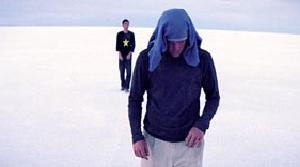
Right after three commercially viable and successful films, one of which earned him an Oscar nomination (Good Will Hunting, 1997), it's very surprising that Gus Van Sant follow it up with a film like Gerry. Gerry is basically a film about nothing, but despite that, it's always fascinating. From the lengthy opening sequence of two guys (Casey Affleck and Matt Damon) driving past the highway accompanied by the music of Arvo Pärt, you instantly get hypnotized by the alluring non-predicament. Once the enchantment of filmed car rides wears off, Van Sant instantly brings you back to mundane Earth by having the two men alight their car and follow a track. Everything seems normal (they even meet fellow trackers which they return a friendly hello to), until the predicament of this non-predicament film creeps in. The duo gets lost in the middle of Death Valley.

The rest of the film is a repetitive sequence of the two walking past the rocky landscape or the barren desert, and again, despite that, it's still very fascinating. There are occasional breaks in the repetition. Conversations between the two are captured. These are mostly discussions on mundane non-topics yet in these conversations we gather that both of them are named "Gerry." Yet, we are really unsure of that since the characters use "gerry" so many times that the term might not even mean their names, but some kind of a mysterious code which we might never ever find out. The breaks also have moments of humor: One of the guy finds himself "rock-marooned" and insists that the other guy make him a dust mattress so he won't break his ankle. Other than that, it's mostly quiet and dull sequences of them walking, and the brown landscape baking.

Is the film, like the surroundings it shows, lifeless? Not really. In fact, despite the fact that the austere plot is stretched to fill up the running time, there's a gradual growth in Van Sant's visual pallette that I find very interesting. Little by little, the landscape's life is sucked by the two characters' eventual demise. Green plants disappear, tumbleweeds make an entrance, and everything becomes deathly white. In one surreal sequence, we find the two walking in an uncomfortable stance and pace amongst the paleness of their surroundings. Again, it's a very quiet moment but is not without the thunderous gasps for life, the only reminders that they are not zombies but actual human beings who find themselves dying in the middle of the Death Valley.

That troubling scene is repeated by Van Sant in his next feature Elephant (2003) wherein one of the students would play a computer game where the characters being shot and killed look frighteningly similar to the dying men in Gerry amongst the bare desolate backdrop. It's almost exactly the same, except for the fact that in Elephant, the two Gerry's are transformed into bitmap images, but in the same way, are unwitting targets of the unpredictability of death. We later know that the computer images being shot are representative of their victims in their planned shooting spree in their school. In Gerry, death arrives in casual and almost luxurious fashion, spending almost two hours of relaxed and gradual pacing to sink its teeth in its victims' sorry necks.

Wednesday, September 06, 2006

Elephant (2003)


Elephant (Gus Van Sant, 2003)

The title alludes to the parable wherein some blind men were asked to describe an elephant. Unable to see the elephant as a whole, the blind men were only able to give descriptions of the elephant's parts that they were able to feel and touch. Of course, none of them were able to completely describe the animal but as to what they've felt and touched, their descriptions were accurate. Gus Van Sant's Elephant can be seen as a blind man's description of the American youth's angst and needs. Van Sant prepares the stories of what could the victims of a Columbine-like shooting have been doing or thinking hours before the fateful event. Each of the episodes could be accurate descriptions of youth culture, but even as a whole, the deeply rooted problem can never be wholly appreciated and one has just to gasp in horror and bewilderment as the innocent are being shot to death.

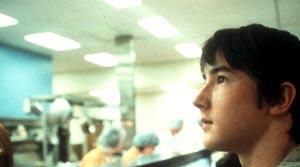
It's a tremendous film. Van Sant mostly follows his subjects from the back as they do their school routine, mostly. Their conversations do not provide for clues or anything deep, it's just anything and everything a high school kid would say or be enchanted to. Banal, mundane, and too familiar, Van Sant's mini-episodes are excellent examples of a base to a really hideous horror film. These subjects are just too vulnerable for death and violence, unaware that that day might be their last.

In an early scene in the film, a gay students' meeting's focus was on how to determine if someone walking by is gay. One of the students then ask if that is even possible. Van Sant's camera rotates showing the faces of the members of the group and it's a fascinating technique as you can't really tell if any of the meeting's members were straight, gay, or lesbian. The same way, it is almost impossible to tell who of the students will just explode and start shooting everyone. Some of the students have problems and angst that may provide a bit of reason as to why they would suddenly storm the school and kill everyone, but the capability for such massacre is impossible to determine. The students' faces, pure and innocent, declare an incapacity for harm and murder. It's chilling.

Van Sant's visuals (through cinematographer Harris Savides) and the sound design are important elements of the film. The subjects are mostly seen from the back and it's an almost prophetic notion especially when a scene where one of the shooters starts to play a computer game where he shoots men mostly from behind. The way Savides focuses on the subjects and blurring the background is quite an effective means of showing the subjects' world as revolving merely on the little space that they have, and that the surroundings are taken for granted. More effective is how the sounds are limited or expanded depending on the situation. It creates for a very eerie feeling that something is a astir and that the fact that Van Sant is unwrapping the events in a careful, almost meditative manner, keeps you ready for something to happen and keeps you curious as to who, what, and how the eventualities will happen.

Van Sant's Elephant is the surprise big winner in the 2003 Cannes Film Festival. It's what the French wants, a provocative film that can be seen as an attack, or an uncomfortable commentary on America, as seen through the eyes of the United States' supposed future, its youth. However, to look at it that way is to see the film as a political film, which I think it's not. While like one of the blind men who were tasked to describe an elephant, one can see it as a provocation or graphic manifestation as to the corruption of the youth.

It can also be described as the middle portion of Van Sant's Death Trilogy, wherein Van Sant examines the inevitability of death, and its being a commodity for those who found themselves alive in a cruel world, or as an unexpected punishment for those who don't care whatsoever. Death is a hindrance to the unbearable events of tomorrow, or opportunities and dreams. The killers are seen both as victims and oppressors. The same way, the victims are all seen as mindless targets, as complete lives and personalities, as in a harsh way, beneficiaries of an option (chosen for them) to end a life in complete innocence.

Monday, September 04, 2006

Last Days (2005)


Last Days (Gus Van Sant, 2005)

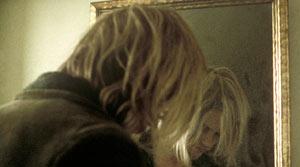
Gus Van Sant's final entry to his Death Trilogy (which includes Gerry (2002) and Elephant (2003)) reportedly solicited several walk-outs upon screening. It's not an easy film to watch and if you are expecting a biopic of the life of tragic musician Kurt Cobain, it's best to stay clear of the film. Originally planned as a somewhat silent film, Last Days evolved into a contemplative examination on the last few days of a musician, Blake (Michael Pitt), the fictional rocker inspired by Kurt Cobain, before he dies. The film, from its first frame to its last evokes a deathly sensation despite its lush setting (a mansion in the middle of a healthy forest), and the several near-interventions from friends and co-workers. It's a powerful film, to say the least and through its meandering pacing, it generates a feeling of an impending event that is impregnated with religious, philosophical and psychological possibilities.

Last Days starts with Blake walking alone, mumbling indecipherable statements, to the forest's falls. He hops in and takes a bath, and steps out of the pond to urinate directly on the water. Interpretations of the opening scene range from a symbolism of baptism being ultimately shattered by Blake's pissing all over the baptismal font, to just about anything. Blake then walks to his mansion, tries to defrost his meal, then goes up and changes to a woman's lingerie and just depressedly does nothing. Again, that makes for difficult viewing as the character embodies a fatal ache that remains mysterious and thus, terrifying. Of course, it's been said that Kurt Cobain's death is a result of his addiction with drugs, added by his personal motivations, but all of that is brushed aside here, Blake's reasons for taking his life is not an issue but the journey from absolute resolution to death to the final act is the meat of the movie.

There are several scenes in the film that allude to religion. Two young Mormon missionaries visit Blake's mansion and is met by Blake's two loafer friends, Luke (Lukas Haas) and Asia (Asia Argento). The missionaries talk about their religion with memorized conviction, and tackles an interesting point that one can only reach purity upon killing a pure creature. Everything is cryptic and it is almost impossible to completely understand the dynamics of the film, but it is easy to connect the events and the dialogue to the fact that Blake is resigned to death. When all the preaching is happening, Blake is in his room dazed and clearly in a state of disarray. The background of this scene is punctured by the music of BoyzIIMen playing, and ending with the rather corny MTV playing in the television screen. It's a curious symbolism that tackles a form of washing away of his rock and roll convictions for contemporary pop trash, a graduated punishment for him to purity. Of course, I'm guessing but nevertheless, the scene is pumped up with deadpan humor.

The film is connected by several situations, mostly involving several persons involving themselves with Blake. It's a sort of intervention that concludes in a clearer conviction to end his life. In only one scene do we see compassion from one of Blake's companions and the rest are barely knowledgeable on what is really happening, even to the point that to his last hour, friends still pour to ask for favors yet never care as to why Blake is acting strangely. It's probably the drugs, or the liquor, or the highness to rock and roll.

It's been said that one achieves nirvana when one has achieved the greatest high through narcotics, but I differentiate Blake's scenario with the drug-induced nirvana. Blake's assuredness, his purity, is his nirvana which is why his character is impenetrable and his movements seem illogical and out of this world. From the first frame to the last, Blake is in a state of sureness that is probably absent in his entire life. That being said, Last Days can be accurately described as one of the greatest death scenes (all of its running time) ever filmed.