Showing posts with label Isao Takahata. Show all posts

Saturday, May 19, 2007

Goshu the Cellist (1982)


Goshu the Cellist (Isao Takahata, 1982)
Japanese Title: Sero hiki no GĂ´shu

The first few scenes that director Isao Takahata allows us to see in Goshu the Cellist are beautiful portraits of nature and pastoral Japan. Takahata's patient eye can be appreciated as Ozu-like, allowing his audience to partake of the beauty of his animated compositions. Against the music of Ludwig van Beethoven's symphony, the scenes suddenly take a more familiar form, similar to those vignettes in Disney's Fantasia (1940) and the much more recent reincarnation Fantasia 2000 (1999).

The visuals follow the rhythm and the escalations of Beethoven's music. Then we see Takahata's orchestra fervently playing Beethoven's symphony. They are merged, flowed, and flown with the rest of the imagery; the orchestra members take part in the "visual storm" their music has produced. Then, the imagery dies down. The conductor tells Goshu, one of the two cello players, that he is not with the orchestra's rhythm. They try again. The conductor again stops the music, but instead of scolding Goshu, scolds another member. Finally, the conductor gives up and again points at Goshu, telling him that he knows the music, but plays it without any emotions. The conductor comedically leaves the room, the rest of the orchestra follows, leaving poor Goshu alone, and obviously bothered by his conductor's comments.

This gem of a film, made by Takahata long before the creation of the now-famous Ghibli Studio, is refreshing in its simplicity and sincerity. The plot, adapted from a novelette by Kenji Miyazawa, flows with admirable grace. Takahata doesn't merely tell the story of Goshu's dreamy involuntary training by several animal neighbors (a cat, a cuckoo, a racoon, and a mouse) but instead savors each unnatural and surprising encounter for all its worth. Goshu's encounter with the cat and the cuckoo are ripe with both overt physical humor and witticism. Goshu's encounter with the naive racoon and the mouse mother and child is gorgeously painted with subtle emotionality and cuteness (a common trait of all encounters).

Seeing Goshu the Cellist gives you a clue as to Takahata's growing talent in portraying humanity through animation. True, the characters aren't lifelike and the scenarios are mixtures of real events and fantasies. However, Takahata never detaches from the truthfulness of every scenario. For example, when Goshu is forced to play a solo piece as an encore in the concert. He doesn't decide to show-off by playing a gorgeous Beethoven tune. Instead, he is swelled by anger and decides to play a melody he used to torture the cat. That by itself betrays the supposed climax of the film but instead it shows that Takahata's characters aren't merely following the guidelines of artificial narratives. Instead, they breath and react like real human beings --- their needs, aspirations and failures in life are therefore given a greater cinematic weight than those produced by the machinations of a plot device.

Takahata of course improves on this much later on. In Grave of the Fireflies (1988), he livens the tale of two youngsters driven by the war to starvation. These youngsters are directed by their stubborn youthfulness and pride to the tragic result. In Pom Poko (1994), he turns mythical racoon creatures into a myriad of human personalities co-existing in a time of change and dire need. The two later films are gratifying exercises of Takahata's understanding of human psychology; all wrapped up in beautifully created imagery.

******
This post is my contribution to Joe's Movie Corner: Ghiblog-a-thon.

Tuesday, September 12, 2006

The Little Norse Prince (1968)


The Little Norse Prince (Isao Takahata, 1968)
Japanese Title: Taiyo no oji: Horusu no daiboken

It was a rocky relationship between Isao Takahata and his producers at Toei Studios. The studio bigwigs wanted an animated film styled after the ones made by the Disney Studios in America. They wanted to have song and dance numbers, talking animals, and a story that would cater predominantly to young kids.

The story Takahata wanted to film was an Ainu folktale, translated to the screen by puppet-theater drama writer Kazuo Fuzakawa, but the bigwigs thought that setting it in aboriginal Japan would turn off the masses, thus a more Westernized (more specifically Scandinavian) setting was used. After three years of development, the film was released and it was a financial flop. However, little did the bigwigs in Toei or even Takahata (or probably even Hayao Miyazaki who also worked in this film as "chief animator and concept artist") that The Little Norse Prince would spawn an entire culture of Japanese anime and animated films that have in them a natural literary quality as compared to the comedy-oriented ones that are being created in the West.

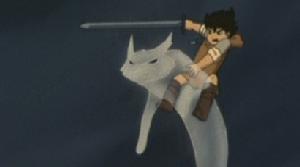
The Little Norse Prince quickly springs up as soon as the studio credits end. Horus is fighting a pack of wolves with his trusty axe and ends up being rescued by an rock golem. Stuck in the rock golem's shoulder is a rusty sword which Horus removes ala King Arthur. When his grandfather dies, Horus, along with his talking bear friend, travels to a village which is being pestered by a fish monster. Horus rescues the village, brings to them a mysterious girl named Hilda, and protects them from an evil demon named Grunwuld who is behind all the wolves, the fish monsters, and the rats that hound the human village.

The animation of The Little Norse Prince, if compared to the later efforts of Takahata and Miyazaki, might feel a little bit outdated. However, knowing that the film was finished in 1968, it is quite astounding how the movements of the characters, and the colors, and the concepts are so very fluidly developed. The animation feels a bit more Western (the lines on the characters are much more distinct as compared to the more recent anime efforts, the designs also look very Disney-esque), probably to the insistence of Toei Studios. They did get their talking animals, with Horus' best pal bear, and Hilda's companions, a talking squirrel and owl. They also got their song numbers, which I must say give the film a very literary and mythical quality that I very much enjoyed.

Probably more important than the technical advances of The Little Norse Prince is the fact that the film, despite its straightforward narrative, is very much deeply-layered (probably to the annoyance of the studio bigwigs). The character of Hilda is not merely the romantic partner of the hero, but is also the center of a psychological and moral battle. Hilda is an embattled character who has to choose between the inevitability of death by siding with the humans, or eternal life by siding with Grunwald who lets her wear an amulet of life. It's a stirring dilemma that is quite revolutionary at that time, especially when narrative animation is mostly restricted to children fare. Also, The Little Norse Prince feels especially epic. Horus' battles with the different monsters and demons create a folkloric or mythical depth to the entire feature that I was quite surprised to find out that the film's story was not sourced from Norse mythology, or even a richly adorned children's book, but from an Ainu folktale.

Many might say that The Little Norse Prince's value is more for its historical contribution rather than its inherent artistic merits. I disagree. Even if let's say, the entire anime revolution didn't erupt from the film's growing cult status, the film still holds a powerful storytelling sincerity that is very much affecting and resonating even to adults. The film's narrative simplicity transcends the cutesy animation, or the fact that animals do talk in the feature, or the plentiful songs. Forgetting it's important place in film history, watching The Little Norse Prince feels like being told a sprawling epic tale where good always triumphs against evil.

******
This post is my contribution to Joe's Movie Corner: Ghiblog-a-thon.