Showing posts with label 1982 Films. Show all posts

Saturday, October 20, 2007

Fanny and Alexander (1982)


Fanny and Alexander (Ingmar Bergman, 1982)
Swedish Title: Fanny Och Alexander

I just sat there trembling. Fanny and Alexander, the 188-minute edit Ingmar Bergman reluctantly made for theatrical screening, just ended. The credits were rolling but that final shot of young Alexander (wide-eyed Bertil Guve) finding refuge on the lap of his grandmother Helena (a magnificent Gunn Wållgren), along with other mesmerizing images that miraculously fleeted with their uncanny burdensome implications stuck with me, paralyzing my limbs temporarily.

Most cinephiles would call Fanny and Alexander as Bergman's most accessible work, the advisable first Bergman film to watch if you're planning to succumb to the Swedish director's mostly desolate filmography. My first Bergman film is Cries and Whispers (1972), a tantalizing and palpably painful work which shattered all trace of happiness in my body during the hour and a half I spent watching it. That film moved me, but not as much as how Fanny and Alexander did, which not only rattled my existential core but also delighted, frightened, and amused me in a way that was not shallow and ephemeral.

A flock of older women was not so quietly discussing the overt cruelty in the film. It was obvious that they related closely to the trials Alexander and her younger sister Fanny (Pernilla Allwin) had to go through, especially after the death of their father Oscar (Allan Edwall), seemingly the only sensible man in the Ekdahl household. Indeed, I find Bergman discomfortingly cruel to his younger protagonists (Alexander serves as Bergman's alter ego in this film and both him and the character share similar experiences) but not because of the extraneous experiences they have to undergo, but because of their (more specifically Alexander) sudden realization of the bleakness of life and the probable futility of the afterlife.

Alexander is often haunted by his father's ghost, who often just stands with forlorn gazes, inutile and useless in the afterlife. In his conversation with his dead father in the puppet room of Isak (Erland Josephson), a Jew and very close companion of the Ekdahl matriarch, Alexander questions his father's inactivity and the reason why he is not with God, before starting to angrily challenge God's existence and nobility. God replies by instilling fear, rattling a cabinet and threatening to show all his terrifying majesty and glory to the young boy. Of course, there is no God; it was just a well-crafted puppet made by Isak's playful nephew Aron (Mats Bergman). The bigger picture is laid down for us, that in life, we are governed by a religion that promotes self-denial, pain, punishment, sacrifice, and fear as a way of life only to be utterly dismayed and disappointed in death, where one's ghost is left roaming unnoticed and hopeless within the halls of his former life. It is that uncertainty that really scares us. There is covetable solemnity in the mummy's restful stance, eternally breathing and blissfully ignorant of the presumable emptiness of death.

Bergman weaves a colorful tapestry of life through the Ekdahl clan, a family entrenched in the local theater. Their mansion, we first see through abandoned in a hallucinatory daydream of imaginative Alexander (a memorable opening, tremendously horrifying in its opulent sparseness), becomes alive for Christmas Eve dinner. Underneath the routine yearly celebration are apprehensions, voiced out only in the privacy of their chambers --- a sexual affair between Gustav Adolf (Jarl Kulle) and a pretty maid (Pernilla Wallgren) matures into a suffocating relationship that confuses financial freedom with actual freedom; Gustav's brother Carl (Börje Ahlstedt) is on the edge of frustration over his financial reverses and the servile predisposition of his foreigner wife; Helena recounts the exploits of her youth to Isak, while the latter doesn't regret the depletion of their youth as the world is getting worse, there's no better time to die.

Despite the normal intrigues of the household, there's much vitality within the mansion as compared to the abstinent life forcefully fed to Alexander and Fanny in the household of their stepfather (Jan Malmsjö), a bishop who woos their mother Emilie (Ewa Fröling) into marriage. The walls are drab, the servants are colorless and treacherous, the residents are cruel. The ascetic and self-flagellating lifestyle led has tortured these people to utter disfigurement (an obese aunt in her deathbed, a tormented sister, a stern and domineering mother); there is blatant abomination in this example of misconstrued piety and purity. Alexander turns into his imagination for comfort and defense (he and his sister have been abandoned and helpless, their father is a mere watcher and a lonesome presence, their mother is trapped in her own passions, and God seems to be on the side of the righteous bishop), inconsequentially sinning to an indifferent deity who may or may not exist.

Fanny and Alexander is supposed to be Ingmar Bergman's final film (his final film turned out to be Saraband (2003), released four years prior to his death). It certainly feels like a grandiose summation of his life's work --- perfectly beautiful (lensed by legendary cinematographer and frequent collaborator Sven Nykvist), mysterious and magical, awing and hypnotizing, cruel, tragic, and fatal, but still a biblical celebration of life and of the living, their many facets and denominations.

Saturday, May 19, 2007

Goshu the Cellist (1982)


Goshu the Cellist (Isao Takahata, 1982)
Japanese Title: Sero hiki no Gôshu

The first few scenes that director Isao Takahata allows us to see in Goshu the Cellist are beautiful portraits of nature and pastoral Japan. Takahata's patient eye can be appreciated as Ozu-like, allowing his audience to partake of the beauty of his animated compositions. Against the music of Ludwig van Beethoven's symphony, the scenes suddenly take a more familiar form, similar to those vignettes in Disney's Fantasia (1940) and the much more recent reincarnation Fantasia 2000 (1999).

The visuals follow the rhythm and the escalations of Beethoven's music. Then we see Takahata's orchestra fervently playing Beethoven's symphony. They are merged, flowed, and flown with the rest of the imagery; the orchestra members take part in the "visual storm" their music has produced. Then, the imagery dies down. The conductor tells Goshu, one of the two cello players, that he is not with the orchestra's rhythm. They try again. The conductor again stops the music, but instead of scolding Goshu, scolds another member. Finally, the conductor gives up and again points at Goshu, telling him that he knows the music, but plays it without any emotions. The conductor comedically leaves the room, the rest of the orchestra follows, leaving poor Goshu alone, and obviously bothered by his conductor's comments.

This gem of a film, made by Takahata long before the creation of the now-famous Ghibli Studio, is refreshing in its simplicity and sincerity. The plot, adapted from a novelette by Kenji Miyazawa, flows with admirable grace. Takahata doesn't merely tell the story of Goshu's dreamy involuntary training by several animal neighbors (a cat, a cuckoo, a racoon, and a mouse) but instead savors each unnatural and surprising encounter for all its worth. Goshu's encounter with the cat and the cuckoo are ripe with both overt physical humor and witticism. Goshu's encounter with the naive racoon and the mouse mother and child is gorgeously painted with subtle emotionality and cuteness (a common trait of all encounters).

Seeing Goshu the Cellist gives you a clue as to Takahata's growing talent in portraying humanity through animation. True, the characters aren't lifelike and the scenarios are mixtures of real events and fantasies. However, Takahata never detaches from the truthfulness of every scenario. For example, when Goshu is forced to play a solo piece as an encore in the concert. He doesn't decide to show-off by playing a gorgeous Beethoven tune. Instead, he is swelled by anger and decides to play a melody he used to torture the cat. That by itself betrays the supposed climax of the film but instead it shows that Takahata's characters aren't merely following the guidelines of artificial narratives. Instead, they breath and react like real human beings --- their needs, aspirations and failures in life are therefore given a greater cinematic weight than those produced by the machinations of a plot device.

Takahata of course improves on this much later on. In Grave of the Fireflies (1988), he livens the tale of two youngsters driven by the war to starvation. These youngsters are directed by their stubborn youthfulness and pride to the tragic result. In Pom Poko (1994), he turns mythical racoon creatures into a myriad of human personalities co-existing in a time of change and dire need. The two later films are gratifying exercises of Takahata's understanding of human psychology; all wrapped up in beautifully created imagery.

******
This post is my contribution to Joe's Movie Corner: Ghiblog-a-thon.

Wednesday, January 10, 2007

Time Masters (1982)


Time Masters (René Laloux, 1982)
French Title: Les maîtres du temps

Time Masters is the second Stefan Wul novel ("L'Orphelin de Perdide") director René Laloux adapted. The first one being "Oms En Serie" which Laloux turned into the now classic The Fantastic Planet (1973). It certainly feels like Laloux's cinematic style is compatible with Wul's tales of otherworldly lifeforms, civilizations, and struggles. Laloux breezes through the planet of Perdide with its interesting landscapes and living curiosities, while accommodating a storyline that invokes a gripping twist in the end; a twist that all of a sudden turns the tale into an involving temporal puzzle.

The plot follows a troupe of space mercenaries in a race against time trying to rescue a little boy who is left alone in the wilderness of Perdide. The boy, who is merely kept alive by an intergalactic radio (from which he receives information and company from the space mercenaries) he, by his youth and innocence, thinks of as a friend called "Mike."

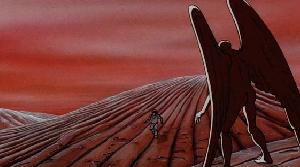
Time Masters feels a less serious effort compared to The Fantastic Planet. Unlike the latter film wherein adult themes surface from the planetary rebellion by the little aliens against their blue-skinned humanoid masters, Time Masters is pretty much a straightforward rescue film wherein the heroes jump in and out of problematic scenarios and try to arrive in Perdide before the boy gets devoured by locust-like creatures. There are scenarios wherein Laloux seems to be pushing a certain theme --- the troupe lands in a deserted planet inhabited by faceless angel-like creatures. These creatures would kidnap visitors and through a ceremony turn them into "puppets" just like them. The scenario feels like a commentary against organized religion (especially with the utilized imagery of angels, the ceremonial baptism to a common ideology). The scenario being a mere point within the entire film betrays the depth of the commentaries for narrative ease and straightforwardness. It feels like Laloux is kept from truly exploring these alien environs by his adherence to storytelling; something i never felt while watching The Fantastic Planet.

Time Masters marks the first collaboration between Laloux and comic book artist Jean Giraud. Giraud is most famous for co-creating The Silver Surfer, and would later on work on as concept artist for films like Alien (Ridley Scott, 1979), Willow (Ron Howard, 1988), and The Fifth Element (Luc Besson, 1997). This is perhaps the reason why there is such a huge difference between the designs of The Fantastic Planet and Time Masters. The Fantastic Planet's art is grotesque, surreal, and at times, downright disturbing. Time Masters feels much more cartoon-y and friendly. Giraud is responsible for the sketches, and there is indeed a comic book feel to the film. There is very minimal movement, and more often than not, Laloux bathes the film in sedentary moments; giving us the opportunity to examine and enjoy his and Giraud's collaborative art.

The animation is not smooth, which shouldn't pose a problem, especially when one is already used to Laloux's cinema. Time Masters seems to be confused of its classification; whether or not it is a children's film or an adult-centered animated film. Most of the alien designs are clumsily conceived (especially if compared to the dangerous flora and fauna of The Fantastic Planet), on the verge of being silly in the level of those Hanna-Barbara cartoons. Yet at times, it's quite fantastic and the level Laloux infuses these made-up alien landscapes with real ecosystems and cycles is just compelling.

Friday, October 27, 2006

Kisapmata (1982)


Kisapmata (Mike de Leon, 1982)
English Title: Blink of an Eye

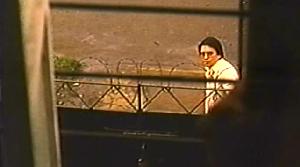
The middle class house of the overbearing father (Vic Silayan) pretty much summarizes the intricacies of the character. The exterior is characterized by a steel gate and cement walls adorned by chicken wires. Instead of a lush flower garden, the vast unused space is turned into a pigpen where the retired police officer keeps his pet hogs. Elsewhere, the father also keeps an earthworm farm. He claims that a retired police officer should try to keep himself busy by tending to hogs and earthworms. I thought it was merely a clever excuse --- the earthworms, the hogs, even the poor household help are just receptacles of the excess amount of macho energy (in the form of the father's gripping overcontrolling nature) which simply can't be contained by the immediate members of his family, his common-law wife (Charito Solis) and his psychologically tortured daughter Mila (Charo Santos).

The interior of the house evidences the father's almost psychotic nature even more. Despite its normal-looking arrangement, the architecture is actually intricately plotted to serve the father's controlling reach over his family members. The daughter's room is directly across her parents' room on the second floor of the house. In the middle of the two rooms is the bathroom. Below the hall is the living room, which can clearly be seen from the kitchen. The telephone is directly below the parents' room. It's almost impossible for anybody to walk from one section of the house to another, or to even use the telephone, without the father knowing or at least hearing.

Kisapmata (Blink of an Eye) begins with Mila announcing to his father that she is getting married to her boyfriend Noel (Jay Ilagan). The daughter is clearly talking to the father, with barely a notice to the mother, always a background ornament to the overpowering patriarch. When the mother tries to speak out, it's always with a careful acknowledgment that what might come out of her mouth may have drastic repercussions. The mother's resignation of her role in the household (a mere proof that the father has sole control of everything that happens within the house and the family) creates an even more effective level of intensity to the events that ensue. Noel and Mila get married. Through devious means, the father is able to force them to stay at his house for a week, until Noel breaks and insists that he and Mila move out and live on their own. Noel's introduction to the household is a stirring circumstance that drives the father's familiar lordship over his household into a deliberately paced downfall into madness.

It's not merely Noel's invasion of the family's carefully structured status quo. The father is not one who bows down to societal institutions. He and his wife aren't married, which probably rationalizes why he doesn't regard Mila's marriage to Noel as an event that would free the daughter from the clutches of the father. The father is clearly a slave of alcohol --- he acknowledges his youthful looks to the fact that he exercises and can down a couple of beers every night. He tries to extend his control over Noel --- convincing him to down a couple of beers over one of his macho exploits as a cop, but when Noel declines and decides to tend to his wife instead, the father ridicules Noel as weak and wonders how he could've swayed his daughter into marriage. It is quite convincing that there is something more that boils beneath the father's controlling character --- it is not merely his patriarchal duty, or an abnormal excess of macho behavior. Mike de Leon seems to subtly reason a sexual perversity between the father and the daughter, and the fact that the daughter has fallen for a man who he thinks is inferior to him, is an attack to his machismo. When Noel successfully escapes with Mila to the provincial town of Los Banos, we first witness the father crying --- a devastating acknowledgment that an indelible damage to his masculinity has been caused by the daughter's disobedience and Noel's winning over his calculated designs.

Kisapmata is de Leon's masterpiece. Hitchcock is an obvious influence. The film's score mirrors Psycho's famous shower murder scene. It seems that de Leon fashions the house as a Filipino Bates motel. The normal-looking house is shot like the infamous hotel, from outside; the unassuming building towering even so with the knowledge that a monster is jealously guarding its occupants. The father looks from the front window with a keen eye of a vulture; the same way Norman Bates would observe the occupants of his inn.

Yet the creepy thing about Kisapmata is that the events are all too real, unlike Hitchcock's Psycho wherein the murderer is merely haunted by a domineering yet dead mother. In Kisapmata, the machinations of the father is not extended from the grave, but from real and lethal threats. It is clear that the characters in de Leon's film are real human beings --- they work, they interact with other people, they have needs and ambitions. It is that factor that turns this nightmare even far more chilling than Hitchcock's masterpiece. The subject house looks ordinary, and the father is actually quite charming and doting, but you instantly know that there is something deeper than mere insanity or psychotic behavior or point blank notions of evil that is at work here. The corruption that is detailed in Kisapmata extends from the uncomfortably intimate quarrels in the subject household, but to the fact that this form of patriarchal family is not totally alien to Filipino culture, and probably elsewhere.

Monday, September 18, 2006

The Prefab People (1982)


The Prefab People (Béla Tarr, 1982)
Hungarian Title: Panelkapcsolat

Béla Tarr's third feature The Prefab People is often considered the Hungarian's best out of his early documentary-like fiction films. The film is a concise and personal look on a dying marriage in the midst of a socialist country on the verge of impending commercialism. Tarr's palette consists of residential buildings, smoke belching factories, dance clubs, and of course, the harshly claustrophobic interiors of a middle class flat which houses the couple and their two young children.

A celebration (consisting of a musical band playing a joyous melody) preempts the film sarcastically. Right after the final notes of the joyous song ends, Tarr pits his audience immediately on the hopeless marriage by introducing the couple in a point of discordant intimacy. It's something you'd rather not see. The husband (Robert Koltai) suddenly storms inside the flat, grabs his things and tells the surprised wife (Judit Pogany) that he's leaving them for good. Sounds of weeping and wailing ensue after as the wife begs the husband to rethink his decision. Tarr abruptly ends the sequence, by showing something that seems a bit sweeter, the couple's ninth anniversary. We really don't know if the anniversary precedes the dramatic introductory sequence or if that was after the husband has finally returned to the begging wife. The celebration turns sour when the wife suddenly decides to use the anniversary as an avenue to nag on the husband's domestic inadequacy.

It's not really an engaging film. It's more depressing than revealing. The couple come and go ending every bit of something good with an opportunity to disagree. A vacation turns sour when the husband suddenly decides to visit a friend and becomes unaware that he has left his wife and children for about an hour and a half. When he shows up, he gets a verbal lashing from the nagging wife. The film is basically a repetition of scenes wherein the couple would lash out in disagreement. It's obvious that they are both in love with each other, but perhaps due to some societal or psychological reason, they always end up in conflict.

Depressing, repetitive, taxing and sometimes unwatchable due to its saddeningly intimate content, The Prefab People however showcases unmeasurable talent from the young director. His camera captures the emotional angst as it transforms from pleasant and normal relations to erupting and bitterly unbearable domestic drama. In one fascinatingly done sequence, Tarr begins by catching the couple enjoying an entertainment show which leads to a night of frenzied dancing. Tarr then lets time pass by, catching the husband in drunken ecstasy singing songs to pass time as the wife downs a glass of liquor, letting her tears out in the film's single most honest image. It is in that melancholic scene wherein Tarr lets alcohol dominate celluloid, catching the characters in their most sincere and their most quiet repression of pent-up emotions.