Showing posts with label Ken Loach. Show all posts

Tuesday, November 04, 2008

It's A Free World (2007)


It's A Free World... (Ken Loach, 2007)

In Ken Loach's It's A Free World..., there are two generations of the working class that are separated not only by age but by their immense moral gap. Geoff (Colin Caughlin) is retired and spends his day taking care of his grandson. He lives comfortably with his wife, despite his acknowledgment of his limited financial capabilities, and goes about life with his head up high although his belt is tightened. He is representative of most of Loach's protagonists, those who maintain an adamantly dignified stance against the afflictions that plague the working class. Angie (surprisingly terrific newcomer Kierston Wareing), Geoff's daughter (and if we are to follow Geoff's logic, a severe disappointment) is in her early thirties, a single mother and has been switching jobs year after year and unable to find decent employment opportunities in a modern world of increasing wealth and diminishing integrities.

After being fired (presumably for violently reacting against the sexual advances of a male superior) from an employment agency that recruits immigrants for manual work in England, Angie returns to London and convinces Rose (Juliet Ellis), her flatmate, to start-up their own manpower agency in the backlot of a local pub. Angie's operations reflect her roots. Riding her motorcycle around town, recruiting overstaying aliens and convincing businessmen to provide work for her recruits, Angie's irresistable demeanor, consisting of a mix of unique confidence brewed from both desperation and years of economic and social struggle, would carry her entrepreneurial experiment to modest successes. She establishes rules at work (for example, she would not provide aliens without any papers employment), and in the process, protects whatever dignity and integrity from the probable repercussions of her chosen endeavor.

However, the capitalist world is not nearly as predictable as Angie thinks it is. Businesses fail. Employers become bankrupt and unable to pay wages. Commissions are unearned. Mobs of dissatisfied immigrants become unruly and her and her family's safety is compromised. Her rules are bent, first to favor an Iranian refugee who is desperate to find any job to feed his family, and later on, to finally complete her transformation from exploited to exploiter. No matter how Angie insists that there are borders to her profession, it is this uncomfortable meshing of her two roles (as a member of the exploited middle class and as the superior and empowered recruiter) in the bigger scheme of international economics and politics that forces her to choose which side she really belongs to: the abused, or the abuser.

To make matters worse, Angie's privilege is not her innate industry or other talents and skills, but the simple fact that the world also has arbitrary economic classes among nations, where Britain is hardly the working class as compared to its Eastern European neighbors whose citizens spend decades worth of their savings to gain entry to London, forced to be employed with meager wages and hardly any benefits, where promises of decent living and income is mutated into paranoia and nightmares of either being cramped into decrepit buses, factories, and inhumane working places or being chased out of the country by the immigrations police.

Loach's concern is hardly these impoverished illegal immigrants. Their stories have been told and retold by countless other filmmakers, almost always with the emotional efficiency of daytime soap. Loach pits his beloved middle class in the center of this contemporary world, where nations are interconnected by trade treaties, loosened borders, and easy communication. Although afflicted with the same working class problems (poverty, lack of professional recourse, and a youth that is being pushed to delinquency by lack of proper parenting), Angie's generation is provided with a pressing choice: of living the same lives as those who preceded them, or exploiting the more desperate and desolate members of the enlarged and supposedly freed world.

Saturday, November 18, 2006

The Wind That Shakes the Barley (2006)


The Wind That Shakes the Barley (Ken Loach, 2006)

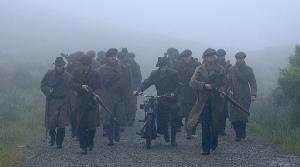
A group of men play jovially in the green fields of an unnamed village in Ireland. They go home to meet with their family members. The opening sequences can be of any era in the island's modern history, until a gang of Black and Tans (paramilitary "soldiers" sheltered by the British monarchy to quell the Irish rebellion) arrives and starts to harass the men, along with their family. They are ordered to answer their questions truthfully, then stripped for weapons. One man is headstrong and answers the harassments with brave reluctance; he gets murdered. The palpability of the Brit's oppression is now felt by the Irish villagers, forcing them to join the independence cause of the IRA. Damien (Cillian Murphy), who also witnesses the murder opts to go to London and start his career in medicine. Another example of the Black and Tan's brutality at the train station forces Damien to return to his village; swear allegiance with his more militaristic brother Teddy (Padraic Delaney) to the independence cause; and start military training.

Ken Loach's surprise Cannes winner The Wind That Shakes the Barley details the Irish independence cause, not through the eyes of its primary movers and noted personalities, but by the direct recepients of the effects of the politics and its resulting warfare. It's wonderful filmmaking by Loach. The title is drawn from the lyrics of an Irish patriotic ditty we hear sung by the women in the early parts of the film. The film shares the melancholic quality of the song; the film's evocation of the pristine greens of the grass fields --- turned in a matter of minutes into battlefields littered with dead soldiers and patches of irrevocable sacrifices of soul and morality. The same transient nature of the Irish landscape is shared by the film's turn of events; like its introduction wherein a game in the fields is transformed into a political meeting by the oppressive Black and Tans; like members of the independence cause turning in a matter of minutes (with the help of intimidation and duress) into faultless traitors; like friends turning into executioners; more importantly, midway into the film, compatriots turning into rivals, much more intimately, a brother, turning into an enemy.

The two halves of the film is divided by a truce, an event that is ironically made known to the characters right after one of the film's bleakest moment: Damien, along with his co-fighters watch (without taking action; their rifles have run out of ammunition) the Black and Tans harrasing his girlfriend and burning their house. A short period of jubilation occurs afterwards until, through a silent film reel, they learn the contents of the proposed treaty offered by the British. The political party is crushed by a schism. One half wants to continue the cause, the other wants to accept the treaty to deflect a possible and more horrific retaliation by the British Army. History paves way, the treaty is ratified, and Damien and Teddy find themselves in opposing camps.

The Wind That Shakes the Barley aches with historical burden. It somewhat points an angry finger against imperialist Britain for the present state of Irish politics. In one point of the film, a land-owner accused by the IRA of treachery accuses that if the cause succeeds, the land will turn into a backwater nation run by Catholic priests. The prediction of the land-owner rings true as Ireland hasn't arose from the ghosts of its violent historical past. The obvious manipulation of the colonial powers, the heartbreaking break-up of friendships and families, by death, by treachery, and by the common attributes of war turn Loach's The Wind That Shakes the Barley a sincere, achingly poignant and sometimes too painfully accurate look at a nation's inglorious past, which still haunts the country's psyche up to this day.

Wednesday, August 09, 2006

Tickets (2005)


Tickets (Ermanno Olmi, Abbas Kiarostami & Ken Loach, 2005)

Perhaps the most overused metaphor for life is that it is like a journey: people hop in and out, bumps and unexpected occurences happen, and lastly, there will always be an arrival notwithstanding any unexpected stoppage of that journey. Tickets does not exactly use the train ride as a metaphor for life, but simply as setting for a triptych of character examinations which seemingly sum up in an obvious suggestion that train tickets represent an accepted social divide the characters in the film will have to act or react on.

The film begins with Italian Ermanno Olmi's piece, a rather inert tale about a pharmaceutical intellectual (Carlo de Piani), who develops an infatuation for the company secretary whose hospitality and sense of care has struck the old intellectual as a rejuvination of his life's light. He struggles while writing an email of gratitude to the lovely assistant, daydreaming of candlelit dinners inside his first class coach, when a row of military men suddenly invade and with their brash rudeness, interrupt the old man's fantasies. This wakes up the old man who notices a family of refugees standing in the border between the first class coach and the lower class coach, and their milk for the baby spilt by the constant opening of the coach doors. He orders a warm milk, stands up, and delivers his milk to that family.

Once the intellectual alights the train, a couple stubbornly hops in and looks for available comfortable seats. This is the start of Iranian auteur Abbas Kiarostami's segment. The fat old lady (Silvana de Santi) finally gets a seat in the first class coach, after which, her companion (Filippo Trojano) coyly asks if he can go to the restroom. We are not aware of the exact relationship between the two. The younger man seems to show a distant respect towards the older woman, like a scared child to a strict mother, but the older woman seems to be too disconnected, too shrewd in her ways to the young man, hinting of something more like the young man being paid to serve her. The young man is used, abused, and finally explodes in fury, and leaves the older woman to fend for herself in her dead husband's memorial service.

Last is British filmmaker Ken Loach's segment, about a group of rowdy young football fans who are going to Rome to watch their team play the championship. A dilemma arises when one of their train tickets is stolen by the Albanian family (the same family the pharmaceutical intellectual helped by delivering a warm glass of milk), and the kids are faced with the decision of turning in the family of refugees or donating the ticket, the obvious repercussions of the decision being the refugee would either be sent to prison, or riding the train for free, respectively.

Unlike most other omnibus films, where the tying bond between the segments is a similar theme or a genre, Tickets is more of a seamless collaboration between the three auteurs in generating a full feature film that tackles human relationships within a tightly classed environment such as the European train line. The directors pass off their chair in fluid fashion, with no need for segment titles, or differences in style (the differences mostly consist of the language spoken, the depth of the segment, and of course, the quality). If one is forced to compare the three segments, the weakest would be Olmi's since it is far too inert, inactive, and the object of affection of the main character, too weakly construed.

The high point of the triptych is Kiarostami's segment, a delightfully humorous observation of a lady who is unwilling to let go of a former grandeur and dignity that is suddenly dissolved by the death of her husband, an army general. She literally forces things her way, and mostly gets away with it. Loach's segment is the typical Loach film, with an obvious heart for the working class, and a bigger heart for the oppressed. He ends the film in a jovial note, which is all good, since Tickets, wonderful celebration of the world's three truest auteurs' works, and putting them together in one feature, is pure unadulterated joy.