Showing posts with label Rene Laloux. Show all posts

Sunday, January 14, 2007

Gandahar (1988)


Gandahar (René Laloux, 1988)
a.k.a. Light Years

Gandahar is probably the closest René Laloux ever came in replicating the level of sophistication he gave alien civilizations in The Fantastic Planet (1973). He opens the film with an overview of a seaside community: blue skinned humanoids living life in utter simplicity. Laloux presents the planet of Gandahar as a utopian paradise where everything is in joyful order; nature and civilization coincide like connecting puzzle pieces (a plant gives birth to a pet, the pet is then taken care of by a female Gandaharian by breastfeeding it). The supposed peace is disrupted when laser rays start targeting the peaceful Gandaharians, turning them into stone.

Laloux cuts to the capital of Gandahar, Jasper. Beneath the carved bust of a female Gandaharian, the council of elders is debating on who to send to uncover the mysterious enemies of Gandahar. Sylvain is chosen; and is sent to the vast ocean to learn more about Gandahar's attackers, an army of metal men. On the way, he discovers an underground civilization of deformed Gandaharians (botched experiments of Jasper who were completely forgotten), and an oversized brain (again, another botched experiment of Jasper thrown to the sea when it was getting too big to destroy).

It's an interesting concept, sprawling in its seemingly unlimited area of creation; which is perfect for the highly imaginative Laloux. Laloux eats up the concept, and populates the alien world with a civilization that becomes too advanced (probably not industrially; but the scientific experimentations to turn nature into a tool for advancement cannot relate Gandahar as naturally perfect), too selfish and perfectionist (the deformed Gandaharias have turned into a mere tall tale; and instead of turning them into a distinct class, Gandahar has totally forgotten them (class structures cannot exist in a Utopian society)), and too complacent that it is almost powerless to any external struggle. The plot relies on time travel for its movement; Sylvain seems to be the chosen one to enact the prophecy but the prophecy's cyclical syntax connotes an impetus for salvation. I suggest that the sudden appearance of the Gandaharian dinosaur-like creature that saves Sylvain and love interest Airelle from their egg-shaped cell as the impetus; Sylvain thought that the dinosaur as extinct; I thought that the dinosaur is one of those Gandaharian creatures that have escaped Gandahar's god-like machinations and is therefore the proper turning point (it being pure from Gandahar's "sins against nature") that could enact the cyclical prophecy and in turn save Gandahar.

Gandahar is released in the United States as Light Years. The plot remains relatively unchanged except that the script was revised by Isaac Asimov, the music is modified to include generic sci-fi melodics and sound effects, the director's credit shamelessly grabbed by Harvey Weinstein. Asimov's translation turns Laloux's film into an unexciting talkfest; Asimov delights in several voice-over narrations, suggests a maternal relation between the Gandaharian queen Ambisextra and Sylvain, lightens the romantic angle between Sylvain and Airelle. Asimov's screenplay is also riddled with hyphaluting wordplay, which somehow lessens the natural transition of Laloux's original film --- the result is a disorienting flow, a boringly sexless characterization, and an inevitably less enjoyable film. Harvey Weinstein does employ several actors and actresses to provide voice talents for the characters (Glenn Close as Ambisextra, Christopher Plummer as Metamorphis the evil oversized brain). However, the delivery remains flat; presumably because of Asimov's distancing semantics.

Seeing both versions, I cannot deny that Laloux's final feature film is indeed a worthy feature; still miles away from his masterpiece The Fantastic Planet, but definitely up and above Time Masters (1982). Even with Weinstein's mutated Light Years, you can still observe Laloux's undeniable artistry and imagination in cooking up an alien civilization complete with its social and governmental structures, and biological make-up.

Wednesday, January 10, 2007

Time Masters (1982)


Time Masters (René Laloux, 1982)
French Title: Les maîtres du temps

Time Masters is the second Stefan Wul novel ("L'Orphelin de Perdide") director René Laloux adapted. The first one being "Oms En Serie" which Laloux turned into the now classic The Fantastic Planet (1973). It certainly feels like Laloux's cinematic style is compatible with Wul's tales of otherworldly lifeforms, civilizations, and struggles. Laloux breezes through the planet of Perdide with its interesting landscapes and living curiosities, while accommodating a storyline that invokes a gripping twist in the end; a twist that all of a sudden turns the tale into an involving temporal puzzle.

The plot follows a troupe of space mercenaries in a race against time trying to rescue a little boy who is left alone in the wilderness of Perdide. The boy, who is merely kept alive by an intergalactic radio (from which he receives information and company from the space mercenaries) he, by his youth and innocence, thinks of as a friend called "Mike."

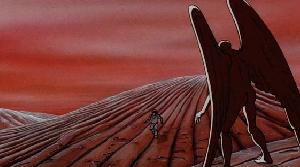
Time Masters feels a less serious effort compared to The Fantastic Planet. Unlike the latter film wherein adult themes surface from the planetary rebellion by the little aliens against their blue-skinned humanoid masters, Time Masters is pretty much a straightforward rescue film wherein the heroes jump in and out of problematic scenarios and try to arrive in Perdide before the boy gets devoured by locust-like creatures. There are scenarios wherein Laloux seems to be pushing a certain theme --- the troupe lands in a deserted planet inhabited by faceless angel-like creatures. These creatures would kidnap visitors and through a ceremony turn them into "puppets" just like them. The scenario feels like a commentary against organized religion (especially with the utilized imagery of angels, the ceremonial baptism to a common ideology). The scenario being a mere point within the entire film betrays the depth of the commentaries for narrative ease and straightforwardness. It feels like Laloux is kept from truly exploring these alien environs by his adherence to storytelling; something i never felt while watching The Fantastic Planet.

Time Masters marks the first collaboration between Laloux and comic book artist Jean Giraud. Giraud is most famous for co-creating The Silver Surfer, and would later on work on as concept artist for films like Alien (Ridley Scott, 1979), Willow (Ron Howard, 1988), and The Fifth Element (Luc Besson, 1997). This is perhaps the reason why there is such a huge difference between the designs of The Fantastic Planet and Time Masters. The Fantastic Planet's art is grotesque, surreal, and at times, downright disturbing. Time Masters feels much more cartoon-y and friendly. Giraud is responsible for the sketches, and there is indeed a comic book feel to the film. There is very minimal movement, and more often than not, Laloux bathes the film in sedentary moments; giving us the opportunity to examine and enjoy his and Giraud's collaborative art.

The animation is not smooth, which shouldn't pose a problem, especially when one is already used to Laloux's cinema. Time Masters seems to be confused of its classification; whether or not it is a children's film or an adult-centered animated film. Most of the alien designs are clumsily conceived (especially if compared to the dangerous flora and fauna of The Fantastic Planet), on the verge of being silly in the level of those Hanna-Barbara cartoons. Yet at times, it's quite fantastic and the level Laloux infuses these made-up alien landscapes with real ecosystems and cycles is just compelling.

Monday, December 25, 2006

How Wan-Fô Was Saved (1987)


How Wan-Fô Was Saved (René Laloux, 1987)
French Title: Comment Wang-Fo fut sauvé

Watch René Laloux's animation now with eyes trained to detect the individual strands of fur in a character or the realistic human-like movements of digitized children and your bound for disappointment. Laloux's animation is not about emulation of what's real. Animation is after all a means to release the restrictions of reality. Laloux's most popular feature The Fantastic Planet does not have anatomically accurate beings; it is sci-fi and its world is populated by blue skinned aliens, little humanoid creatures, a host of bizarre fauna, and a compelling environment that stretches the boundaries of human imagination. Laloux has made only three feature length films in his career; most of his other works are short films. How Wan-Fô Was Saved is his favorite among his works. Adapted from a short story of Marguerite Yourcenar, which is also rewritten adaptation of a Chinese parable, How Wan-Fô Was Saved is told in a simplistic yet thought-provoking manner that is quite absent from the mainstream animated cinema of today which seems to be more interested in mundane details than adept storytelling.

The animation is coarse. Laloux is not interested in smooth movements. His characters are limited in their mobility; most of the action is suggested by the narration which supplies a level of psychology to the immobile artworks. Yet with the little movement that is portrayed, the accuracy of human experience is felt. The air of alcohol intoxication is portrayed with deliberate accuracy by Laloux using the most economic of details. From the point of view of the narrator, the apprentice of master painter Wan-Fô, the entire tavern feels alive in a drunken man's perspective. Movement is slower; laughter is louder; visual points of interest are more profound (a lady roasting a pig; his master's finger painting spilled wine; personal musings of the depth of art).

With less than fifteen minutes, Laloux was able to manipulate a story to serve his philosophical interests. He details the master and his apprentice's capture and delivery to the emperor of the Han kingdom. He emotionally paints a background tale on the pale-skinned emperor; his character design establishes himself as a heartless villain, but his back story tells otherwise. He plants an indefatigable sense of loyalty in the apprentice's character for his master and his master's craft, to the point of lethal jealousy for his beautiful wife. In a sense, the characters of How Wan-Fô Was Saved are as alien as the humanoid citizens of The Fantastic Planet, despite being grounded on an exotic yet real Chinese culture, with their warped psychology that befits the constructs of its narrative genre.

The ending is even more brilliant. The apprentice is punished for loyally defending his master; the palace guards behead the defensive apprentice and Laloux does not shy away from the portrayal of violence. He nonchalantly depicts the beheading as mere background noise --- a thud accompanying the animated fall of the headless body. Wan-Fô is ordered to complete a painting that has been bothering the emperor since his childhood days. Again, Laloux insists on immobility. Bystanders and the emperor statically watch the master complete the painting of a vast ocean; then the painting bursts with life, a little boat inches closer and closer to rescue the old master from his fate. Laloux, before he did his first animated short film, worked for a psychiatric ward and has opted to describe his cinema as schizophrenic. In a sense, Laloux achieves an unfathomable excellence in planting imaginative unrealism in his animated works; he allows us to lose ourselves in our imagination and join the old master in his escape from the clutches of a tyrant who misunderstands the value of art.

******
This post is my contribution to the Short Film Blog-A-Thon hosted in Only the Cinema and Culture Snob.