Showing posts with label Takashi Miike. Show all posts

Saturday, November 17, 2007

The Great Yokai War (2005)


The Great Yokai War (Takashi Miike, 2005)
Japanese Title: Yôkai daisensô

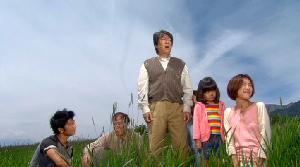
The plot of Takashi Miike's The Great Yokai War is generic: scrawny and frequently bullied little boy finds the courage to battle it out with an apocalyptic force thus saving the world. The little boy is Tadashi (girly boy Ryunosuke Kamiki), a Tokyo-bred kid who is spirited away to his mom's provincial village after his parents' divorce. In one village festival, he gets chosen to be the kirin rider, supposedly the nominal keeper of the peace. The apocalyptic force is Kato (Etsushi Tokokawa) and his dastardly plan is to merge the discarded junk of the city (these metallic trash is said to have a negative energy supposedly out of being thrown away and forgotten) with the so-called yokai or traditional spirits, creating metal monsters that would wreak havoc wherever they go.

Miike obviously has a bigger budget (not nearly as big as the normal budget of a Hollywood flick, though) than usual to play with as The Great Yokai War is mostly a string of spectacles tied together by a flimsy and random plot. The problem is that the film is seldom spectacular. The metal monsters are obviously CGI creations; the yokai are a mixture of puppets, animatronics, or actors in heavy make-up and prosthetics. The computer generated effects aren't very impressive. The puppetry and the make-up, on the other hand, are quite charming in all their cheesy glory. The turtle-like yokai, for example, wears a green-hued rubber suit. His face is made up to include the beak-like choppers of a tortoise, and his extremities bear similar modifications. The rest of the yokai are all delightful creations including a one-eyed, one-legged umbrella, a walking wall, a long-necked woman, and several others. Visually, it's a mixed bag; the CGI doesn't merge well with the prosthetics and the puppetry. Oftentimes, you'd wish Miike had just stuck with traditional effects, had trusted his zany sensibilities, and had given us something that doesn't look half-baked as this.

The themes are unsubtly laid down. It's basically a tale of good versus evil. The good guys are the traditional spirits led to defend their existence by the unlikely hero who is himself a victim of divorce and bullying. The bad guys are the mechanical hybrids, produced from smoke belching factories using depletable resources: yokai tortured and collected by Kato's henchmachines and one yokai desperately in love with the evil mastermind named Agi (Chiaki Kuriyama of Kill Bill fame). Modernity and the unnecessary wastage that it produces are the causes of the impending apocalypse; they are the underlying evils that we are warned against as opposed to the giddy and often amusing antics of the yokai (who are too busy partying to actually wage a war against impending doom). There's also an anti-war message in the end from what seems to be a yokai leader, uncomfortably as an afterthought.

Hayao Miyazaki is a clear inspiration with his works that appropriate the same theme and style (like Nausicaa and the Valley of the Winds (1984), Princess Mononoke (1997) and Spirited Away (2005)). In one scene, Tadashi rides a mysterious bus (reminiscent of Mei and Satsuki's ride on the Cat Bus in My Neighbor Totoro (1988)) where after breezing through a tunnel (brings to mind Chihiro's entry to the spirit world in Spirited Away), the yokai (mostly the creepy-looking ones) start appearing outside the bus windows. Unlike the famous Japanese animator however, you don't feel any real passion or sincerity. Miike is after all a mere hired gun (reminiscent although in this case, he surprisingly shares screenwriter credits), a director with enough international reputation and a bit of talent to bring about a picture bizarre enough to arouse interests worldwide (especially to the many Miike fans) and still be commercially viable domestically (mostly to the children and those who made Miyazaki's Spirited Away a box office hit).

What he lacks in passion and sincerity, he makes up with irreverence, half-hearted and careful though. There are scenes that border being sexually provocative like when the river nymph rescues Tadashi from drowning, we are given a close-up of the kid's hand subtly caressing the nymph's thigh, or when Agi suddenly removes her top (and this is promoted as a children's film), or when Tadashi starts wearing his armor in a bizarre montage (a startling butt crack makes an appearance, totally unwarranted). Miike is quite good when he puts his heart in his work (like in Audition (1999), the film that established Miike as a relentless director of torture porn, or Big Bang Love, Juvenile A (2006), a homoerotic and far more successful reworking of Lars von Trier's production experiment in Dogville (2003) and Manderlay (2005)). Sadly, Miike dons mercenary clothes with The Great Yokai War, and the result is far less fruitful than it aims to be.

Wednesday, July 04, 2007

Big Bang Love, Juvenile A (2006)


Big Bang Love, Juvenile A (Takashi Miike, 2006)
Japanese Title: 46-okunen no koi

Takashi Miike has more than seventy films under his name. While most of these films are trashy fare, more commonly available in the cheap bins of Japan's DVD stores, others have crossed over to the international festival circuit. Despite his growing fanbase outside Japan, there is still little validation to the aging and prolific director. Films like the Dead or Alive Trilogy (1999, 2000 & 2002), Ichi the Killer (2001), Visitor Q (2001), and Gozu (2003) have given him god status to the quasi-pornographers of America (Eli Roth gave Miike a cameo in his Hostel (2005)), and his venture to J-Horror (the relatively interesting but very popular One Missed Call (2003)) has turned him into master of the genre (enough to give Imprint (2006) the season-ending pimp spot of the first season of the Masters of Horror television series).

Big Bang Love, Juvenile A, Miike's latest film to receive international attention, is caviar compared to his other more famous works, which are mostly delicacies of different yet plebian sorts. It's essentially a murder mystery involving inmates in what seems to be a prison by way of Lars Von Trier's Dogville (2003) and Manderlay (2005)'s chalk-drawn settings. That's the basic structure but Miike pumps the air with vibrant colors and an unhealthy dose of male pheromones; turning the prison into a literal stage for bloody brawls and homoerotic tension.

The intro has a man (Kenichi Endo) reciting from a book about light years, Earth thousands of years ago and youth, on cue of an onscreen clapper board; the camera placed still outside a room lit and colored with Chris Doyle-lusciousness (by Masahito Kaneko) with the man sitting with a stick of lighted cigarette in his hand.

The victim in Miike's murder mystery is Kazuki (Masanobu Ando), supposedly strangled to death by effeminate Ariyoshi (Ryuhei Matsuda). The two enter the penitentiary together. Their respective fates are entangled by their individual misfortunes, as both are murderers of not so identical motives (Ariyoshi was allegedly raped by his middle-aged gay patron, while Kazuki was brought up to cherish violence by an environment that is not proper in common standards). The investigation accumulates much more than the simple procedural rules of motives and reasons; but instead delivers a backdrop of something deeper; more spiritual and philosophical than mundane.

The literal translation of the Japanese title is "4.6 Billion Years of Love," alluding to the time when everything was space dust that resulted from that primordial explosion in outer space. Miike time travels to that fictional future with his prisoner boys gazing lustfully with each other, while talking about space ships and Mayan pyramids that promise of space travel and heaven, respectively.

With all the billion years of slow creation, the result is their fated attraction, made questionable by their similar sex organs, under the not-so-perfect circumstance of jealous inmates and sadistic guards. Then there's their unattractive pasts --- literal ghosts guarding their every movement. These men are literally having their hearts bleed with this cosmological mistake; the rays of a bright future literally pass through their bodies as if they weren't part of the cumulative space dust that will inevitably meet and turn into matter. And matter turns back into space dust when applied with the potent formula of death; as we see a prisoner (animated) trying to escape burst into dust as he gets electrocuted by the high-voltage wire walls.

Cryptic, overly stylistic and ambitious yet, everything makes perfect sense. Miike was able to connect the metaphysics of the cosmos and the quiet yearnings of his two male characters. With Big Bang Love, Juvenile A, Miike may have made his first true art film, and I'm liking it.

Monday, October 02, 2006

Imprint (2006)


Imprint (Takashi Miike, 2006)

Imprint, Takashi Miike's contribution to the television series Masters of Horror suffered a fate of not being in television due to its content. Instead, Imprint, carrying the acclaim of its prolific helmer, has landed a spot in many film festivals and has finally reached its audience with the release of its DVD. It's typical gross Miike (the Miike of Audition (1999) and Ichi the Killer (2001)), just a bit more glossy and with all its actors and actresses speaking English (even if they're not supposed to). Of course, it's understandable. The target audience of the segment are middlebrow Americans who would probably turn off their television sets once it occurred to them that they are required to read subtitles. The problem here is that the English spoken is accompanied by a thick and almost ununderstandable accent, resulting to a jarring viewing experience.

The plot is probably the richest among the other segments in the television series' first season (although John Carpenter's Cigarette Burns is my favorite of the batch). An American tourist (Billy Drago) travels to an island to find Komomo (Michie Ito), a sweetheart he left behind but promised to bring back to the United States. He visits the whorehouses of the island, determined to find her golden haired Japanese girlfriend, but is only successful in hooking up with a prostitute (Youki Kudoh) with a gruesomely malformed face and an even more gruesomely mysterious past. It seems that the prostitute has some knowledge of what happened to Komomo, and in a series of flashbacks, tells the American the fate of his love.

There's a rich visual style Miike makes use of here. He turns the unidentified era of Japan into a time wherein whores are equated with freaks, monsters, and demons. Miike paints his film with bright colors, which to a certain extent disservices what he aims for. The result is mightily fantastical, and at times, abusively eye-straining especially when scenes of gratuitous violence is draped with bright eerie reds. More interesting is Miike's choice of turning his characters into anti-social outcasts. The American is blanketed with a mysterious past, and is played by Drago with a curiously hysterical tone, turning his love search into an absurdist nightmare. Komomo, who is described by the prostitute, as golden hearted, is portrayed as having a bit of insanity accompanying her fiery red hair (she insists that she's a princess in the midst of the fact that she prostitutes herself for meager coins). The most intricately designed character however is the prostitute --- her face divided into two halves (a normal one and one that is curiously monstrous); her hair is much too big for her meager frame; her dispassionate voice concealing a horrific story.

Imprint also has Miike's faults. Miike tends to have no restraint, turning his film into carnival fare instead of compelling cinema. Imprint is the most carnival of fares. Miike's desire to create something absurdly beautiful out of what is inherently disgusting and abrasive turns the film into a grandiose confusion. The prostitute describes her hometown as the most impoverished community in her province, but that doesn't stop her poor mother in putting up brightly hued windmills each time she performs her odd business. The images resulting from Miike's incoherence provide for an atmosphere of odd dread that the Brothers Grimm achieved with their fairy tales. Miike is a compulsive filmmaker, leaning more towards what looks horrific, violent, and shocking, thus sacrificing basic concepts of logic, and common sense.

Wednesday, September 27, 2006

The Happiness of the Katakuris (2001)


The Happiness of the Katakuris (Takashi Miike, 2001)
Japanese Title: Katakuri-ke no kôfuku

The Katakuris operate a guest house in the middle of a remote mountain where a highway is supposedly to be built. The family is composed of the grandfather (Tetsuro Tamba), father Masao (Kenji Sawada), mother Terue (Keiko Matsuzaka), son Masayuki (Shinji Takeda), daughter Shizue (Naomi Nishida), and granddaugher Yurie (Tamaki Miyazaki). There hasn't been a single guest in the Katakuris' guest house, until a morose traveller makes an appearance and in the middle of the night, decides to kill himself by stabbing himself in the neck with the room key. The family decides to just bury the body in order to salvage the guest house's business feasibility. Guests do flock in, but meet the same morbid fate.

The plot comes from Kim Ji-woon's The Quiet Family (1998), but in the hands of Japanese schlock-meister Takashi Miike, becomes a musical extravaganza that is both weirdly entertaining and surprisingly touching. The family whose core seems to be best suited for a dysfunctional family: there's the idealistic dad and the supportive mom, the criminally callous son and the flirtatious and hopelessly romantic daughter. Yet in the hands of Miike, the dysfunction becomes utterly charming. Their bantering and frequent arguments only humanize what may seem like a totally ridiculous familial relationship that can never ever exist in this rational world of ours. And when they start positioning themselves to initiate an absurdly over-the-top musical number, one can't help but both giggle and nod by the fact that despite the weirdness of it all, it works in a totally ununderstandable way.

Miike is at his schmaltziest here. Instead of using CGI to create blood fountains or other gore visual fests, here, computer technology is used to pump up the colors. The Happiness of the Katakuris looks like a 50's musicale in the vein of The Sound of Music (Robert Wise, 1965) with its bright greens, pleasant blues, and other striking hues. Miike also uses claymation to probably excite the toddlers or to make more palatable the more violent and objectionable portions of the film. The claymation sequences are haphazardly done, but that only adds to the cheap charms of the film. The changes in visual style might be a bit too gratuitous but that's better than turning the film into a drab and lifeless feature.

If you intend to watch The Happiness of the Katakuris to grab something deep and subtle, be ready for disappointment. The Happiness of the Katakuris is nothing more than an absurdist fantasy whose only aim is to entertain and while doing so, add some moralistic lesson on what really makes a family happy. It's something you can learn a dozen times while watching the features shown in Hallmark Channel, or reading through last month's issue of Reader's Digest. The only proper way to watch The Happiness of the Katakuris is with an open mind ready for whatever visual and other sensory attacks Miike has devised and just enjoy whatever (positive or negative) effects it has on your intellect (which I assume you've already put at an all time low to get ready for the film). The songs are musically bad, the actors' singing even more so. Yet in the insane hands of Miike, these songs fit perfectly well in the stew pot of kitsch, bad taste, abnormally childish antics, and almost every other thing and gimmick that should never ever be used in a fare like this.

Sunday, August 27, 2006

Bodyguard Kiba (1993)


Bodyguard Kiba (Takashi Miike, 1993)
Japanese Title: Bodigaado Kiba

Takashi Miike is probably Japan's busiest director. He makes around three to four films per year, and while most of them are cheap direct-to-video thrills, it can arguably be said that Miike's films are always entertaining. Miike started as an assistant director for Japanese TV and was trained to make numerous shows in very little time, with controlled budget. He only made his first feature film that was to be shown in theaters in 1995, with Shinjuku Triad Society, and ever since then, he's been getting recognition for his blunt depiction of violence and sex with the primary goal of mere entertainment. Bodyguard Kiba is one of Miike's earlier films, which inevitably was only released in video in Japan. Interestingly, the film is quite well-made, and despite its formulaic structure, is almost always interesting.

Junpei is an ex-boxer who got into trouble with the Okinawa yakuza when he decided to steal 500 million yen. He gets imprisoned for trying to kill his boss, and five years after, he is freed, wants to go back to Okinawa to claim the money he hid, look for his girlfriend, and live the good life he always dreamed of. But of course, the yakuza will be after him, and immediately right after he was freed from prison, a group comes driving by, kidnaps him, and tortures him to reveal the location of the loot. His hired bodyguard, Kiba, is late, but eventually rescues him from the clutches of his ex-colleagues and guards him from Tokyo, to Okinawa.

It's not much of an interesting premise, but Miike and his screenwriters keeps on adding surprising touches to this film that keeps it from being repetitive and boring. Right after Junpei and Kiba lands in Okinawa, Kiba gets a handful of challenges from different karate dojos in Okinawa. The result is a quick yet exciting mini-competition where Kiba's master defeats each and every Okinawa karate master (most of which would use different kinds of weapons) with embarrassing ease. Of course, despite not having to defend his dojo from the Okinawa challengers, Kiba gets a huge piece of the action. Loads of fight scenes depict Kiba in his top form, coolly and breezefully pummeling opponents right and left. One might criticize the titular character for being invincible, but that's the point of it. The character's pretty much underwritten, and he is portrayed as uninteresting, stoic, and with girly facial features for such a savage fighter. He is in the truest form, just a bodyguard and therefore, not much drama is expected from him. The drama comes from Junpei who despite being a boxer, is quite a sissy in the arena. If Kiba gets most of the action, Junpei gets most of the beating, both physically and emotionally. He reveals the most about himself, while Kiba is the silent listener. In the end, the two guys' chemistry becomes very watchable. Kiba's non-personality and Junpei's vulnerability delivers a partnership that is interestingly near-perfect.

Miike directs the film quite well. His visuals here would reflect his future bluntness. Although there's not much outrageous bloodshed here and the use of guns and other weaponry is quite limited, Miike still gratuitously provides for entertaining violence, and sex scenes that are filmed primarily for titillation. Flashbacks are frequently used, yet that doesn't hinder the easy flow of the plot elements. The film rolls by in clockwork fashion, and despite its emptyheaded goal of mere entertainment, Miike adequately provides for thrills that keep me from yawning in violent disagreement.