Showing posts with label 1969 Films. Show all posts

Thursday, September 28, 2006

A Gentle Woman (1969)


A Gentle Woman (Robert Bresson, 1969)
French Title: Une femme douce

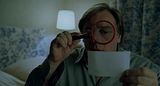
Adapted from Dostoyevsky's short story, A Gentle Woman, Robert Bresson's first feature film in color, is as elusive as the title character's intentions. The film opens with the woman's suicide by jumping off her apartment. It's a suicide scene that is uncharacteristically filmed --- a sudden noise from the balcony erupts the serenely lighted apartment room, Bresson then cuts to the exterior, the woman lands violently while her white scarf floats in what may seem like a peaceful release. The rest of the film evokes the total opposite of the suicide: dark, trapped, and suffocating.

Dominique Sanda plays the woman. Her skin is pale and her gentle facial features resemble an delicate marble statue, worthy of admiration and idolatry. A pawnbroker (Guy Frangin) does exactly that. When she was living, the pawnbroker takes an attraction upon first sight. Impoverished, the woman pawns her crucifix. The pawnbroker takes the golden cross and offers back the statue of Christ, and paying the woman more money than what the golden cross is worth. Unaffected by the pawnbroker's expectant generosity, the woman gives back the excess of what the golden cross is worth. Undaunted, the pawnbroker offers something more: a life of happiness where the poverty she has lived through will never happen again. The two marry and try to live off a loveless relationship. Outwardly normal, the two challenge each other in bouts of jealousy and struggles for control.

Even at death, the woman is subject of adoration. The pawnbroker recalling their relationship to his elderly maid Anna (Jeanne Lobre) surrounds the body of the woman in pious reverence. The pawnbroker walks around the still beautiful corpse, trying to objectively determine the cause for the woman's emotional demise. He does point out several instances where an obvious emotional void is present --- the woman purposely puts herself in a position wherein the pawnbroker would catch her and consume himself of an unbated jealousy. Yet there are no outward signs of hatred or marital discord. Everything is shown in quiet touches and gestures that dictate a deeply rooted source of marital dysfunction.

It's a questionable salvation, the woman's suicide. But in Bresson's mind, it perhaps may be a valid release from the earthly pains of a loveless relationship. One may argue that a more rational resolution for the woman's dissatisfaction is a legal divorce or an informal separation. In my opinion, the release or salvation that is sought here should elicit permanence. In Bresson's claustrophobic portrayal of a dead end relationship where the beginning is already met with a misunderstanding of the primaries of a smooth marital relationship, the woman's choice of release seems appropriately (although questionable in terms of morality and social acceptability) realized. The woman's face upon death evokes a quiet peace that cannot be found when she was living. During her lifetime, her eyes contain a fiery and purposeful force that antagonizes her gentle outwardly ways. In her death, she is truly an immobile idol, her soul released from an earthly prison that is also imprisoned in a marriage that is unevenly invoked. The pawnbroker pleads for the woman to open her eyes for at least a second, praying to the idol for a momentary miracle that can never happen. Why succumb to a second of human conflict when the soul has already reached pacification?

Sunday, August 06, 2006

Medea (1969)


Medea (Pier Paolo Pasolini, 1969)

Pier Paolo Pasolini's adaptation of the tale of Greek mythological sorceress Medea starts with Jason growing up under the guidance of a centaur. Pasolini unbears his themes right there in the beginning. Jason, as an infant, listens to the half man, half horse telling his fate, his Greek genealogy, and then just discards everything as boring banter. Jason grows up and the centaur looks much more normal, a talkative sage instead of a mystic mythological humanoid. He prepares the adult Jason (Giuseppe Gentile) to face his quest and regain his throne from his usurping uncle. The uncle then sends him to retrieve the magical golden fleece from a foreign land after which the uncle would freely give up the kingdom to the returning heir.

Medea (Maria Callas) is a priestess in a foreign land. She helps Jason retrieve the golden fleece and runs off with him, falling in love with the brute Greek, and bearing him two children. Jason leaves the foreign priestess to marry the daughter of the King of Corinth. Medea, passionate and vengeful, offers her priestly robes, causing the Corinthian princess to burn. As a final act of vengeance to Jason, she murders his two children. Pasolini does not stray far from the age old tale, but completely revamps the mythological aspects, choosing a setting more archaelogically, or at least anthropologically accurate, or creative, and setting his Marxist principles at work.

A Greek tale is almost impossible without the accompanying tinge of mysticism, of a reliance to the machinations of the elemental gods that duly guide the Greek heroes and villains to their respective places in history. Pasolini throws everything out the window. Mysticism is transformed into ritualistic processes, and the dieties' presence merely bestowed from Pasolini's cinematographer Ennio Guarnieri's clever use of natural lighting in invoking the divine and the otherworldly. Pasolini wraps the film with an atmosphere of earthliness, despite the fact that the tale is that of myth and of gods. Chants, rhythmic drumbeats, or Japanese songs accompanied by string instrument strummings complete the anthropological notion of the multi-racial world of the Mediterranean. Nothing magical ever happens, nor gods never materialize in the human world. The only instances of mysticism happen when Jason is an infant, and a toddler and sees his mentor as half-man and half-horse, and when Medea, plotting his revenge, cooks up her plan in the only way she knows how, as a priestess receiving divine intervention from the sun, and her vengeance culminating in a magical fiery demise of the king and the princess.

Intead, Pasolini's thrust is provided by human instincts. The vengeance does not end with the magical robe burning both princess and king, but with the princess ending her life in sorrowful anguish, and the king following as an endnote to all suffering. There is still a sense of ceremonial respect, with the infanticide happening as a ritual, instead of a passionate act of insanity. Medea calling her children, one by one, to take a bath, and sleep, and she then stabs them with an intricately designed dagger, and sending them to their silent deaths. It's deeper that way, and paints a portrait of a woman lost in a world whose gods are logic, ritual and rationality.

Medea is a tragic figure: a woman plucked from a society whose reliance on magic keeps her needed and worthy and then transported to a society that has rightfully forgotten its ancient, primitive traditions in the guise of human progress, and finally forgotten by the man who she has given everything up for. Pasolini draws the line and alludes ancient Greece to present society: a society of progress where religion and the reliance to the divine is of no use. The tragedy of Medea being the tragedy of the everyman whose reliance to faith and religion is as pathetic as the sorceress unable to grasp progress.