Showing posts with label Pier Paolo Pasolini. Show all posts

Monday, August 21, 2006

The Decameron (1971)


The Decameron (Pier Paolo Pasolini, 1971)

The Decameron is Pier Paolo Pasolini's first film in his Trilogy of Life, a trilogy of cinematic adaptations of classic collections of stories. Pasolini's adaptation of Boccaccio's collection of stories forgoes of the entire framing of the stories within the context of a group of men and women huddled up in a villa while the rest of Italy is dying from the plague. Instead, Pasolini merely glances upon such historical context (we get glimpses of people suddenly dying without any logical reason why, and corpses abound this film), and instead cooks up his Italian setting as forever sunny, beautiful, and green --- entirely ripe for friendliness turning into treachery, piety into debauchery, sinners into saint, love into lust, and vice versa.

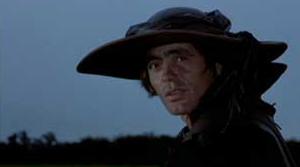
The film starts with Ciappelletto (Franco Citti) bludgeoning a man inside a sack to death, and then drags the corpse and disposes it into the pit. We later learn that Ciappelletto is a hired thug who is used by usurers to force loan payments out of the people, usually with violence. His tale ends with him being sanctified by the high priest for confessing what might seem to be sins of innocence. Then there's the tale of an unfortunate young man whose riches are stolen by a beautiful swindler, and is later on trapped inside an archbishop's tomb, while trying to steal a ruby ring from the adorned corpse. In Pasolini's adaptation of Boccaccio's work, there is no permanence in fortune, or in virtue.

The film also mirrors two portraits of love, differentiated by class. The first one concerns two young lovers who finally meet in the girl's terrace, and make love, only to be discovered by the father who surprisingly acknowledges the two young lovers and blesses them, as long as the rich man marries his daughter. The second one has almost exactly the same plot, but instead of a rich man, we have a laborer who is in love with a girl of higher standing. The girl's brothers discover the laborer's love for the girl and murders him. Two similar stories of youthful romance only differentiated by social class, the results are as different as night and day. Pasolini's Marxist leanings are at work here.

Pasolini himself acts in his film, as a painter commissioned to paint the walls of a cathedral. He goes around town and discerns the faces of the townspeople, looking for inspiration for his tremendous work. In the final stages of his project, he dreams of divinity, where the Virgin Mary is in the center, with a host of angels beside her, and beneath her are the mortals forced into work and debauchery. It is curious to note that in Pasolini's next film, The Canterbury Tales (1972), he would imagine hell, and in Arabian Nights (1974), cook up both paradise and hell in Earth through magic, mysticism, and a cycle of tales. The film ends with the painter celebrating his work but finishes with a line that suggests that the process of dreaming while working is better than the final artwork.

Later on, Pasolini would disavow his Trilogy of Life as his least favorite works mainly because these are pedestrian fare, where commercial success is the result of an abundance of flesh and sex rather than artistry. I'd like to think that Pasolini disavowed the trilogy merely because the process of making them was tremendous in his part, and the success that ensued was not commensurate to his artistic processes, and the commercialization of these films turned them into moneymaking schemes instead of actual artistic products. I disagree, these films are from the first scene of a man violently bludgeoning a debtor trapped in a sack to death, to a young man being reunited with his beloved slave inside a golden palace, are all magnificent works of cinema and in their entirety, a joyful experience to behold.

The Canterbury Tales (1972)


The Canterbury Tales (Pier Paolo Pasolini, 1972)
Italian Title: I Racconti di Canterbury

The Canterbury Tales, Pier Paolo Pasolini's middle entry to his Trilogy of Life (also consisting of cinematic adaptations of The Decameron (1971) and Arabian Nights (1974)) won the Golden Bear, the top prize in the prestigious Berlin Film Festival. Obviously, it is an adaptation of Geoffrey Chaucer's beloved collection of tales as told by different travelers who are in a pilgrimege to the English town of Canterbury. Chaucer's work is supposedly telling of morality in both serious and humorous ways, but Pasolini decides to withdraw from Christian morality and use the tales as fervent attacks on religious institutions. Pasolini's The Canterbury Tales may very well be deemed blasphemous as religious symbols are pitted against acts of amorality, where holy men are shown as greedy, where the only language understood is that of sexual appetite and avarice. Yet, despite Pasolini's strategy of overblowing the more libidous aspects of Chaucer's tale, the adaptation remains to be faithful, which is quite a feat.

The Canterbury Tales may be the most pedestrian of Pasolini's films. Humor is mostly achieved through unsavory methods, and Pasolini does not shy away in graphically detailing his comedy. We are forced witnesses of several pissing, farting, adulterous sexual acts, and much much more. Yet, despite Pasolini's questionable methods, the film still feels grounded and does not let its boisterous values to drown its storytelling roots. Moreover, the film does give a certain notion that Hollywood does not have a patent as to making use of farts, piss, and other bathroom matters as sources for cinematic humor, Pasolini was way ahead, and did it much better.

What The Canterbury Tales lacks is a form or structure. Although Pasolini tries to provide for a logical continuation of the tales, by beginning the film with a tavern encounter, and showing little glimpses of Geoffrey Chaucer (played by Pasolini) working on the compilation, most of the tales are randomly stringed together without a clue or a guess how they are supposedly linked. It's probably Pasolini making use of the literary source's given popularity that he decided to forgo of formalities and just see the tales cinematically told in whatever manner. The randomness somewhat works, but Pasolini showed how good a storyteller he can be with Arabian Nights were the tales flawlessly spring forth like infants from other tales. Here, the storytelling is erstwhile interesting, but mostly dull.

While the film as a whole is good, the parts are of various quality. "The Cook's Tale" turns into an annoying Chaplinesque slapstick comedy with one of Pasolini's frequent actor prancing around town with a bowler's hat and a stick, inviting trouble all around, and ending his fate while atrociously chanting in a very annoying manner. "The Miller's Tale" is deliriously obscene. The last tale is visually and nightmarishly inventive, with friars being farted out of Satan's red buttocks in outright comedic fashion.

The Canterbury Tales is one of those films you'd either love or hate. I'm one of those who thought that it's brave filmmaking, that Pasolini's irreverent rendition of Chaucer's tales of piety and morals is not done out of bad taste but with a primal passion for portraying man as creatures of desire, and desires as weapons for violence and trickery. Others hated it, and I really can't blame them. The literary source is a revered tradition, taught in different schools from around the world, and is considered as England's most important contribution in world literature. That its cinematic adaptation is this raunchy, oftentimes obscene, and even rather plainly photographed feature is a mighty hard stab to the enriched tradition of Chaucer's work.

Sunday, August 20, 2006

Arabian Nights (1974)


Arabian Nights (Pier Paolo Pasolini, 1974)
Italian Title: Il fiore delle mille e una notte

Arabian Nights is Pier Paolo Pasolini's final entry to his Trilogy of Life, consisting of filmed adaptations of classic literature, The Decameron (1971) and The Canterbury Tales (1972). The films in the trilogy are supposedly Pasolini's least political films, whose main intent is to straightforwardly tell the stories in the film medium without any social or political fuss. The trilogy also shows Pasolini in his most sensual, where his gift for poetry does not merely exist in the beauty of words but in lush colors, exotic locales, and sexual charge. It is said that Arabian Nights is the laurel in the trilogy, as it is the most beautiful and most lyrical of the films. I'd have to agree, Arabian Nights is a towering achievement in storytelling.

The film starts with a young boy purchasing a slave, but eventually falls in love with the slave he bought. The girl is kidnapped and finds herself in a kingdom where she is proclaimed king. The boy then travels all over looking for the girl, and on his way, meets different personalities with different tales. Arabian Nights does not use the literary source's means of telling the story, wherein a princess is tasked to tell stories for a number of nights. Instead, Pasolini celebrates the vibrancy of life by infusing the primary tale with the ability to give birth to different tales. The primary tale gives way to a tale, and a character from that tale, gives way to another tale, and so on, and in the end, everything wraps up beautifully and one gets a dreamy feeling of satisfaction one usually arrives at as a child.

However, Arabian Nights is nowhere near a children's story. It is in fact very graphic in its portrayals of the chosen entries of the literary source. Instead of repeating the stories of Aladdin or Ali Baba, Pasolini chooses the more sexually charged entries and depicts them with a candidness that makes the scenes both unusually magical despite the rawness of the topic. Yet again, Pasolini strays away from magic and religion. Although some of the tales do involve a certain element of mysticism (a demon flying and turning a curious human into a monkey, a metal-plated night being destroyed by a young man who follows a whispered prophecy), such is kept to a minimum and is balanced by a healthy dose of accurate anthropology and cultural diversity Pasolini mastered in the two films (Medea (1969) and Oedipus Rex (1967)) before the trilogy of life. Arabian Nights is delightfully accurate, with Pasolini not limiting his settings to Arabic palaces, deserts, but goes to far-off places like Nepal or Africa, where most of the original tales of the literary source were set.

Arabian Nights is truly a celebration of life for Pasolini. To a certain extent, I can probably declare this as Pasolini's accurate portrayal of his wet dream. The storytelling is vibrant and his visuals are full of bright colors. His characters are young and robust. The boys are laidback and inutile, lazy and oftentimes mainly instructed by hormones instead of intellect. The females are cunning and sly, some are virtuous and some are flirts. When the characters collide, one can easily predict that they will copulate, or at least engage in violent combat. Pasolini does not make room for his usual political discourse, but instead lets the images and the scenery depict his humanity. No wonder Pasolini decided to end his Trilogy of Life with this, a gorgeous and appetizing orgy of man's innate nature to tell stories.

Thursday, August 10, 2006

Oedipus Rex (1967)


Oedipus Rex (Pier Paolo Pasolini, 1967)
Italian Title: Edipo re

Oedipus Rex is arguably Pier Paolo Pasolini's most autobiographical film, as he admitted having a longing for his mother, and adversity against his father. For those who take the psychoanalytic theory creatively named after the Greek tragedy seriously, the film may very well be as biographical to them as it was for Pasolini. The film is a straightforward adaptation of Sophocles' play, with a few added Pasolini touches for creative and artistic sake. Gone are the traditionally Greek-inspired costumes, replaced by African masks, less boisterous props, and a setting where the sun bakes the land unforgivingly. Pasolini's curiosity for cultural diversity and anthropological detail would not have reached its heights until Medea (1969).

Franco Citti plays the Greek tragic figure, who was ordered killed by his blue-blooded parents in the fear of the prophecy of the son killing his parents coming true. However, the baby survives and is adopted by the king of Corinth until he turns into an adult, and is hounded by a recurring dream for which he would try to seek answers from the Oracle. The Oracle basically repeats the prophecy: that he will kill his father and he will make love with his mother.

Curiously, Pasolini bookends the adaptation of Sophocles' play with a prologue and an epilogue that is set in contemporary times. The prologue is basically a staging, or more accurately, a filming of the psychological concept in action: a young boy's adversity towards his father, a military officer, for taking his mother away and stealing his mother's affections from him. The prologue hasn't anything much to say. The filmmaking is standard Pasolini, straightforward and sometimes lingering to idle poetry. Yet, it doesn't work until the film shifts to primitive times, where emotions aren't dressed and protected with modern ideas of propriety and ethics.

The Oedipus Pasolini presents is no Greek hero, but more of a cheat, a primal specimen of the naked id. Once aware of the prophecy, it is the id which gains control (although, it always seems to be that case, the competitive Oedipus cheats in discus-throwing and makes a dastardly effort to prove himself). The highest point of Pasolini's psychotic Oedipus is when his pride was damaged by a traveling king (his father, but he doesn't know that yet). Like a coward, he runs to save his skin, but a mysterious force keeps on urging him to stop and fight it out, until finally, he reaches to his father's throat and slits it. Pasolini's filmmaking here is intense. He shoots against the light, with the swordfights usually blanketed by the sun's glare, an imagery gesturing a heated and uncontrolled impulse.

Oedipus' biological mother is played by Silvana Mangano, who is a welcome presence against Citti's lack of middle range in acting (he either screams and shrieks in anger or is comatose in unlively scenes). Mangano's Jocasta is regal, seductive, controlled, beautiful yet unmaternal. As a mother, she is uncaring and almost negligible but as a lover, she reminds me of a playful and less conniving Lady Macbeth. The incest is played matter-of-factly, I have this impression that Pasolini's talent is portraying sex as a fact of life, its emotional or moral implications furthered by what the audience knows of its backgrounds. Here, the sex is primitive, with Oedipus switching from son to lover in uneasy gestures and variations of kissing, finally withdrawing to the wishes of the id, to make love.

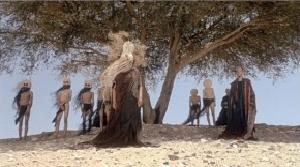
The film ends with the character of Oedipus being transported into contemporary times, blind and guided by a young boy. He plays his flute underneath two imposing figures: a Catholic cathedral, and then, an industrial factory. This might be Pasolini's Marxist philosophies at work - a push against faith, and a push forward to the everyman. I really don't know, as the film's ending is far too opaque for deliberation, and symbolisms like these are far too obvious and blatant that it will belittle my little liking of Pasolini's adaptation of Oedipus Rex.

Sunday, August 06, 2006

Medea (1969)


Medea (Pier Paolo Pasolini, 1969)

Pier Paolo Pasolini's adaptation of the tale of Greek mythological sorceress Medea starts with Jason growing up under the guidance of a centaur. Pasolini unbears his themes right there in the beginning. Jason, as an infant, listens to the half man, half horse telling his fate, his Greek genealogy, and then just discards everything as boring banter. Jason grows up and the centaur looks much more normal, a talkative sage instead of a mystic mythological humanoid. He prepares the adult Jason (Giuseppe Gentile) to face his quest and regain his throne from his usurping uncle. The uncle then sends him to retrieve the magical golden fleece from a foreign land after which the uncle would freely give up the kingdom to the returning heir.

Medea (Maria Callas) is a priestess in a foreign land. She helps Jason retrieve the golden fleece and runs off with him, falling in love with the brute Greek, and bearing him two children. Jason leaves the foreign priestess to marry the daughter of the King of Corinth. Medea, passionate and vengeful, offers her priestly robes, causing the Corinthian princess to burn. As a final act of vengeance to Jason, she murders his two children. Pasolini does not stray far from the age old tale, but completely revamps the mythological aspects, choosing a setting more archaelogically, or at least anthropologically accurate, or creative, and setting his Marxist principles at work.

A Greek tale is almost impossible without the accompanying tinge of mysticism, of a reliance to the machinations of the elemental gods that duly guide the Greek heroes and villains to their respective places in history. Pasolini throws everything out the window. Mysticism is transformed into ritualistic processes, and the dieties' presence merely bestowed from Pasolini's cinematographer Ennio Guarnieri's clever use of natural lighting in invoking the divine and the otherworldly. Pasolini wraps the film with an atmosphere of earthliness, despite the fact that the tale is that of myth and of gods. Chants, rhythmic drumbeats, or Japanese songs accompanied by string instrument strummings complete the anthropological notion of the multi-racial world of the Mediterranean. Nothing magical ever happens, nor gods never materialize in the human world. The only instances of mysticism happen when Jason is an infant, and a toddler and sees his mentor as half-man and half-horse, and when Medea, plotting his revenge, cooks up her plan in the only way she knows how, as a priestess receiving divine intervention from the sun, and her vengeance culminating in a magical fiery demise of the king and the princess.

Intead, Pasolini's thrust is provided by human instincts. The vengeance does not end with the magical robe burning both princess and king, but with the princess ending her life in sorrowful anguish, and the king following as an endnote to all suffering. There is still a sense of ceremonial respect, with the infanticide happening as a ritual, instead of a passionate act of insanity. Medea calling her children, one by one, to take a bath, and sleep, and she then stabs them with an intricately designed dagger, and sending them to their silent deaths. It's deeper that way, and paints a portrait of a woman lost in a world whose gods are logic, ritual and rationality.

Medea is a tragic figure: a woman plucked from a society whose reliance on magic keeps her needed and worthy and then transported to a society that has rightfully forgotten its ancient, primitive traditions in the guise of human progress, and finally forgotten by the man who she has given everything up for. Pasolini draws the line and alludes ancient Greece to present society: a society of progress where religion and the reliance to the divine is of no use. The tragedy of Medea being the tragedy of the everyman whose reliance to faith and religion is as pathetic as the sorceress unable to grasp progress.