Showing posts with label 1971 Films. Show all posts

Friday, November 15, 2013

Lilet (1971)


Gerardo de Leon's Lilet: Patriarchy as Nightmare

They know her. She doesn’t know them. Lilet (Celia Rodriguez) enters her family’s mansion with dread and suspicion. Each object is a trap. Each face is a mystery. A victim of severe amnesia, her only linkage to an obscured past is fear. Her mother (Paraluman) welcomes her with grave hesitation. Her grandmother (Tita Munoz), a striking woman despite her being constrained within a wheelchair, and her father (Vic Silayan), meet her with evident dismay. After a short reintroduction that evokes anonymity rather than delight, she is dismissed.

That night, she becomes a woman on the verge of insanity. She hears a familiar voice repeatedly calling out her name. A mysterious machine chugs, adding to the cacophony that seem to force demons out of her enclosed memories. A masked man with a pair of scissors suddenly appears to haunt her. She is unsafe in her own home. Screaming, she sprints away from the mansion, before a car nearly runs her over. Out of the car is her knight in shining armor, Edgar (Ronaldo Valdez), her doctor and savior from all the horrors that seem to debilitate her.

Gerardo de Leon’s Lilet is repetitive in the way it portrays its titular character as a woman on the edge, desperately clinging on the remaining shreds of lucidity while everything around her pushes her to insanity. De Leon, a medical doctor prior to becoming a director, shows a very astute understanding of mental suffering. While he exploits Rodriguez’s peculiar features when in the state of shock to visualize shock, he nevertheless utilizes logic in injecting fear into his disturbed protagonist.

The film, surprisingly produced by businessman-turned-evangelizer Mike Velarde, is astoundingly vivid in its depiction of mental torture. Set mostly within the mansion that takes the form of a cage gilded by expensive but overwhelming trappings, the film is greatly reliant on De Leon’s ability to visualize terror. He maps Lilet’s descent to madness with clarity, creating ominousness out of ordinary everyday things and noises.

Beneath Lilet’s gothic surface however is something more disturbing. Lilet is after all a film about women who despite familial ties are all too willing to inflict mental torture on fellow women all in the name of love. The love that is the center of the film’s depravity is in fact even more depraved. De Leon paints the incest that happens so often within the mansion with a certain flair that makes it even more terrifying than the triggers that force Lilet to hysterics. Subtle gestures grow into devastating revelations, exposing a very rotten core that may not be endemic to Lilet’s melodramatic family.

Although Silayan’s father figure is pathetic, the bare fact that he is the sole man in the mansion forces all the women in the household to fight for his attention. His mother lusts for him. His wife begs for his forgiveness. His daughter struggles for his attention. Every other man is competition, whether it is his son or the doctor who sways Lilet’s attention from him. Patriarchy is the original sin here. The rest are just projections of a horrifically skewed perception of a societal wrong. With Lilet, De Leon has woven a nightmare straight out of reality.

(First published in Rappler.)

Tuesday, October 20, 2009

Pagdating sa Dulo (1971)


Pagdating sa Dulo (Ishmael Bernal, 1971)
English Title: At the Top

In Guru Dutt’s Kaagaz Ke Phool (Paper Flowers, 1959), a film director, played with piercing sensitivity by Dutt, sees his career flounder as the career of his muse, a beggar he discovers while shooting a scene in his adaptation of Devdas and subsequently grooms to become a very successful actress, blossoms. The painful downfall of the director who at one time was celebrated by crowds of adoring fans after a very successful run of one of his films and at a later time is seen alone, walking the paved ways of his former studio in tattered rags, unrecognizable by his friends and peers, destroys the very core of these double lives that are forced to exist to suit the inflicted fantasies of working in cinema notwithstanding the need to endure the realities of living. Amidst the several musical interludes, the film lyrically reflects on the gargantuan gap that separates the facile glamour of the silver screen and the material, spiritual and emotional poverty of everything else.

Ishmael Bernal’s Pagdating sa Dulo (At the Top) ends with a striking sequence that consummates the hypocrisy that was portrayed in the carnivalesque affairs of the film. Ching (Rita Gomez), scandalously tipsy after a day of lonesome drinking, and Pinggoy (Vic Vargas), who attempts to salvage Ching from further embarrassing herself in public, see a mob of adoring fans, separated from their fantasy world by a metal gate and obviously oblivious to the excesses of their fleeting limelight. Their faces transform. The once self-absorbed alcohol-glazed gestures of Ching and the guarded yet clearly affectionate concern of Pinggoy suddenly breaking to give way to faces jolted by a sudden but timely awareness, of how far they have gone up and how far they have fallen. As with Dutt’s immortal masterpiece, Bernal, by mapping an actress’ deliberate and painful rise to the top, reflects on the disconnect between the realities of life and the quasi-realities of cinema that debilitates the men and women who chose to indulge in its promising allures.

The film opens with Ching, then a stripper, performing to the lustful stares of her patrons. She arrives home, slowly climbing the stairs, with every step turning into a gargantuan struggle as she carries herself and all her life’s worries up to her room. There, she breaks into a silent yet tearful soliloquy until Pinggoy arrives, attempting to woo her into bed only to be rebuked. Bernal finally breaks the several minutes of quiet yet persuasive storytelling with the first of the many arguments between the eternally incongruous lovers, with Ching’s vocal frankness overpowering Pinggoy’s contained machismo, to the point of the latter attempting to wrestle Ching’s dominance with violence, only to end in conciliation and lovemaking. In that initial sequence, Bernal adequately summarizes Ching and Pinggoy’s relationship. By portraying with painstaking detail the overbearing imperfections of their life together, characterized by the graveness of Ching’s discontent with her current state in life as afflicted by Pinggoy’s paralyzing satisfaction over his existence as a cab driver, Bernal sets the stage not only for the couple’s surprising reversal of fortune, initiated first by Ching’s discovery by an idealistic film director (Eddie Garcia), and later on, the forced entry of Pinggoy to showbusiness (he figuratively and literally penetrates his way to fame and fortune), but also the accompanying transformation of their less than ideal but honest union into a publicized and sensationalized sham.

Pagdating sa Dulo is an impressive first feature. It confirms Bernal, very early in his career as a filmmaker, as a director who fully comprehends the value of the moving image. There are very impressively directed sequences, perfectly composed with every minute gesture or piercing gaze from the actors timed and orchestrated to evoke a subtle sensibility that is all at once strange and fascinating. The opening sequence, with its several minutes of quiet assuredness that unpredictably erupts in domestic cacophony, arrests in the way it portrays the couple’s weariness of their meager existence. Nearing the film’s conclusion, Bernal revisits the pensive mood of the opening sequence in the gorgeously shot sequence right before the film’s culminating summation, only this time with the two lovers in the heat of their careers yet suffering from a different malady, one that is caused by the callousness of the professions chosen for them by fate. The intoxicated air slows seems to slow down the sequence, which is further elaborated by the film’s recurring musical scoring. Ching, wearing a glamorous gown yet clearly under the influence of alcohol, flutters down the stairs as Pinggoy climbs up to fetch his former lover and current onscreen partner. You wait, even wish for an emotional outburst, a torrid embrace, a crazed kiss, even an exchange of harsh insults, yet nothing happens. The silence unsettles.

The director, presumably patterned by Bernal after legendary filmmaker Lamberto Avellana (director of well-regarded films like Anak Dalita (The Ruins, 1956), Badjao (1957) and Kundiman ng Lahi (Song of the Race, 1959)), becomes Bernal’s mouthpiece for his aches and hopes for Philippine cinema. Bernal has made startlingly accurate observations, pertinent up to this day. The dichotomy in Philippine cinema, as characterized by two existing and seemingly irreconcilable halves that form it (one half is a capitalist creature, more interested in profit-making than culture-creation; the other half is the problematic so-called independent film scene, where most of the interesting works hail from but is largely ignored by the populace), becomes the wellspring of his woes and frustrations. Kalapati, the film he made with Ching as lead actress, is a flop at the box office, to the ire of his producer, which will eventually lead to his voluntary decision to dedicate himself to making artful yet unseen documentaries. The director represents the consummate Filipino artist who is unfairly pushed outside the expanding bubble of public consciousness despite a veritable grasp in his artistry simply because integrity is not bankable. One of Bernal's most understated tragic figures, the director persists despite living a life of unfulfilled ambitions: his marriage is a failure, his film that sought to marry truth and cinema is a failure, his unpronounced affection for Ching is also a failure.

Pagdating sa Dulo opens with Ching exploited by the several men who paid money to see her dance and strip. It ends with Ching similarly exploited by her adoring audience who await the screening of her movie, a titillating feature that promises only to sexually arouse. At the top, everything is the same except that their sacrifices are bigger, their risks are greater, and the money and fame they reap only entrench them deeper into the system, changing them completely. It's a tremendous film; probably ranks right up there with Dutt's Kaagaz Ke Phool as one of the best films about filmmaking ever made.

Wednesday, January 09, 2008

Women in Cages (1971)


Women in Cages (Gerardo de Leon, 1971)

Women in Cages, made for Roger Corman and Cirio Santiago’s production outfit, seems to be an unremarkable entrant to the women-in-prison subgenre. Standing alongside Jack Hill’s The Big Doll House (1971) or Jonathan Demme’s Caged Heat (1974), the film looks like a paltry offering, a mere by-the-numbers redoing of the formulaic scenario. However, beneath the unflattering production values and the very stylized visual theme is a film that is much more than an addition to the infamous subgenre of women in prison films. Women in Cages is a bleak and truly suffocating look at women’s descent to physical, mental, emotional and spiritual imprisonment.

The difficult proposition of raising Women in Cages above the confines of surface-level thrills and excitement is bolstered by the film’s final shot, its thematic coup de grace. We are given a close-up of a woman’s face, drenched with icy sweat, her lips shivering while her partner starts to make his sexual advances. It shows desolation in full unflinching view, an unguarded summation of the subgenre’s intended or unintended thesis. That final scene where the frame encages the feverish yet still beautiful face with her eyes revealing a half-awaken daze, presumably caused by the numbing effects of the drugs she takes but in reality represents everything that binds her body, mind, and soul, sums up the film where women are perpetually encaged.

Apparently, screenwriters David Osterhout and James Watkin would recycle the tired tale of innocent suspects being convicted, imprisoned, and eventually terrorized out of their sanity. It begins with a package being passed on from the passengers of the Zulu Queen, a mysterious ship which hosts a well-kept bordello, to a drug lord lounging with his girlfriend Jeff in a cockpit. Upon being signaled by his underlings of the arrival of the police, the drug lord switches the package to his girlfriend Jeff. The package turns out to contain prohibited drugs, and Jeff, overly naive and agreeable, lands in jail. Women in Cages basically tells her story, her initial interactions with her cell mates and the impossibly difficult prison matron, and her attempt to escape the penitentiary.

Jeff, (Jennifer Gan) is easy to regard as a stupid and infantile girl. Hopeful that her felonious boyfriend will bail her out, absentmindedly swims in a confused ecstasy of a non-existent romance, ignorantly grounding her survival to the person who caused her imprisonment. It’s easy to condemn the character as unrealistically too simpleminded, yet we have to understand that she is new to the terrifying circumstance. Unlike her cellmates, it is still possible to comprehend hope in her character. Probably one of the most disturbing scenes in the film is when Jeff is unjustly punished by trapping her inside a dark chasm where out of sheer hopelessness, she starts reciting children’s limericks. We literally witness all her innocence and hope deteriorate as she is further castigated, later on disclosing a woman permanently changed and scarred.

Although Jeff is the primary concern of the narrative, the film also details the misfortunes of other jailbirds of the aptly named women’s penitentiary “Carcel del Infierno.” These are all women who have suffered longer than Jeff, already hardened and turned callous by the inhumane conditions within the prison. Sandy (Judy Brown), a battered wife, was imprisoned for murdering her husband. She has developed a relationship with the police officer who is tasked with tracking down evidence to finally pin down Jeff’s boyfriend. Stoke (Roberta Collins), the girl in the aforementioned final scene, is in the prison for untold reasons. One would guess that it is due to her insufferable dependence on drugs as we first see her lying in bed, her face sparkling with cold sweat, and clearly thinking of other things other than the arrival of newcomer Jeff. She is then lured with drugs into killing Jeff by the drug traders before Jeff snaps and becomes witness against her boyfriend. These two women have ulterior motives for befriending Jeff. Both of them prisoners of their respective vices: Sandy with her incessant need for love in the person of the police chief, and Stoke with her undying itch for drugs.

Teresa (Sofia Moran, curiously uncredited despite her noteworthy performance) is the statuesque Filipina beauty who relishes in her uncomfortable relationship with prison matron Alabama (Pam Grier). She drowns in a sea of contradicting emotions, of lust and love, hatred and passion, physical imprisonment and emotional torture, all dealt upon by her one-way emotional attachment to Alabama. Alabama, on the other hand, has no room for affection having attained a status wherein she could deal to other people the suffering that she has experienced growing up. Her one motivation in life, the one stimulus that delights her, is the satisfaction of her twisted sense of retribution, not against those who have maltreated her, but against anybody she has ascendancy on. The chemistry between Teresa and Alabama is sublime, to say the least. Both are dependent females who are predicated by their respective races: Teresa is the lone Filipino in her cell (she doesn’t really fit in with her Caucasian cell mates nor the rest of the other Filipino prisoners) while Alabama laments on her sufferings as a black girl living in the ghetto. However, they are separated by their disparate needs: Teresa is longing for genuine attention and romantic companionship while Alabama merely sexual satisfaction dealt upon by her higher status. The duo’s comeuppance feels like one of the film’s campiest moments. Deep in the wilderness, Teresa comes back from safety only to violently ravage an entangled Alabama, supposedly out of spite and vengeance, only to be invaded by passion and suddenly kisses and fondles her with what seems like gripping reminiscence of a relationship and an equality that never happened. Their stubborn desires prove to be their downfall as both of them are caught, raped and killed by the marauders. It turns out that their respective fantasies of romance and dominance are quite insignificant in the face of men.

Women in Cages is significantly improved by those little details and clever touches that embellish the bland and unoriginal story. Rather than merely telling the story by going from point A to point B and adding a number of scenes with gratuitous nudity, filmmaker Gerardo de Leon infuses both depth and a distinct and effective visual style to the film, probably to the disdain of those looking for cheap thrills. Observe the ominous crimson tinge that paints Alabama’s pleasure cell. It clearly spells out a warning for fatal danger yet at the same time is tempting. Her underground dungeon offers a bevy of Gothic-inspired contraptions designed to inflict the most perverted of tortures. De Leon truly has an indubitable eye for color, compelling blocking and intuitive editing as the film, despite its limited budget and several flaws, succeeds in looking and feeling more than some cheap and one-dimensional B-movie.

In the end, we have a film that is harsh, much harsher than the typical entrants to the infamous sub-genre. Instead of focusing on the triumph against adversity and the success of escape, the film details the horrible transformations, the irreparable wounds and lesions, the vicious cycle of violence and evil that are the major points of the film’s unpalatable thesis. The scenes that purport happiness and joy, like Sandy’s reuniting with her police officer or Jeff’s daring rescue aboard the Zulu Queen are merely fleeting moments, forgettable instances that can never take us away from the film’s overbearing despair. You forget the sunlight, the smiles, the well-bred breasts, the pretty women that carry them, and of course, freedom. All that is eventually left with us are the anguish, the agony, the different afflictions and vices that imprison the women, cruel Alabama and her torturous affair with Teresa, and of course, the indurated face of Stoke signaling “The End.”

Thursday, November 30, 2006

Just Before Nightfall (1971)


Just Before Nightfall (Claude Chabrol, 1971)
French Title: Juste avant la nuit

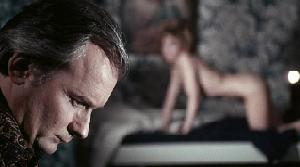
It was exactly like a dream, an erotic one. Advertising executive Charles Masson (Michel Bouquet) sitting and pondering with a naked blond woman inviting him to bed "Come and play... or I'll make you pay." The woman successfully seduces Charles to bed wherein they exchange sexual advances. The woman is Laura (Anna Douking), the wife of Charles' best friend Francois (François Périer). Charles is also married to Helene (Stéphane Audran) and has two children with her. We didn't know such complexities of that sexually tense initial encounter when we see it; the same way we didn't know that the encounter will end with Charles putting his hands upon Laura's neck; successfully killing her. The dream has turned into a nightmare, a nightmare that will haunt Charles.

Just Before Nightfall may be informally divided into two halves. The first half concerns Charles' efforts in evading the moral dissolve post-murder. Guilt will slowly grip Charles' psyche as a sense of safety from punishment is assured. Just minutes after the murder, he enters a bar to drown his stress and guilt. Although the murder might still be undiscovered, Charles acts as if he's already hunted --- he vomits minutes after in a sense of trying to withdraw the initial shock of his actions. Thereafter, he wears sunglasses inside the common darkness of a Parisian pub. Coincidentally, Laura's husband Francois is also there; sees the person beneath the sunglasses; invites him to a drink and a ride home (despite Charles' upper middle class stature in French society, he denies himself the luxury of having his own transport). He goes home to his family and struggles to contain his knowledge through the night. The morning papers brought the news; that Laura has been murdered. The formalities of death involves Charles and his family since Francois is a dear friend. Despite all the possible linkages of Charles to Laura's death, a connection is proven impossible and it seems that Charles has escaped criminal justice.

The second half involves the shift from evasion from justice to evasion from the corruption of knowing that one has committed a moral wrong and has successfully evaded its societal consequences. A late night nervous breakdown forces Charles to a vacation wherein he tells his wife the entire story. The remarkable twist here is that while we witness Charles deteriorate with guilt, the focal murder is exposed to be merely accidental and not an act of moral depravity; a mere aftereffect of an act of sexual perversion. It's a point of rationalization for his wife to maintain the status quo, a fulcrum in Charles' determination of his moral dilemma (he suddenly feels that he might've wanted to kill Laura; just to logically explain his guilt), a sudden shift for the audience to rethink Charles' methods.

Charles' revelation proves to be merely a temporary cure to his moral dissolve; he suddenly holds affinity to criminals (an accountant at work swindles money from the company coffers to escape with his mistress --- this sideplot is a further complication to the natural occurrence of guilt and how it is almost an act of fate that gestures will often bring a criminal to justice); his revelations (later to his friend) result in complacency (not even forgiveness which should be preluded by an acknowledgment of the wrongdoing) which further deepens the moral scar that Charles harbors ever since the murder.

Just Before Nightfall is a carefully structured psychological drama. Claude Chabrol further dissects middle class society by placing one at the mercy of his guilt; that same guilt later places the people around him (his wife, his friend, probably his mother and children) in a test of moral ambiguity. Their reactions prove to be dissatisfying, at least to the perpetrator who has broken the lines of social class by pasting his mindset alongside that of the outcasts of civil society --- the criminals and the victims of a socially imposed moral structure. Is class structure, that innate reaction to protect the status quo (an always recurring question when Charles opts to bring himself to justice is: what will happen to the children; how will your mother react; what will happen to us?) a viable reason to separate from traditions of justice? Chabrol further blurs these questions by insensitively making the victim an active seducer, who might've called the tragedy to herself.

Sunday, October 08, 2006

Four Nights of a Dreamer (1971)


Four Nights of a Dreamer (Robert Bresson, 1971)
French Title: Quatre nuits d'un rêveur

After tackling Dostoyevsky with A Gentle Woman (1969), Robert Bresson follows it up with another adaptation of the Russian writer's work. Four Nights of a Dreamer has less of A Gentle Woman's mortal themes and dire scenarios, and instead Bresson creates his sarcastic, ironic romantic comedy (well, it's certainly not your typical comedy but the film is indeed funny). The plot is spread throughout four nights, as the title suggests, wherein a man finds and loses love.

The man is Jacques (Guillaume des Forêts), a painter who seems to have trouble finding love. He admits that he is never in love with women, but to an ideal woman. At one scene, he glances on a beautiful girl shopping and as she walks past, decides to stalk her until another beautiful woman passes his fancy, for which he changes targets. Jacques is definitely a dreamer and lives in a fantasy he has created for himself, and hasn't quite perfected. His loft is riddled with unfinished paintings, and whenever a visitor arrives, he hides them. It's as if Jacques is always trapped in a perpetual search for perfection and even in his art, he can't really achieve --- very similar to the way he discards a romantic attraction when another beautiful woman passes by. Being a dreamer, a person in an everlasting search for an unattainable ideal, Jacques ultimately is never in love. He finds the girl she is stalking to an older individual, and upon arriving home, he voice records a perfect scenario wherein that girls decides to just suddenly elope with him. He plays the recorded scenario over and over while he paints, capsulating him inside a dream that he has created himself.

One night, Jacques saves Marthe (Isabelle Weingarten) from suicide. Marthe is the exact opposite of Jacques, a woman who is bored to her wits and forces herself to fall in love with her mother's boarder (Maurice Monnoyer) just to get away. She is a dreamer herself as when the boarder moves to America, promising her that upon his return they'll get married, she wraps her entire existence on that dream that when she hears news that the boarder finally returned and she never got a word from him, she decides to just commit suicide. Yet unlike Jacques who insists on ideals, Marthe is grounded on reality and knows the hierarchy of life and fantasy.

It's an entirely humorous proposition by Bresson that Jacques falls in love with Marthe, who remains in love with her lover. Bresson interrupts possible moments of romance with what is typically suited for such scenes. One night wherein Jacques would finally uncover his love for Marthe, a cruise ship passes by and the sound of Brazilian musicians singing a lovers' tune would interrupt his endeavor. Every night, Bresson plays a cruel joke against the male dreamer and climaxes his clever satire when Jacques finally gets what he wants.

Jacques and Marthe walk as a couple when the boarder shows up, and calls Marthe. Typically, the sacrifices Jacques has already made would ensure Marthe's changed loyalties, but Bresson, in an ingenious attack against romanticism and lovers' dreams, insists on the illogical. Marthe walks towards the boarder and gives him a torrid kiss, returns to Jacques and pecks him a number of times and in a twist of human unpredictability, returns to boarder and walks away with him. Jacques is left a dreamer in search for that perfect ideal that may never arrive.

Wednesday, September 06, 2006

W.R.: Mysteries of the Organism (1971)


W.R.: Mysteries of the Organism (Dusan Makavejev, 1971)
Croatian Title: W.R. - Misterije organizma

There's so many unconnected things happening in Dusan Makavejev's W.R.: Mysteries of the Organism that the words confusing, sloppy, whimsical aren't far-fetched descriptions of the film. The film starts with a documentary on Wilhelm Reich (the W.R. in the title) that focuses on Reich's political and psychosexual theories that resulted to his incarceration and death. The bulk of the film however is a satiric narrative that somehow pokes fun at the restrictions of communism, the liberalities of democracy, and the cowardice of everything in between. In between scenes are snippets from an archived melodrama on Stalin's life, an interview with a glam gender-bender, several footages inside a mental hospital, and continuations of the documentary discussing Reich's work. The film is an utter hodgepodge: messy, unbearably tactless, yet fascinatingly insightful. I'd like to describe Makavejev's filmmaking as Godard without class, finesse and limitations.

The interconnections between the different scenes are tedious. Reich's teachings seem to mirror Makavejev's philosophy of sexual freedom, being ousted from politics. It's desirous that Makavejev begin the film with the documentary instead of plunging his audiences head on to a warped yet wondrous take on sexual politics within the sphere of realtime politics. Reich is described in the documentary as an odd fellow who escaped to America after being persecuted in his native land for his experiments. Yet even in America where freedom is supposedly the driving force of the great American dream, his experiments are considered far too communist or too eccentric and that eventually led to his demise. Reich's experiments feel like new age stuff, a mixed bag of sexual freedom, naturalism, and psychological hooplah that feels more pornographic and immoral, than medical.

More interesting is the narrative, a giddy satire that ends in a crass tragedy. Milena (Milena Dravic) has been espousing sexual freedom within the rigid communist society of Belgrade. She believes that sexual freedom is part and parcel of the beliefs and the philosophy of a socialist state. In a humor-filled scene, Milena starts preaching his beliefs in front of her crowded tenement when an old neighbor scoffs at her roommate who is again having sex with a stranger. Milena falls in love with a visiting ice skater (Ivica Vidovic), who misunderstands her sexual philosophy despite the fact that they are both communists. The narrative sparks in extreme satire when Milena achieves the orgasm she desires from the Russian ultra-communist, she is entreated to be beheaded and even without a body, she continues to preach sexual freedom and delights in the fact that her goals have been achieved: a true martyr of the sexual revolution she espouses, as she continues in liberating despite the fact that she is without the body for which to derive pleasure in liberation.

Makavejev's film has been described as revolutionary, and is even compared to Orson Welles' Citizen Kane. I disagree. Makavejev owes much to Godard and other experimental filmmakers and documentarians and nothing really new is contributed to filmmaking with this piece. It's insightful in its crassness and bluntness. Much of Makavejev's messages have become cryptic because of the fact that Soviet socialism has been declining and the scenario wherein Majavejev sets his preachings have become lost in history. It's still an interesting film, probably at par with Godard's more political works, than Welles.

Monday, August 21, 2006

The Decameron (1971)


The Decameron (Pier Paolo Pasolini, 1971)

The Decameron is Pier Paolo Pasolini's first film in his Trilogy of Life, a trilogy of cinematic adaptations of classic collections of stories. Pasolini's adaptation of Boccaccio's collection of stories forgoes of the entire framing of the stories within the context of a group of men and women huddled up in a villa while the rest of Italy is dying from the plague. Instead, Pasolini merely glances upon such historical context (we get glimpses of people suddenly dying without any logical reason why, and corpses abound this film), and instead cooks up his Italian setting as forever sunny, beautiful, and green --- entirely ripe for friendliness turning into treachery, piety into debauchery, sinners into saint, love into lust, and vice versa.

The film starts with Ciappelletto (Franco Citti) bludgeoning a man inside a sack to death, and then drags the corpse and disposes it into the pit. We later learn that Ciappelletto is a hired thug who is used by usurers to force loan payments out of the people, usually with violence. His tale ends with him being sanctified by the high priest for confessing what might seem to be sins of innocence. Then there's the tale of an unfortunate young man whose riches are stolen by a beautiful swindler, and is later on trapped inside an archbishop's tomb, while trying to steal a ruby ring from the adorned corpse. In Pasolini's adaptation of Boccaccio's work, there is no permanence in fortune, or in virtue.

The film also mirrors two portraits of love, differentiated by class. The first one concerns two young lovers who finally meet in the girl's terrace, and make love, only to be discovered by the father who surprisingly acknowledges the two young lovers and blesses them, as long as the rich man marries his daughter. The second one has almost exactly the same plot, but instead of a rich man, we have a laborer who is in love with a girl of higher standing. The girl's brothers discover the laborer's love for the girl and murders him. Two similar stories of youthful romance only differentiated by social class, the results are as different as night and day. Pasolini's Marxist leanings are at work here.

Pasolini himself acts in his film, as a painter commissioned to paint the walls of a cathedral. He goes around town and discerns the faces of the townspeople, looking for inspiration for his tremendous work. In the final stages of his project, he dreams of divinity, where the Virgin Mary is in the center, with a host of angels beside her, and beneath her are the mortals forced into work and debauchery. It is curious to note that in Pasolini's next film, The Canterbury Tales (1972), he would imagine hell, and in Arabian Nights (1974), cook up both paradise and hell in Earth through magic, mysticism, and a cycle of tales. The film ends with the painter celebrating his work but finishes with a line that suggests that the process of dreaming while working is better than the final artwork.

Later on, Pasolini would disavow his Trilogy of Life as his least favorite works mainly because these are pedestrian fare, where commercial success is the result of an abundance of flesh and sex rather than artistry. I'd like to think that Pasolini disavowed the trilogy merely because the process of making them was tremendous in his part, and the success that ensued was not commensurate to his artistic processes, and the commercialization of these films turned them into moneymaking schemes instead of actual artistic products. I disagree, these films are from the first scene of a man violently bludgeoning a debtor trapped in a sack to death, to a young man being reunited with his beloved slave inside a golden palace, are all magnificent works of cinema and in their entirety, a joyful experience to behold.