Showing posts with label Woody Allen. Show all posts

Sunday, April 01, 2007

Scoop (2006)


Scoop
(Woody Allen, 2006)

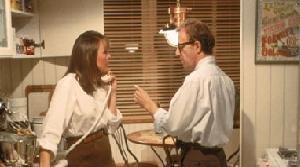
In a scene in Scoop, Woody Allen's character, neurotic magician Sid Waterman, tells Scarlett Johansson's character, journalism student Sondra Pransky, that his wife left him because he never grew up, never matured. Physically, Allen shows signs of maturity --- the white and grey hairs, the numerous wrinkles and his even more diminutive frame. Artistically, he seems to have stagnated; he never grew up and aside from the few surprising good works he's done in recent years, there's nothing really exciting, or defining as his past works like Annie Hall (1977) or The Purple Rose of Cairo (1985). Scoop is no different; it's drab, barely entertaining, and just a tad interesting.

It's a murder mystery set in London. It actually starts quite well: a famous Brit journalist (Ian McShane) has just died and while traversing the river to hell (heaven? hell no, with these journalist's vicious means of getting a scoop?), gets a reliable information from a fellow deceased that the son of a lord might be the dreaded Tarot Card Murderer. Death is no hindrance to the journalist to unravel a possible scoop, so he escapes death; contacts Sondra, the amateur journalist, while inside one of Sid's magic boxes and tells her everything he knows. Sondra, with the help of Sid, comes up with a plan to uncover the dark secrets of the suspected murderer Peter Lyman (Hugh Jackman).

Allen again inhabits his usual neurotic character; yet in London wherein restraint and decorum are characteristic qualities, his quirks and usual monologues are ungainly and unimpressive. He clowns around the beautiful locales and among the demure upper class without much comedic effect, only a slightly absurdist touch, mostly unintended. Johansson fares much worse. She dons a pair of spectacles and brandishes her retainers; confidently showing off her transformation from naive bombshell of former roles to this nutty, outgoing, and manipulative Allen-esque femme. The only problem is that there seems to be no smooth transformation; Johansson mumbles her dialogue, she has no talent for physical comedy, and strives too hard to inhabit the same neurosis Allen's character has, unsuccessfully.

While it's a patent lack for comedy that betrays Johansson, it is also Allen's writing that's at fault. Allen conceives Sondra as a female version of his offscreen and onscreen self. Allen's obsession for Johansson is quite apparent --- the conversations between them tend to prolong endlessly. These exchanges aren't necessarily helpful to the plot, nor are they always funny (mostly amusing, to be honest), but there's a certain sense that they have to be there to satisfy Allen's ego; that there might exist a chemistry between him and Johansson, which sadly isn't true.

While the murder mystery stretches the imagination to a great extent, I would've preferred that believability remain intact. However, in Allen's mind, logic is thrown out the window to satisfy his cinematic and narrative quirks. A Brooklyn magician with absolutely no sense of stage finesse successfully lands a gig in London; a wealthy up-and-coming political figure of semi-royal background befriends and romantizes a girl she hardly knows, at a whim; among others. The film is really quite a mess; it's imaginative at times but fails in a way that is already very predictable with Allen.

Tuesday, October 03, 2006

Bullets Over Broadway (1994)


Bullets Over Broadway (Woody Allen, 1994)

Struggling playwright David Shayne (John Cusack) is ranting about how it's so difficult to have an honestly "art-ful" play to get financing in 20's Broadway. Olive Neal (Jennifer Tilly), one of the dozens of girls in a chorus line, rants to her mobster lord boyfriend how she is still a bit player for so many years. The solution, according to director Woody Allen, is to put mobster money to fund the playwright's drama. The consequences are plenty: Olive turns out to be a very wooden actress with a difficulty in memorizing lines; she also brings along Cheech (Chazz Palminteri), the bodyguard who seems to have a knack in making revisions to Shayne's work. The result is probably one of the funniest films Allen ever made.

It helps that Allen didn't cast himself as the struggling playwright. Although he does inject a lot of the stereotypical neurotic New Yorker he usually plays into the character, Cusack molds David Shayne into a less cardboard cut-out character, and thus, giving the character a youthful and more balanced charm that doesn't get tiring.

Jennifer Tilly is wonderful here. Her hoarse voice fits the personality of the character like a glove. She throws Allen's witty lines like it naturally came from the social climber's own consciousness. When she rants about how the black pearls given to her as a gift by her boyfriend comes from degenerate oysters, it bursts out so perfectly that the inevitable consequence is a well-earned chuckle. She fits the mold of unawarely talentless ambition-driven skank with so much earnest eager that it's so pathetic, its pitiful.

Diane Wiest plays the Broadway prima donna Helen Sinclair, who topbills David Shayne's play. Shayne and Sinclair eventually develop into an odd couple who respectively seems to be both in love with each other's external personalities. In fact, Allen insists on the theme of whether one is in love with the artist or the person, and exemplifies such with the relationship that comedically develops between the prima donna and the playwright, and later on, between Shayne and his real girlfriend Ellen (Mary-Louise Parker). Wiest delivers a performance to match Tilly's outright crassness. Wiest is at all times classy, histrionic, and the most affectionate of all drama queens. Her Helen Sinclair possesses a low-pitched seductive voice that is at the same time gorgeous and dangerous. But Allen doesn't turn her into a femme fatale, but a bagful of laughs. He makes use of Wiest's low-pitched voice to turn the mundane line "Don't speak!" into a source of chuckles.

Bullets Over Broadway is not the most visually stunning of Allen's work. Carlos di Palma's cinematography is, as always, quite uninspired. Allen does recreate the look of 20's New York with costumes, sets, and dialogue that allude to that dangerous decade. The film mostly works because it contains bravura performances from almost all fronts (Jim Broadbent's desperately dieting thespian turns a rather inept and unoriginal comic sequence into a hilarious riot). I sometimes don't quite buy Allen's philosophical musings on art, theater, and love, but upon a backdrop of this kind of intense comedy, it doesn't come off as impendingly high brow as other Allen films like Deconstructing Harry (1997).

Saturday, August 19, 2006

Manhattan Murder Mystery (1993)


Manhattan Murder Mystery (Woody Allen, 1983)

The script to Woody Allen's Academy Award Best Picture-winning Annie Hall (1977) was supposed to have a sideplot involving a murder mystery, but that never materialized in the final film. That sideplot would materialize a decade or so later as the central plot of Woody Allen's aptly titled film, Manhattan Murder Mystery. Manhattan Murder Mystery also features a reteam-up of Allen and actress Diane Keaton, as a couple who lives in an apartment building where a supposed perfect murder took place in the apartment just beside theirs. The team-up between Allen and Keaton surfaced when Allen and his ex-wife, and frequent lead actress in his films, Mia Farrow are currently in a custody battle after a disastrous divorce.

It can be said that Manhattan Murder Mystery is one of those films that are products of an auteur's unfortunate personal incident (very much like David Cronenberg's The Brood (1979) where we find the Canadian director balancing his personal aches and the very personal approach to the horror film). However, Allen seems to be rather disinterested with his personal stuff while doing Manhattan Murder Mystery as the film is quite oddly cheerful and features a couple surviving the trials of a boring marriage intact until the end.

The couple, Larry (Allen) and Carol (Diane) Lipton live in an apartment beside that of a suspicious philatelist Paul House (Jerry Adler) and his sweet wife. One night, they discover that Paul's wife died of cardiac arrest, which is highly unlikely as the wife maintains a healthy lifestyle despite her sweet tooth. This leads to Carol investigating Paul's actions and discovering a likely conspiracy involving Paul, his actress lover, his wife's twin sister, and his movie theater's crippled manager. Of course, Larry disapproves of Carol's intrepid investigations as he just wants a normal, though boring to the brink of dissolution, marriage. However, ideas of Carol falling for his recently divorced friend Ted (Alan Alda) force Larry to get into the mystery as well.

The beginning and the middle of Manhattan Murder Mystery didn't give good signals for the Allen film. It was restless, talky, and quite banal. It features Larry and Carol, who are most of the time arguing about Carol's involvement with the investigation that might not even go anywhere, switching back and forth, from life's banalities. It's quite unhealthy and one can almost feel Allen's angst with his recent divorce with Mia Farrow in the frequent conversations between the film's couple. Brian di Palma's cinematography is rather loose, and doesn't help to liven the tired commentaries on married life vis-a-vis the murder mystery.

Also, Allen and Keaton's chemistry seems to have laxed over the years. It's probably due to the fact that Allen had such a good time with high-pitched lovely actress Farrow, that it took a while for Allen to finally revive the beautiful chemistry between him and Keaton. Keaton seems to be out-of-character most of the time, her energetic and hyperactive performance seems to overshadow Allen's more reserved acting, which is quite uncomfortable to watch as one has acquired the taste for Allen's neurotic tics taking over the film, rather than have a poorly underwritten female character boisterously squeak about things that might or might not have happened.

The film is salvaged when the actual mystery ensues. Once Allen gets to his groove and starts throwing witty jokes about his inadequacy, it suddenly looks brighter for the film. The actual murder mystery is mostly a hodgepodge of different films. There's a lot of Allen giving tributes to his favorite noirs: there's a scene where Allen and Keaton are watching Double Indemnity (Billy Wilder, 1944), a bus where a Mrs. Hous look-a-like appears features a sign for Vertigo (Alfred Hitchcock, 1957), The climactic ending seems to have been borrowed from Orson Welles' The Lady from Shanghai (1947). One can actually say that the entire film is Allen trying to figure himself and his directing style over the very stylistic yet highly combustible genre. It almost works, but Allen's lack of visual control over his film and his need to figure Manhattan neurosis into all of his works turn the film into simply a tribute to the genre, rather than a genre piece itself. It's still indelibly a Woody Allen film --- still drably shot, aptly scored, inconsistently edited, purposefully acted, and more importantly, still a lot of fun.

Wednesday, August 02, 2006

Hannah and Her Sisters (1986)


Hannah and Her Sisters (Woody Allen, 1986)

I'd like to classify Woody Allen's filmography into two categories: the first one being those wherein he or his actor stars as the stereotypical Allen protagonist, and the second one being those that are completely devoid of any manifestation of this neurotic Allen stereotype. The categorization seems unfair as Allen's artistry is far-reaching enough that boxing them into categories belittles the director's creativity. But I feel comfortable with the categories and it makes reviewing his films a lot easier. For example, I can say that Annie Hall (1977) is a masterpiece of the first category, and The Purple Rose of Cairo (1985), is the masterpiece of the second category.

Then comes Hannah and Her Sisters, which muddles the categorization completely. The film has a Woody Allen protagonist, although it doesn't center on that character's antics. The film mostly tackles the lives of three sisters and their men, one of which is the Allen stereotype, who enter and re-enter each other's lives like molecules drifting in space only to bump into each other, and then separate, with electric consequences. Hannah and Her Sisters completely ruins my categorization technique as it is without a doubt, an Allen masterpiece, but as to which category I'd sneak it in, I wouldn't know, since the Allen protagonist is one of the terrific elements of the film, but the film as a whole, is wonderful in itself.

Hannah (Mia Farrow) is the eldest of three sisters. Holly (Diane Wiest) is the middle child who is both rebellious yet is always seeking approval from her sisters and the people surrounding her. Lee (Barbara Hershey) is the youngest whose only aim is to please those who are always guiding her. Hannah is married to Elliot (Michael Caine), who secretly longs for Lee, the girlfriend of art snob and social recluse Frederick (Max von Sydow). Hannah's ex-husband is television producer Mickey Sachs (Woody Allen), a hypochondriac who thinks he has cancer and is now re-examining his life choices, including his lack of religion, his professional career, and his relationships. Holly, a former coke addict and struggling actress-turned-caterer meets a dreamy architect in one of her catering jobs. However, the architect is snatched by her best friend, and business partner April (Carrie Fisher), leaving Holly's ego bruised.

The screenplay is probably the most complex Allen has ever written. It features a number of three dimensional characters who interact with each other with real natural consequences, despite the typical scenarios Allen has created for them. Interestingly, despite some instances wherein Allen's own character would jump out of context with his typical razorsharp wit and comedic self-loathing, the typical Allen protagonist doesn't come off as inert or out-of-place but mixes and meshes with the rest of the characters. His quest to find a justification for living through organized religion is both humorous and actually quite touching: a perfect affirmation on life by someone like Allen whose cynicism and literary expertise dominate his writing, leaving humanism behind. The sisters' personalities are complete and psycho-analytically taut, if we completely base it on Freud's theories.

One understands why Holly is both dependent, rebellious and seemingly always in the verge of discovery since she is a middle child. And there is Lee whose inability to be without a mentor is understandable as a need to find identity. Everyone loves Hannah, especially since their parents have praised her to the heavens. She's depicted as a perfect being: caring, cool and calm in the face of adveristy, able to be good friends with an ex-husband, successful in both her previous profession and her domestic affairs. She's the quintessential eldest daughter.

It is the men who disorganize, and in a way, free the sisters from the preconceived psychological stereotypes. Mickey affirms Holly's ambition, thus finding both merit and love and forever disattaching herself from dependency. Elliot forces, through emotional leverage, Lee to cheat on Frederick thus freeing her from an unromantic mentor-student relationship that she by herself cannot escape from. The turn-of-events between Holly's self-discovery and Lee's freedom from Frederick causes Hannah to be free from her sisters and finally just become a wife to her Elliot and a mother to her children from her previous marriage. All those complicated characters and plot manipulations harmonize in a beautifully conceived ending that is both a proof that Allen is a filmmaker and that Allen's blurting out of his philosophical and aesthetic theories through his self-depreciating character doesn't remain in theory, but also in practice, though most of the time, his philosophical musings seem repetitive to be of any merit.

Wednesday, July 26, 2006

Deconstructing Harry (1997)


Deconstructing Harry (Woody Allen, 1997)

Woody Allen is first and foremost a writer who can direct films. He takes his cinematic cues from his favorite directors, most notably Ingmar Bergman. He sometimes experiments with the medium, modifying the mood, the style, and the form. However, the writing is still distinctly Allen. Allen's screenplays would always have that neurotic New Yorker, usually played by him. This neurotic New Yorker has a variety of professions: usually a novelist, a writer, or anything that has to do with the imagination. He is often well-off, with enough money to support his vices which include alcohol, anti-depressants, and the occasional whore. Finally, the neurotic New Yorker is more often than not, a fast-talker, his mouth spewing line after line of witty retorts that need no impetus to get released. This character feels like a window to Allen's brain.

While there is that comfort of knowing exactly what to expect from an Allen-written and directed picture, that predictability, I believe, is one of Allen's pitfalls. Allen has a narcissistic tendency that can be observed in all his films: his characters would always be molded from him. In Deconstructing Harry, Allen's recreation of Wild Strawberries (Ingmar Bergman, 1957), Allen recreates his standard protagonist, a famous novelist who is invited by the university that kicked him out to be honored for his life's work. Harry Block (Allen), the character's name obviously alluding to his writer's block is a deplorable character. He married twice, has one child from an irate ex-wife, several mistresses, and few real friends. He is a potential alcoholic who subsists in popping pills for emotional comfort, has a major problem with Judaism despite being a Jew, which eventually causes him to have a rift with his sister. With too many personality quirks for an aging man, Harry has a hard time finding anyone who is willing to accompany him to his former alma mater, to the point that he had to pay off a prostitute five hundred dollars just to be with him for that day.

As I've said, Harry is not a very lovable character. Allen however, supplies him with natural wit, and a gift for writing which in turn, becomes the window for the audience to discover what exactly is happening inside the mind of Harry. Allen shifts from the real world of Harry to Harry's literary creations which are obviously based from Harry's real life events, with the characters' names just changed to little effect or comfort. This effect, the switching from real life to fictional, is where the film got its name. Deconstructing Harry is in fact a deconstruction of the main character, what makes him click, what psychoanalytical explanation can be garnered to give justice to such an imbalanced character, what aspects of his real life determines his literary decisions. Actually, the little stories are pretty interesting and could have made feature films if they weren't part of the whole process of deconstructing Allen's stereotypical neurotic.

Deconstructing Harry is one interesting mess of a film. Incongruently edited, blandly shot, and with a story that can be described as a collection of half-baked although brilliantly written comic sketches, the film may be a struggle to watch. The conclusion feels a bit too self-congratulatory for comfort. While I may have complaints, the mess actually becomes rather enjoyable after a while. The little bits and pieces mesh pleasantly, revealing a likable side to a character whose ability to throw witty lines and to write stories cannot save him from being deplored. Also, I have always enjoyed Allen's brand of cynical humor, which comes in huge doses here.