Tuesday, October 10, 2006

A Prairie Home Companion (2006)


A Prairie Home Companion (Robert Altman, 2006)

At eighty one, Robert Altman has established himself as one of the world's most important artists. His films have defined what several decades of American filmmaking should look and feel, and with that, have spawned many admirers and copycats. His latest feature, A Prairie Home Companion is probably his most delightfully personal film. It might very well have been made by Altman as his swan song, that final masterpiece to cap a wonderful and illustrious career. A Prairie Home Companion is so preoccupied with death that it might be mistaken as morbid or depressing. It is not. The death A Prairie Home Companion envisions is a death that is inevitable but sweet. It is a death that symbolizes an end to a lifetime of wonderful moments and familial relationships.

When one of the longtime beloved performers (LQ Jones) suddenly dies awaiting his lover, Lola (Lindsay Lohan), the daughter of the one of the show's singing sisters Yolanda (Meryl Streep), insists that Garrison Keillor (who reprises his real life personage in the film) that people should know about the passing and that a moment of silence should be given to honor the man. Keillor declines noting that radio does not know silence, and more importantly, he doesn't want people to be forced to honor life. Lola cries and doesn't quite understand the wisdom to Keillor's words. She's in her teens and busies herself writing poetry about death and suicide, designating herself as an expert on mortality but when faced with death as close as that day, she succumbs to emotionality and dissolves the mask her teenage sensibilities have forced her to wear.

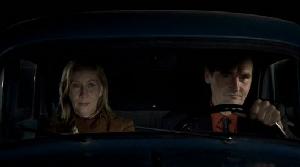
Death is such a pervading presence in the live radio show that although quite absurd, death actually shows up in the form of a seductive femme fatale (Virginia Madsen), all dressed in a white trench coat and dizzyingly glides through the many passageways of the theater, finally attracting the dim-witted and self-important security guard Guy Noir (Kevin Kline). Noir fashions himself a private eye, but instead has landed a job as security officer to the dying radio show. He talks and moves about like a forgotten leading man, without the dashing macho sexuality, causing him to rely on flirtation to establish his masculinity. Noir's character gives form to the nebulous array of live musical performances and notable talk about life and nostalgia by summing everything into a storyline which involves the Axeman (Tommy Lee Jones) closing down the show that played at the Fitzgerald Theater, a building that will be demolished to make way for a parking lot. There's a funny joke there on how vicious corporations take down little human businesses in favor of spaces for automobiles. Noir seeks the identity of the luscious femme fatale while finding ways to stop the Axeman from closing down the show which he himself (he tries so hard to be part of the musical cast and crew that in one scene, he insists on playing the piano as a signal, but I'm sure he just wants to let the crew know that he knows a bit about music and is not entirely an outsider to the radio show family) has become an integral part of his life.

Altman directs the film with a mixture of understated flair and grace. The antiquated theater contains narrow passageways leading to dusty wooden dressing rooms, where ghosts float in and out the rooms and to and fro the corridors. Altman's camera wafts through the theater like a a voyeur, catching the denizens of the radio show in their several conversations and banter, most of which are memorable throwbacks to past secret relationships, and discussions on dismissed opportunties. Altman's visual assuredness keeps the characters glued into one beautiful relationship, that when the Axeman finally arrives to tell the rumored closing down of the show, the film exudes a poignant note that simply breaks your heart. You've heard their stories, you've seen them sing and dance, you've participated in listening to their heartaches, their joys and their little discussions about nothing, that to see everything end with a cruel Texan destroying everything that he has no actual knowledge of is utterly painful.

The most heartbreaking of all is that that's probably what everybody is expecting from the aging Altman; that one day, the newspapers, radio programs, and entertainment shows will mourn his passing. Altman here is detailing the inevitability of death while showing that it's not all bad. He after all ends his film with a dubious note involving the angel of death staring through the celluloid and Noir trying to find out who's to die next by little hand signals. He follows up the ending by a joyous song that accompanies the end credits. Altman seems to see death as an expected result of the greatness of life, and that there's no point in mourning a passing, and instead, one should celebrate life, the same way the best way to celebrate the end of the radio program (which I believe, is still around) is to replay the memorable songs that have touched and affected the millions of patrons it has served the past thirty years.

Monday, October 09, 2006

The Man Without a Past (2002)


The Man Without a Past (Aki Kaurismaki, 2002)
Finnish Title: Mies vailla menneisyyttä

Aki Kaurismaki's The Man Without a Past is so disarmingly simple that it's such a treat in our present cinematic world that fetishizes in complex convoluted plot lines and stories that are grounded upon unexpected twists and turns. If it weren't for the stylish use of colors and the droll yet motivated blankness of Kaurismaki's visuals, The Man Without a Past would be convincing as a 50's Hollywood film. Also, Kaurismaki's humor can be traced to Jim Jarmusch rather than the comedic geniuses of the golden age of Hollywood cinema.

A man (Markku Peltola) is mugged and left as dead by a band of thugs. He awakes, wrapped in white bandage, and the first thing he does is to fix his broken nose (a rather funny note as Kaurismaki would be using Peltola's prominent nose through the numerous profile shots that pervade the film). The man turns out to be like the invisible man who unwraps his bandages and learns that he is as transparent as air. Instead of the curse of invisibility, the man is cursed (or gifted) with the sudden disappearance of his memory. He moves in an empty container van near the ship docks of Helsinki, and starts to work as a crew for the Salvation Army, where he meets and falls in love with Irma (Kati Outinen).

It's a funny predicament the man lands himself into. He is consistently bullied by the head honcho of the homeless community, with a female dog named 'Hannibal.' The local chapter of the Salvation Army plays routine music that is much too old and safe for the tastes of the miserable denizens of the container vans. Even his girlfriend Irma is a perpetual virgin, morose and manly when wearing her outfit, and still morose but rises a few notches in terms of femininity whenever she's in casual wear with the titular amnesiac. Kaurismaki doesn't go for hilarity. Instead, he persists in deadpan humor, letting the absurdity of the scenario seep into his audience's cognition which in turn, brings about well-earned chuckles. The dialogue is slight, but that adds to the mysterious charm of the film which somehow survives with the cleverness and ingenuity of Kaurismaki's directorial designs.

Kaurismaki intends to end the film with a subtle twist --- a throwback to the cleverer sci-fi features of classic Hollywood --- and ultimately happily concludes the unfortunate tale of the man. It's a worthwhile film, despite the fact that the plot plays out like a straightforward feature which is absolutely devoid of contemporary notions of climaxes. Instead, Kaurismaki draws out interest by staging even more absurd scenarios out of the already absurd groundwork that he has mustered. A bank robber steals his money from the bank, and then asks the man, to deliver the money to the unpaid laborers which he has neglected to pay --- that is just one of the paradoxical statements that glue this film of virile paradoxes. Each of these little scenarios, little scenes, bring about a conclusion that makes you want to watch the film again to see the subtle nuances Kaurismaki placed in the film.

Sunday, October 08, 2006

Goodbye Lenin! (2003)


Goodbye Lenin! (Wolfgang Becker, 2003)

After being left by her husband in favor of a more lucrative life in West Germany, Christiane (Katrin Sass) has decided to spend her life raising her two children properly and loyally serving socialist East Germany as a teacher. When her children grew up to become adults, nothing much has changed except that the unification of the two Germanys are coming close. Of course, the characters in the film do not know that, and when Christiane suffers a heart attack followed by an 8-month coma which is conveniently timed during the breaking of the Berlin Wall, the two children decide to keep the unification a secret from their mother who awakens without knowledge of the quick events that happened during the time she was unconscious.

It's an ingenious concept, I thought. A concept that is not entirely free from ridiculous inconsistencies, but in the end, is truly compelling. The democratic world saw the unification of Germany as the triumph of capitalism, but the inconvenient truth of a forcedly forgotten idealism towards socialism remains in the heart of former East Germans. Goodbye Lenin! seeks to visualize the hidden emotional impact of the unification by cooking up a comedic farce that is both emotionally deep and touching.

Wolfgang Becker directs the concept with able hands. Although there is a needless reliance to tired comedy, Becker still succeeds in creating a humorous attack to the historical event that this democratic world has considered a triumph. One scene that is charmingly funny yet also heartaching is when Christiane finally goes out from her room to discover a neighborhood that has changed since the time she suffered from coma. Katrin Sass walks weakly down her apartment, her face stoic from the lies that her children has supplied her ego, but is also unable to understand the presence of West Germans in her neighborhood, capitalist signs, and in one brilliant stroke of visual humor, a helicopter flying carrying the enormous bust of Lenin. But Becker doesn't direct the scene with humor in mind. He supplies the scene with a heartracing soundtrack that accompanies the resulting internal disagreement of the lies of the children and the mother's own reconciling of what she sees, and the effect is quite astounding.

Then Becker makes a huge cinematic mistake. He decides that the lie should go on, covering the amazing scene with another lie the son cooks up. I thought the brilliantly directed scene went down as an annoying emotional tease. I was expecting a difficult reckoning for the mother --- an uncovering of the life and the hard hitting fact that everything she lived for has turned into nothing when capitalism has ruled over socialism. Instead, Becker introduces more melodramatic elements into his film including a touching but not too original reunification of children and father, and so on. Sure, Becker, by following more commercial instincts, has made a more friendly film --- one that doesn't disagree with conventional wisdom of what is pleasant and acceptable. But upon deciding that, he forego what could've been truly impressive and devastating --- a mother breaking down from the treachery (although probably reasonable and rational) of the two most important parts of her life.

Four Nights of a Dreamer (1971)


Four Nights of a Dreamer (Robert Bresson, 1971)
French Title: Quatre nuits d'un rêveur

After tackling Dostoyevsky with A Gentle Woman (1969), Robert Bresson follows it up with another adaptation of the Russian writer's work. Four Nights of a Dreamer has less of A Gentle Woman's mortal themes and dire scenarios, and instead Bresson creates his sarcastic, ironic romantic comedy (well, it's certainly not your typical comedy but the film is indeed funny). The plot is spread throughout four nights, as the title suggests, wherein a man finds and loses love.

The man is Jacques (Guillaume des Forêts), a painter who seems to have trouble finding love. He admits that he is never in love with women, but to an ideal woman. At one scene, he glances on a beautiful girl shopping and as she walks past, decides to stalk her until another beautiful woman passes his fancy, for which he changes targets. Jacques is definitely a dreamer and lives in a fantasy he has created for himself, and hasn't quite perfected. His loft is riddled with unfinished paintings, and whenever a visitor arrives, he hides them. It's as if Jacques is always trapped in a perpetual search for perfection and even in his art, he can't really achieve --- very similar to the way he discards a romantic attraction when another beautiful woman passes by. Being a dreamer, a person in an everlasting search for an unattainable ideal, Jacques ultimately is never in love. He finds the girl she is stalking to an older individual, and upon arriving home, he voice records a perfect scenario wherein that girls decides to just suddenly elope with him. He plays the recorded scenario over and over while he paints, capsulating him inside a dream that he has created himself.

One night, Jacques saves Marthe (Isabelle Weingarten) from suicide. Marthe is the exact opposite of Jacques, a woman who is bored to her wits and forces herself to fall in love with her mother's boarder (Maurice Monnoyer) just to get away. She is a dreamer herself as when the boarder moves to America, promising her that upon his return they'll get married, she wraps her entire existence on that dream that when she hears news that the boarder finally returned and she never got a word from him, she decides to just commit suicide. Yet unlike Jacques who insists on ideals, Marthe is grounded on reality and knows the hierarchy of life and fantasy.

It's an entirely humorous proposition by Bresson that Jacques falls in love with Marthe, who remains in love with her lover. Bresson interrupts possible moments of romance with what is typically suited for such scenes. One night wherein Jacques would finally uncover his love for Marthe, a cruise ship passes by and the sound of Brazilian musicians singing a lovers' tune would interrupt his endeavor. Every night, Bresson plays a cruel joke against the male dreamer and climaxes his clever satire when Jacques finally gets what he wants.

Jacques and Marthe walk as a couple when the boarder shows up, and calls Marthe. Typically, the sacrifices Jacques has already made would ensure Marthe's changed loyalties, but Bresson, in an ingenious attack against romanticism and lovers' dreams, insists on the illogical. Marthe walks towards the boarder and gives him a torrid kiss, returns to Jacques and pecks him a number of times and in a twist of human unpredictability, returns to boarder and walks away with him. Jacques is left a dreamer in search for that perfect ideal that may never arrive.

Wednesday, October 04, 2006

The Departed (2006)


The Departed (Martin Scorsese, 2006)

Finally, something good has come out of the recent Hollywood fetish of Americanizing popular Asian films. Just this year, two Americanized Asian films left me in regretful boredom (Alejandro Agresti's The Lake House and Jim Sonzero's Pulse). Martin Scorsese's reworking of Infernal Affairs (Andy Lau & Alan Mak, 2002), the first of a trilogy touted as Hong Kong's answer to Francis Ford Coppola's The Godfather Trilogy, is an amazingly exhilarating feature from its first minute to last. William Monahan keeps the story of Infernal Affairs intact, updating it with some interesting details and additional characters and finally, uprooting the plot from the seedy underbellies of Triad-run Hong Kong to within the hugely Irish-run organized crime scene of Boston.

The title also gets a face lift. The Hong Kong films address relations that compares to a torturous afterlife. the American remake merely describes its set of characters as departed, or in less stylized language, dead. The title is apt. Almost all deaths in the film are caused by gunshots to the head (I can think of three deaths wherein the characters die in a different manner, two of which are still caused by gunshots, and none of which ends with survival), where there is no assurance of survival, no uncomfortable middle ground wherein one is given an opportunity to address his life decisions and the results of such in his afterlife. It seems that Scorsese instantly wants his audience to know that the characters in his mob film are dead men walking. He twists and turns them in situations wherein the only way out is death. In an uncomfortable twist of logic and Scorsese's dry humor, he appropriates the dictum that "dead men don't talk," especially dead men who weren't given a chance to talk at all. In the film where the value of life is equated to the revelations that could be spewed, the theme of death is all too palpable.

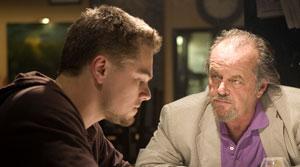
The story is simple. There are two sides: the police and the Irish mob. The Irish mob is headed by Frank Costello (Jack Nicholson), a hedonistic and very hands-on mob leader. He dotes and lets Colin Sullivan (Matt Damon) into the police as his rat, who gives his benefactor early warnings as to the police's operations and other very pertinent information. The police, under a very fatherly Oliver Queenan (Martin Sheen) and his mercurial assistant Dignam (Mark Wahlberg), puts Billy Costigan (Leonardo di Caprio) into the Irish mobster's inner ring by delegating years to make his transformation from cop to criminal believable. Two rats in both opposing sides, racing to discover each other.

But the film is a lot more than the plot whisked away from the Hong Kong original. Monahan successfully made the effective storyline into a purely American tale, a tale that Scorsese would be able to handle with his trademark talents. The plot is rooted in an American scenario of racial conflict: Irish against Blacks; Irish against zealot Catholics; American paranoia against the fastly developing Communist China. Then Monahan also intricately details the American police bureaucracy into the picture: making two department heads (head of Special Investigations Department played by a testosterone-laden Alec Baldwin), instead of the original one; adds the FBI into the picture complicating red tape and bureaucracy further. Monahan, with the help of a very macho-thinking director like Scorsese heats up the sexual politics and the romance, with the entry of a more believable, more humanly erring psychiatrist girlfriend (Vera Farmiga) of both opposing rats, as compared to the beautiful yet largely useless poster girl of the original film. Farmiga's psychiatrist adds a feminine dizziness into this machismo-driven picture. It's an altogether grittier picture, and with the careful eye for these little details, makes the outrageous plot a bit more plausible, and churns out a complexity that is both enticing and exciting.

Scorsese has been accused of being an Oscar-whore ever since he made two big budgeted epics that came too close to finally giving him the award. What Scorsese can't be accused of is being a lousy filmmaker. Scorsese doesn't waste any time in brewing up with useless details, instead he opens the film with Costello quoting, and like an evil pedophile, recruiting an Irish kid from an ice cream parlor with candies, milk, and a comic book. Costello storms up each scene he's in. His unpredictable nature, quick-tempered yet nobly fair (he pays up a huge sum of money after breaking Billy Costigan's hand numerous times) demeanor, makes his character into such a memorable personality, an improvement to Eric Tsang's triad leader, which I thought was a brilliantly played stereotype. Nicholson plays up the role with a deranged confidence that is both curiously comedic and scary at the same time.

Monahan juices up the mobster lord's role to the detriment of Queenan. One of the emotional thrusts of Infernal Affairs is the relationship that developed between the cop boss and his secret agent. It's a quiet paternal relationship that achieves full emotional power in one of the film's important plot movements. In Scorsese's remake, the relationship is kept to a minimum, or is at least shown subtly. There are little instances wherein I sense a bit of the fatherly relationship of Queenan and the undercover cop rise, and when it does show up, it makes the inevitable end to the relationship, more poignant. Juxtapose their relationship to Costello and his rat's, wherein the code alludes to such relationship, but in the end, results in something remarkably ironic.

The hugest difference I saw between Scorsese's The Departed and Infernal Affairs is the fact that the latter contained a religious thrust, a Buddhist implication that seemed to describe the relationships established in the film as a hellish endeavor. Scorsese's thriller is as mortal its title suggests. Religion and the accompanying salvation in the afterlife it promises is merely a backdrop. There seems to be a battle of good and evil in the film, but the Church is a non-player, and goodness is a wishy-washy thing. Evil, on the other hand is present in Costello's person. Scorsese seems to turn Boston into a battleground where evil has already won and the devil as finally incarnated on Earth. The stench of corruption is outrightly manifested. Even the supposed agents of goodness (in this case, agents of the law) act in despicable means, and again, have that impermanent tendency of turning into evil.

The Departed is a lot of things: a superb remake of a Hong Kong film, arguably superior to the original; a return-to-form for Martin Scorsese, an intelligently written police thriller, and easily, one of the best American films of 2006.

Pulse (2006)


Pulse (Jim Sonzero, 2006)

Kiyoshi Kurosawa's Kairo (2001) is arguably the best horror film ever made in the past decade. Yes, that rules out Hideo Nakata's influential Ringu (1999), and all the Shyamalans, Cravens, and Amenabars from the top spot. Kairo has that odd mix of creeping terror and philosophical possibilities, all cramped up in a free-flowing narrative that isn't dragged by typical conventions of what is supposed to be scary and what is not. It also has Kurosawa's distilled directorial tact; making sure that his scare tactics doesn't go overboard --- showing just little by little, until all of a sudden, apocalypse has already invaded the plot. Wes Craven probably thought Kairo is pretty excellent too. He bought the American rights to the remake after all, rewrote the entire plot to follow American horror conventions, plucked out a nobody director out of nowhere to helm his written and rewritten screenplay, and release it to the public.

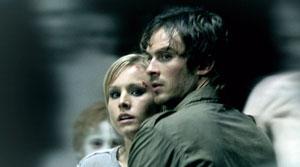
Jim Sonzero is the nobody director. Well, probably not exactly nobody. He does direct MTVs and commercials, but other than that, he's pretty much unknown in film world. He takes in the project, probably not understanding what made the original film such a wonderful piece of horror filmmaking. He goes all out, as if he were directing a 30 second commercial for a telecommunications corporation. First five minutes to the film, my eyesight has been overloaded with images of cellphones, people calling through cellphones, laptops, computers, and other gizmos. Sure, the film is about these modern modes of communication, but to practically drown the film with reminders through recurring images of such is, to a certain extent, insulting to the intellect. After all, Kurosawa did imply on the theme, as well as other exciting themes and possibilities, without overloading his film with outright and overt images of what he intends.

The direction is one of the serious faults in Pulse. Another is Craven's rewriting of Kurosawa's story. The beauty of Kurosawa's Kairo is that it's open to so many possibilities, so many theories, so many explanations, that just through it's open-endedness, it's a terrifying creature. Craven insists on his own interpretation, and with Sonzero's directing, literally grabs their audiences' hands and forcedly feeds their interpretation like it was very good, when in fact, it's quite crappy. Ghost-like creatures thriving on this mysterious bandwidth that scientists suddenly open up to provide faster and more efficient modes of communication, spread through viruses --- all of that invented theory to Kurosawa's masterpiece is quite a load of crap, and to sit through Craven and Sonzero's theory branching to more ridiculous stuff, is really quite a painful experience.

When I was in high school, whenever I didn't have time to read the thick novels assigned, I would just buy those Cliff Notes to make sure I have enough information to pass an examination. Afterwards, I'd try to read the novel and a world of difference occurs. Sonzero's Pulse is pretty much like a Cliff Notes of Kurosawa's Kairo. Craven and Sonzero cook up a more swallowable and easier-to-watch version of Kurosawa's sprawling nightmare vision. It's dumbed down a hundred percent, the characters shrunk into television soap opera students with problems with romance and all those boring stuff that's better left to television, and adorned with computer graphics and thick make up to make the ghosts look scarier. For others, it might be enough, but for those who really want to get a more satisfying experience, I suggest you just find a copy of Kurosawa's Kairo and forget this version ever existed.

Tuesday, October 03, 2006

Who Killed the Electric Car? (2005)


Who Killed the Electric Car? (Chris Paine, 2005)

Chris Paine's documentary Who Killed the Electric Car? opens with a funeral parade. Several testimonials follow suit, all declaring the good traits of the deceased. It turns out that the deceased is not human at all, but an electric car. The entire funeral parade is in fact part of the program by former electric car owners who are now protesting General Motors' retrieval of the environment-friendly consumer vehicles. The electric car in in truth dead. General Motors, against the rabid campaigning and vigil of activists, has terminated the last few units left, and left some for automobile museums. Paine weeps the unfortunate passing of what could have been a solution to the many problems that surround gas-powered vehicles, and then starts pointing fingers at the likely suspects.

It's a very well-presented documentary of a topic that I think is of important relevance. The first half of the film is told like a clever testimonial to the dead. Paine presents the history of the electric car, avidly describing the fact that these cars have existed alongside fuel-powered ones a century ago. It remains a mystery why the electric cars totally disappeared, only to resurface in a hopeful and probably one of the few bravely political mandates that ever came out of California: the mandate that would slowly phase out fuel-powered cars in favor of electric cars. Paine shows the importance of such, environmentally, economically, health-wise and politically. After telling the story of the rise and fall of the electric car, Paine starts to dissect the details in CSI-fashion and determine who caused the death of the electric car.

The documentary is narrated by a very boring and bored voice of Martin Sheen. Sheen's voice doesn't have the complementary power his visual presence provides and turns the documentary's important messages into a sort of infomercial extravaganza that doesn't quite effectively match up the magnitude of the film. Paine's efforts can be observed. He comes up with several interviews with politicians, ex-employees of General Motors, celebrities (including a bearded Mel Gibson who miraculously doesn't say things that can damage his or the film's reputation), advocates, environmentalists, and an aging inventor and his sweet wife. Paine also shoves up some archived videos from the David Letterman Show (showing a Tom Hanks who is so enamoured by the electric car), a Naked Gun film (which surprisingly and disturbingly accurately describes the reason behind the silent maneuverings to make sure that not a single electric car be driven in the highways of California), and the administrative proceedings that completely toppled the important electric car mandate.

It's a cool and intelligently pieced out feature. There's a sort of sadness by the fact that the only piece of hope or joy the documentary provides is the idea that there are now hybrid plug-in cars in existence or in development (that doesn't really help the cause since electric cars are already an available technology, why spend more cash for something safely in between). It quite feels that the documentary is entirely a lost cause, a mere precaution for what could happen in the future by good-natured technology that may drive huge corporations out of profitable existence. Overall, Paine made a documentary of a story worth telling, and it is told with coherent competence, but above that, there's really not much else. Paine's call for action is not emotional enough to disturb, his documentary not passionate enough to rouse attention.

Bullets Over Broadway (1994)


Bullets Over Broadway (Woody Allen, 1994)

Struggling playwright David Shayne (John Cusack) is ranting about how it's so difficult to have an honestly "art-ful" play to get financing in 20's Broadway. Olive Neal (Jennifer Tilly), one of the dozens of girls in a chorus line, rants to her mobster lord boyfriend how she is still a bit player for so many years. The solution, according to director Woody Allen, is to put mobster money to fund the playwright's drama. The consequences are plenty: Olive turns out to be a very wooden actress with a difficulty in memorizing lines; she also brings along Cheech (Chazz Palminteri), the bodyguard who seems to have a knack in making revisions to Shayne's work. The result is probably one of the funniest films Allen ever made.

It helps that Allen didn't cast himself as the struggling playwright. Although he does inject a lot of the stereotypical neurotic New Yorker he usually plays into the character, Cusack molds David Shayne into a less cardboard cut-out character, and thus, giving the character a youthful and more balanced charm that doesn't get tiring.

Jennifer Tilly is wonderful here. Her hoarse voice fits the personality of the character like a glove. She throws Allen's witty lines like it naturally came from the social climber's own consciousness. When she rants about how the black pearls given to her as a gift by her boyfriend comes from degenerate oysters, it bursts out so perfectly that the inevitable consequence is a well-earned chuckle. She fits the mold of unawarely talentless ambition-driven skank with so much earnest eager that it's so pathetic, its pitiful.

Diane Wiest plays the Broadway prima donna Helen Sinclair, who topbills David Shayne's play. Shayne and Sinclair eventually develop into an odd couple who respectively seems to be both in love with each other's external personalities. In fact, Allen insists on the theme of whether one is in love with the artist or the person, and exemplifies such with the relationship that comedically develops between the prima donna and the playwright, and later on, between Shayne and his real girlfriend Ellen (Mary-Louise Parker). Wiest delivers a performance to match Tilly's outright crassness. Wiest is at all times classy, histrionic, and the most affectionate of all drama queens. Her Helen Sinclair possesses a low-pitched seductive voice that is at the same time gorgeous and dangerous. But Allen doesn't turn her into a femme fatale, but a bagful of laughs. He makes use of Wiest's low-pitched voice to turn the mundane line "Don't speak!" into a source of chuckles.

Bullets Over Broadway is not the most visually stunning of Allen's work. Carlos di Palma's cinematography is, as always, quite uninspired. Allen does recreate the look of 20's New York with costumes, sets, and dialogue that allude to that dangerous decade. The film mostly works because it contains bravura performances from almost all fronts (Jim Broadbent's desperately dieting thespian turns a rather inept and unoriginal comic sequence into a hilarious riot). I sometimes don't quite buy Allen's philosophical musings on art, theater, and love, but upon a backdrop of this kind of intense comedy, it doesn't come off as impendingly high brow as other Allen films like Deconstructing Harry (1997).

Monday, October 02, 2006

Imprint (2006)


Imprint (Takashi Miike, 2006)

Imprint, Takashi Miike's contribution to the television series Masters of Horror suffered a fate of not being in television due to its content. Instead, Imprint, carrying the acclaim of its prolific helmer, has landed a spot in many film festivals and has finally reached its audience with the release of its DVD. It's typical gross Miike (the Miike of Audition (1999) and Ichi the Killer (2001)), just a bit more glossy and with all its actors and actresses speaking English (even if they're not supposed to). Of course, it's understandable. The target audience of the segment are middlebrow Americans who would probably turn off their television sets once it occurred to them that they are required to read subtitles. The problem here is that the English spoken is accompanied by a thick and almost ununderstandable accent, resulting to a jarring viewing experience.

The plot is probably the richest among the other segments in the television series' first season (although John Carpenter's Cigarette Burns is my favorite of the batch). An American tourist (Billy Drago) travels to an island to find Komomo (Michie Ito), a sweetheart he left behind but promised to bring back to the United States. He visits the whorehouses of the island, determined to find her golden haired Japanese girlfriend, but is only successful in hooking up with a prostitute (Youki Kudoh) with a gruesomely malformed face and an even more gruesomely mysterious past. It seems that the prostitute has some knowledge of what happened to Komomo, and in a series of flashbacks, tells the American the fate of his love.

There's a rich visual style Miike makes use of here. He turns the unidentified era of Japan into a time wherein whores are equated with freaks, monsters, and demons. Miike paints his film with bright colors, which to a certain extent disservices what he aims for. The result is mightily fantastical, and at times, abusively eye-straining especially when scenes of gratuitous violence is draped with bright eerie reds. More interesting is Miike's choice of turning his characters into anti-social outcasts. The American is blanketed with a mysterious past, and is played by Drago with a curiously hysterical tone, turning his love search into an absurdist nightmare. Komomo, who is described by the prostitute, as golden hearted, is portrayed as having a bit of insanity accompanying her fiery red hair (she insists that she's a princess in the midst of the fact that she prostitutes herself for meager coins). The most intricately designed character however is the prostitute --- her face divided into two halves (a normal one and one that is curiously monstrous); her hair is much too big for her meager frame; her dispassionate voice concealing a horrific story.

Imprint also has Miike's faults. Miike tends to have no restraint, turning his film into carnival fare instead of compelling cinema. Imprint is the most carnival of fares. Miike's desire to create something absurdly beautiful out of what is inherently disgusting and abrasive turns the film into a grandiose confusion. The prostitute describes her hometown as the most impoverished community in her province, but that doesn't stop her poor mother in putting up brightly hued windmills each time she performs her odd business. The images resulting from Miike's incoherence provide for an atmosphere of odd dread that the Brothers Grimm achieved with their fairy tales. Miike is a compulsive filmmaker, leaning more towards what looks horrific, violent, and shocking, thus sacrificing basic concepts of logic, and common sense.

Wal-Mart: The High Cost of Low Price (2005)


Wal-Mart: The High Cost of Low Price (Robert Greenwald, 2005)

An anti-Wal-Mart protester compares Wal-Mart's dawning on the town of Inglewood, California with Godzilla's destructive invasion of Tokyo. It's not really an accurate metaphor for Wal-Mart's destructive forces. I have a soft spot for the oversized reptile. Godzilla is also a victim despite looking like a heartless monster. Wal-Mart, based on political documentary filmmaker Robert Greenwald, is nothing but a vicious victimizer, descending on little American communities, exciting consumers with its bargain prices bought by a Faustian contract with the demon of greed.

Wal-Mart: The High Cost of Low Price is obviously one-sided. The documentary doesn't give any opportunity for the Wal-Mart management to air their side. I doubt the management will ever give their side, at least not in Greenwald's documentary. Greenwald's allegations, aside from the typical aftereffects, like the closing down of small time shops because of impossible competition, of gargantuan retail corporations landing a pimp spot in any locale, is of immense damaging potential that retaliation from the management would only seem futile and conveniently rehearsed. Actually, Wal-Mart management indeed lends a voice to Greenwald's striking documentary. The film opens with Wal-Mart CEO Lee Scott in an archive footage excitedly wowing a crowd of Wal-Mart associates with opportunities of earning more. The film also contains several of the glossy and equally sleazy inaccurate Wal-Mart commercials Greenwald makes use as a sort of divider to his documentary's many issues, and as a target for stirring yet humorous sarcasm.

Greenwald's attacks range from the obvious to the real eye-openers. Greenwald makes an obvious effort to put a human face on the several businesses that Wal-Mart forcedly closes. It's an emotional touch to an already tired issue that Greenwald seems to be mightily concerned with, and as that, rejuvinates the point with a more humanist rather than an economic concern. Then Greenwald mostly centers on Wal-Mart's deliberate labor abuses, both in America and its foreign factories. Wal-Mart's concern against labor unions and any similar activities is quite distressing --- the way they spend an amount of money for security cameras to detect union activities within their premises, but neglects any security spending for their very own customers; the way they hire multitudes to hinder an impending labor voting. Greenwald tries to connect sexual and racial discrimination in the Wal-Mart workplace with the management's seeming lack of concern for such. It's kind of ill-placed in the documentary but is still nevertheless very telling.

Overall, Wal-Mart: The High Cost of Low Price is compelling stuff. It adds more insult to injury that Greenwald makes use of former employees (even some of those who have spend a quarter of a lifetime working for the retail corporation) who have become disgruntled of Wal-Mart's inhumane ways. Greenwald even makes his way to China and other offshore sweatshops to put a human story to the often told tale of sweatshop workers laboring for a fraction of a dollar per hour. It's amazing research work and Greenwald puts all the stuff together in coherent and scandalizing fashion. With the immense difference between the cost of the products sold and the actual cost for their manufacture, you can't help but wonder what happens to the more than one thousand percent profit being made. Greenwald doesn't let the major culprits get away without being smeared like their unjust corporate vehicle: The Walton Family and its boisterous mouth Lee Scott get majority of the profits to fund their anti-apocalypse bunker and a fleet of jet planes and helicopters.